
Sun Li is not compelling because she plays “strong women.” She is compelling when strength becomes expensive. Zhen Huan gains control and loses intimacy; Zhou Ying gains commercial freedom and attracts melodramatic punishment; Su Xiao masters systems that can consume the person who understands them best.
Sun Li actress in 60 seconds
| Reader question | Direct answer |
|---|---|
| Who is Sun Li? | Sun Li (孙俪), sometimes credited internationally as Betty Sun, is a Chinese film and television actor best known for playing Zhen Huan. |
| What is her most important drama? | Empresses in the Palace. It remains the clearest demonstration of how she changes voice, stillness and social access across one long character arc. |
| What should I watch next? | Nothing Gold Can Stay for appetite and commerce, Shadow for film-scale ambiguity, I Will Find You a Better Home for modern workplace friction and The Ideal City for institutional competence. |
| Does she always play the same role? | No, but the criticism is worth testing. Later productions often sell her as an exceptionally capable woman; the interesting difference is what each world makes competence cost. |
| What is her current direction? | Breaking the Shadows moves her into crime investigation, where certainty, fatigue and moral suspicion matter more than costume authority. |
| East Moment verdict | Her signature is not crying or command. It is the moment emotion becomes a decision about what the room may see. |
A normal career guide arranges roles by year. Sun Li is easier to understand by rooms.
Put her in a palace chamber, a merchant courtyard, a monochrome war room, a property-sales office, a construction meeting and a police station. Then watch the same five things: where she looks, how quickly she decides, whether breath reaches the end of the sentence, who is allowed close and what competence makes impossible.
Room one: Zhen Huan learns that composure is a border
The miracle of Zhen Huan is not that Sun Li ages the character with heavier costume and darker makeup. She changes what reaches the surface.
Early Zhen Huan is intelligent before she is powerful. Her attention moves quickly, but the reply still carries social softness. Later, stillness becomes strategic: other people must reveal more because she reveals less. The voice no longer merely expresses feeling; it decides who gets access to feeling.
The difference becomes clearest around names. “Huan Huan,” “Wan Wan,” “Zhen Huan” and “Consort Xi” are not labels attached to one stable person. Each tells her what kind of woman the speaker currently needs.
This is why our full Empresses in the Palace guide treats the drama as a relationship system rather than as a list of schemes.
The length is essential. A short prestige film can show a brilliant change of expression; seventy-six episodes can make the viewer remember the earlier version of a voice while hearing the later one. Zhen Huan's transformation lives in that accumulated comparison. The same formal address becomes colder because we remember when it still carried trust. The same pause becomes threatening because earlier pauses asked for permission.
This is also why the heavily shortened international edit cannot replace the full route. Plot survives compression more easily than relational memory. Sun Li's work depends on the viewer carrying dozens of small permissions, betrayals and recalibrations into the next room.
Room two: Zhou Ying refuses to move like a consort

Zhou Ying in Nothing Gold Can Stay (那年花开月正圆) is useful because appetite returns. She moves quickly, speaks before a room has agreed she may speak and treats commerce as improvisation rather than ceremonial order.
I do not accept the shortcut that every later Sun Li role is Zhen Huan in different clothes. Zhou Ying disproves it whenever her body claims public and commercial space before checking whether it is safe. Zhen Huan survives by controlling access; Zhou Ying discovers possibility by spending energy.
But the criticism cannot be dismissed completely. Long melodrama sometimes enlarges Zhou Ying's reactions until spontaneity becomes another recognizable star mannerism. The honest conclusion is sharper than fan defense: the role proves range in appetite, gait and conversational speed, while also showing how a successful actor can repeat a rhythm even when the character type has changed.
Room three: Shadow cuts the face in two

Zhang Yimou's Shadow removes the warm social density of television. Black, white, rain and screens make every body part of a design. Sun Li's Madam has to remain emotionally legible without breaking the film's controlled surface.
Here her gaze becomes more useful than declaration. She stands close to men who are performing power, injury and substitution. The role asks whether she can see the difference before she can safely name it.
This is the film to watch if you think Sun Li's authority depends on dialogue. A cutaway, held look or delayed movement can carry the knowledge that speech would make dangerous.
Room four: Fang Sijin makes efficiency look lonely

In I Will Find You a Better Home (An Jia / 安家), Fang Sijin arrives as the kind of manager contemporary television loves: disciplined, effective and capable of solving what a softer team avoids.
Sun Li makes the type worthwhile when efficiency appears learned rather than natural. The clipped voice, guarded appetite and direct movement suggest a person who treats need as a vulnerability others can price.
The character should not be admired simply for working harder. The room gets interesting when competence damages trust - when being right does not create belonging and when a home cannot be reduced to a successful transaction.
Room five: Su Xiao thinks in systems, and systems do not love back

The Ideal City is the most revealing modern test because Su Xiao's expertise is not decorative. Cost, rules, bids, responsibility and institutional loyalty must change how she speaks.
Watch the difference between knowing an answer and obtaining permission to act on it. Su Xiao's authority is repeatedly mediated by hierarchy and by men who benefit from systems while pretending the rules are neutral.
Sun Li's habitual steadiness helps because the character must calculate. It hurts when every setback receives the same clenched register. The performance becomes specific when fatigue changes decision speed or when the desire to be correct prevents her from noticing what a colleague needs.
Room six: Breaking the Shadows finally lets viewers ask for danger

The most valuable question I have for Sun Li is not whether she is “a good actor.” I want a riskier Sun Li.
Zhou Ying gives me the satisfying shock of unexpectedly sharp acting. I want to see Sun Li in an ambiguous suspense role because her gaze can turn sharp, laughter can settle into uncanny stillness, and even the rhythm of blinking feels controlled.
That transition is what excites me, not the reputation attached to it. Sun Li's command can become frightening when laughter settles too quickly, a gaze sharpens before the sentence does, or blinking slows as if the character has moved from conversation into calculation.
Breaking the Shadows places that desire inside a crime series. iQIYI's official series page identifies the 2025 production as a seventeen-episode crime mystery and Sun Li's character as police officer Han Qing. Han Qing's competence must coexist with missing information, grief and suspicion. The useful test is whether Sun Li allows certainty to decay—whether investigation changes the investigator, not only the case board.
That distinction separates a police uniform from a police mind. A procedural role should make us feel the cost of sorting incomplete evidence while another person is waiting for an answer. Han Qing cannot simply project command. She must revise. I watch for the moment a confident question becomes a defensive one, or when professional calm arrives a fraction too quickly because the personal meaning of the case has entered the room.
This is why the shorter run interests me. A seventy-six-episode palace drama can accumulate transformation slowly. Seventeen episodes remove that luxury. Sun Li has to show pressure changing the rhythm before a long arc explains it. When fatigue is only makeup, the role becomes a familiar capable-woman shell. When fatigue changes who receives her patience, how long she waits and which clue she refuses to release, the authority becomes lived.
Sun Li's acting lives in the transition between feeling and permission
The six rooms reveal one method. Sun Li often lets the first emotion appear for less than a second, then replaces it with the response the character's position permits.
Zhen Huan may receive pain and return protocol. Zhou Ying may receive resistance and return speed. Fang Sijin may receive embarrassment and return a task. Su Xiao may receive exclusion and return a calculation. Chen Jian may receive suspicion and return a question whose calmness hides how much the answer matters.
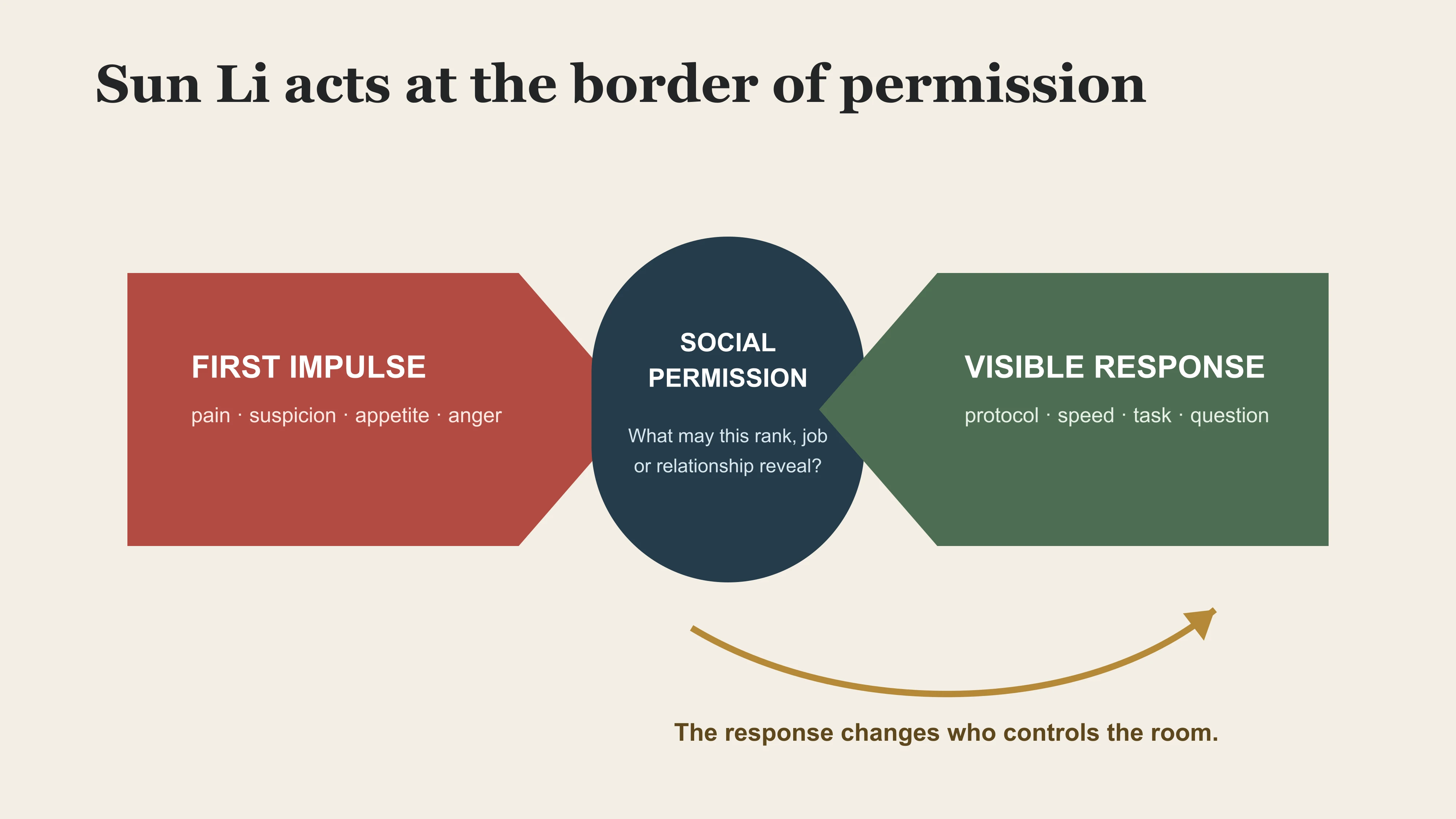
This is why isolated crying clips are a poor way to judge her. The payoff is not the released emotion; it is the border built before release. Watch the listener, not only the speaker. Ask what she understood, what she prevented the room from seeing and what practical decision follows. When all three beats are clear, Sun Li is precise. When the middle beat hardens into the same severe face, the performance becomes predictable.
The criticism she should not escape
Sun Li has become a production shorthand for female authority. That creates a loop: cast her as the woman who understands the system, frame her seriousness as quality and let the audience arrive already respectful.
The loop is not false. It is limiting.
Her future work needs less automatic moral centrality—not because villains are inherently more artistic, but because ambiguity would force voice and stillness to stop functioning as proof of correctness.
She does not need to become louder. She needs rooms that refuse to agree with her.
There is a second limitation: viewers now arrive knowing how to read a Sun Li pause. Reputation has trained us. The slight delay, sharpened gaze and lowered voice already carry the memory of Zhen Huan, so a production can borrow that memory without earning a new character. I felt this most strongly whenever a modern role treated seriousness as self-evident competence. The performance looked correct before the scene had produced a cost.
The solution is not to erase her signature. It is to interrupt it. Give her a colleague who is right when she is wrong, a family member whose need cannot be solved as a task, a subordinate who sees the fear behind efficiency, or a room where speaking softly loses power instead of gaining it. Then the familiar control becomes something the character must negotiate rather than a prestige filter placed over the drama.
A room-power map makes Sun Li's craft visible
For one episode, ignore the plot recap and draw the room. Mark the door, the table, Sun Li's first position and the person who controls the next decision. Then record three changes: who crosses the room, who interrupts, and whose sentence produces the next physical action.
Use a Zhen Huan palace scene first. Repeat the map with Su Xiao in a construction meeting or Han Qing in an investigation room. The comparison reveals more than a montage of emotional peaks. Zhen Huan often gains power by reducing movement; Su Xiao must move information through hierarchy; Han Qing must keep authority while admitting the evidence is unfinished. The same stillness therefore performs three different jobs.
This is the contribution I want readers to bring back to East Moment: not “she acted so well,” but a small map that shows exactly when a room changed hands. A shared archive of those transitions can distinguish durable technique from the aura of an iconic role.
Where to start with Sun Li
- For the defining transformation: the 76-episode Empresses in the Palace. Do not use the shortened edit as a substitute for the relationship arc.
- For physical and social contrast: Nothing Gold Can Stay.
- For cinema and visual withholding: Shadow.
- For modern service work: I Will Find You a Better Home.
- For institutional competence: The Ideal City.
- For the current suspense direction: Breaking the Shadows.
Use the Chinese TV shows collection to compare these series by genre rather than star prestige, or move to the Chinese movies guide for Sun Li's film context. The wider Chinese actors collection shows how her model of authority differs from younger performers whose public image formed through idols, short video and platform drama.
In the comments, identify the transition before or after a line when Sun Li changes who controls the room. Then join the East Moment community to compare timing, voice and gaze with viewers who can make the scene more precise.