Chang'e is the Chinese woman who takes an immortality drug and goes to the moon, becoming its best-known goddess. But there is no single unchanged “original Chang'e story.” Early surviving passages disagree in important details, and the familiar tale of a virtuous wife protecting the elixir from a villain is a later composite.
I dislike the way Chang'e is usually marched into a courtroom before her story has even begun. One retelling calls her greedy. Another hurriedly acquits her by inventing a villain. Both want a clean verdict; the surviving record gives us a messier and far more interesting woman.
Here is where I stand: Chang'e survives because no version has managed to own her. Across two thousand years, storytellers keep moving the moral pressure around her—thief or protector, punished exile or liberated woman, ugly transformation or beautiful goddess, lonely wife or sovereign lunar figure. The right question is not “Which summary wins?” It is “Who needed Chang'e to be this kind of woman, in this particular age?”
The Chang E story begins with a problem: everybody remembers a different woman
The version most people hear today usually runs like this:
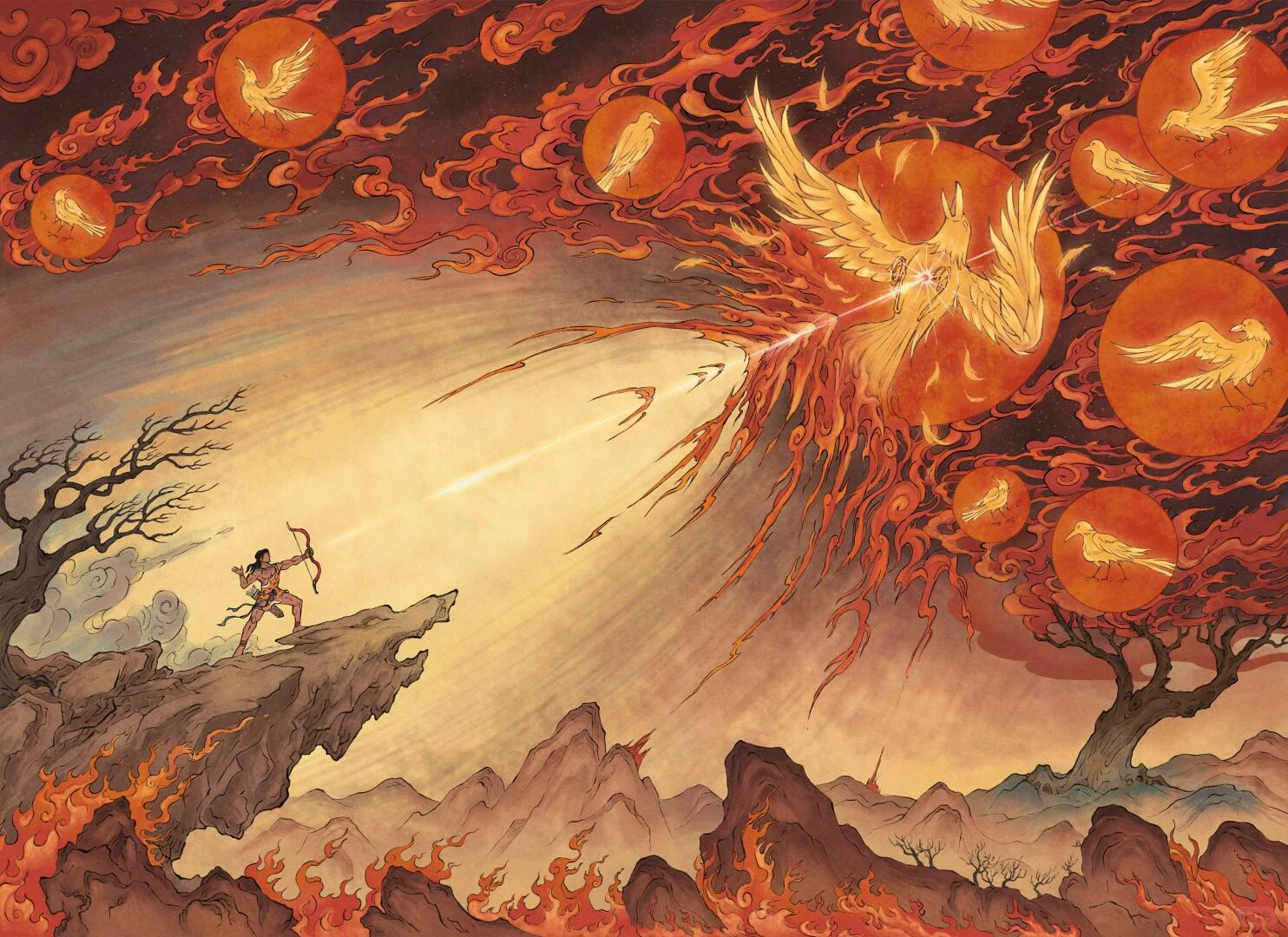
- The archer Hou Yi shoots down nine of ten scorching suns and saves the world.
- He receives an elixir of immortality, often from Xiwangmu, the Queen Mother of the West.
- Yi does not immediately drink it because he does not want to leave his wife Chang'e.
- A villain, commonly called Peng Meng or Feng Meng, tries to seize the elixir while Yi is away.
- Chang'e swallows it to keep it from him and rises to the moon.
- Yi grieves, sets out foods she loved and looks toward the moon.
- Chang'e lives in the Moon Palace with the Jade Rabbit, and the story becomes associated with the Mid-Autumn Festival.
This version is clear, dramatic and morally generous to Chang'e. It combines heroic myth, marital devotion, attempted theft, sacrifice, separation and lunar imagery into one sequence.
It is an excellent story. I would happily tell it at a Mid-Autumn table. I would only refuse to call it the ancient original, because the early passages available to us are much shorter and do not contain all these motives, characters or emotional explanations. Affection for a story does not require a false pedigree.
What the Huainanzi actually says
The Huainanzi passage preserved by the Chinese Text Project, from a major early Chinese work associated with the court of Liu An and presented in the second century BCE, is brutally concise. In the Lan Ming Xun chapter, the received text says:
羿请不死之药于西王母,姮娥窃以奔月,怅然有丧,无以续之。
A bounded translation is:
Yi requested the drug of immortality from Xiwangmu. Heng'e stole it and fled to the moon. He was desolate, as if bereaved, and had no way to continue it.

The key word is qie (窃), “to steal” or “take secretly.” The passage names Yi, Xiwangmu, the drug, Heng'e's taking of it, her flight to the moon and Yi's grief.
It does not name Peng Meng or Feng Meng. It does not say that an attacker forced her choice. It does not explain that she swallowed the drug to protect Yi. It does not present the complete sun-shooting episode in this sentence. It also does not supply a detailed Moon Palace domestic scene.
So yes, “Chang'e stole the elixir” is textually grounded here. “Chang'e sacrificed herself to save the elixir from a villain” belongs elsewhere. That distinction matters because I do not want to rescue her by quietly rewriting the evidence. A woman can be worth defending even when an old text uses an accusatory verb.
Why does the text call her Heng'e?
The passage writes her name as Heng'e (姮娥), while modern Chinese normally uses Chang'e (嫦娥). A conventional historical explanation connects the change with a naming taboo around the personal name of Emperor Wen of Han, Liu Heng. Later copying and usage favored Chang'e.
For an ordinary reader, the practical rule is simple: Heng'e and Chang'e refer to the same mythic figure in this source tradition. Keep the older form when quoting the text; use Chang'e in general English prose.
The transliteration also varies online: Chang'e, Chang E, Chang-Er and Ch'ang-o may all appear. Chang'e best reflects Hanyu Pinyin, with the apostrophe separating the syllables Chang and e. The apostrophe is doing real work; without it, an English reader may treat the name as one syllable.
The Lingxian adds a stranger transformation
A transmitted passage in the Lingxian (Spiritual Constitution), traditionally attributed to the Han polymath Zhang Heng, gives a materially different account. Here Chang'e takes Xiwangmu's immortality drug, consults divination about going west, receives an omen and then goes to the moon. The passage ends by making her a chanchu (蟾蜍), a toad.
This detail often shocks readers who know only the beautiful woman in flowing robes. Yet the moon toad belongs to a much older and wider field of Chinese lunar imagery. A toad's apparent cycles, transformation and associations with moisture and reproduction made it a potent lunar creature.
The cautious wording matters. Lingxian is known through transmission, and exact wording, dating and textual history require specialist handling. It is still strong evidence that the received Chang'e tradition did not always end with an elegant goddess seated peacefully in a palace.

The first two panels summarize named textual layers; the final two reproduce institutionally identified historical images. The art documents later visual identities, not the plot of an early passage.
I trust the source layers more than any tidy verdict
| Layer | What it clearly includes | What it does not establish |
|---|---|---|
| Huainanzi, received early passage | Yi obtains the drug from Xiwangmu; Heng'e steals it and flees to the moon; Yi grieves | Virtuous-protector motive, named villain, rabbit and palace scene |
| Transmitted Lingxian account | Drug, divination, moon journey and transformation into a toad | One universally accepted moral or a complete modern romance |
| Later visual and literary traditions | Beautiful moon goddess, elaborate garments, lunar atmosphere, inscriptions and expanded attributes | The plot of a second-century BCE passage |
| Familiar modern composite | Sun shooting, devoted marriage, villain, protective swallowing, Moon Palace and Jade Rabbit | An unchanged single ancient source |
Which version should you tell? Match the version to the task.
- For a children's Mid-Autumn story, tell the familiar composite and call it a popular retelling.
- For a class or article about early texts, quote the Huainanzi and state what it leaves unsaid.
- For a mythology discussion, compare the thief, toad and protector layers.
- For visual art, identify the specific object before interpreting its symbols.
The worst choice is to borrow the authority of an ancient text for details that the text does not contain. Our wider Chinese mythology guide uses the same rule: let each source speak from its own century before joining the stories together.
How later art changed Chang'e's moral position

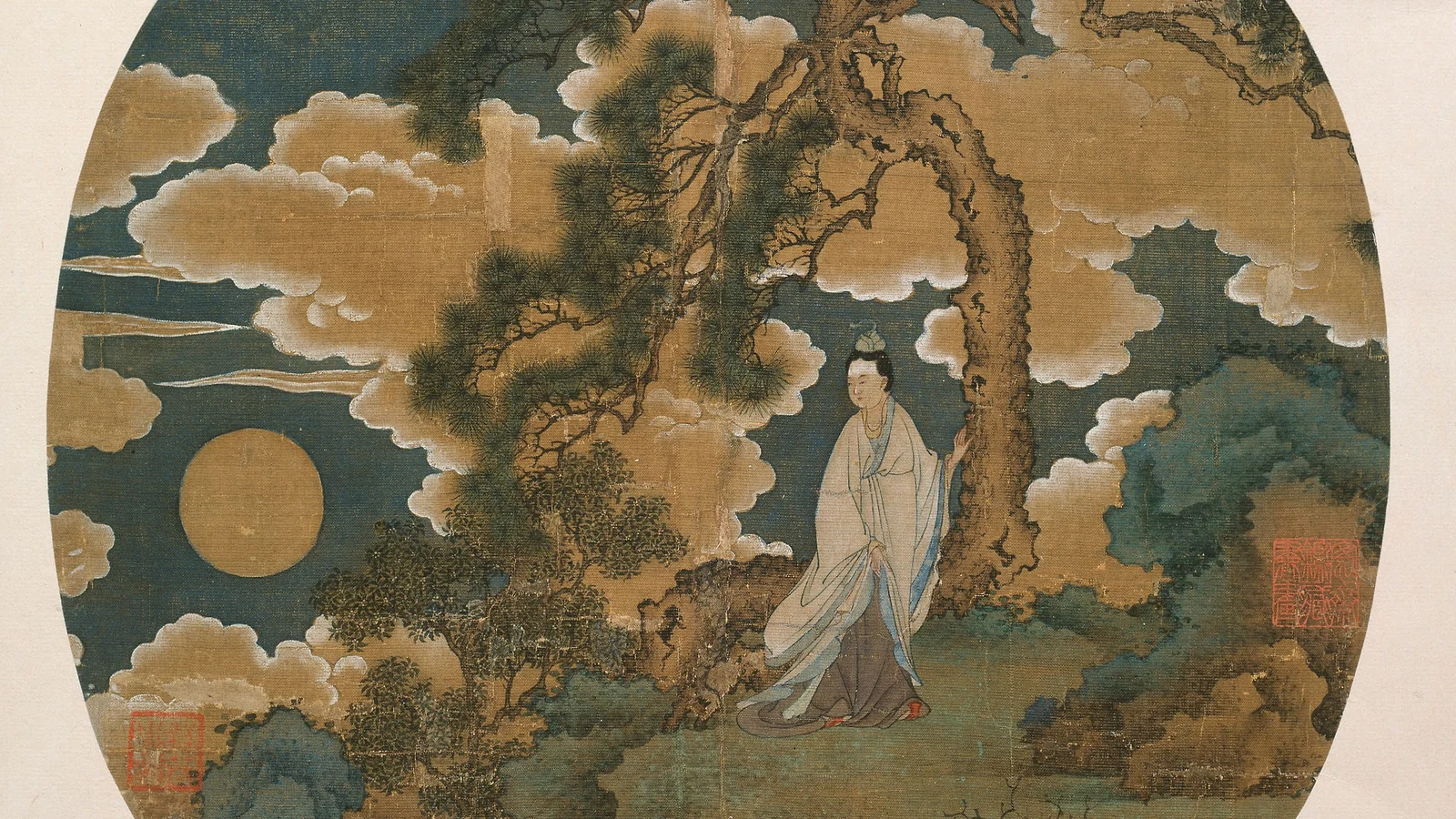
The Moon Goddess Chang E, unidentified artist after Tang Yin, Ming dynasty, ink and color on paper. The Metropolitan Museum of Art, public domain.
The Metropolitan Museum of Art identifies this hanging scroll as a Ming-dynasty work by an unidentified artist after Tang Yin. By this point Chang'e is no toad. She is a cultivated, beautiful female figure commanding an atmospheric pictorial world.
The image changes how judgment works. A short verb such as “stole” pushes the reader toward an act. A painted figure with controlled gesture, elegant garments and lyrical space asks the viewer to stay with a presence. Beauty proves nothing in court. Here, however, it refuses to let one ancient verb consume the whole woman.

A crop of the same identified object. It supports close visual reading; it cannot tell us why the Heng'e of the Huainanzi took the drug.
This is an important method for mythology. An image is evidence for the visual culture that made and used it, not an illustration secretly carried forward from the earliest text. A Ming painting can show how a Ming or later viewer encountered Chang'e. It cannot settle what a Han compiler meant.
The Art Institute of Chicago also records a historical work titled Chang'e, The Moon Goddess. Placing institutionally identified works beside source passages is more valuable than using an unattributed digital fantasy image, because the object record gives the interpretation a dateable home.
Was Chang'e a thief, a victim or a heroine?
The most accurate answer is: the source and moral frame decide.
In the Huainanzi passage, the verb supports calling her act theft. It does not explain motive, so “greedy traitor” goes beyond the line just as surely as “selfless protector.” Later versions supply motives that can condemn, excuse or admire her.
The toad transformation can be read as degradation or as lunar metamorphosis, but an interpretation must be argued, not smuggled in as translation. The elegant goddess can embody loneliness, transcendence, desire or independence depending on the surrounding text and viewer.
I understand the modern urge to rescue Chang'e from millennia of blame. I share it. But pretending the accusatory verb is absent gives us a thinner victory. The sharper defense asks why a woman's acquisition of immortality attracted such moral scrutiny, how later works made her isolation beautiful and why generations eventually needed a protector narrative.
Likewise, insisting she was “simply a thief” mistakes the earliest surviving concise wording for the complete history of meaning. Myths are not court transcripts. They remain alive because later communities argue with them.
What about Hou Yi, the Jade Rabbit and the Moon Palace?
These figures and places belong to the wider Chinese lunar myth complex, but they do not all enter through one door.
Hou Yi has his own heroic traditions, especially the shooting of excess suns. His relationship with Chang'e becomes central in later integrated narratives. The Hou Yi source guide separates the rescuer, grieving husband, murdered teacher and ruler traditions rather than making Chang'e's page absorb his whole cycle.
Xiwangmu, the Queen Mother of the West, is already present in the cited Huainanzi passage as the figure from whom Yi requests the immortality drug. Her own history is far larger than a supporting role in a romance.
The Jade Rabbit is associated with the moon and the pounding or preparation of an elixir. It becomes Chang'e's familiar companion in popular imagery, but readers should not project it into every early Chang'e sentence.
Guanghan Gong, the Palace of Broad Cold, gives later imagination an architectural home for lunar exile. Osmanthus trees, the woodcutter Wu Gang and other motifs may populate the moon world. Their coexistence in a modern illustration does not prove they entered the tradition simultaneously.
The safest visual-reading sequence is:
- Identify the object and date.
- Name only attributes actually visible.
- Check whether the museum or text identifies the figure.
- Separate the object's period from the period of the story it evokes.
- Treat absence as absence, not as a hidden symbol.
Why Chang'e is connected with Mid-Autumn
Chang'e lives on the moon in the cultural imagination, so the full-moon festival offers an obvious time to tell her story, display her image and think about separation. The modern devoted-wife version makes the connection especially emotional: a husband and wife cannot reunite, while families on earth try to do exactly that.
But Chang'e does not explain the entire festival. The Mid-Autumn Festival guide documents a larger practice of lunar dating, family reunion, mooncakes, lanterns and regional observance. People may celebrate without retelling the myth, and communities may emphasize different stories or none.
This boundary protects both pages. The festival is lived social practice; Chang'e is a changing textual and visual figure. Their histories overlap without becoming identical.
Chang E survives because no version can close the case
I cannot reduce Chang'e to “the Chinese moon goddess who sacrificed herself” or “the woman who greedily stole immortality.” Each label reveals the needs of one version more clearly than it reveals the whole figure.
The Huainanzi gives us a terse theft and flight. The transmitted Lingxian adds divination and a toad transformation. Later art makes her beautiful, composed and available for sympathy. Modern retellings give her a villain and a protective motive.
Name the layer before naming the moral. Then make your judgment and own it. Mine is this: the lasting power of Chang'e lies in her refusal to stay sentenced. A thief becomes a toad, a toad becomes a beauty, a beauty becomes a lonely wife, and the lonely wife becomes a woman whom later readers insist on hearing differently. For more than two thousand years, she has carried arguments about desire, blame, separation, transformation and a woman's right to reach the moon. I do not want the case closed.