Hou Yi is the archer in Chinese mythology who saves the earth by shooting down nine of ten suns. His greatness is not nine perfect arrows. It is the decision to leave one sun alive. Later storytelling joins that public victory to a private wound: Chang'e takes the immortality drug and rises to the moon, while Hou Yi remains below.
That is the Hou Yi worth knowing. I do not need a catalogue of every later title attached to his name, and I do not need to turn him into a flawless superhero. The story already contains something sharper: a man can rescue the whole world and still fail to keep his own home from breaking apart.
Who is Hou Yi, and why did he shoot the suns?
Hou Yi—often written simply as Yi in early sources—is the legendary archer called when the sky itself becomes unlivable. In the familiar story, ten suns rise together. The heat burns plants, dries water and makes ordinary life impossible. Yi climbs to a high place, draws his bow and shoots nine of them down. One remains to light and warm the world.
The Huainanzi, “Ben Jing Xun” places Yi's action in the age of Yao among a series of catastrophes that afflict the people. Ten suns appear together; dangerous creatures also trouble the land. Yi removes the threats, and people can live again. The Shanhaijing, “Hainei Jing” preserves another important piece: Di Jun gives Yi a red bow and white arrows so he can bring relief to the world below.
Neither passage reads like a modern illustrated children's book. The details became fuller as storytellers, artists, teachers and families retold the episode. Yet the central action stayed stable because it is so strong: the sky has too much power, and one human being dares to reduce it.

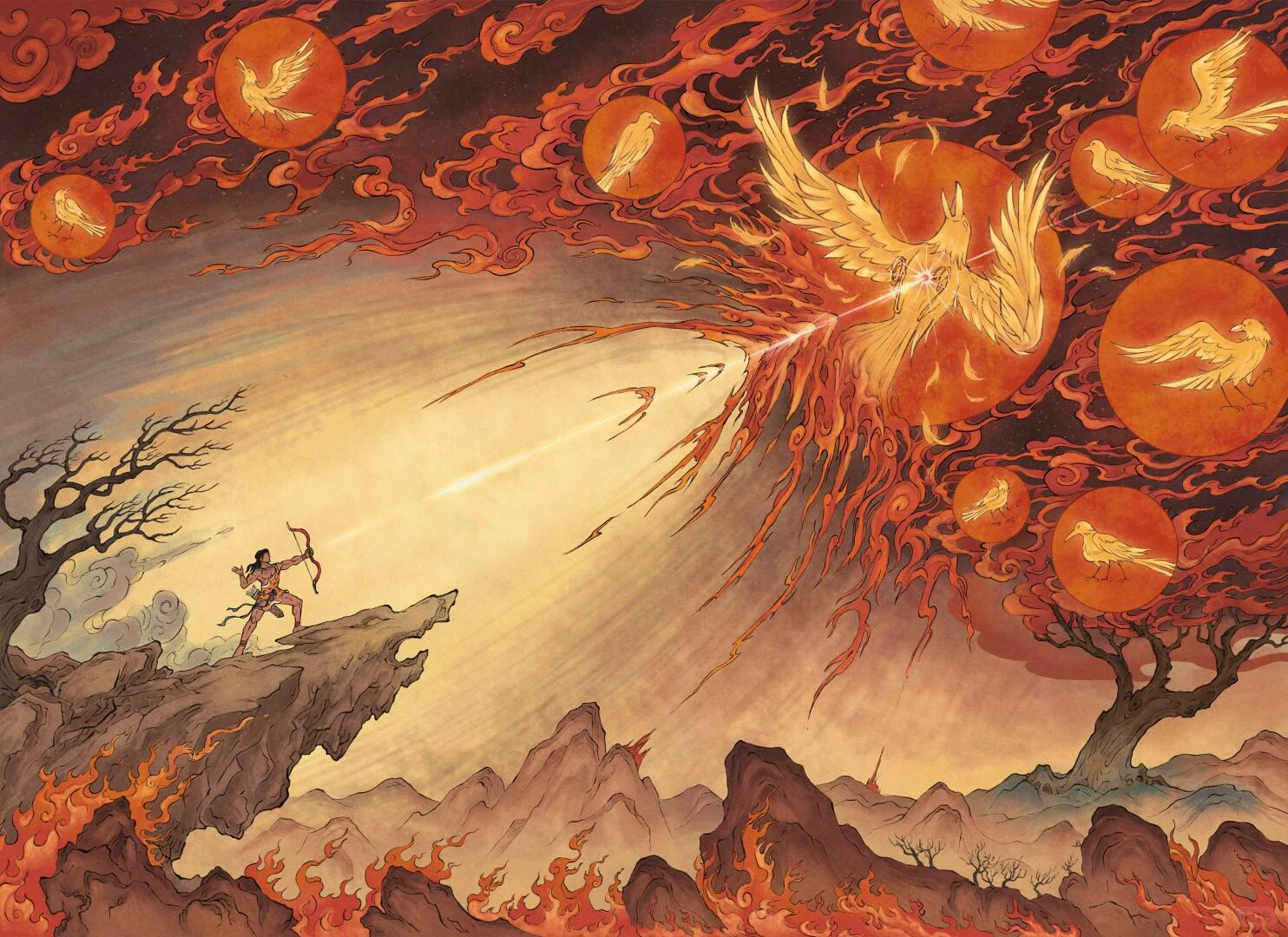
This contemporary illustration gives the archer a human scale against a damaged world. It visualizes the familiar myth; it is not archaeological evidence of how an ancient storyteller pictured him.
The disaster is not darkness. It is excess. Ten suns are ten sources of life behaving as one uncontrollable force. That makes the myth more interesting than a simple battle between good and evil. Sunlight is necessary. Heat is necessary. The problem begins when a good thing loses measure.
Hou Yi shooting the suns is really a story about restraint
Most retellings spend their energy on the arrows. I care more about the pause after the ninth.
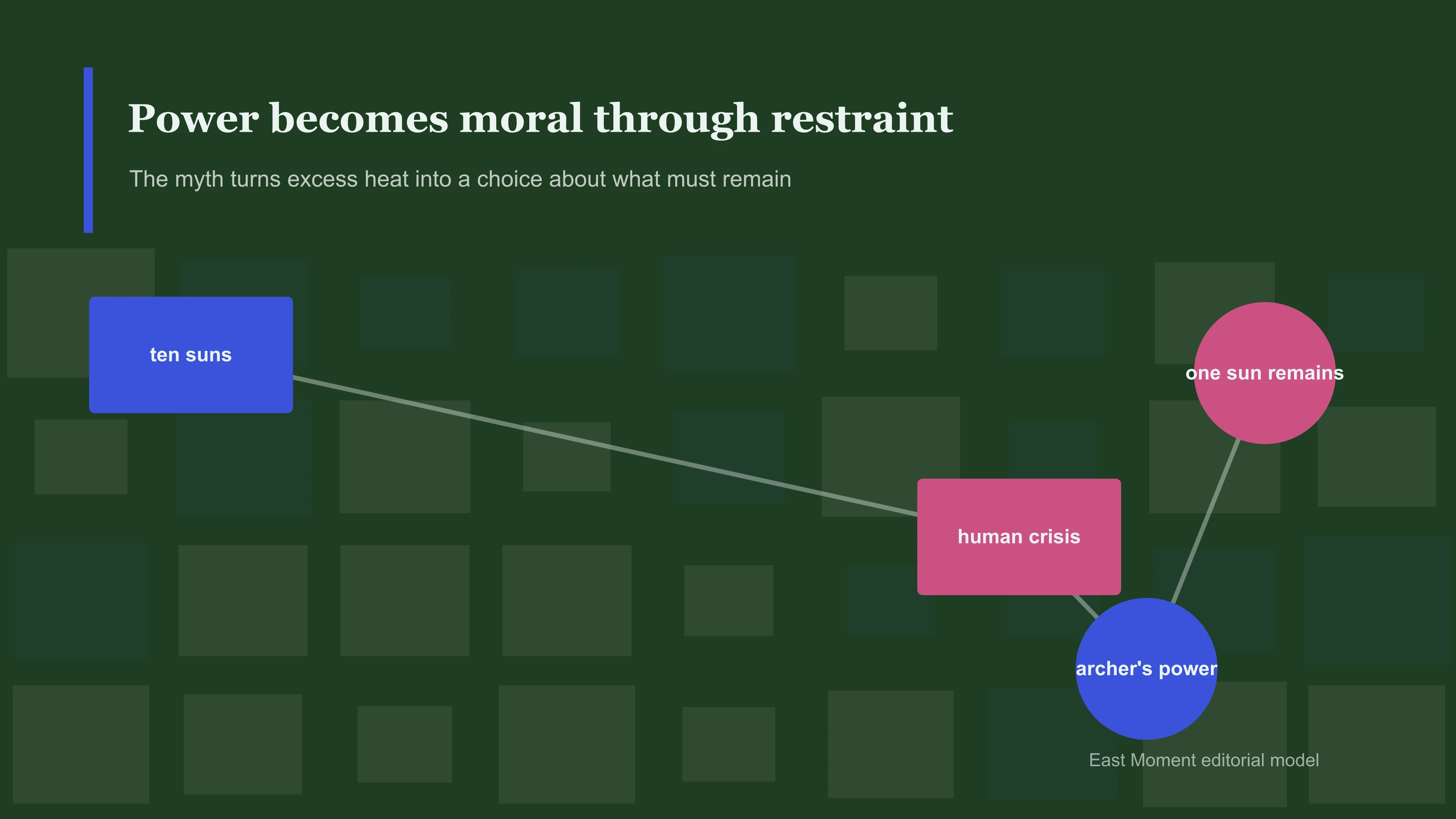
If Hou Yi were merely angry, he could empty the quiver. If he were addicted to applause, he could keep shooting until nothing remained above him. The final sun survives because the archer understands the difference between removing danger and destroying the system that sustains life.
That is a harder form of courage. Starting violence is easy when everyone is cheering. Stopping while you are still powerful is rare.

The creator's panel turns impact into a visible instant and uses bird forms familiar from later sun imagery. It cannot prove that every early source described all ten suns in exactly this form.
I grew up hearing the episode as a feat of marksmanship: Hou Yi was great because he could hit what nobody else could hit. Reading it as an adult, I think that is only half the lesson. Accuracy explains how he wins. Restraint explains why the victory deserves to last.
The people below do not need a spectacular corpse in the sky. They need crops that can grow, water that does not vanish and mornings that arrive at a tolerable temperature. Hou Yi's heroism is therefore practical. He does not save an abstract “world”; he makes breakfast, farming, work and childhood possible again.
This is where I part company with glossy superhero comparisons. A superhero often proves strength by meeting a larger explosion with an even larger one. Hou Yi proves strength by restoring proportion. He does not conquer the sun. He repairs the relationship between sunlight and human life.
Why were there ten suns?
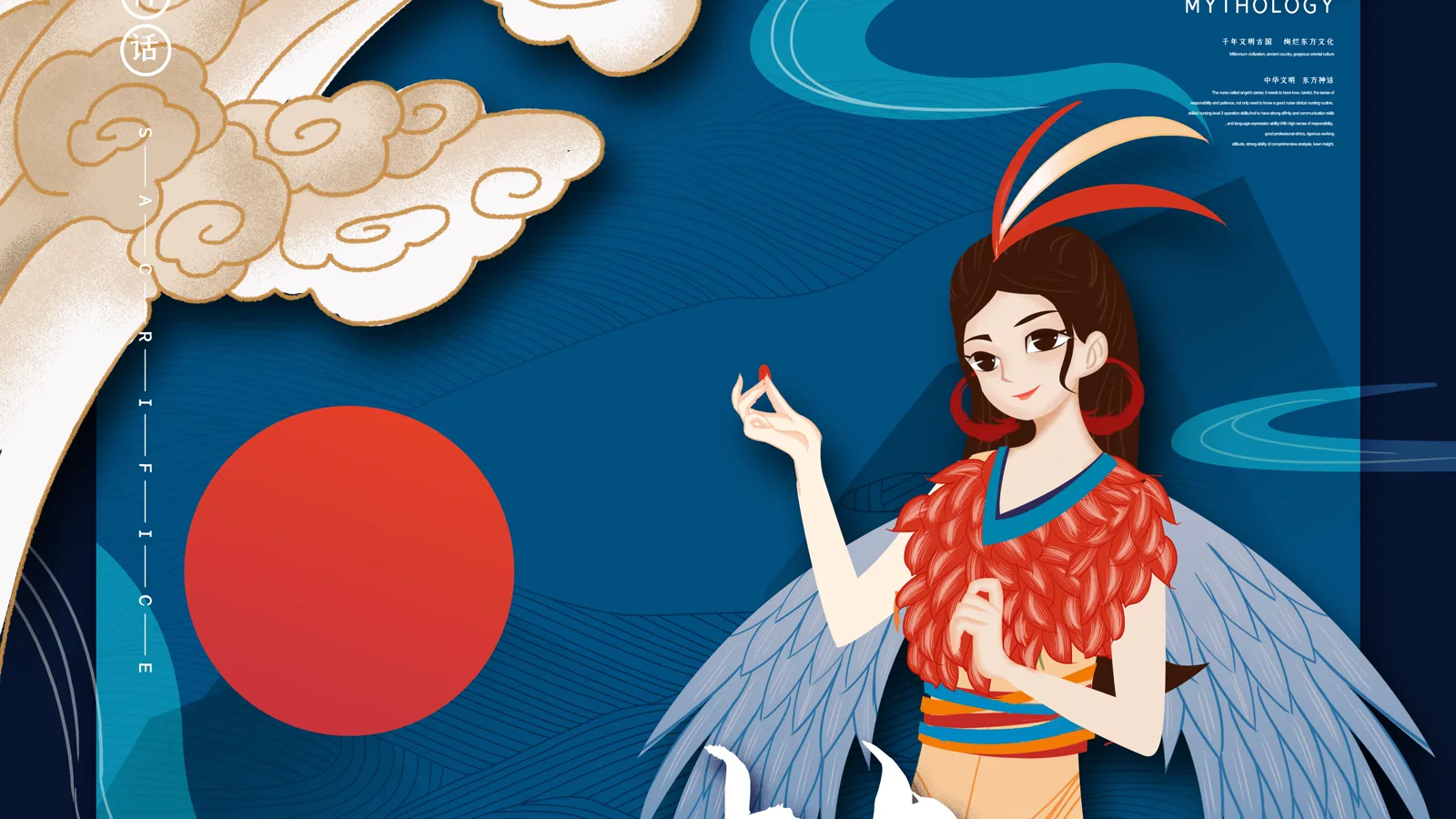
The most familiar explanation makes the suns brothers who normally travel across the sky one at a time. One day they appear together, whether from playfulness, disobedience or cosmic disorder, and their combined heat scorches the earth. Some later images connect the suns with three-legged birds or golden crows.

A second visual tradition turns the compressed myth into speed: horse, drawn bow, falling fire and a sky still crowded with suns. It shows how a later Chinese illustrator made the catastrophe readable for ordinary families; it does not claim to reproduce an original ancient image.
Readers should not force every detail into one supposedly original script. Early Chinese mythology survives through different texts, commentarial traditions and later retellings. One source supplies the bow; another supplies the disaster; later storytellers make motivation, dialogue and family relations emotionally complete.
That does not make the story meaningless. It makes the story alive. A myth is not weakened because different generations keep asking what caused the catastrophe. The stable question is more important: what should a capable person do when a system meant to sustain life becomes the thing destroying it? Hou Yi acts.
The ten suns can be read as literal mythic beings, as a picture of drought, or as a moral image of uncontrolled abundance. I do not pretend one interpretation cancels the others. My own reading is direct: the story distrusts power without rhythm. One sun crossing the sky has rhythm. Ten appearing together have only force.
Hou Yi and Chang'e: saving the world did not save the marriage
The second half of Hou Yi's popular story changes temperature completely. The sky cools, but his home becomes lonely.
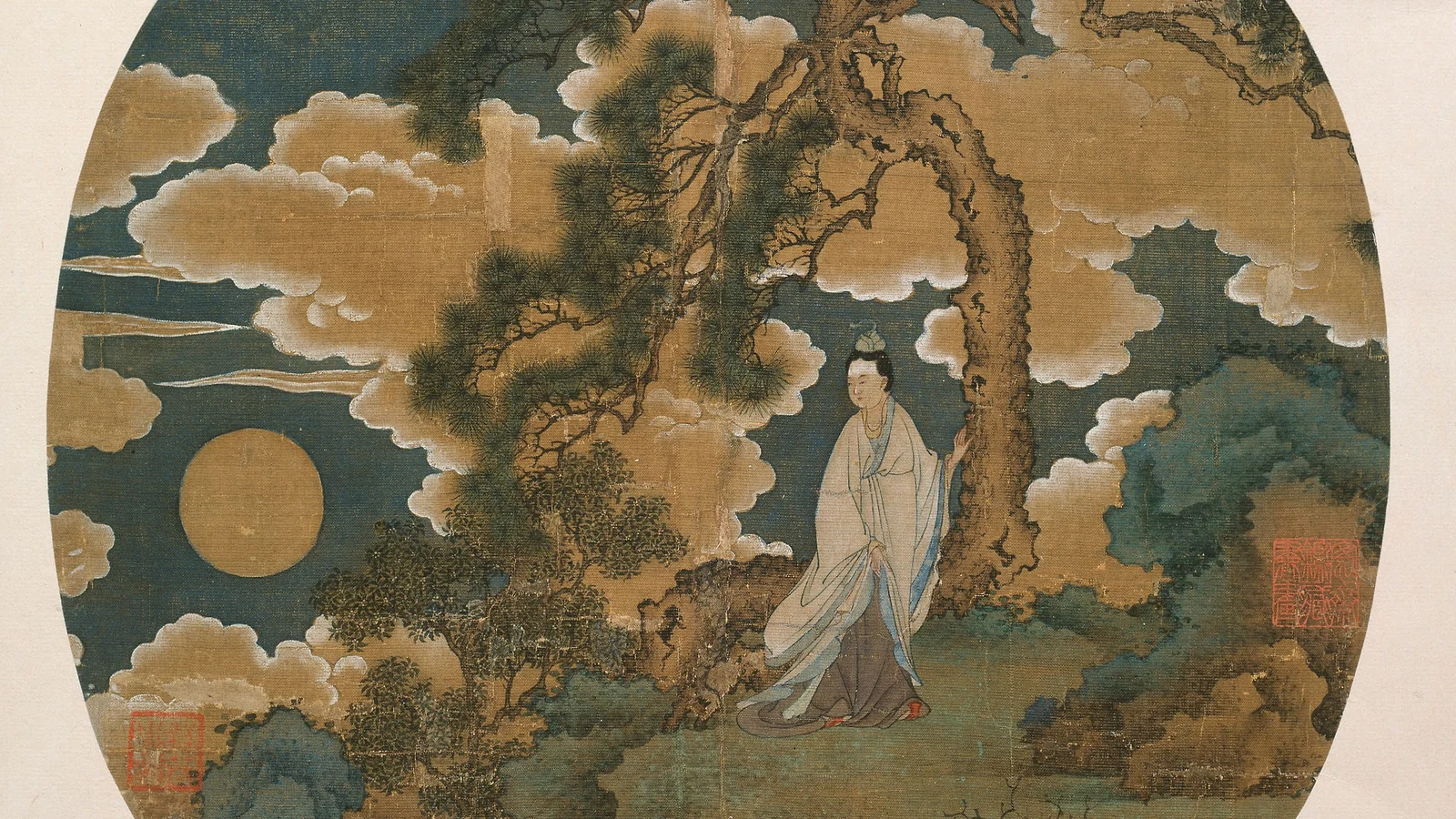
In the best-known modern version, Hou Yi and Chang'e are husband and wife. After his heroic deeds, an immortality drug enters their household. Hou Yi does not immediately abandon mortal life to take it alone. Then, during a crisis, Chang'e swallows the drug and rises to the moon. In many family-friendly retellings she takes it to prevent a villain from stealing it; in other versions her motive is less flattering. Hou Yi returns too late and can only look upward.
The early textual evidence is shorter and rougher than the romance many people know. The Huainanzi, “Lan Ming Xun” says Yi obtained an immortality drug from Xiwangmu and Heng'e stole it before fleeing to the moon. It does not supply the entire modern scene of a protective wife, a named intruder, a desperate struggle and an annual reunion. Those later additions soften Chang'e and deepen Hou Yi's grief.
I do not dismiss the popular version because it is later. It became beloved for a reason. A bare theft leaves a moral accusation. A woman forced to choose between surrendering the drug and swallowing it creates tragedy. A husband laying out food beneath the moon creates longing. Storytellers kept returning because the source left emotional space open.
Read the dedicated Chang'e guide for the source layers and the way her image changed from an accused fugitive into the luminous moon figure most people recognize. On this page, her role is more intimate: she exposes the limit of Hou Yi's power.
He can hit a sun at impossible distance. He cannot call his wife back from the moon.
That contrast is why the couple survived in memory. Public achievement does not guarantee private happiness. Skill does not prevent separation. The man everyone needs can still return to an empty room. No victory celebration can solve that.
Did Chang'e leave Hou Yi on purpose?
There is no single answer accepted by every version.
- In a concise early account, she takes the drug and goes to the moon.
- In widely told modern versions, she swallows it under pressure to keep it from a threatening man.
- In romantic retellings, her moonward flight becomes sacrifice and permanent separation.
- In moralizing versions, the act can look like betrayal, impatience or the price of desiring immortality.
The responsible answer is not “pick the oldest and ban the rest.” It is to name which version you are telling. The oldest surviving sentence and the version grandparents tell children perform different cultural work.
My preference is the tragic version in which neither person gets what they wanted. Chang'e reaches immortality but loses shared human life. Hou Yi keeps mortality but loses the person with whom he might have spent it. The drug defeats death and still fails to create happiness. That is much more Chinese in emotional logic than a simple prize: blessings become burdens when they break the relationship they were meant to protect.
How Hou Yi became part of the Mid-Autumn imagination
Hou Yi's sun-shooting episode is not the origin of every Mid-Autumn custom. The festival has calendrical, seasonal, agricultural and family-reunion layers that cannot be reduced to one myth. Yet the Hou Yi–Chang'e separation fits the festival's emotional center almost perfectly.
On the fifteenth day of the eighth lunar month, families look toward a bright round moon and think about reunion. Chang'e is visible only through the moon; Hou Yi remains on earth. Their separation gives human pain to an astronomical object. A round moon suggests completeness, while the couple remains incomplete.
That tension is why the story belongs beside the festival without owning it. The Mid-Autumn Festival guide explains how reunion dinners, mooncakes, moon viewing and lanterns work in real Chinese life. Hou Yi supplies one emotional story inside that larger living system.
I would never tell a visitor that Chinese families gather because they are literally commemorating one archer. Most people are not conducting a mythology lesson at dinner. But the story gives language to something families already understand: distance can make love more visible, and looking at the same moon can make absence briefly shareable.
Why people still remember Hou Yi
Hou Yi lasts because three different readers can meet him at three different ages.
A child sees bravery. The sky is burning, adults cannot solve it, and the archer steps forward.
A teenager sees extraordinary skill. Hou Yi does not hesitate; he draws, aims and changes the world through mastery.
An adult sees cost. He leaves one sun, but he cannot prevent every later loss. The world he saves does not reward him with a perfect home.
I see one more reason: Hou Yi gives Chinese culture a hero whose decisive virtue is measure. He removes nine and preserves one. This is not compromise born from weakness. It is judgment exercised at the height of strength.
That matters now. We live among systems that reward maximum output, maximum attention, maximum speed and maximum growth. Hou Yi's story says maximum is not the same as life. More light can become fire. More power can become disaster. The heroic act may be subtraction—and the moral act is knowing where to stop.
The Chinese mythology collection contains stranger gods, cleverer survivors and more complicated transformations. Hou Yi remains one of the clearest because his silhouette needs almost nothing: a human body, a bow and an impossible sky.
One sun left alive is Hou Yi's real victory
Hou Yi should be remembered as the archer who restored a livable world, then discovered that public greatness could not protect him from private separation.
The nine arrows make the scene unforgettable. The one sun left behind makes the hero morally intelligent. Chang'e makes him human.
If I had to keep only one image, it would not be the arrow striking fire. It would be Hou Yi lowering the bow while one sun still crosses the sky. Anyone can admire force. The harder lesson is restraint: save the world, but do not destroy what the world still needs.