The Double Ninth Festival falls on Sunday, October 18 in 2026, the ninth day of the ninth lunar month. Also called Chongyang, it connects three kinds of height: climbing into autumn air, looking back toward ancestors and noticing that the people beside us are aging. Modern respect for elders belongs to the festival, but it should not erase its older landscape, protection and remembrance traditions.
The image that stays with me is not a slogan about respecting seniors. It is a path whose pace has changed. A parent who once waited for a child now needs the child to wait. Double Ninth becomes meaningful at exactly that adjustment: not ceremonial praise, but the decision to walk at another person's speed.
When is the Double Ninth Festival in 2026?
The 2026 date is October 18. The Hong Kong Observatory calendar identifies that Sunday as the ninth day of lunar month nine.
The common Chinese name, Chongyang Jie, refers to the doubled ninth. In traditional number associations, nine is yang; two nines create “double yang.” English names include Double Ninth Festival and Chongyang Festival.
The name explains the date. It does not prove one tidy origin story. Festival customs accumulated across places and centuries, so a legend about escaping danger, an autumn rite, a later literary gathering and a modern elders' day should not be forced into one unbroken event. The useful answer is layered: the doubled-nine calendar holds the day together; climbing, remembrance, chrysanthemums and care give different communities ways to inhabit it.
That distinction matters because search results often turn Chinese festivals into origin myths with suspiciously perfect beginnings. A festival that has survived this long is not a fossil from one morning in antiquity. It is a calendar container repeatedly filled by people whose landscapes, family structures and obligations changed.
The first height is physical: climb into autumn
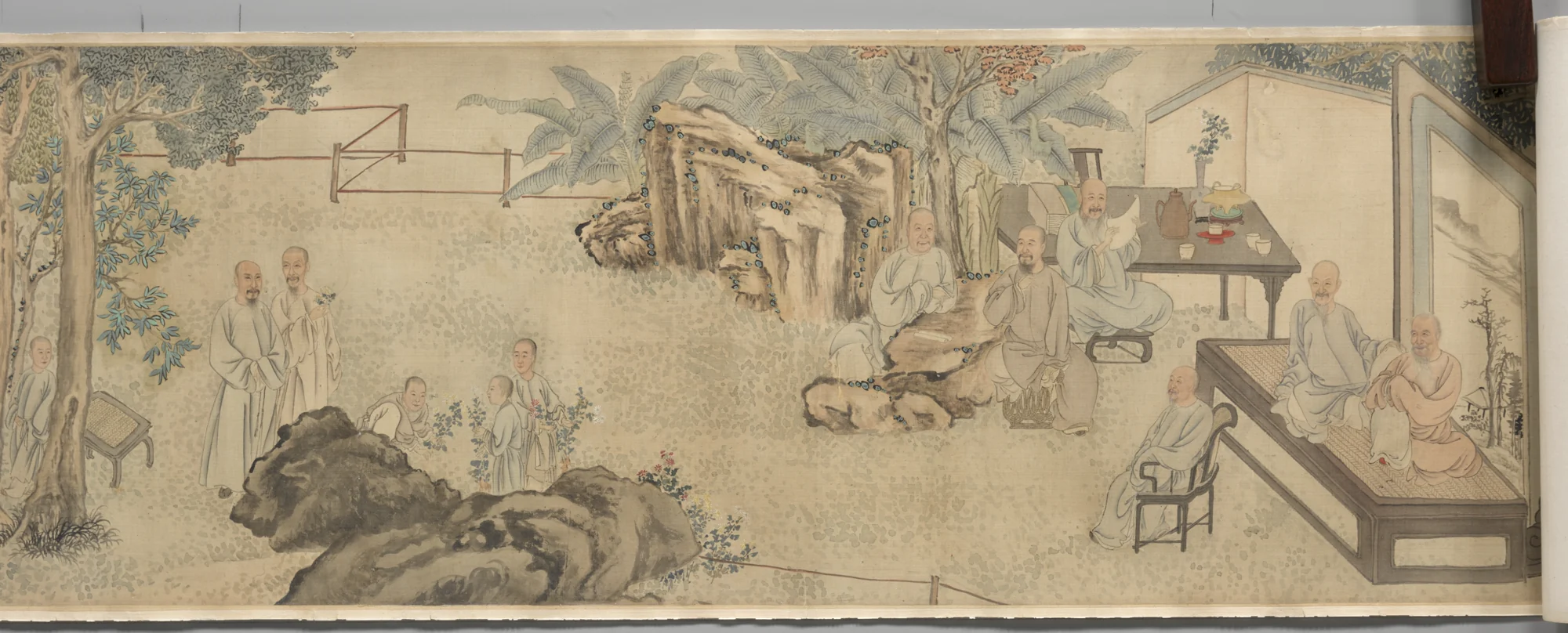
Climbing hills, mountains or high places is one of the festival's best-known practices. Stories connect the ascent with avoiding danger, health and seasonal custom, while later outings also make room for friendship, poetry and the autumn view. The Cleveland Museum of Art scroll used in this page's opening shows older friends dispersed between rocks, trees, conversation and a table. It is an eighteenth-century artistic construction, not a camera record, but it restores an element the cemetery photographs had overwhelmed: Chongyang can be sociable.
Height changes attention. At street level, the day is errands and traffic. From a slope, paths connect, roofs compress and the season becomes visible across a larger field. Autumn gives the view an edge: clarity arrives with decline.

The Metropolitan Museum of Art landscape records an artist marking the date through mountain space. It cannot tell us how ordinary households observed Chongyang.
That is why Double Ninth's climbing should not be sold merely as wellness. The walk is a technique for seeing time.
Choose the route for the oldest knees, not the best photograph
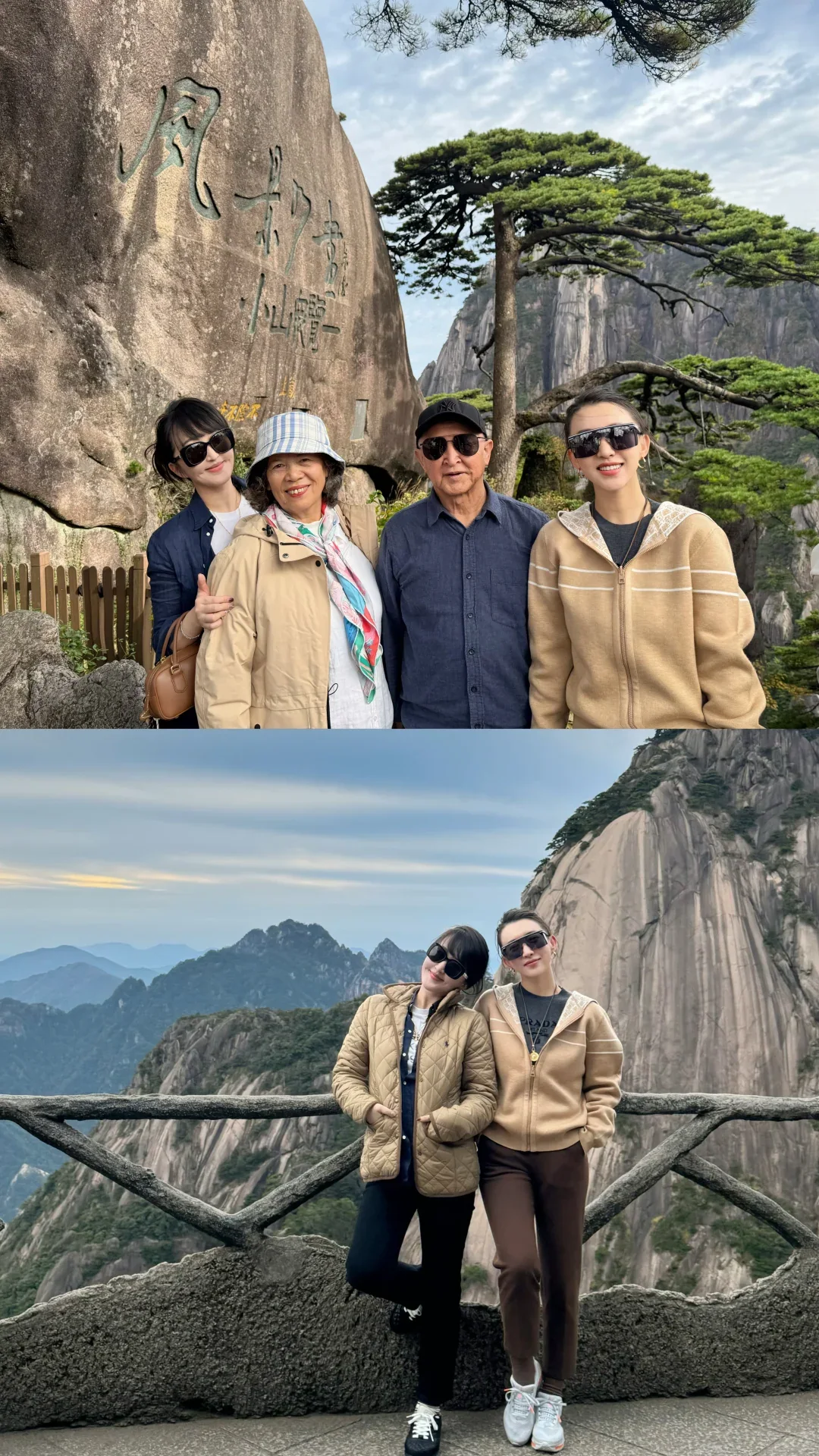
A family of four records its 2025 Double Ninth climb at Huangshan: the parents share the upper frame with their daughters, while the lower frame keeps the daughters' own mountain memory. It proves one family turned the festival into time physically spent together. It cannot prove that Huangshan, cable cars or a summit portrait are required Chongyang customs.
This is where a picturesque custom meets an unromantic test. A steep route can exclude the very person whom a family says it wants to honor. If an older relative is coming, the correct summit is not automatically the highest one. It is the place the group can reach without turning care into endurance theatre.
Before leaving, settle four decisions:
| Decision | The weak version | The caring version |
|---|---|---|
| Route | Choose the famous climb, then ask who can manage it | Ask about stairs, rest points, toilets, shade and transport first |
| Pace | Let the fastest person set the rhythm | Put the person with the least comfortable pace near the front |
| Photograph | Treat the summit picture as proof of filial care | Stop the camera if someone is tired, exposed or simply unwilling |
| Meaning | Assume climbing is required | Keep the shared autumn view; change the route or skip the climb when needed |
I am blunt about this: no symbolic ascent is worth making a real person feel like luggage. A riverside walk, a flat garden or tea beside an open window can preserve the day's act of looking outward. The tradition is not weakened when the body is taken seriously. It is finally being understood.
The second height is social: put the elder at the center
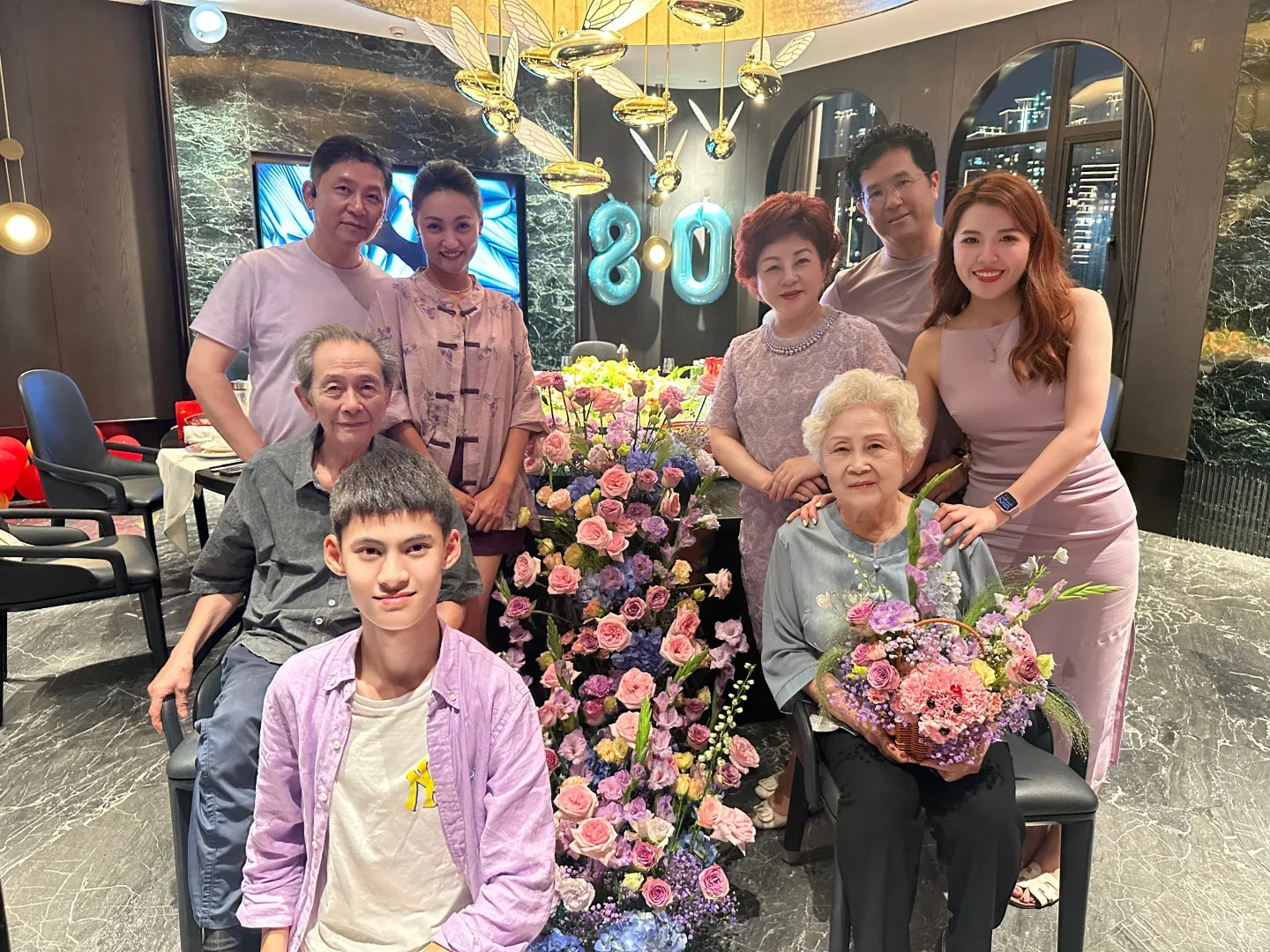
Three generations have actually arrived and made room around the oldest family member. That physical presence says more about respect than a festival slogan.
This photograph records an eightieth-birthday gathering rather than a Double Ninth ceremony. I chose it because it exposes the standard that Chongyang should meet. Respect is not a poster of two smiling elders beneath an orange sunset. It is relatives crossing the city, rearranging a table, making space for a chair and allowing an older person to remain a person rather than become the day's symbol.
The image is celebratory, even extravagant, but its strongest detail is spatial: the elder is not parked at the edge while younger people perform for the camera. Several generations have organized themselves around her. Double Ninth cannot manufacture intimacy where none exists, yet it can force one useful question: who is physically present when care becomes inconvenient?
Ancestor visits remain a regional layer
In Hong Kong and some southern traditions, Double Ninth is also a major time for grave visits and ancestor remembrance. The practice overlaps visibly with Qingming but occupies a different season and local calendar. Steep cemeteries make the connection between climbing and ancestry literal.
That regional practice should be explained without allowing rows of tombstones to become the festival's entire visual identity. The practical question remains physical access. Older people may face stairs, heat, crowds and uneven paths. Respect means planning transport, carrying supplies and deciding whether a person should make the climb at all. No festival virtue requires risking someone's health for a photograph.
Double Ninth, Qingming and Hungry Ghost are not interchangeable
Ancestor practice is where quick explanations often collapse several Chinese festivals into one vague “day for the dead.” That erases calendar, season and action. The overlap is real, but the festivals do different work.
| Festival | Seasonal position | Main spatial action | Boundary that matters |
|---|---|---|---|
| Double Ninth | Ninth day of lunar month nine, in autumn | Climbing; in some regions, grave visits on elevated ground | Grave visiting is important in places such as Hong Kong, not a universal national script |
| Qingming | Spring solar term | Cleaning and tending graves, remembrance and spring outings | Qingming is the stronger nationwide reference point for tomb sweeping |
| Hungry Ghost Festival | Seventh lunar month | Offerings and hospitality directed toward wandering or unattended spirits in many traditions | It is not simply another family grave-cleaning day |
The difference is not academic trivia. It changes what the body does. Qingming asks many families to tend a particular grave in spring. Double Ninth may add an autumn return, often shaped by local geography. Hungry Ghost customs can widen attention beyond one's own named ancestors. A translation should preserve those directions instead of replacing all three with “ancestor worship.”
The third height is age: look across a lifetime

This open-access image records one identified artistic or documentary setting connected with Double Ninth. It expands the festival beyond a generic climbing photo, but it does not prove an unchanged ancient custom or a universal way of observing the day.
Modern China also marks the day through respect and care for older people. That emphasis gives the festival immediate social value, but it can become shallow when reduced to performances, gifts or one annual visit.
An elder is not a symbol of longevity. They are a person with preferences, unfinished arguments, expertise, boredom and the right to make decisions. Useful respect can look unphotogenic:
- listening without finishing a story for them;
- increasing type size on a phone;
- recording the name of someone in an old photograph;
- making a public route physically accessible;
- sharing care work rather than praising the relative already doing it;
- accepting that age does not automatically make every opinion correct.
The festival becomes honest when reverence does not erase personhood.
Role reversal arrives as a changed pace
People rarely announce the exact moment when a relationship changes direction. It appears in small friction. The parent who once carried the bags now pauses at the station stairs. A message needs larger type. A familiar road is suddenly too loud or too fast. A story repeats, but a name inside it remains important.
The hardest adjustment is not performing one generous act. It is accepting that efficiency may no longer be the right measure of time together. Younger relatives often want to solve the task quickly: book the appointment, order the gift, finish the form, move the conversation along. Older relatives may be trying to protect independence, dignity or a rhythm that still feels like their own. Both needs are real. Care begins when the faster person stops treating delay as failure.
This does not require pretending every family relationship is tender. Some histories contain neglect, control or injury. Respect for age does not cancel boundaries, and an older person is not automatically right. Double Ninth becomes more credible—not less—when it can hold affection, duty, distance and unresolved conflict without painting every family in the same warm color.
Chrysanthemums, cakes and family meals belong to particular tables
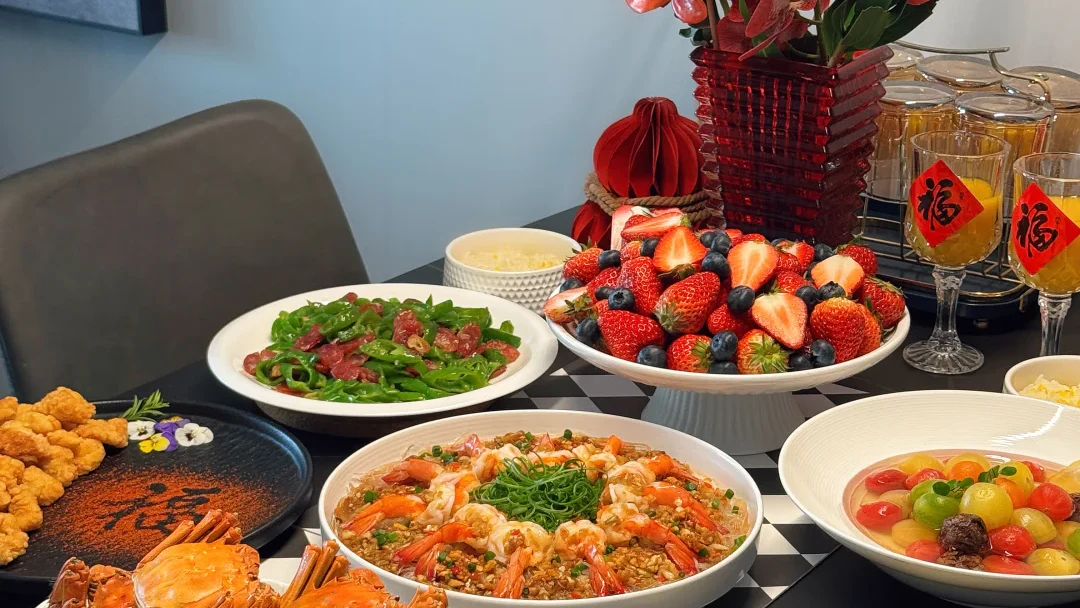
Chrysanthemums, chrysanthemum wine and chongyang gao are frequently associated with Double Ninth. The word gao for cake sounds like the word for “high,” allowing food to echo climbing. But not every family drinks wine, eats the same cake or observes the festival through food.
Objects gain meaning through use, region and memory. A chrysanthemum in a painting, a medicinal preparation, a cup of wine and a supermarket gift box cannot be treated as interchangeable proof of one ancient national custom.
A family meal may be the most honest modern form of the festival precisely because it is not spectacular. Let the older person choose the restaurant, dish, time and length of the visit. If chewing is difficult, adapt the food. If noise is exhausting, do not confuse a crowded banquet with affection. A table becomes respectful only when the guest of honor still has agency.
The feast in Fang Shishu's scroll should be read carefully. It shows men gathered with cups, vessels and food inside a cultivated garden world. It proves that sociability belonged to one painted vision of the ninth day; it does not license us to call every contemporary family dinner an ancient custom. What it offers is a better emotional frame: autumn reflection does not require a grave in the foreground.
Art adds another kind of ascent. The viewer moves through painted distance rather than a physical mountain. Literary gatherings and landscapes show how cultivated elites used the festival, but those records should sit beside household meals, accessible walks and regional cemetery practice, not replace them.
How Double Ninth Festival is observed today
There is no single modern Chongyang timetable. The festival may appear as a family outing, a cemetery journey, a school activity, a community visit or little more than a message in a family chat. These are not equally deep, but they are all part of the present landscape.
- At home, a family may share a meal, call an older relative, bring chrysanthemums or ask about a photograph whose names are disappearing.
- In a neighborhood, volunteers or community organizations may arrange performances, health activities or visits. These can be useful when they create lasting contact; they become theatre when the older person is only a prop for a group photograph.
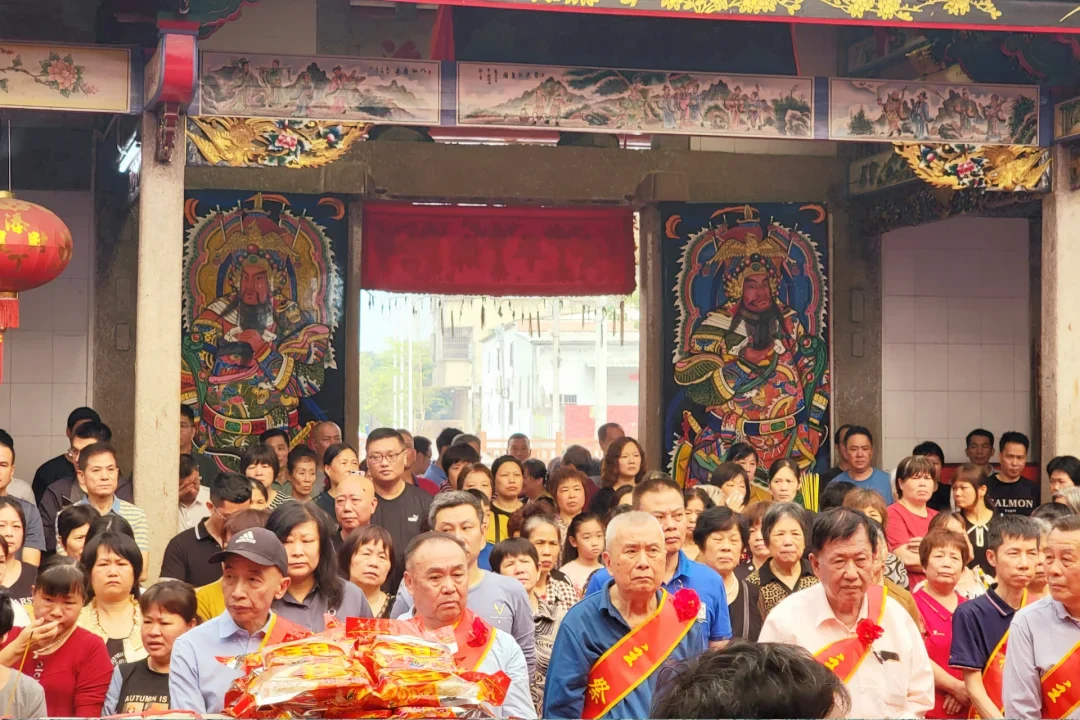
- At a cemetery, local practice, access, weather, transport rules and family preference decide what is appropriate. The meaning cannot be inferred from the image alone.
- At school, children may learn the calendar name or make a gift. The stronger lesson is to notice who already performs care every day and what would actually help them.
The Academy of Contemporary China and World Studies overview identifies caring for older people as a more recent layer added to a festival with older autumn and ancestor associations. That chronology is important. “China's Seniors' Day” is not a false label; it is an incomplete one.
If you want to observe the day without staging it, build one hour around the older person's choice. Ask one memory question, complete one practical task they have postponed, and share one food or view they genuinely want. Do not arrive with a fixed script and call obedience respect.
The memory question should be specific enough to open a door: Who is the person standing beside you in this photograph? What did this street look like before the towers? Which festival task did your mother hate doing? Specific questions protect memory from becoming the same three polished family stories.
Seniors' Day is one layer, not the whole festival
It is tempting to explain Double Ninth as “China's Seniors' Day” because the phrase is immediately legible. It is accurate only as a modern layer. If used as the entire definition, it deletes climbing, protection traditions, chrysanthemums, poetry, graves and the doubled-nine calendar logic.
The reverse error is equally weak: presenting only elegant historical imagery while ignoring present-day aging. Longer lifespans, migration and unequal care burdens give the festival urgent contemporary questions. Who accompanies an older person to appointments? Who lives far away? Which neighborhood remains walkable when knees weaken?
Tradition is strongest here when the old ascent exposes a current responsibility.
The responsibility must continue after the date. A festival phone call is better than silence, but it cannot substitute for the appointment someone still has to accompany, the inaccessible step no one has repaired or the caregiver who has not had a free afternoon in months. The most honest Double Ninth promise is small enough to keep next Tuesday.
Walk at the pace of the relationship
If you observe Double Ninth, choose a route for the people actually coming. A small hill or city overlook can hold the meaning without imitating a dramatic mountain photograph. Bring water, check weather and access, and ask before planning an ancestor visit for someone else.
The Chinese festivals guide places Chongyang in the autumn calendar. Compare its family grave visits with spring Qingming and its attention to the dead with the wider hospitality of the Hungry Ghost Festival.
Who taught you to slow your pace, and what ordinary form of care matters more than a festival gesture? Share the changed pace, not a generic tribute: the route you shortened, the word you finally asked about, the object you repaired or the task you stopped leaving to one person.
Then turn it into a Moment in the East Moment community: one photograph or object, one sentence of family context and one action that will still matter after Chongyang. Return after the festival and tell us whether the promise survived an ordinary week. That is a more serious measure of respect than a perfect holiday caption.