The next Qingming Festival falls on Monday, April 5 in 2027. “Tomb-Sweeping Day” is a useful translation, but it makes the festival look narrower and gloomier than it feels in many homes. Families may tend a grave, gather in an ancestral hall, prepare food, speak names, eat together and walk into spring. Qingming is not a day spent staring at death. It is a day when the living do the work of keeping a relationship alive.
I understand Qingming most clearly through the hands. One hand folds dark sesame into green dough. Another arranges bowls in a family hall. Someone carries cooked dishes from the kitchen; someone else steadies an older relative on uneven ground. A child hears an unfamiliar name and, perhaps for the first time, learns how that person belongs to them. The day can be solemn, noisy, practical and warm within the same few hours. That mixture is not a contradiction. It is the festival.
When is Qingming Festival in 2027?
The next Qingming date is April 5, 2027. The Hong Kong Observatory's official 2027 calendar marks that Monday as Qingming. Unlike festivals fixed to a numbered lunar day, Qingming is also one of the twenty-four solar terms, so it normally falls around April 4 or 5.
| Year | Qingming Festival | Day |
|---|---|---|
| 2025 | April 4 | Friday |
| 2026 | April 5 | Sunday |
| 2027 | April 5 | Monday |
The festival date and a jurisdiction's public-holiday arrangement are not the same question. Check the local calendar before planning travel. Cemetery visits may also spread across nearby days because of work, distance, weather and crowd controls.
Before the grave, Qingming gathers a living family
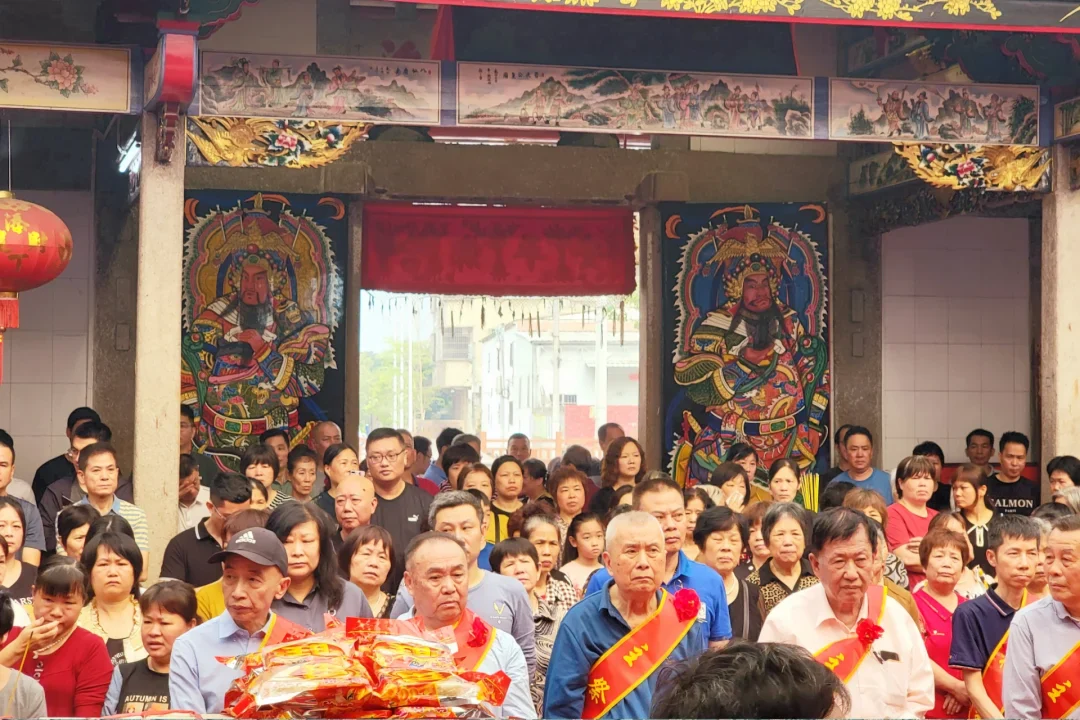
A Qingming morning does not always begin at a cemetery gate. In some families, preparation starts at home or in an ancestral hall: relatives arrive, names and responsibilities are checked, offerings are set out, incense or bows follow local practice, and the adults quietly decide who is carrying what. The opening photograph matters because it returns people to the center. It documents one lineage gathering—the hall, age range and offerings are visible—but it cannot tell us every participant's belief or make this a national template. A festival explained only with tombstones forgets that remembrance is organized by a room full of living relatives.
An ancestral hall is not simply a photogenic old building. It can hold tablets, lineage records, ritual duties and the uncomfortable politics of belonging. Who stands near the front? Who cooked? Who travelled back? Which branches of the family are present, and which names have disappeared from the spoken account? The building makes continuity visible, but it can also expose who has been left outside it. I would rather admit that tension than present “clan unity” as a perfect antique picture.
Nor is this the universal Chinese Qingming. Many urban families have no usable hall; many households follow other religious or secular forms; migration may reduce the gathering to a car journey, a meal, a video call or one person carrying everybody's questions. The shared principle is not architecture. It is the deliberate return to a relationship.
Spring reaches the kitchen before the family leaves
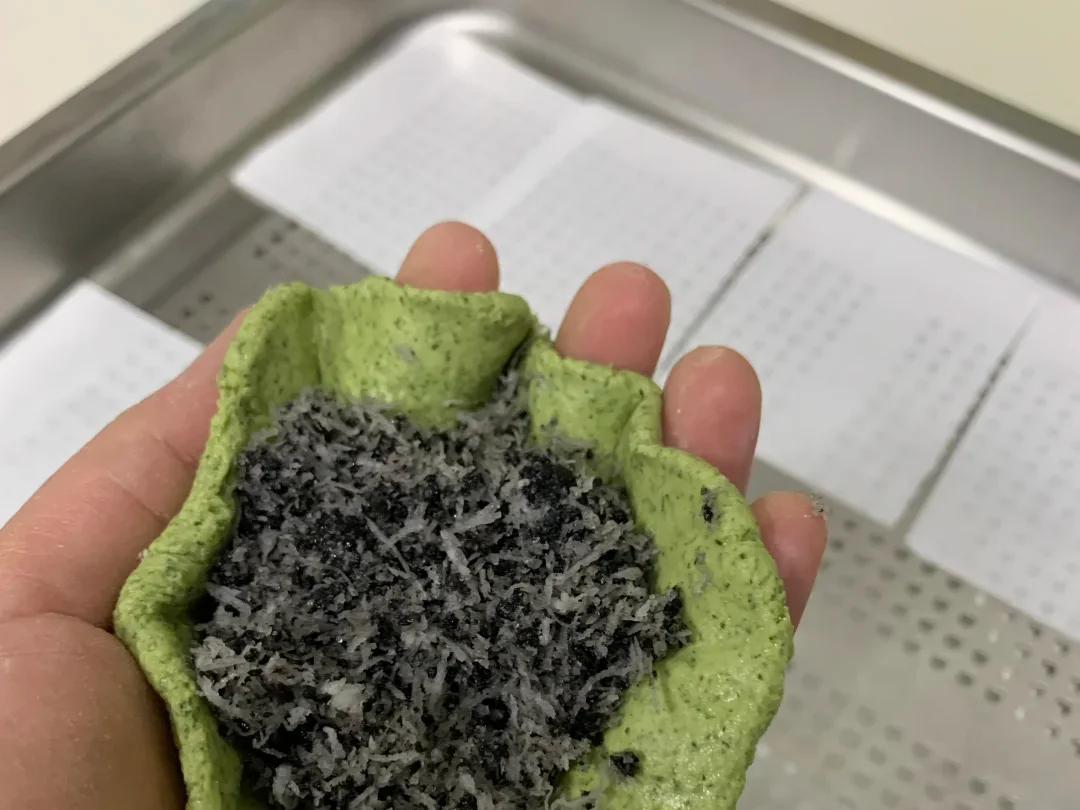
The filling, green dough and flour-dusted hand catch qingtuan at its most revealing moment: before the finished snack becomes a polished seasonal symbol.
Qingming does not wait for a family to reach a memorial site. In parts of Jiangnan, spring has already entered the kitchen through qingtuan: green, soft rice cakes made with plant color and wrapped around sweet or savory fillings. The photograph shows one sesame-and-coconut version being closed by hand. It is not a national Qingming recipe. Its value is more immediate: seasonal culture is being made, squeezed and slightly misshapen by an ordinary hand.
I prefer this unfinished qingtuan to a perfect gift box. The open edge exposes the work. Someone prepared the greens, mixed the dough, portioned the filling and accepted that the first few pieces would not look identical. That is exactly how Qingming survives—through tasks repeated by people, not symbols floating above them. Our separate qingtuan guide explains the ingredients and regional variations; here the food matters because it places renewal beside remembrance before the family even leaves home.
“Tomb sweeping” sounds almost ceremonial in English. In practice, it can be ordinary maintenance: cutting grass, removing leaves, clearing drainage, brushing soil from an inscription and making the place reachable again. Singapore's National Heritage Board describes grave cleaning and offerings among Qing Ming practices, while also recording how observance changes across families and religious traditions.
That labor is the first argument of Qingming. Memory does not maintain itself. A grave left to weather is not evidence that descendants stopped loving someone, and a perfectly cleaned site is not proof of moral virtue. Distance, migration, health and access matter. Yet when a family can return, the work says something words struggle to say: you still occupy space in our lives, so we will care for this place.
Offerings turn memory into a household language
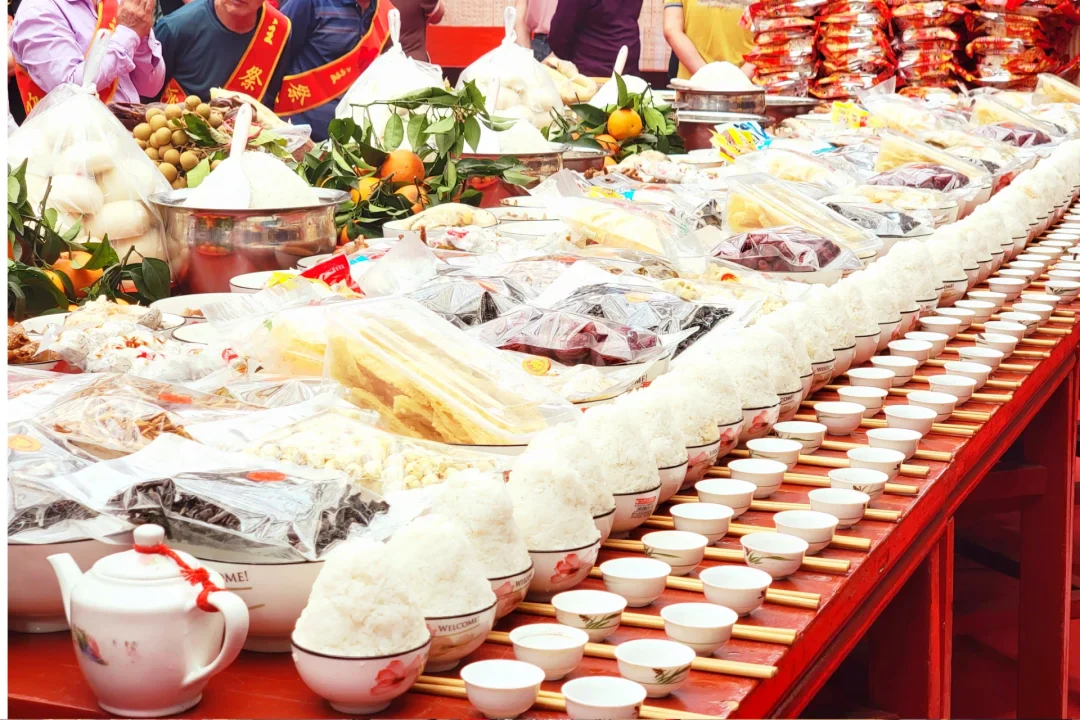
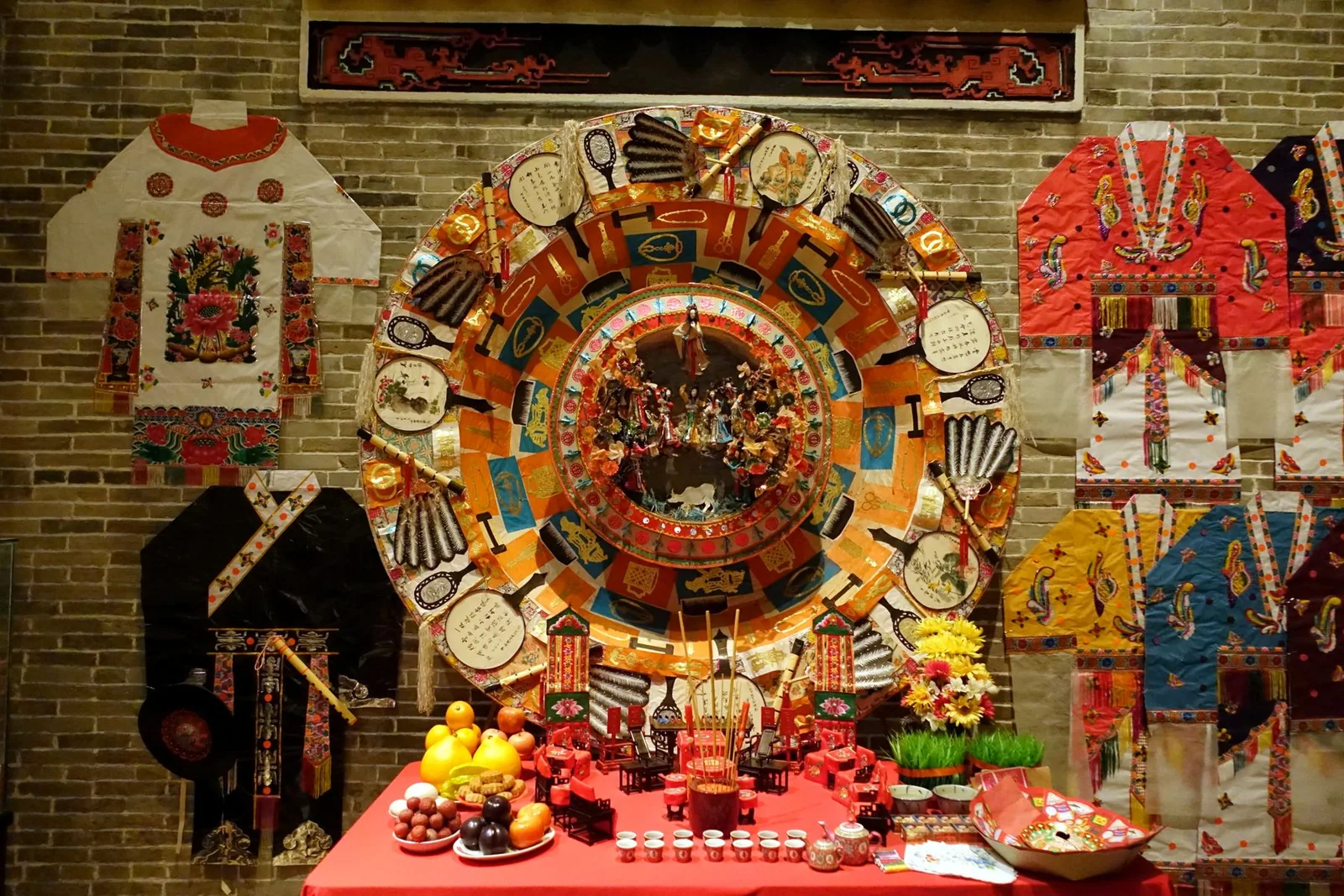
Rows of rice, cups, fruit and cooked food show the scale and order of one hall's offering table. They do not establish a required Qingming menu for other families.
Offerings vary by region, household, belief and the preferences remembered about the deceased. Food, tea, alcohol, fruit, flowers, incense and paper objects may appear in different combinations. Contemporary families may choose chrysanthemums or other flowers; some burn paper offerings where local law and site rules allow it; others do neither.
The useful question is not “What must Chinese people offer?” It is “Why did this family choose these things?” A favorite food can preserve personality better than a generic symbol. A small cup can recall how someone drank. A long row of bowls also reveals organization: remembrance depends on shopping, cooking, transport, washing and people who arrive early. Those jobs are cultural evidence too. They are usually less photographed than the final bow, yet without them no table exists.
Do not photograph a family ritual simply because it looks culturally significant. Cemeteries are not open-air sets. Ask permission, keep distance and never rearrange an offering for a cleaner composition.
The meal after remembrance is part of Qingming too
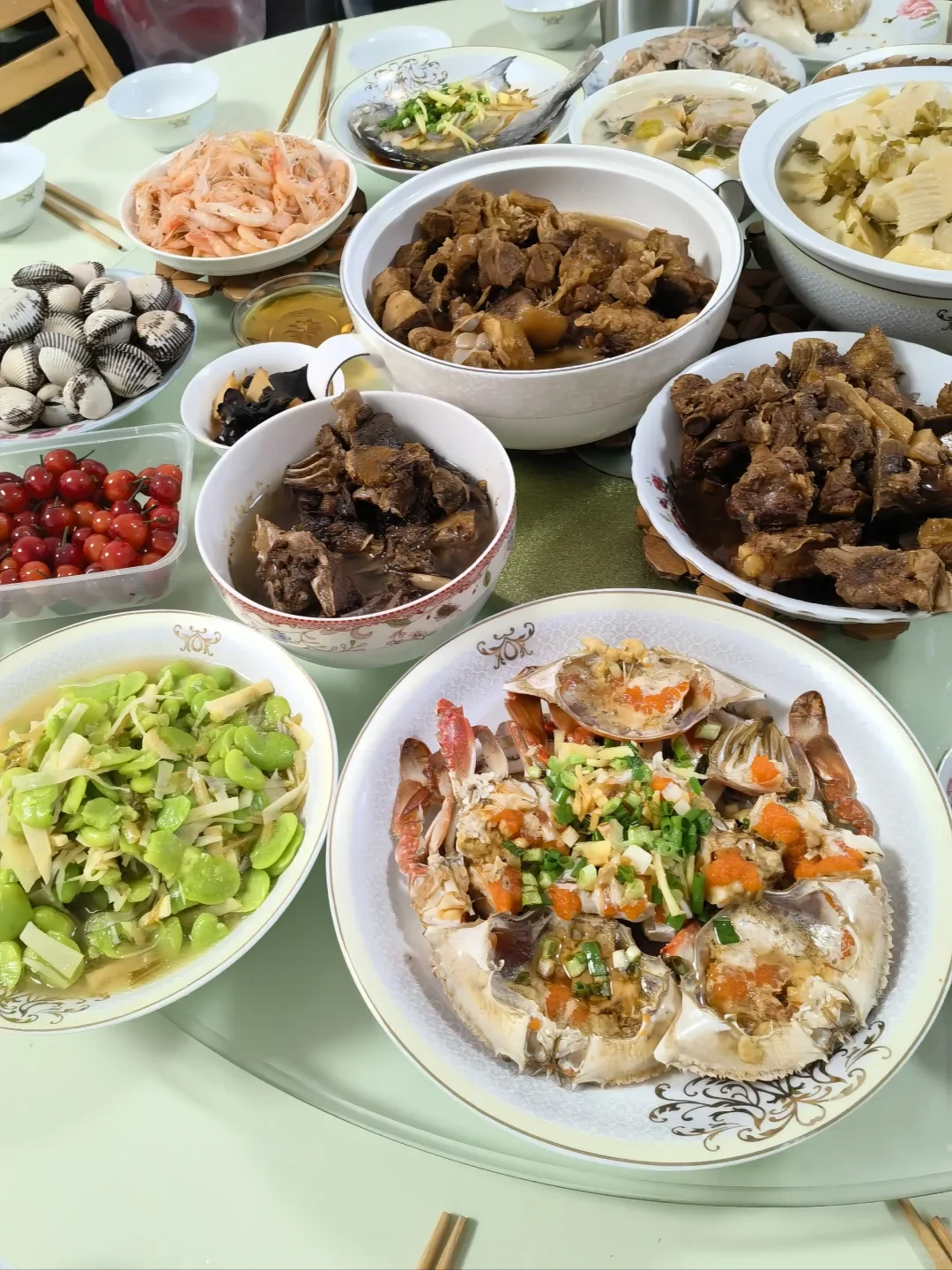
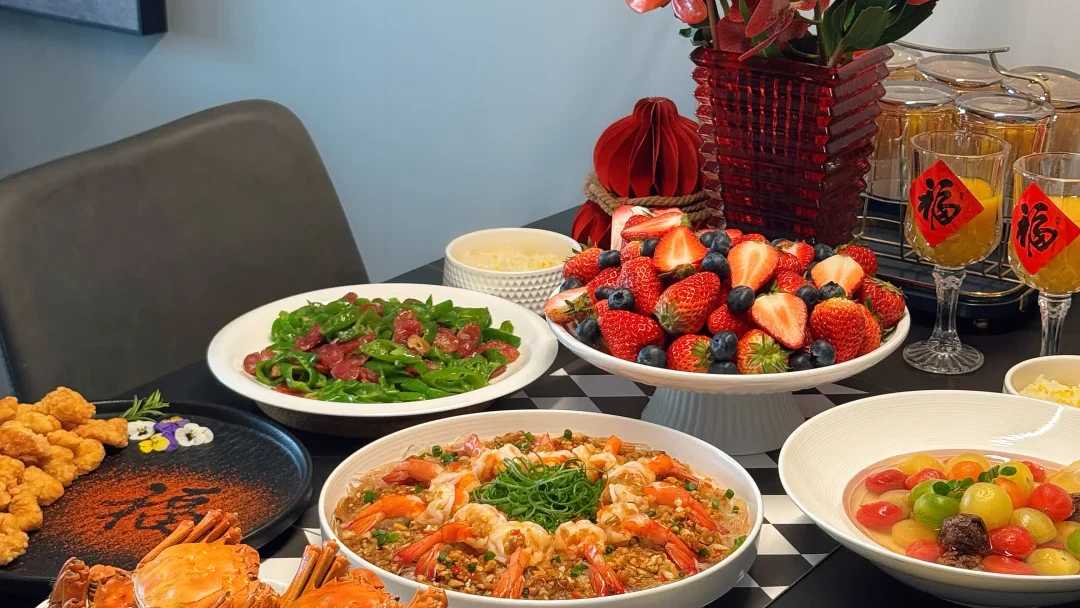
A full family table makes the social return visible. It proves what was served in one household, not a fixed national Qingming menu.
After the grave or hall, people eat. That sentence sounds almost too ordinary to include in a festival guide, which is exactly why it belongs here. The shared meal is where the ritual stops being a sequence of correct gestures and becomes family life again. Chairs move. A child reaches too early. Someone asks who still wants rice. An old story is corrected across the table.
The meal need not consist of “Qingming foods.” In the photograph, fish, shellfish, meat and vegetables fill the table because this household cooked a generous family meal. Elsewhere the dishes will be completely different. The cultural fact is not a universal recipe; it is that food gives relatives enough time to remain together after the formal act ends.
I think this is where Qingming often does its deepest work. At the grave, people know how to be solemn. At the table, they reveal what the family actually remembers, avoids, laughs about and argues over. A name spoken during ritual may become a person again only when an aunt says, “He always picked that piece first.” The detail is small. The recovery is enormous.
An object must lead back to a person
The phrase “ancestor worship” can make every grave look like evidence of one abstract belief system. That is too blunt. A family may arrive through Buddhist, Daoist, Christian, local, secular or mixed practices. Some participants believe strongly in offerings reaching the dead; others come because respect, kinship and family expectation remain real even when metaphysical certainty does not.
The ordinary object cuts through that abstraction. A thermos, a brand of tea, a work tool, a dish cooked too salty, a faded photograph, a phrase repeated whenever money was tight—these details return scale to a life. They tell a child that the person under discussion was not born as “an ancestor.” They once had preferences, irritation, humor, work and a body that occupied rooms.
This is where I become impatient with beautiful but anonymous remembrance. Generic solemnity is easy to stage. Particularity is harder and more respectful. If no one can explain whose favorite food was placed down, the offering may still have ritual meaning, but it has lost an opportunity to transmit a person. Qingming should not merely demonstrate that a family remembers. It should help the next generation know whom they remember.
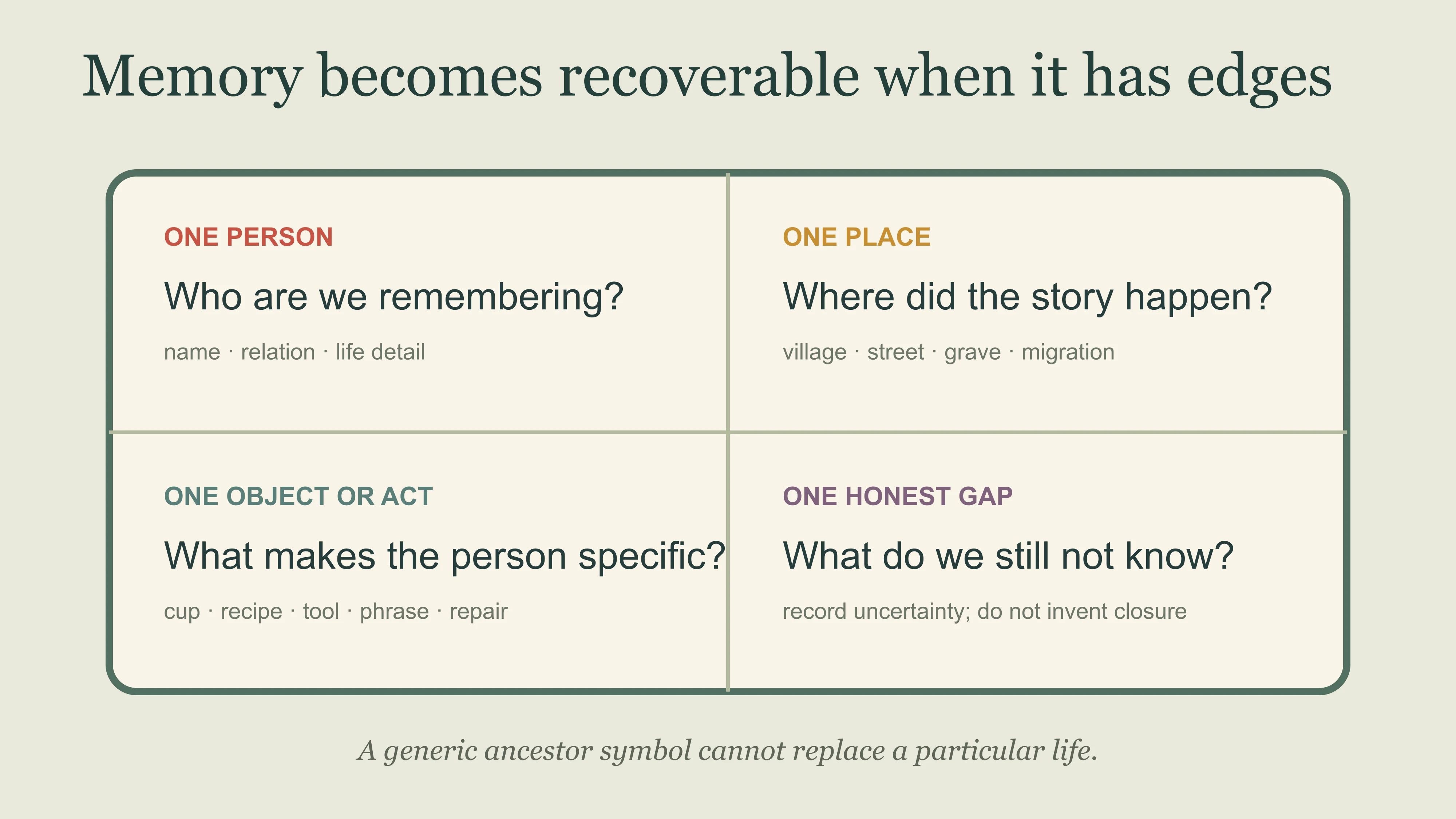
A memory becomes recoverable through edges: one name, one place, one ordinary detail and one uncertainty that nobody pretends to solve. East Moment original editorial diagram.
The most important act may be speaking
Cleaning and offerings create a reason to gather, but conversation transmits the relationship. Who was buried here? What work did they do? Which habit still appears in the family? Why did they leave one town for another? Children often inherit fragments rather than a complete biography. Qingming gives adults a recurring deadline to tell one more piece.
For families separated from an ancestral grave, remembrance can move to another site: a local cemetery, a home altar, photographs, food or a call between relatives. That is not a diluted substitute. Ritual has always had to survive war, migration, redevelopment and new religious commitments. The form can change while the task remains recognizable: locate the dead inside the living family's story.
Distance changes the archive, not the duty to be accurate
Migration can make a grave unreachable and a family story dangerously smooth. One relative remembers a village name; another remembers a county that has since changed administrative boundaries; a third insists a photograph was taken before a move, while the clothes suggest otherwise. The temptation is to force the fragments into one confident narrative. Resist it.
An honest family archive can hold several kinds of certainty:
- Confirmed: a full name on a grave, certificate, letter, household register or dated photograph.
- Remembered: a relative's account, attached to the speaker and the time it was recorded.
- Inferred: a connection supported by context but not yet proven.
- Unknown: a gap that remains visible so somebody can investigate later.
This does not make memory cold or bureaucratic. It protects it from becoming fiction. Record the original characters in a name. Keep former and current place names together. Photograph the back of a family photograph when handwriting survives there. Ask whether two relatives independently remember the same event before turning it into settled history.
I believe Qingming needs this discipline because love encourages certainty. We want the family story to close neatly; grief wants missing pieces returned. But invented closure makes a future researcher less able to find the truth. “We do not know yet” is not disrespect. It is a door left open.
What children inherit is the method of remembering
A child may not understand incense, genealogy or why adults have become quiet. They can still learn the sequence: clear carefully, place rather than throw, ask a name, listen to one story, return the site without leaving damage. The method reaches them before the theology does.
Do not turn that teaching into an obedience test. A young person who asks why a practice matters is not automatically rejecting the family. Explain what this household believes, what earlier generations did and what has changed. Let them distinguish fire-safety rules from ritual preference, family memory from historical proof and personal grief from compulsory performance.
The goal is not to reproduce every action forever. It is to transmit enough care and knowledge that change remains conscious. A tradition revised with understanding is alive. A tradition repeated without anyone knowing whom it serves is already becoming scenery.
This is also why Qingming should not be collapsed into the Hungry Ghost Festival. Qingming commonly centers family visits and grave care. The seventh-month festival can extend attention to wandering or unclaimed spirits and creates a different public atmosphere.
Spring is not disrespectful to grief
After the grave comes the hillside, new grass, damp air and the journey home. Spring outings have long belonged beside remembrance. The combination can feel strange only if grief is imagined as a room that must remain dark.
Qingming makes a firmer claim: the dead are remembered in a world that continues to grow. Families may picnic, walk or eat seasonal foods without betraying the people they visited. In parts of Jiangnan, green qingtuan are strongly associated with spring, but no single food defines the national festival. Our separate qingtuan guide owns the ingredient and buying questions.
How to observe without performing somebody else's ritual
If Qingming is not your family practice, you do not need to copy offerings from a checklist. Learn whose grave or memorial you are visiting, follow the family's lead and help with practical work. If you are visiting a public cemetery, obey rules on fire, incense, litter and photography.
If distance makes a visit impossible, ask one precise question of an older relative. “What was she like when she was angry?” may recover more human truth than “Tell me our family history.” Record names, places and the uncertainty around them. Memory becomes more trustworthy when people are allowed to say, “I do not know.”
Make the answer usable. Write the person's Chinese name as well as a romanized form. Add the town or neighborhood. Name the object that triggered the memory. Record who told you and when. One precise field card is worth more than a page of generic praise because another relative can correct, extend or verify it.
Do not crop disagreement out of the record. If two siblings remember the same kitchen, migration or funeral differently, keep both accounts beside the evidence each person cites. The contradiction may reveal age, distance or an old family silence. Qingming memory becomes trustworthy when the archive preserves friction instead of polishing every relative into the same voice.
The Chinese festivals guide places Qingming inside the full annual calendar. The Double Ninth Festival guide follows a different autumn connection between height, ancestry and age.
Qingming is relationship maintenance
Qingming is not primarily a gloomy Chinese “day of the dead.” It is a day when love, duty, disagreement and memory become visible through maintenance. The family does not defeat death by cleaning a grave. It refuses to let death make a person socially weightless.
What small act carries your family memory: cleaning, cooking, telling a story, keeping a photograph or visiting a place? Share the exact object and the person attached to it in the comments. In East Moment's community, those details can become a living archive rather than another list of festival symbols.