Qingtuan should not taste like a green sweet with a festival story attached. Its skin should carry a faint spring-herb aroma, its chew should yield before it becomes tiring, and its filling should sharpen that green note rather than bury it. The color catches the eye; the plant is the soul.
Qingtuan turns fresh spring plants into a chewy Qingming rice ball
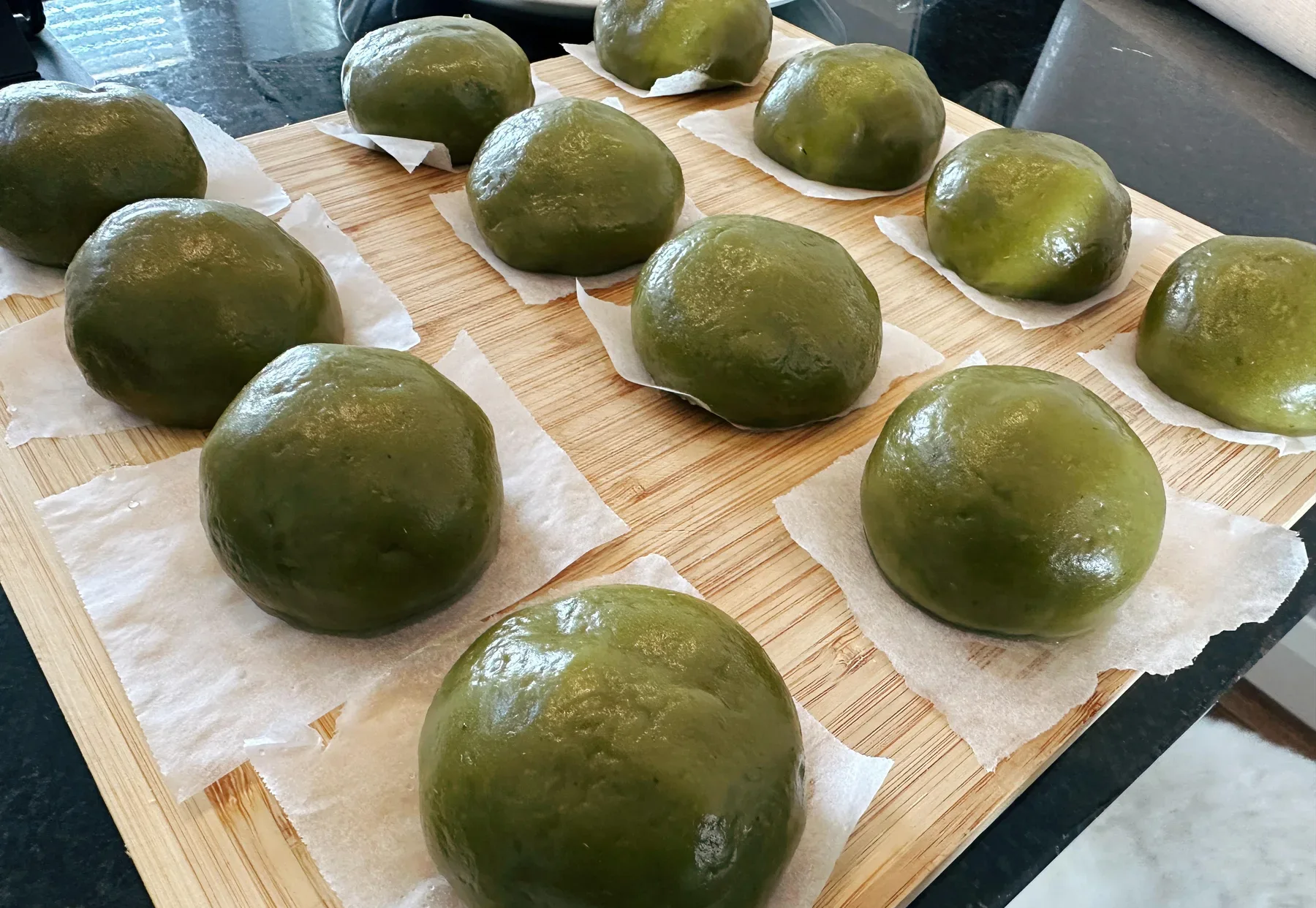
Qingtuan (青团, qīng tuán) are green rice-flour cakes strongly associated with the Qingming Festival in Jiangnan and other parts of southern China. A dough made from glutinous rice, often adjusted with non-glutinous rice flour or wheat starch, is colored and scented with seasonal plants such as mugwort, Jersey cudweed or young wheat juice. It is wrapped around sweet or savory filling and steamed.
English descriptions often call qingtuan “green rice balls” or compare them with mochi. That gets the shape and chew roughly into view, but misses the reason I care about them. Mochi tells you a texture family. Qingtuan asks a seasonal question: can a plant gathered in early spring remain present after grinding, kneading, filling and steaming?
The Shanghai Municipal Government's 2026 English guide describes modern qingtuan as soft, chewy and lightly herb-scented, with classic red bean and newer savory fillings. That is a reliable definition. My stricter judgment is this: if the skin contributes only color and sugar, the most distinctive part of qingtuan has already been lost.
| Quick question | Useful answer |
|---|---|
| How do you say qingtuan? | Roughly ching-twan; 青 means green/blue-green, 团 means a round mass or ball. |
| What does it taste like? | Mildly grassy or herbal, gently sweet or neutral in the skin, chewy outside and defined by the filling inside. |
| Is it always sweet? | No. Red bean and sesame are common sweet fillings; spring bamboo shoots, preserved greens, pork and salted egg yolk–pork floss are among savory possibilities. |
| Is it a national Qingming requirement? | No. It is especially associated with Jiangnan and southern regional foodways, not every Chinese household. |
| Is it gluten-free? | Do not assume so. Some recipes use wheat starch, and fillings or production environments vary. Read the actual label. |
The green must carry aroma, not just prove that it is green

The Chinese word qing makes color sound like the main event. In practice, “the green” is an ingredient decision.
Households and regions do not rely on one universal plant. Mugwort can bring a recognizable bitter-herbal perfume. Jersey cudweed—often called shuqicao, mianqing or by local names—can change both aroma and softness. Young wheat or barley grass juice is common in some commercial and Jiangnan traditions. Other edible leaves appear in regional relatives.
This variation is not a flaw to be corrected. It is the map inside the food. A dark, flecked skin may tell a different plant story from a smooth jade-green shop version.
What I distrust is color without consequence. An unnaturally brilliant qingtuan may photograph beautifully while tasting like an ordinary sweet glutinous-rice wrapper. Natural qingtuan also change color during steaming and storage. Brightness alone cannot prove freshness, plant quantity or quality.
The more useful test is sensory:
- Smell the torn skin before the filling dominates it.
- Look for fine plant fibers if the maker says whole herb was used.
- Notice whether bitterness remains as a clean edge or becomes harsh.
- Ask whether the aroma survives the second bite.
I want the green to do more than win the photograph. It should make the white rice flour remember where spring came from.
The real beginning is a basket of uneven leaves

The most revealing qingtuan image is not always the finished sphere. It is the untidy harvest: different greens, roots, damp stems and spring bamboo shoots sharing a concrete floor.
That image corrects the luxury-box version of the food. Before qingtuan becomes polished seasonal merchandise, somebody has to identify edible plants, pick tender growth, wash away grit, sort damaged leaves and decide how much bitterness to keep. For many households, that labor is part of why the food matters. The season arrives as work before it becomes nostalgia.
I do not turn one family's gathering routine into a national tradition, and I would never advise an unfamiliar reader to forage from a photograph. Similar-looking plants can be unsafe; roadside or sprayed vegetation creates additional risk. Use correctly identified food-grade herbs from a reliable source.
But I keep the image in the argument because it reveals a truth the wrapper hides: qingtuan compresses a landscape of decisions into one smooth ball.
Blanching fixes one problem and creates another

Fresh greens are commonly cleaned, blanched, cooled, squeezed and chopped or blended before entering the flour. Some cooks use a small amount of alkali or baking soda to help preserve color and soften bitterness. The exact process depends on the plant and recipe.
The visual transformation is dramatic: loose leaves become dense green portions ready to grind. The flavor transformation is harder. Too little treatment can leave coarse fibers and aggressive bitterness. Too much can produce a beautiful green with the personality boiled out of it.
This is where I disagree with the idea that “more emerald” automatically means “better qingtuan.” Color is an engineering problem; flavor is a balance problem. The best skin does not shout vegetable. It leaves a clean, fleeting herb note between the rice and the filling.
Texture requires another balance. Pure glutinous rice flour can become very sticky and stretchy. Adding rice flour or wheat starch can improve structure and reduce clinging, but every ratio changes softness after cooling. There is no honest universal recipe detached from the plant puree's moisture, flour brand, filling and intended serving time.
Sweet and savory qingtuan are different arguments about spring

One plate can contain a dark, rich filling, a pale crumbly filling and a savory mixture of chopped vegetables and tofu or meat. The cut surface is more informative than a perfect green exterior because it shows the ratio that controls the bite.
Red bean and traditional sweet fillings
Red bean paste remains a classic because its earthy sweetness does not automatically crush the herb aroma. Sesame, peanut and related pastes create a deeper roasted center. Handmade bean filling may retain a little texture; highly refined paste can become smooth and rich. Neither is universally superior, but an oily or excessively sweet center can make the green skin feel cosmetic.
Spring bamboo shoots and preserved greens
Savory qingtuan can make seasonality more literal. Bamboo shoots bring crispness and fresh vegetal sweetness; preserved mustard greens or pickled vegetables add salt and acidity; diced pork, tofu, dried tofu or shrimp can deepen the filling in local combinations.
This is the qingtuan I find most intellectually complete: spring plant outside, spring shoot inside, preservation beside freshness. The wrapper and center speak to each other rather than acting like packaging and product.
Salted egg yolk and pork floss
Salted egg yolk–pork floss became a widely recognized modern filling because fat, salt and loose fibers cut through the sticky skin. It can be genuinely delicious. It can also dominate so completely that any green wrapper would do.
I do not reject novelty in order to protect a museum object. Qingtuan has always varied. My rule is more demanding: a new filling should create a better relationship with the skin, not merely borrow qingtuan's seasonal attention.
Qingtuan is related to Qingming, but the history needs restraint
It is tempting to write a straight line from an ancient Cold Food Festival rice dish to the qingtuan in a Shanghai bakery. The evidence is less tidy.
Cold-food customs, herb-colored rice foods and Qingming ancestor offerings developed and merged over long periods. The Shanghai government guide distinguishes early herb-stained foods from the modern filled rice ball and places clearer documentation of the present form in the Ming and Qing periods. A 2026 cultural history account cites the Qing-dynasty Qing Jia Lu, which records green dumplings sold as offerings for Qingming.
That is enough history. We do not need a heroic invention legend.
The deeper continuity is practical. Qingming joins remembrance and spring growth. Qingtuan can serve as an offering, a food carried outdoors, a gift between households and a seasonal pleasure after grave tending. It holds mourning and appetite without asking one to cancel the other.
Our Qingming Festival guide owns the date, grave care and family-remembrance questions. This page owns the food: plant, skin, filling, texture and choice.
Qingtuan is not simply green mochi, tangyuan or zongzi
These foods share rice and chew, but their structures solve different problems.
| Food | Defining structure | What matters most |
|---|---|---|
| Qingtuan | Herb-colored rice-flour skin wrapped around filling and steamed | Plant aroma, skin-to-filling balance, spring seasonality |
| Tangyuan | Rice-flour ball, usually boiled and often served in liquid | Wrapped or rolled formation, filling temperature, soup or finish |
| Zongzi | Glutinous rice enclosed in leaves and cooked as a packet | Leaf container, rice seasoning, filling, fold and closure |
| Mochi | Broad Japanese rice-cake family with multiple production methods and forms | Rice processing, elasticity and the specific regional preparation |
Calling qingtuan “Chinese mochi” may help a first-time eater anticipate chew. It should remain a bridge, not the definition. Qingtuan's green plant is not merely flavoring added to a generic global rice cake. It is the reason the food belongs to this moment of the year.
How to choose a qingtuan worth eating

Start with the skin, not the novelty label.
- Read the plant. Does the maker name mugwort, Jersey cudweed, wheat grass or only “green qingtuan”? A named ingredient gives you a real expectation.
- Read the flour and allergens. Glutinous rice does not contain gluten by definition, but wheat starch, soy, sesame, peanut, egg, dairy and meat may appear.
- Inspect the ratio. A paper-thin skin around a massive filling may photograph well but leaves no room for the herb to speak.
- Choose one classic and one local savory version. Red bean establishes the sweet baseline; a bamboo-shoot or preserved-green filling reveals the regional meal inside the snack.
- Buy fewer, fresher pieces. Qingtuan loses softness and aroma as it sits. A giant gift box often creates a storage problem disguised as generosity.
The bite above shows what marketing copy cannot: skin thickness, filling grain and the way both compress under teeth. That physical evidence is why East Moment uses real food photographs rather than treating green color as proof of flavor.
How to store and reheat qingtuan without ruining the skin
Fresh qingtuan are best eaten promptly according to the maker's instructions. The Chongqing market regulator's guidance advises refrigerating pieces that cannot be eaten the same day, following packaged shelf-life directions and reheating refrigerated qingtuan by steaming or microwave before eating. Discard pieces with sour, alcoholic or moldy odors or visible mold.
For texture, use gentle heat:
- Steam until the center is warm and the skin yields again.
- In a microwave, cover to retain moisture and heat in short intervals.
- Do not assume the exterior temperature matches a dense filling.
- Let a very hot salted-yolk, sesame or bean center cool before a full bite.
Qingtuan are dense, sticky foods. Eat slowly and cut smaller portions for anyone who has difficulty chewing or swallowing. This is ordinary food judgment, not a reason to turn a cultural guide into a medical warning sheet.
My verdict: the best qingtuan cannot be separated from its green
I do not measure qingtuan by how many surprising fillings a brand can fit into one spring campaign. I remember the ones whose skin interrupts the filling with a faint, clean herb aroma—the moment when sweetness pauses and the season becomes visible on the tongue.
That is East Moment's compass for this food. The green should carry origin, labor and taste. The filling should answer it. The chew should make me slow down without becoming a contest. A qingtuan that achieves those three things deserves its short season.
Continue through Chinese festival foods or the broader Chinese food guide. Then tell us in the East Moment community: what should qingtuan protect first—its spring-herb aroma, a family filling, or the freedom to keep changing?