Tangyuan is not one white ball in sweet soup. It is a family of glutinous-rice foods whose eating experience changes with formation method, wrapper thickness, filling, size and serving medium. The most useful distinction is practical: tangyuan are generally wrapped from a piece of dough, while yuanxiao are traditionally built by rolling a filling through moistened rice flour. Everyday names can overlap, so technique is a clue rather than a reason to correct the cook.
This definition solves more than a symbolic one. If you are ordering, buying frozen rice balls or cooking them for the first time, roundness tells you very little. The structure tells you whether the exterior will be smooth or powdery, whether the center may run when hot and whether the dish belongs in a clear soup, fermented-rice broth, dry coating or savory stir-fry.
What is tangyuan?
Tangyuan (汤圆 / 湯圓) are soft glutinous-rice dough balls served in many sweet and savory forms. They may be filled or unfilled. Familiar fillings include black sesame, peanut, red bean and other sweet pastes, but meat and other savory fillings also exist. Their strongest festival association is the Lantern Festival, when roundness is easily connected with reunion and completeness.
The word glutinous describes the sticky texture of the rice, not the presence of gluten. That distinction matters for vocabulary, but packaged products still need their own ingredient and allergen labels: fillings, flavorings and processing environments vary.
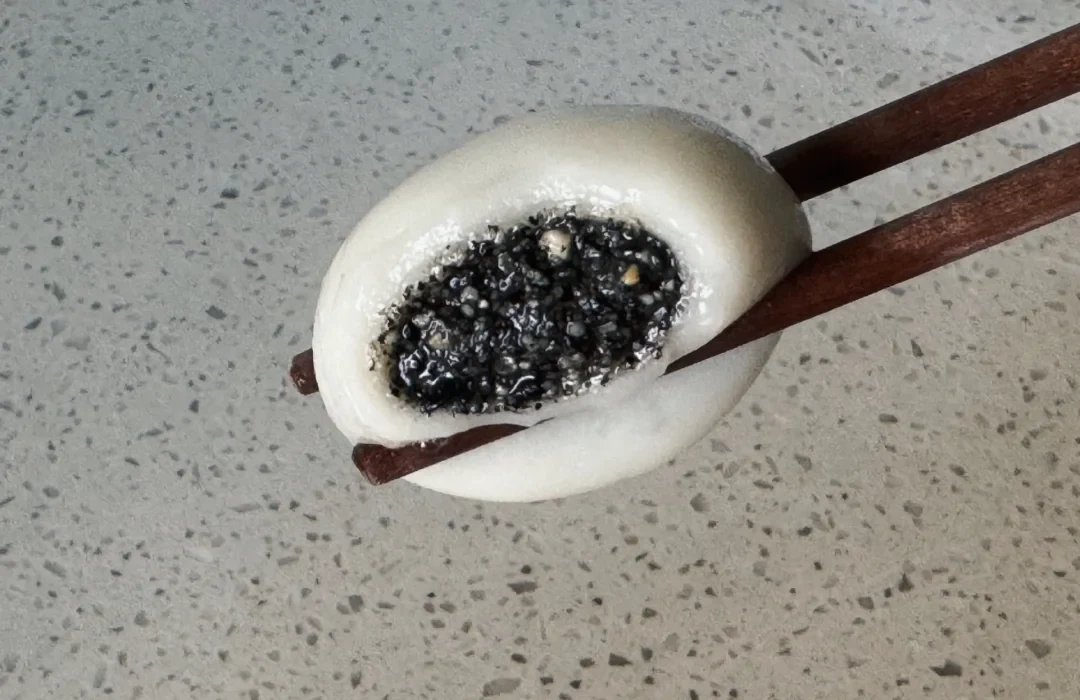
This authorized first-hand cross-section proves that one homemade black-sesame tangyuan can hold a visibly grainy filling inside a continuous wrapped skin. It cannot establish the recipe, sweetness or texture of every tangyuan.
This is the evidence I want from a tangyuan page: not another untouched white sphere, but the wrapper and center exposed in the same frame. The filling here is visibly textured rather than a perfectly smooth black syrup. That one cut already tells us more than festival packaging ever will.
Tangyuan vs yuanxiao: the production difference
The clearest comparison begins before cooking.
| Feature | Tangyuan, commonly | Yuanxiao, traditionally |
|---|---|---|
| Formation | Flatten a piece of hydrated dough, enclose filling and roll smooth | Cut or form the filling, dampen it and roll it repeatedly through dry rice flour |
| Surface before cooking | Smoother and more continuous | Drier, powderier and often less perfectly smooth |
| Wrapper structure | A deliberately wrapped skin | Layers build around the center during rolling |
| Common English shorthand | “Wrapped rice ball” | “Rolled rice ball” |
This distinction is useful because it predicts texture. A wrapped skin can be adjusted for thickness and sealed around a soft filling. A rolled coating builds differently and can produce a looser exterior in cooking liquid. The Beijing municipal explainer on tangyuan and yuanxiao documents this wrapped-versus-rolled production difference. It supports the technique distinction; it does not turn everyday regional naming into a national policing rule.
It is not a linguistic border checkpoint. Regional speech, family habit, restaurant menus and frozen-food branding often use the names more loosely. A dish called yuanxiao may not reveal its factory process; a family may call every festival rice ball tangyuan. The right response is to ask how it is made, not declare the name invalid.
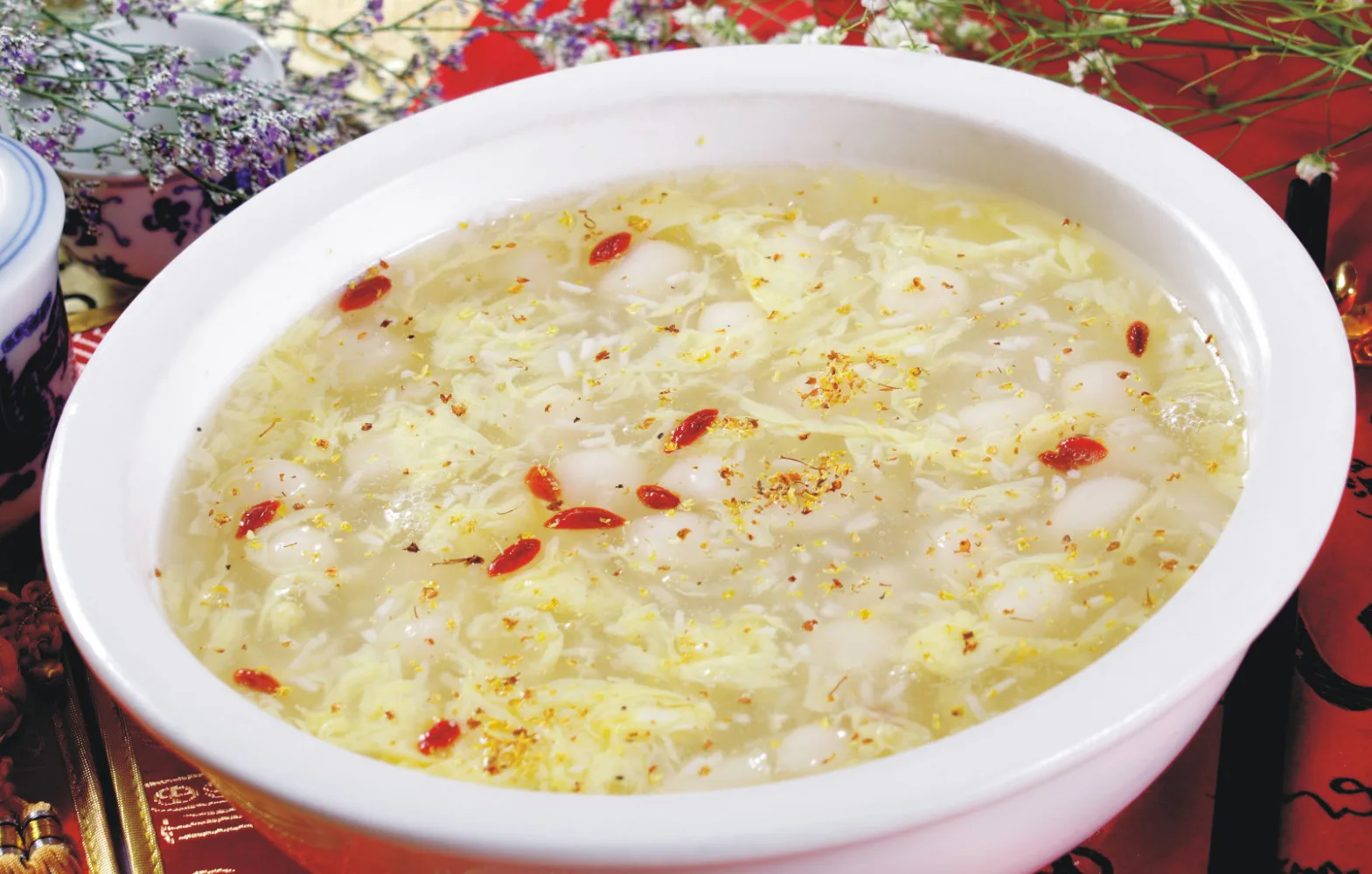
The opening archive image is identified as osmanthus jiuniang yuanxiao. It supports the shared-bowl serving context and visible fermented-rice texture, not the unseen formation method.
Read tangyuan through five decisions
1. Wrapper
The wrapper should be soft and cohesive without becoming a flavorless rubber shell. Thickness matters more than perfect whiteness. A thin wrapper emphasizes the filling but is easier to split; a thicker one gives more chew and protects a loose center. Waxy-rice starch and water create that characteristic cohesive structure. The material science still cannot tell us whether one maker hydrated, sealed or cooked the dough well.
Colored wrappers may come from plant ingredients, flavoring or coloring. Color alone does not establish flavor, quality or tradition.
2. Filling
A filling changes both taste and risk at the first bite. Black sesame and peanut pastes can become fluid when heated because sugar and fat loosen. Let a freshly cooked tangyuan cool briefly before biting. Savory meat fillings need to be cooked through according to the maker's method; do not assume floating alone proves the center is ready.
I reject the idea that a dramatic liquid center is automatically superior. A slightly grainy black-sesame filling can carry more roasted aroma and texture than a glossy stream of sugar and fat. The cut surface matters because it reveals what the perfect white exterior conceals.
When buying, read the filling name before the festival packaging. “Sesame flavor” and a high proportion of sesame are not the same promise. The ingredient list gives a better answer than the front image.
Sweet does not mean vegetarian. Zhejiang's Ningbo tangyuan-making skill standard explicitly includes toasted sesame and the preparation of a pork-fat filling. That is not a rule for every Ningbo maker, every frozen brand or every black-sesame ball. It is a reason to ask before buying one for a vegetarian, a person who avoids pork or someone who needs to know exactly which fats were used. A glossy black center cannot tell you whether its richness came from pork fat, another oil or both. Read the package's ingredient list, or ask a shop about its particular filling; neither a regional name nor a photograph is a substitute.
3. Size
Small unfilled balls distribute through a soup and are easy to eat by the spoonful. Large filled tangyuan make the center the event. A bowl of six large rich pieces and a bowl of twenty small unfilled pieces are different dishes even when both are called tangyuan.
Size also changes cooking. Large frozen pieces need gentler, longer heating so the wrapper does not overcook before the center warms.
4. Cooking or serving medium
Soup is common, not compulsory. A clear liquid keeps attention on the wrapper and filling. Jiuniang, a fermented-rice preparation, adds sweetness, grain texture and aroma. Dry coatings make the exterior itself important. Stir-frying turns the rice ball into one component of a savory dish.
5. Finish and temperature
Some tangyuan are best immediately after boiling, when the wrapper is tender and the filling fluid. Others are cooled, coated or finished in a pan. Ask whether the dish is meant to be sipped, bitten, shared or eaten as part of a larger plate. “Authenticity” is less helpful than knowing the intended texture.
Four real dishes show how wide the category is
The archive comparison below does not claim four official national types. It demonstrates why a visual definition based on white soup balls fails.
Clear or flavored soup service
The citrus-colored soup around pale balls creates a clean visual separation between wrapper and liquid. The photo does not expose a filling, so no filling should be invented from appearance.
Fermented-rice and osmanthus service
The osmanthus jiuniang yuanxiao appears in a textured, aromatic-looking shared bowl. The grain and garnish make the liquid part of the dish rather than neutral cooking water.
Dry-coated leisha tangyuan

This dish proves that a rice ball may be finished and served dry. The photograph cannot establish the powder ingredients, filling or regional ownership.
Leisha tangyuan makes the strongest visual correction to the “always in soup” assumption. Its coating changes how the fingers, teeth and tongue encounter the surface. Whether this particular version contains a filling is not visible and should not be guessed.
Savory stir-fried tangyuan

The authorized archive name identifies preserved-greens stir-fried tangyuan. It documents one dish, not a nationwide everyday default.
Stir-frying changes the category again. The balls sit among savory ingredients, and the exterior may pick up oil, browning and seasoning. This is not a novelty that needs to be defended against sweet tangyuan. Sweet and savory preparations solve different appetites.
How to cook frozen tangyuan without splitting them
The package instructions take priority because size, filling and wrapper formulation differ. The following framework explains the control points.
- Use enough water for the pieces to move without crowding.
- Bring the water to a boil, then moderate the heat before adding fragile frozen pieces.
- Add them without thawing unless the package specifically says otherwise.
- Stir gently near the bottom during the first minute so wrappers do not stick and tear.
- Once they rise, keep the water at a controlled simmer and follow the stated additional time. Floating signals buoyancy, not guaranteed doneness in every size.
- Remove with a slotted spoon rather than pouring a heavy pot through a colander.
- Rest filled pieces briefly before eating; a fluid sesame or peanut center can be much hotter than the surface.
Violent boiling is the common enemy. It throws soft wrappers against one another and can open weak seals. Overcrowding creates the same problem while making temperature recovery less predictable.
For homemade tangyuan, the seal matters more than making every sphere mathematically perfect. Keep filling away from the edge, close the dough completely and smooth cracks with slightly damp fingers. If the filling is very soft, chilling it into portionable centers can make wrapping easier.
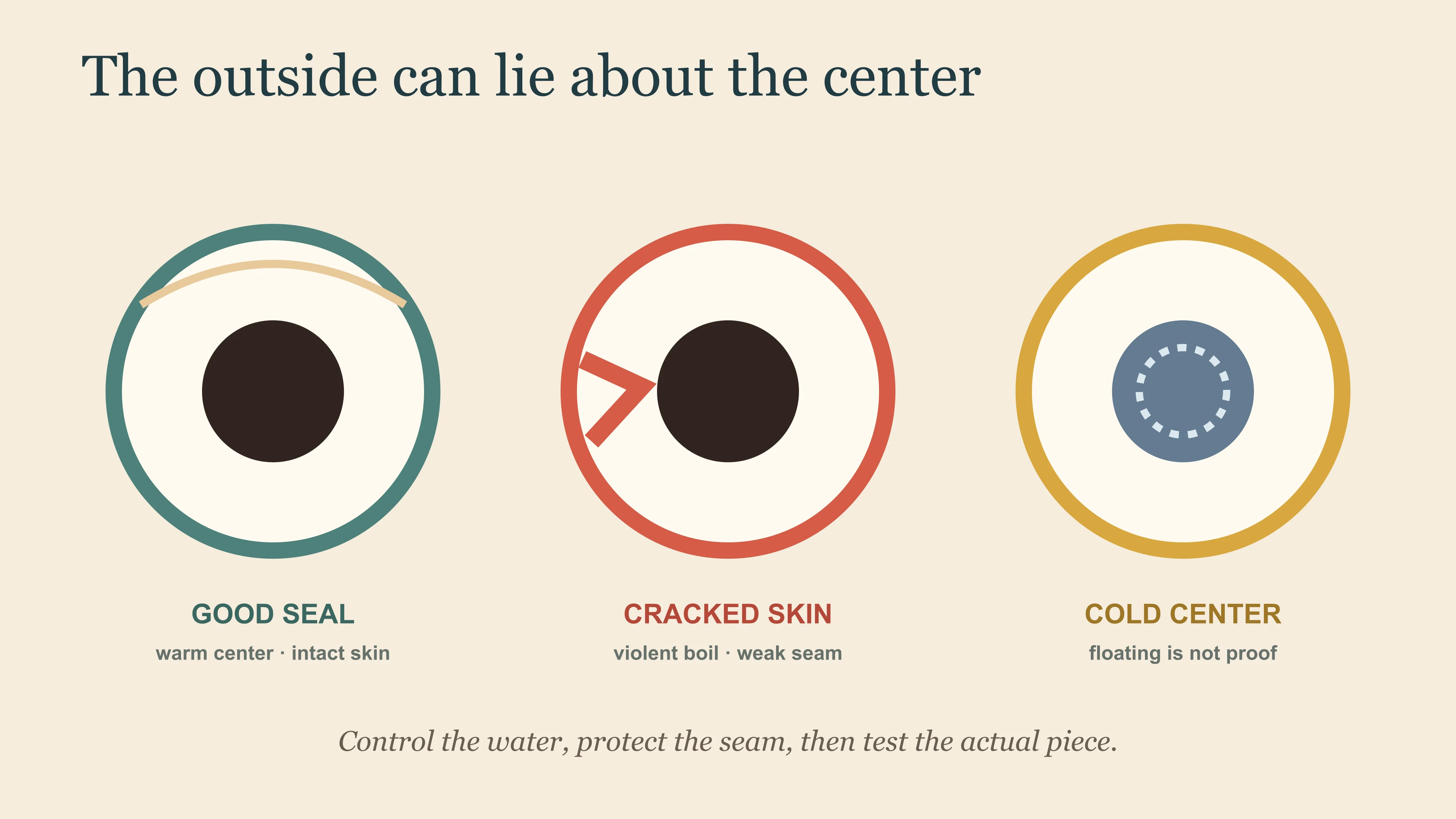
A smooth white exterior can hide three different outcomes. Control the water, protect the seam and judge the actual center—not the moment the ball floats. East Moment original editorial diagram.
Diagnose the failure before blaming the recipe
When tangyuan split, people often blame the wrapper formula first. The cause may have happened elsewhere. A crack visible before cooking points toward dry dough or a weak seal. A skin that tears after violent movement points toward heat and crowding. A soft exterior with a cold center points toward size, frozen state and insufficient time after floating. Greasy filling leaking into the water may begin with overfilling rather than “bad glutinous rice.”
Use the evidence in the pot:
- Crack before boiling: close the surface and protect unused dough from drying.
- Sticking to the bottom: stir gently during the first minute and use enough water.
- Pieces colliding: reduce crowding and keep the boil controlled.
- Wrapper cooked, center cold: lower the heat and give large frozen pieces more time according to the package.
- Filling escapes through one seam: reduce filling or improve closure rather than thickening every wrapper.
This diagnostic approach matters because “authentic recipe” is useless when the actual failure is mechanical. Tangyuan is a relationship among hydrated dough, filling fat and sugar, temperature, time and movement. Fix the relationship that failed.
I insist on diagnosing the failed bowl before copying a new recipe. Otherwise the cook changes flour, water and filling at once, learns nothing, and may reproduce the same split seam with a different ingredient list.
Which tangyuan should a first-time eater choose?
Choose by the eating experience you already enjoy.
| If you like... | Start with... | Expect... |
|---|---|---|
| Nutty desserts | Black sesame or peanut-filled tangyuan | Soft wrapper and a rich, possibly fluid center |
| Gentle soup desserts | Small unfilled balls in osmanthus or jiuniang soup | More attention on broth and chew |
| Dry mochi-like textures | A coated form such as leisha tangyuan | Powdered or crumbed exterior without soup |
| Sweet-savory combinations | A labeled savory or mixed filling | More variation; read the actual ingredient description |
| Savory rice dishes | Stir-fried tangyuan | Chewy balls integrated with pan seasoning |
Do not begin with the most expensive box. Begin with a clearly labeled filling, a manageable quantity and a serving method you understand.
I love tangyuan most when the bowl has a clear point of view: one wrapper texture, one center worth noticing and a liquid or coating that supports it. A crowded “nine-flavor” gift box usually offers more packaging decisions than eating insight.
Why tangyuan belongs to the Lantern Festival, but not only there
Roundness makes tangyuan an effective food for expressing tuanyuan (团圆 / 團圓), reunion. The sound and form association is culturally durable because the food is divided and eaten by people who have gathered. Symbolism works through the social act, not through geometry alone.
The festival moves on the Gregorian calendar because it follows the lunar calendar. For date conversion, use an official calendar rather than a recycled social graphic: the Hong Kong Observatory's Gregorian–Lunar conversion table is the factual clock. It can establish the date. It cannot tell us whether a northern family rolls yuanxiao, a southern household wraps tangyuan or anyone eats the food at all.
Tangyuan also appear at weddings, winter-solstice observances, family occasions and ordinary meals in different communities. Calling them “Lantern Festival food” is correct as an association and incomplete as a biography.
The Lantern Festival guide explains the next festival date, public lantern events and why the night turns the New Year season outward. The Dongzhi Festival guide explains why the same food can mark a winter-solstice table through a different regional and family route. This food page owns the wrapper, filling and serving decisions.
For the broader family of calendar foods, continue to Chinese festival foods. That collection places tangyuan beside zongzi, mooncakes, qingtuan and other foods whose material structure carries a seasonal social task.
The clear conclusion
Tangyuan is a food family, not a single recipe and not a white symbol floating in sweet water. To understand a bowl, identify how the rice ball was formed, how thick the wrapper is, what the filling contains, how large the piece is and what liquid or finish carries it.
The tangyuan-versus-yuanxiao distinction is valuable when it explains technique and texture. It becomes unhelpful when it is used to police regional speech. Read the maker, observe the structure and choose the eating experience you want. That approach gives you more truth than color, shape or festival packaging ever will.
Compare zongzi when you want to see another festival food whose hidden structure matters more than its silhouette. Then post one honest cross-section in Moments: wrapper thickness, center temperature, serving liquid and the exact point where the bowl succeeded or failed. A white sphere is not a review.