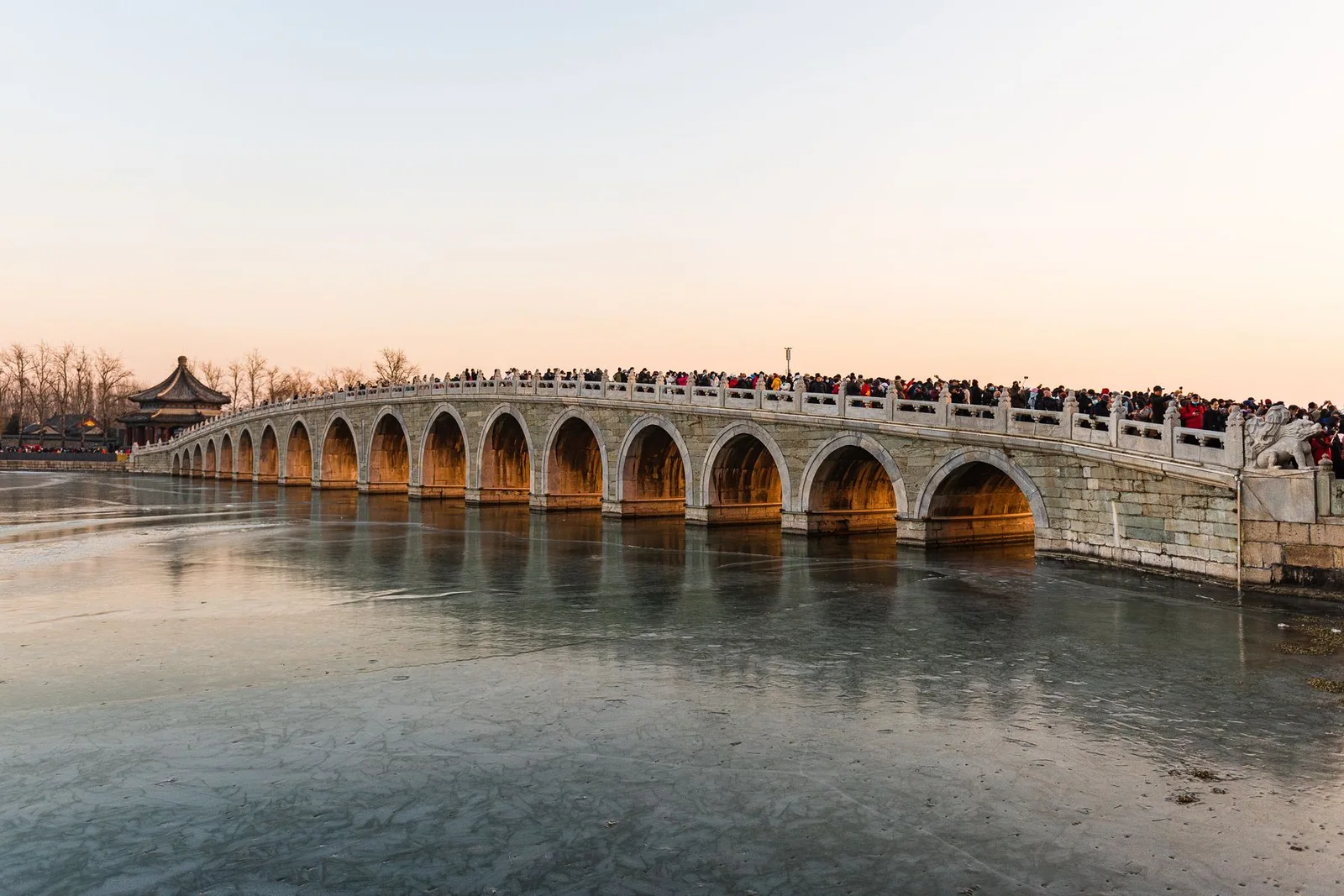
Dongzhi Festival falls on Tuesday, December 22 in 2026. It marks the winter solstice: the longest night and the turning point after which daylight begins to return in the Northern Hemisphere. Chinese families do not agree on one required food, and that disagreement is the point. Dongzhi is where cosmic time becomes local through a warm table.
Ask what people eat at Dongzhi and the answers quickly become geography. Dumplings. Tangyuan. Wontons. Mutton soup. A household dish with no ambition to represent China. Search engines want one winning answer; families keep giving several. I trust the families.
When is Dongzhi Festival in 2026?
Dongzhi is December 22, 2026. The Hong Kong Observatory's official calendar marks the winter solstice on that Tuesday. Britannica's astronomical definition of the winter solstice establishes the seasonal event; it does not explain what a particular Chinese household cooks or believes.
Dongzhi is one of the twenty-four solar terms rather than a festival fixed to a numbered lunar day. Its name means the “arrival” or extreme point of winter. Astronomically, the solstice marks the Northern Hemisphere's shortest period of daylight. Culturally, the important direction is forward: after maximum darkness, light begins to return.
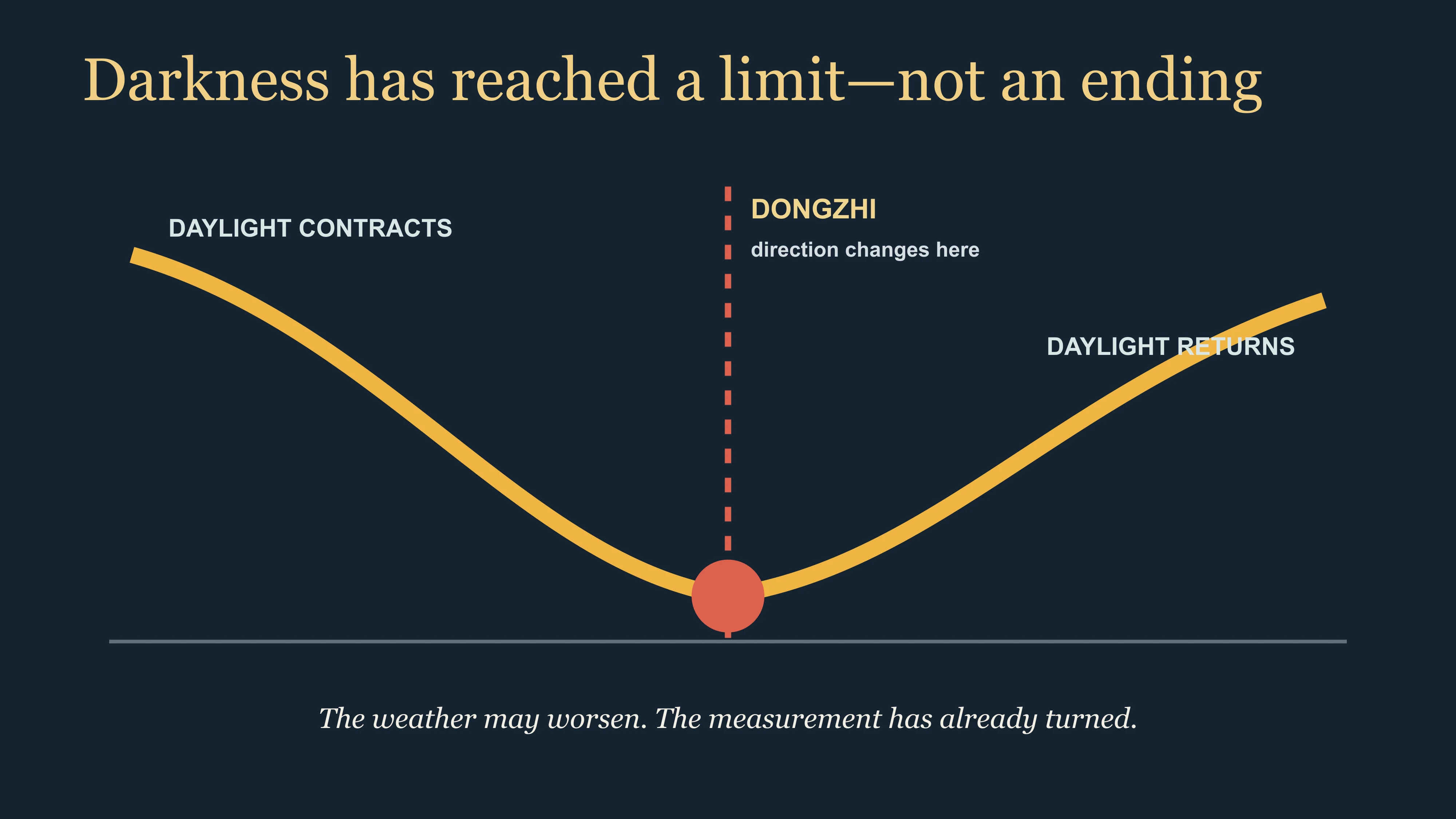
Dongzhi does not promise immediate warmth. It marks the exact point when the direction of daylight changes. East Moment original editorial diagram.
The Chinese character zhi (至) matters here. It is often translated as “arrival,” but the emotional force is a limit reached: winter has come to an extreme point. The next morning can still be bitter. The coldest period may remain ahead. Yet the measurement is no longer moving toward less light. That is a restrained form of hope, and I trust it more than cheerful seasonal slogans.
I reject the postcard version of Dongzhi that reduces the day to one glowing bridge or one “correct” bowl. I insist that the table must keep its regional disagreement, because a festival without family variation is only a graphic. My strongest Dongzhi image is not cosmic at all: somebody notices who has not eaten and moves a warm bowl toward them. The solstice gives the date; care gives the date a reason to survive.
Dongzhi Festival begins with the returning sun
The light through the bridge is visually dramatic because stone makes an astronomical change legible. Yet the solstice is not one orange beam or one Beijing photo opportunity. It is a turning point shared across latitudes and experienced differently by climate, work schedule and local landscape.
That turning point gives Dongzhi emotional restraint. Spring has not arrived. The cold may intensify. Nothing visible changes overnight except the direction of measurement. Hope here is not optimism; it is the knowledge that darkness has reached its limit.
This is why the opening Seventeen-Arch Bridge photograph is useful without needing a mystical construction claim. Low winter sunlight enters repeated arches and makes seasonal angle visible in stone. The bridge is not proof of an ancient Dongzhi instrument. It is a contemporary place where ordinary people can see an astronomical threshold with their own eyes. Culture begins when measurement becomes attention.
The day is cosmic; the response is deliberately small
The solstice is planetary, but a household cannot eat an astronomical event. It translates the sky into scale: a bowl, a call, a visit, a remembered dish. This movement from the immense to the domestic is Dongzhi's real design.
I do not think the day needs louder branding. Its strength is precisely that the change is almost invisible. No firework proves that daylight has turned. No elaborate public performance is required. You notice when the sun disappears, ask who is eating alone and put heat in front of a body. The gesture is modest because winter is not impressed by symbolism.
That modesty also makes Dongzhi vulnerable. Year-end work consumes attention. Families live in heated apartments where seasonal change is less physical. A frozen supermarket package can replace collective preparation. None of this automatically destroys the festival, but it changes what is transmitted. If nobody says why this meal appears tonight, the food remains and the calendar disappears.
History gave the solstice public ceremony

The historical photograph documents one state ceremony in 1914. It cannot stand for household Dongzhi practice or an unbroken imperial ritual.
Chinese states and ritual traditions gave seasonal turning points political and ceremonial importance. The 1914 image is useful precisely because it is not timeless. Clothes, officials, setting and political context belong to a specific attempt to stage authority in the early Republic.
At home, Dongzhi could be much quieter: ancestor attention, family gathering and food. Public cosmology and kitchen practice share the date without being identical. The festival survives less because people reproduce an old court ceremony than because a household notices the cold and decides who should eat together.
In the north, dumplings answer the cold
Dumplings are strongly associated with Dongzhi in many northern Chinese accounts. Stories often connect them with ears, frostbite and the physician Zhang Zhongjing, but folk explanations should not be treated as a single documented invention of the modern dumpling.
The more durable meaning is practical. Dumplings reward group labor. One person prepares filling, another rolls wrappers, several people fold, and a boiling pot turns repeated small actions into dinner. Their warmth matters more than a perfect symbolic caption.
Our Chinese dumplings guide owns wrapper, filling and cooking choices. Dongzhi does not make one filling mandatory.
In the south, tangyuan make reunion edible
Tangyuan are widely associated with Dongzhi in southern regions and overseas communities. Their roundness easily supports ideas of reunion and completeness, while the glutinous texture makes eating slow and shared. They may be sweet or savory, filled or unfilled, and served in different broths.

A second bowl is comparison evidence: even visually similar rice balls can differ in filling, dough and occasion.
The tangyuan guide explains why tangyuan and yuanxiao should not be flattened into one technique. The same food can also appear at Lantern Festival, weddings, family gatherings and other reunion occasions. A food does not belong to only one date.
The north-south argument should remain unresolved
“Do Chinese people eat dumplings or tangyuan at Dongzhi?” is framed like a multiple-choice test. A useful answer refuses the premise.
| What shapes the table | Why it matters |
|---|---|
| Region and migration history | Families carry habits across cities and countries |
| Household preference | People keep, combine or abandon inherited foods |
| Time and labor | Store-bought food may replace group preparation |
| Climate and available ingredients | Winter does not feel or taste the same everywhere |
| Marriage and mixed families | Two traditions can appear at one table |
Regional difference is not noise hiding the real tradition. It is the real tradition. A family that serves both dumplings and tangyuan is not confused; it may be showing exactly how two histories joined.
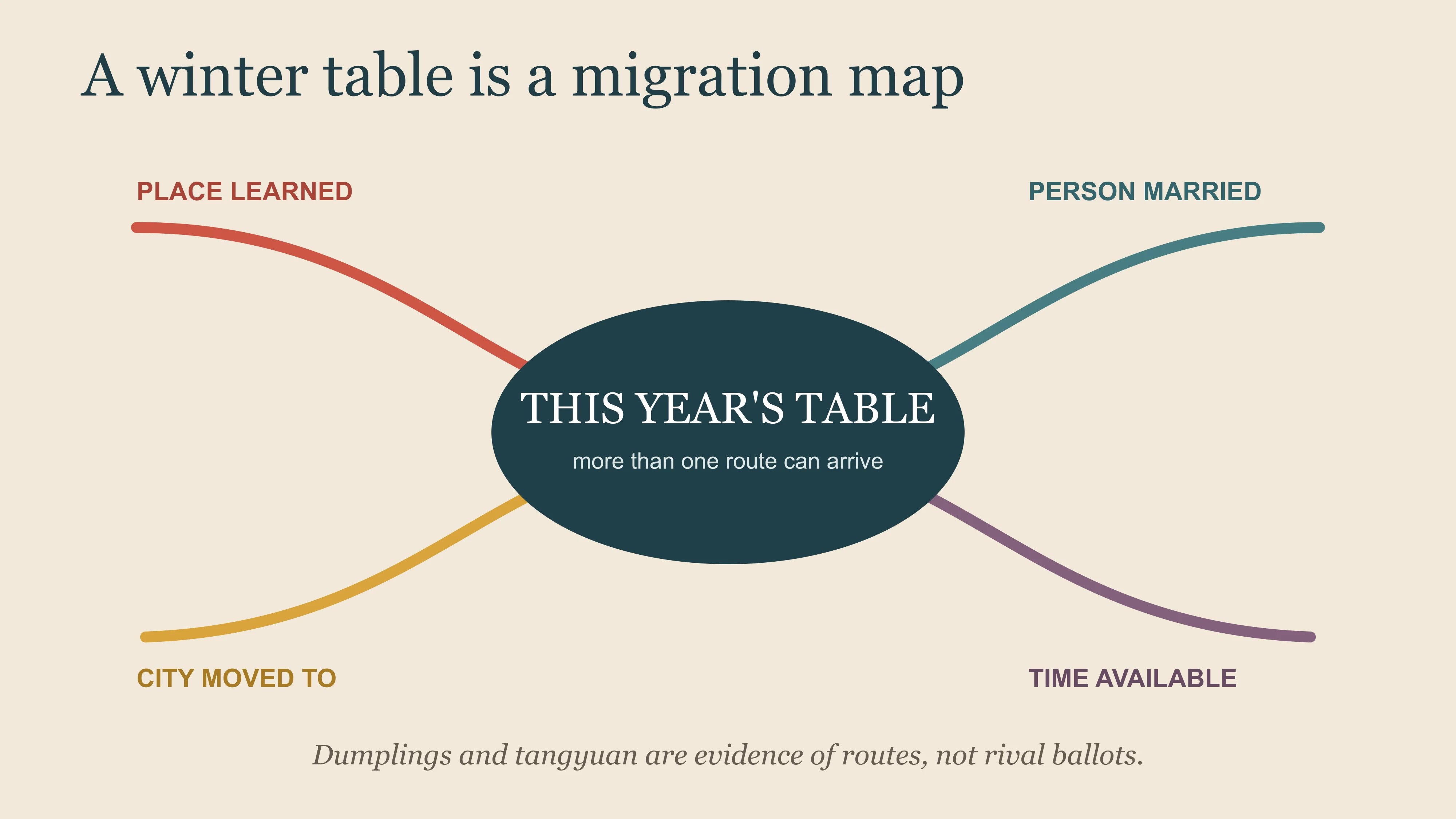
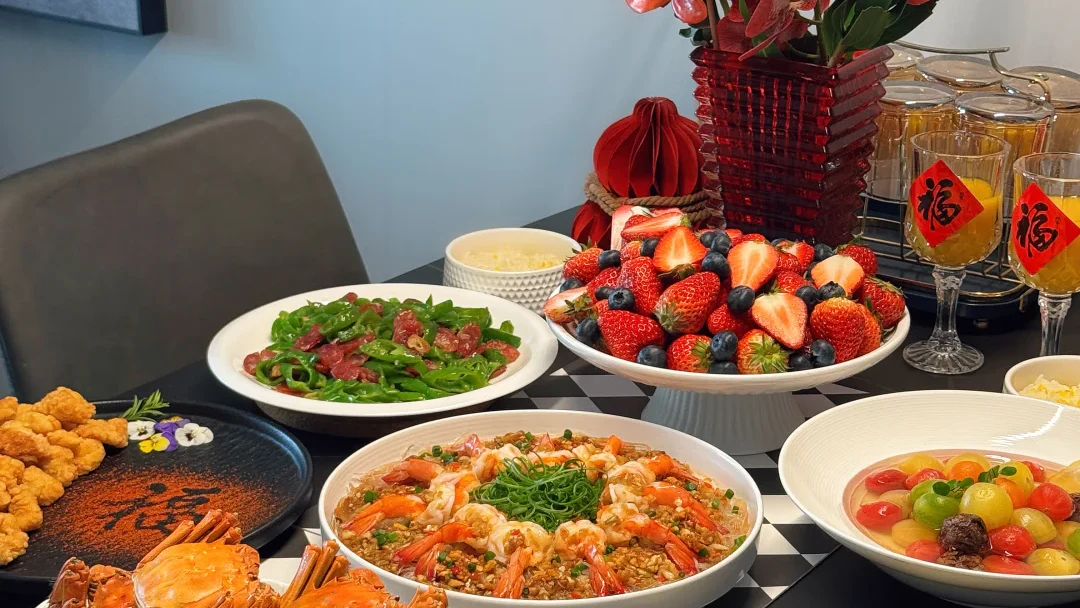
A winter table is a record of routes. Dumplings and tangyuan are not rival ballots; they show who moved, whom someone married and what this household can make now. East Moment original editorial diagram.
Ask where the dish travelled from
“North eats dumplings, south eats tangyuan” is a useful first orientation and a terrible final answer. China is not two kitchens divided by a clean line. Families move. Couples combine habits. Cities absorb workers and students. Overseas households substitute ingredients and organize around a weekend. A northern-born parent may teach dumplings in Guangzhou; a southern grandparent may establish tangyuan in Canada; their children may expect both.
The table therefore contains at least four geographies:
- the place where the cook learned the dish;
- the place where the family lives now;
- the place represented by a partner or elder;
- the place made possible by the ingredients and time currently available.
Ask “Who taught you to expect this?” before asking “Which region owns it?” The first question recovers a route. The second often starts a sterile authenticity fight. Food traditions become legible when attached to movement, not when pinned to a provincial map forever.
The same logic explains store-bought food. Buying frozen tangyuan does not prove cultural decline. It may be the only form compatible with a late shift, a small kitchen or a household without an experienced wrapper. What matters is whether the package still opens a conversation and a shared meal. Convenience can carry tradition; silence cannot.
A mixed table is evidence, not confusion
When dumplings and tangyuan appear together, do not rush to call the meal modern fusion. It may record a marriage, a move, a child who prefers sweetness, an elder whose teeth changed, or two people refusing to make one family history defeat the other. The coexistence itself is the evidence.
I would rather read that complicated table honestly than choose one dish to produce a cleaner photograph. The clean photograph serves the internet. The mixed table serves the people sitting around it.
This is Dongzhi's sharpest lesson for anyone studying Chinese foodways: regional categories explain patterns, but households explain survival. A map can tell you where a custom is strongly associated. Only the family can tell you why it arrived here and why it stayed.
Read the table as a family document
To read a Dongzhi meal seriously, start with the verbs. Who mixed, wrapped, bought, reheated, delivered, served and washed up? A bowl proves almost nothing about a household if the labor that produced it remains invisible. The person with the strongest attachment to a dish may not be the person who had time or physical strength to make it this year.
Then read substitution without contempt. Pork becomes mushroom because somebody stopped eating meat. Homemade wrappers become frozen dumplings because the cook now works nights. Peanut filling disappears because a child has an allergy. A sweet soup becomes less sweet after a diabetes diagnosis. These changes do not sit outside tradition. They show tradition responding to an actual body and an actual household.
Finally, ask what did not reach the table. Perhaps the elder who knew the recipe has died. Perhaps the family moved somewhere without the right flour. Perhaps a marriage brought two dishes together but nobody recorded either method. Absence is evidence too. It points to the knowledge most likely to vanish next.
This gives a practical Dongzhi archive three layers:
- photograph the whole table before isolating one photogenic bowl;
- name the cook, teacher and place attached to each dish;
- record the substitution or missing step that changed this year's version.
That record is far more valuable than declaring one menu authentic. Authenticity without provenance is just confidence. A named route—grandmother, Kaifeng, 1980s migration, frozen wrapper after a late shift—is knowledge another person can test, remember and continue.
What Dongzhi asks now
The modern day can pass unnoticed between work, school and year-end pressure. You do not need a ceremonial performance to recover it. Notice sunset. Call the person who taught you a winter dish. Ask why your family eats it. Make room at the table for someone who would otherwise eat alone.
The Chinese festivals calendar shows how solar terms and lunar dates organize different parts of the year. Dongzhi's contribution is quiet but firm: darkness can be acknowledged without being mistaken for permanence.
If you want the food mechanics rather than the festival argument, continue to the Chinese dumplings guide for wrapper and fold decisions, or the tangyuan guide for filling, seal and cooking control. Dongzhi owns the reason these different foods meet on one winter date.
What appears on your Dongzhi table, and which city or family taught you to expect it? Put the dish, place and memory in the comments. Share a real winter table in the East Moment community so regional difference becomes visible instead of being corrected away.
.jpg)