The 24 solar terms are not twenty-four miniature festivals and they are not a weather app written in ancient poetry. They are twenty-four fixed positions in the Sun's annual path. Their dates are shared; their landscapes are not. I understand the system best by returning to one ordinary place and watching it refuse to change on schedule.
The 24 solar terms divide the solar year into a finer human rhythm
The 24 solar terms—ershisi jieqi (二十四节气, èrshísì jiéqì)—are a Chinese system for marking the Sun's movement through the year. Each term begins when the Sun reaches another 15 degrees of celestial longitude, producing twenty-four points spaced roughly fifteen days apart.
That sentence sounds abstract. The names make it physical: Rain Water, Awakening of Insects, Grain Buds, White Dew, Frost Descent, Major Snow. They connect astronomical time with remembered changes in water, crops, animals, temperature and work.
Yet the names should not be read as promises. Rain Water does not guarantee rain outside your window. Beginning of Autumn can arrive while southern China is still fiercely hot. A Qinghai field and a Guangzhou street can share a date without sharing a season.
That tension is the system's real beauty. The solar position is exact. Life must answer locally.
| Quick question | Useful answer |
|---|---|
| Are the 24 solar terms lunar? | No. They are defined by the Sun's apparent position, although they are integrated into the Chinese lunisolar calendar. |
| How long is one term? | Roughly fifteen days, but a “solar term” strictly begins at a calculated astronomical moment. |
| Do the dates change? | Usually by a day or so between years. Use an astronomical calendar for the specific year. |
| Are all 24 public festivals? | No. Some acquired rituals or foods; many remain calendar and seasonal markers. |
| Do they predict today's weather? | No. They preserve a seasonal framework, not a location-specific daily forecast. |
As of October 2026, Cold Dew (寒露, Hánlù) began on October 8; the next term, Frost Descent (霜降, Shuāngjiàng), begins on October 23. The remaining 2026 sequence is Beginning of Winter on November 7, Minor Snow on November 22, Major Snow on December 7 and Winter Solstice on December 22, according to the Hong Kong Observatory's 2026 calendar. These dates tell a visitor where the calendar is, not whether frost or snow will arrive in their city. For a lived example, continue to Dongzhi and its regional family tables.
All 24 solar terms and their 2027 dates
The table below is next year's complete cycle, not the current 2026 calendar. Its dates follow the Hong Kong Observatory's official 2027 calendar. English names vary between institutions, so I use common modern translations and retain the Chinese and pinyin. For the rest of 2026, use the dated sequence above rather than taking a 2027 row as this year's date.
| 2027 date | Chinese and pinyin | Common English name | What the name notices |
|---|---|---|---|
| Jan 5 | 小寒 Xiǎohán | Minor Cold | Cold strengthens but has not reached its named extreme |
| Jan 20 | 大寒 Dàhán | Major Cold | The final cold term before the spring cycle begins |
| Feb 4 | 立春 Lìchūn | Beginning of Spring | The calendrical opening of spring |
| Feb 19 | 雨水 Yǔshuǐ | Rain Water | A shift from winter precipitation toward rain in the originating climate model |
| Mar 6 | 惊蛰 Jīngzhé | Awakening of Insects | Warming ground and the imagined stirring of hibernating life |
| Mar 21 | 春分 Chūnfēn | Spring Equinox | Day and night approach equal length |
| Apr 5 | 清明 Qīngmíng | Clear and Bright / Qingming | Brightening spring weather; also the date of Qingming observance |
| Apr 20 | 谷雨 Gǔyǔ | Grain Rain | Rain associated with spring crop growth |
| May 6 | 立夏 Lìxià | Beginning of Summer | The calendrical opening of summer |
| May 21 | 小满 Xiǎomǎn | Grain Buds / Lesser Fullness | Grain begins filling but is not yet fully ripe |
| Jun 6 | 芒种 Mángzhòng | Grain in Ear | A busy threshold for harvesting and sowing awned grains |
| Jun 21 | 夏至 Xiàzhì | Summer Solstice | The Northern Hemisphere's longest daylight period |
| Jul 7 | 小暑 Xiǎoshǔ | Minor Heat | Heat intensifies |
| Jul 23 | 大暑 Dàshǔ | Major Heat | The year's most intense named heat period |
| Aug 8 | 立秋 Lìqiū | Beginning of Autumn | The calendrical opening of autumn, often before cool weather arrives |
| Aug 23 | 处暑 Chǔshǔ | End of Heat | Heat begins moving toward retreat |
| Sep 8 | 白露 Báilù | White Dew | Cooler nights make moisture more visible on plants |
| Sep 23 | 秋分 Qiūfēn | Autumn Equinox | Day and night again approach equal length |
| Oct 8 | 寒露 Hánlù | Cold Dew | Dew and cooler air mark deepening autumn |
| Oct 23 | 霜降 Shuāngjiàng | Frost Descent | Frost becomes possible in colder regions |
| Nov 7 | 立冬 Lìdōng | Beginning of Winter | The calendrical opening of winter |
| Nov 22 | 小雪 Xiǎoxuě | Minor Snow | The first named snow threshold, not a nationwide snowfall forecast |
| Dec 7 | 大雪 Dàxuě | Major Snow | Winter cold and snow potential deepen |
| Dec 22 | 冬至 Dōngzhì | Winter Solstice | The shortest daylight period and the turn toward returning light |
The familiar mnemonic begins with Lichun—Beginning of Spring—even though a Gregorian-year table begins in January with Minor Cold and Major Cold. That difference is a useful reminder: calendars can place different frames around the same cycle.
The system is solar even though it lives inside the Chinese calendar
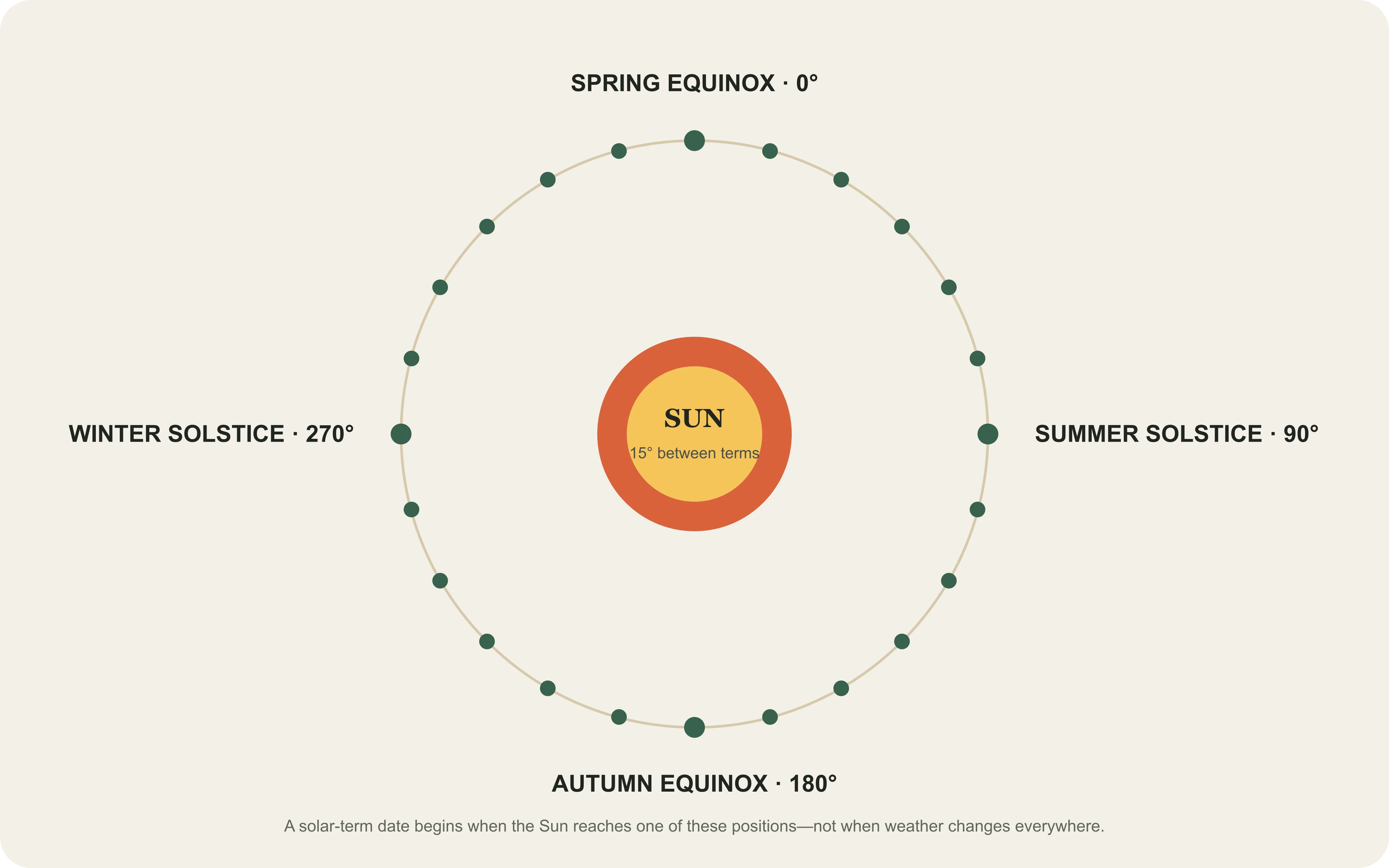
Calling the terms “lunar” is the most common conceptual mistake.
The Chinese traditional calendar is lunisolar: months follow lunar cycles, while solar information keeps the calendar aligned with seasons. The twenty-four terms supply that solar structure. Twelve “major terms” and twelve alternating “minor terms” also help determine where leap months are inserted.
The diagram shows the principle, not Earth's orbit to scale. Spring Equinox is assigned 0 degrees of solar longitude; Summer Solstice 90; Autumn Equinox 180; Winter Solstice 270. The other terms fill the 15-degree steps between them.
The exact moment can be calculated. The visible response cannot. A tree does not read longitude.
The names began as regional observations, not national weather guarantees
UNESCO's record places the system's origins in the Yellow River reaches, where observations of astronomy, seasons and natural phenomena were developed into a framework that later spread across China.
That history explains both its power and its limits. A name built from one climatic experience cannot describe every latitude, elevation and monsoon pattern on the same day. China stretches from tropical coasts to high plateaus and from humid river towns to deserts. “Beginning of Spring” is a calendar position before it is a universal photograph.
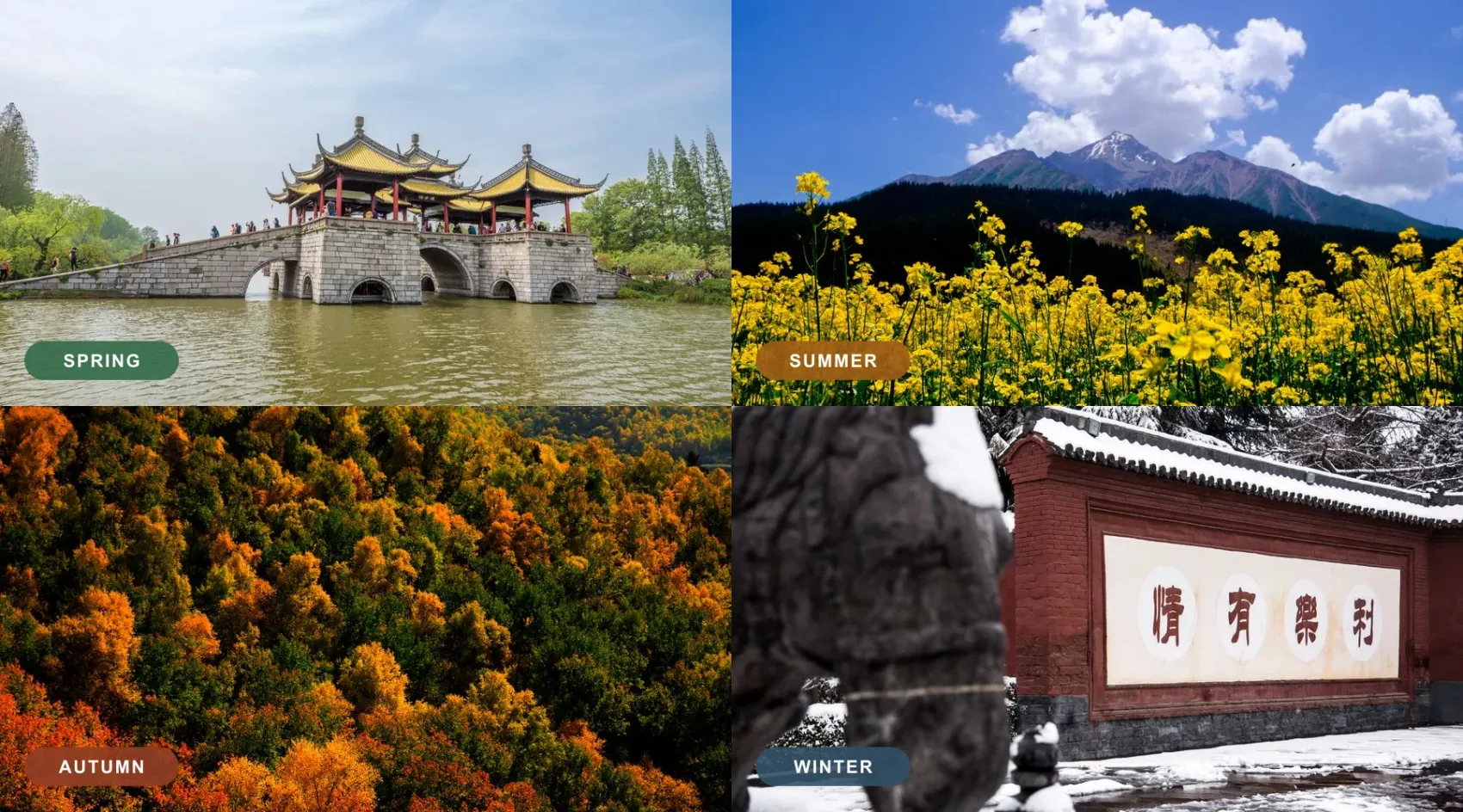
Yangzhou's water, tender trees and crowded bridge make spring visible. But the image cannot tell us that it was taken precisely on Lichun, nor can it stand for spring in Harbin, Kunming or Lhasa. The photograph is valuable because it is local, not because it illustrates a national command.
My rule is simple: use a solar term to ask what is changing, never to insist that nature should already look a certain way.
Agriculture gives the names urgency, but not one universal farm schedule

Names such as Grain Rain, Grain Buds and Grain in Ear preserve agricultural attention. Farmers needed to coordinate soil, seed, water, labor and harvest with recurring seasonal conditions. The China Meteorological Administration describes the terms as roughly two-week divisions used to mark seasonal and climatic change in traditional life.
But a date is not an instruction that travels unchanged. Crop, variety, altitude, rainfall, soil and current weather all matter. A modern grower combines inherited timing with forecasts, field measurements and agricultural science.
The field above carries that meeting in one frame: ripe plants, a walking figure and an electrical pylon. Tradition and infrastructure are not enemies here. The solar-term system remains useful when it organizes attention; it becomes dangerous only when a proverb replaces current local evidence.
One date can hold several seasons at once

Qinghai's summer can hold yellow flowers and a snow-marked mountain in the same view. That image does more for my understanding of the solar terms than a perfect wheel of twenty-four icons.
It shows why seasonal experience cannot be flattened. In one region, July brings a short flowering window. Elsewhere, the same crop bloomed months earlier. At high elevation, snow remains visually present while lowland cities are fighting humid heat.
This is also why a mid-autumn date can still feel like summer in Ningbo or Guangzhou, and why “Minor Snow” may arrive with no snow at all. The term locates the Sun. Geography writes the scene.

Even “autumn color” is not one event. A forest turns unevenly. Shade, tree species, slope, moisture and cold exposure create different clocks within the same hillside. The most honest seasonal photograph contains disagreement.
Qingming and Dongzhi show how a calendar marker becomes lived culture
Most solar terms do not function as major festivals. Two terms make the relationship especially clear.
Qingming is both a solar term and a period of grave care, remembrance and spring outings. Its cultural work is detailed in our Qingming Festival guide. Dongzhi, the Winter Solstice, carries family meals and strong regional arguments over dumplings, tangyuan and other foods; our Dongzhi Festival guide owns that table.
Lichun also matters in specialist calendrical practice. Some bazi systems change the stem-branch year at Beginning of Spring rather than Chinese New Year. Our Chinese zodiac calculator guide keeps that convention separate from the ordinary lunisolar-year result.
These examples prevent a second mistake: not every solar term is “celebrated” in the same sense. Astronomy supplies the coordinate. Communities decide whether it becomes food, ritual, labor, poetry, a school lesson—or simply a name on a phone.
City life has not erased the terms; it has hidden the instruments
The old instruments were not magical. They were repeated attention: shadow length, temperature, rain, bird movement, flowering, insects, soil and crops.
Modern city life interrupts that repetition. A person leaves an air-conditioned apartment, enters a train, works under fixed lighting and returns after dark. The calendar notification says White Dew; nothing in the commute seems different. If a pond is filled for development, a seasonal soup made from its lotus leaves can disappear with it. The term remains; the local sensor is gone.
I do not solve this by demanding that everyone “return to nature.” That phrase is too large to be useful. I would choose one repeatable view:
- Photograph the same balcony plant, street tree or patch of park every two weeks.
- Record sunset position or the time direct light enters one room.
- Note one sound—birds, insects, rain on an awning—not twenty symbols.
- Compare your observation with last year before comparing it with an ancient verse.
- Keep the city and location attached to every claim.
One balcony plant can teach more than twenty-four decorative posters because it can fail, delay, bud, flower and dry in front of you. It converts inherited vocabulary into local evidence.
The 24 solar terms are coordinates for attention
Snow makes winter obvious, but the system matters most when change is subtle: light reaching farther across a floor, one insect returning, a leaf edge drying, the evening staying bright long enough to alter a walk home.
I do not value the 24 solar terms because they prove ancient people predicted every climate perfectly. I value them because they divide a year finely enough to make inattention uncomfortable. Four seasons are broad categories. Twenty-four terms ask us to look again before the scene has completely changed.
Continue through the Chinese Festivals calendar or see how seasonal attention enters food and drink in the Chinese Tea guide. Then add your own evidence to China Moments: photograph one repeated view, name the city and tell us what changed later—or earlier—than the calendar name suggested.