Zongzi is not a triangle with one authentic filling. It is a family of glutinous-rice foods cooked inside leaves. Read each one as a five-part structure: leaf, rice, filling, form and closure. The outside can suggest a wrapping tradition, but it cannot prove what is inside, where it was made or whether it is good.
That structural definition is useful whether you are buying, eating or making zongzi. It also explains why beginner wrapping fails. Most leaks do not come from choosing the “wrong” shape. They come from a broken leaf container, too much filling, a top flap that does not control the opening or string that compresses the packet in the wrong direction.
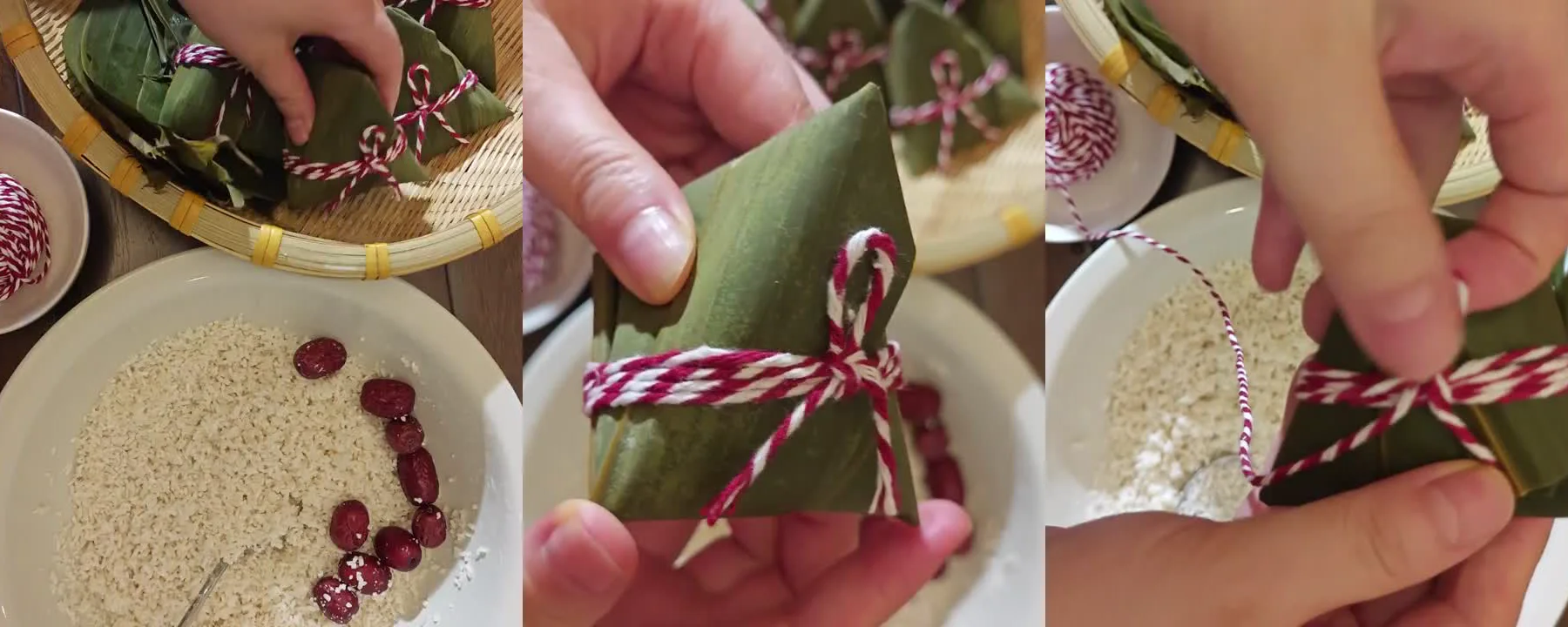
The real process shown here is one authorized four-corner method. It is not the only correct regional form. Its value is that the hands, leaf seams, fill level and closure are visible rather than reconstructed from a finished packet.
I have no interest in using zongzi to restart the sweet-versus-savory argument as if one side needs to lose. The compelling question is smaller and more revealing: what does this packet want to be? A plain rice zongzi may want sugar, a salted egg yolk may need rich pork and a fragrant leaf, while a large savory one needs enough filling to justify its weight. When people call a zongzi disappointing, they are often reacting not to its region but to a packet whose rice, filling and leaf aroma never became one idea.
What is zongzi?
Zongzi (粽子) are portions of glutinous rice enclosed in leaves, tied and cooked. English descriptions often call them “sticky rice dumplings,” which is convenient but can suggest a dough wrapper. The leaf is not an edible dumpling skin. It is a cooking container that shapes the rice, holds fillings and contributes aroma.
Zongzi are especially associated with the Dragon Boat Festival. UNESCO's description of the festival includes rice dumplings among recurring practices while also recording racing, regional heroes and protective customs. The food does not need one universal invention legend to belong to the festival.
The household scale matters as much as the packet. Rice may soak in a basin measured for several people, folding becomes shared work, and a large pot must stay covered with water long after the exciting part is over. Finished zongzi are divided again: some remain on the table, some travel home with children or relatives, and some enter a work refrigerator the next morning. I see the form differently once I notice that logistics. A zongzi is not only food wrapped for cooking; it is food engineered to survive distribution through a family.
Read zongzi through five layers
1. Leaf
The leaf must bend without splitting and overlap enough to form a continuous container. Bamboo and reed leaves are common broad categories, but names, preparation and availability vary. The Chongqing market regulator's consumer guide distinguishes common ruoye bamboo leaves from narrower reed leaves and also records bamboo-sheath use in parts of Sichuan and Chongqing. That is useful evidence for variation, not a license to identify an unknown leaf from a photograph. Fresh, dried, salted or packaged leaves need different handling, so the supplier's directions matter.
The visible color is not a purity test. Cooking changes green leaves toward olive or brown. Extremely bright color is not proof of freshness, and a brown cooked leaf is not evidence of poor quality.
Before wrapping, the practical questions are:
- Is the leaf clean and prepared according to its package or source?
- Can it bend at the fold without cracking?
- Is it wide enough, or do two leaves need to overlap?
- Are the tips or hard edges likely to pierce another leaf?
2. Rice
Glutinous rice creates the cohesive interior. Soaking, seasoning and mixing vary by recipe. Rice expands during cooking, which means a packet packed to maximum capacity before tying has no margin left.
The rice may be plain, sweetened, seasoned with soy or mixed with beans and other ingredients. “White rice inside” and “dark seasoned rice inside” are not quality rankings. They are different formulations.
3. Filling
Common filling families include dates or jujube, red bean, mung bean, chestnut, pork, sausage, mushrooms, salted egg yolk and combinations of these. Unfilled or lightly filled forms also exist.
The useful question is not “sweet or savory: which is authentic?” Both have deep regional and household lives. Ask what the label actually names, whether the filling is centered or mixed through the rice and how rich you want the portion to be.

Pork changes the whole packet: the rice should take on savoury fat and seasoning, but not become a slick paste around a dry center. A meat zongzi needs enough leaf aroma and rice to keep that richness in proportion.

A salted egg yolk makes the same structure more intense—crumbly, saline and rich beside pork. It is a reason to choose a smaller packet or share, not a universal upgrade that every zongzi needs.

Date-filled zongzi work in the opposite direction. The sweetness stays clean when the rice remains plain and the leaf is fragrant; adding more fillings would blur the gentle contrast that makes a jujube center satisfying.
4. Form
Triangular, four-corner, elongated, pillow-like and other shapes can result from different leaves, folds and local traditions. Shape affects rice distribution and how pressure reaches the seams. It is still only a clue to identity.
A four-corner packet sold in one city can contain a filling associated with another. A manufacturer can reproduce a traditional silhouette anywhere. Never infer filling, region or quality from geometry alone.
5. Closure and tying
The leaf flap and string work together. The flap closes the food container; the string preserves that closure through handling and cooking. String cannot rescue an open seam. Tightening harder may simply cut into the leaf or deform the packet.
How to wrap zongzi: four actions that prevent leaks
The selected 216-second authorized tutorial answers a real practical demand. It does not make the creator's method a national standard.
Action 1: Form a continuous leaf container

The left frame shows the container fold; the right shows staged filling. They document one four-corner method, not the only valid fold.
Overlap the leaves so the interior has no open slit along the main seam. Fold into the chosen cone or pocket while keeping the leaf edges high enough to control the rice.
Before filling, hold the empty form up and inspect it. If you can see daylight through the bottom or the overlap opens when your grip relaxes, rice will find the same route. Fix the container now; string applied later will not seal an internal gap cleanly.
Action 2: Fill in stages, not one heap
Add a base layer of rice, position the filling, then cover it. Staged filling distributes the center and keeps hard or pointed ingredients away from the leaf wall. It also lets you stop before the packet becomes overfull.
The correct fill line depends on the fold and rice preparation. The general principle is stable: leave enough leaf and empty space to close the top without forcing rice out of the seam.
Pressing can settle the filling, but aggressive compaction removes expansion room and may push ingredients through a weak fold. The packet needs structure, not maximum density.
Action 3: Close with the leaf, not with the string

The sequence separates closure from tying. It cannot guarantee the result without the preceding seam and fill control.
Fold the remaining leaf over the exposed rice while maintaining pressure on the walls. In a four-corner method, the hand often has to control more than one plane at once: the top closes, side edges turn and a tail folds along the body.
This is the point where most beginner packets lose their form. If rice appears at the edge, do not immediately reach for string. Open slightly, remove excess if necessary and rebuild the flap so leaf covers food continuously.
Action 4: Tie across the forces that want to open
Place string where it holds the folded flap and the body together. The knot should survive lifting and cooking, but “as tight as possible” is the wrong target. The packet should feel secure without the string cutting visibly into the leaf.
After tying, test the packet gently:
- Lift it by supporting the body, not swinging it from the string.
- Rotate it and inspect the bottom seam.
- Check whether the top flap shifts.
- Look for exposed grains.
- Compare packet firmness with the remaining space needed for rice expansion.
The method works as a chain. A continuous container permits controlled filling; controlled filling permits a clean closure; a clean closure gives the string something stable to hold.
Why zongzi leak or lose their shape
| Failure | What is happening | Better correction |
|---|---|---|
| Rice escapes from the tip | The cone seam or leaf overlap is open | Rebuild the empty container and inspect before filling |
| Top will not close | Too much rice or filling, or insufficient leaf length | Remove some filling and preserve a larger top flap |
| Packet opens during handling | String does not cross the active flap or knot is unstable | Reposition the tie around the closure, not only the middle |
| Leaf tears under string | Leaf is brittle, edge is damaged or string is overtightened | Prepare a more flexible leaf and use secure rather than extreme tension |
| Shape collapses | Filling is uneven or folds are not supported during tying | Fill in layers and keep hand pressure through the final wrap |
These diagnoses are more transferable than memorizing hand positions from one camera angle.
The pot is the final stress test
Wrapping looks finished when the knot is tied. It is not. A zongzi still has to absorb water, expand, soften and remain closed through a long wet cook. The pot exposes every shortcut that a neat photograph can hide: a brittle leaf splits, a shallow overlap opens, a hard filling point presses outward and a string placed across the wrong plane lets the flap move.
This is why I reject “tie it tighter” as beginner advice. Excess force can cut the leaf while leaving the real seam untouched. A better packet is designed from the inside out: flexible leaf, uninterrupted overlap, filling below the closure line, a flap that contains rice by itself and a tie that preserves that geometry. The knot is support, not the wall.
Sweet versus savory zongzi is the wrong final argument
The debate is popular because it is easy to join. It is not a useful taxonomy.
Two savory zongzi can differ more from one another than a sweet and savory pair. One may use seasoned rice, fatty pork, salted egg yolk and mushrooms; another may be lightly salted rice around one ingredient. Sweet forms range from plain rice dipped in sugar to date, bean or paste-filled packets.
Use a better comparison:
| Decision | Questions to ask |
|---|---|
| Rice | Plain, sweetened or savory-seasoned? Soft and cohesive or more defined? |
| Filling | Centered, layered or mixed through? Rich, lean, nutty, fruity or bean-based? |
| Leaf | What does the maker identify, and how strong is the leaf aroma? |
| Size | A tasting portion or a meal-sized packet? |
| Service | Eaten warm, room temperature, reheated, dipped or paired with other dishes? |
Preference is not historical proof. You can defend the zongzi you grew up with without declaring another region's food inauthentic.
How to choose zongzi at a shop
The exterior tells you whether the leaf and tie look intact. The label and seller must answer the rest.
- Read the exact filling, not just “traditional flavor.”
- Check storage instructions and whether the product is fresh, chilled, frozen or shelf-stable.
- Compare net weight; a large gift box may contain surprisingly small portions.
- Check allergen and ingredient information, especially for nuts, sesame, egg, soy, meat or mixed fillings.
- Prefer a maker who identifies ingredients and storage clearly over one selling only a regional story.
- Do not buy a damaged, leaking or improperly stored package because its leaf color looks attractive.
For reheating, follow the product instructions. Cooking time depends on whether the zongzi is raw, fully cooked, chilled, frozen or shelf-stable. A generic internet time cannot safely replace the label.
Shape cannot prove region, filling or quality
This is the article's most important buying rule. The packet is opaque by design. Shape gives you information about the wrapper's geometry, not a view of the interior or the supply chain.
To make a regional claim, look for the maker, production location, named style and ingredients. To judge quality, examine storage, leaf integrity, rice texture after heating, filling distribution and whether the flavor matches the label. To identify the filling, read or cut it open.
The triangle is memorable. The evidence lives elsewhere.
How zongzi connects to the Dragon Boat Festival
Stories connecting rice packets with Qu Yuan are culturally important in many communities. They should not be turned into proof that one event invented every leaf-wrapped rice tradition. UNESCO's Dragon Boat Festival inscription records a wider living system of commemoration, ritual, racing and food rather than reducing the festival to one snack or one nationwide explanation.
The festival guide explains why the 2026 date is June 19, why Qu Yuan is central but not alone and what a real race reveals about cooperation. Zongzi belongs in that larger system: families prepare and exchange something that carries memory through repeated handwork.
The clear conclusion
A zongzi should be read as a structure, not a triangle. Leaf flexibility and overlap create the container. Rice and filling determine expansion and eating experience. The top flap closes the food. String preserves that closure. If any link fails, tying harder will not solve the real problem.
For buying, trust the ingredient and storage information more than the silhouette. For wrapping, inspect the empty seam, fill in stages, close with leaf and tie across the forces that want to open. For culture, let sweet, savory, triangular and elongated forms remain evidence of variation rather than contestants for one authentic title.
Continue to the Dragon Boat Festival guide for the racing, remembrance and regional practices surrounding the packet, step back to the festival-food collection to compare what different foods carry through the year, or use the wider Chinese food guide when zongzi is only one part of the meal.
For a different kind of hidden structure, compare tangyuan, where the seam, filling temperature and serving liquid matter more than the perfect sphere. If your family has a zongzi that survives the pot—or one that always fails at the same fold—keep the tied packet, cooked form and cut-open evidence together in the Fold to Pot Atlas. Return when another packet fails at a different seam. The useful story is the repair, not the victory photo.