A student can say “Chinese culture has a long history” perfectly and still explain almost nothing. Who is doing what? What can we see or hear? Why does that detail matter to the people involved? Those are the questions I want answered. A polished slogan is still a slogan.
For Chinese language and culture AP, learn the current course requirements first, then build explanations from particular words, objects and practices. This guide gives you an orientation to the revised course and a way to turn cultural knowledge into communication. It is not an official syllabus or a ready-made assessed presentation.
Chinese language and culture AP: what changed for 2026–27?
AP Chinese Language and Culture develops interpretive, interpersonal and presentational communication alongside cultural understanding. You need to understand other people's Chinese and produce your own; familiarity with Chinese customs does not replace language practice.
The 2026–27 course is revised. College Board's revision notice identifies a required course project focused on music, within Art and Creativity. The project packet is scheduled for January 2027. Students prepare a Personalized Project Reference before answering project-based speaking tasks in Bluebook. Do not mistake an old cultural-presentation video for the current exam instructions.
The current official exam page lists these components:
| Task | What the student does | Share of exam score |
|---|---|---|
| Project Presentation | Present research in response to a prompt | 20% |
| Project Q&A | Respond to four simulated follow-up exchanges | 15% |
| Story Narration | Write from four supplied pictures | 7.5% |
| Email Response | Reply to an email | 7.5% |
| Listening and reading | Answer multiple-choice questions | 25% each |
Use that page and your teacher's current materials for timing, submission rules and accommodations. Old released questions can still train language skills, but their format is not a promise about your exam.
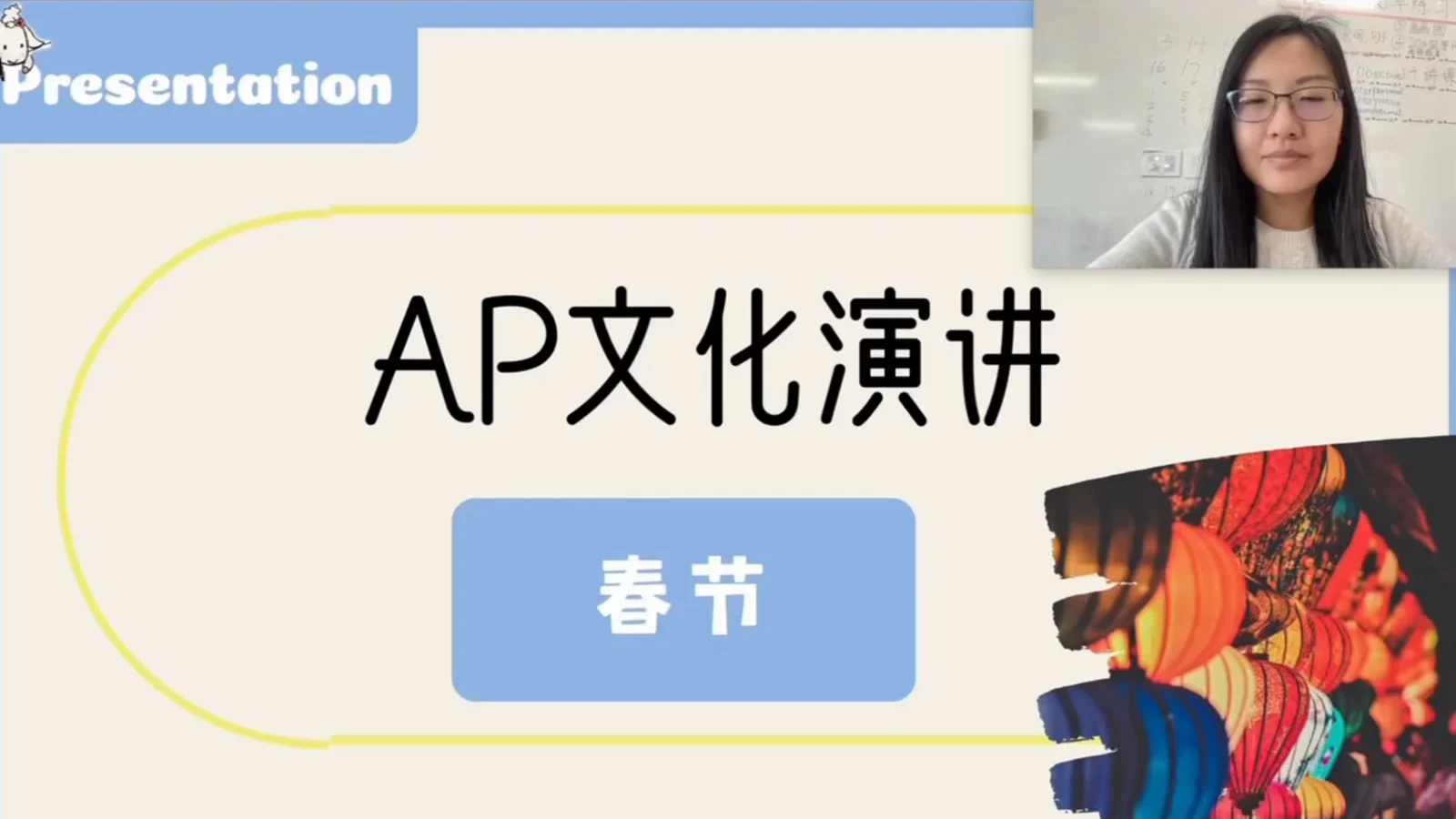
The classroom photograph above shows a Spring Festival teaching example from an earlier presentation context. The useful habit—connecting a practice to a meaning—survives. The old task format does not automatically survive with it. I would rather make that distinction early than let a student spend weeks becoming excellent at preparing the wrong thing.
Replace “this represents culture” with something another person can follow
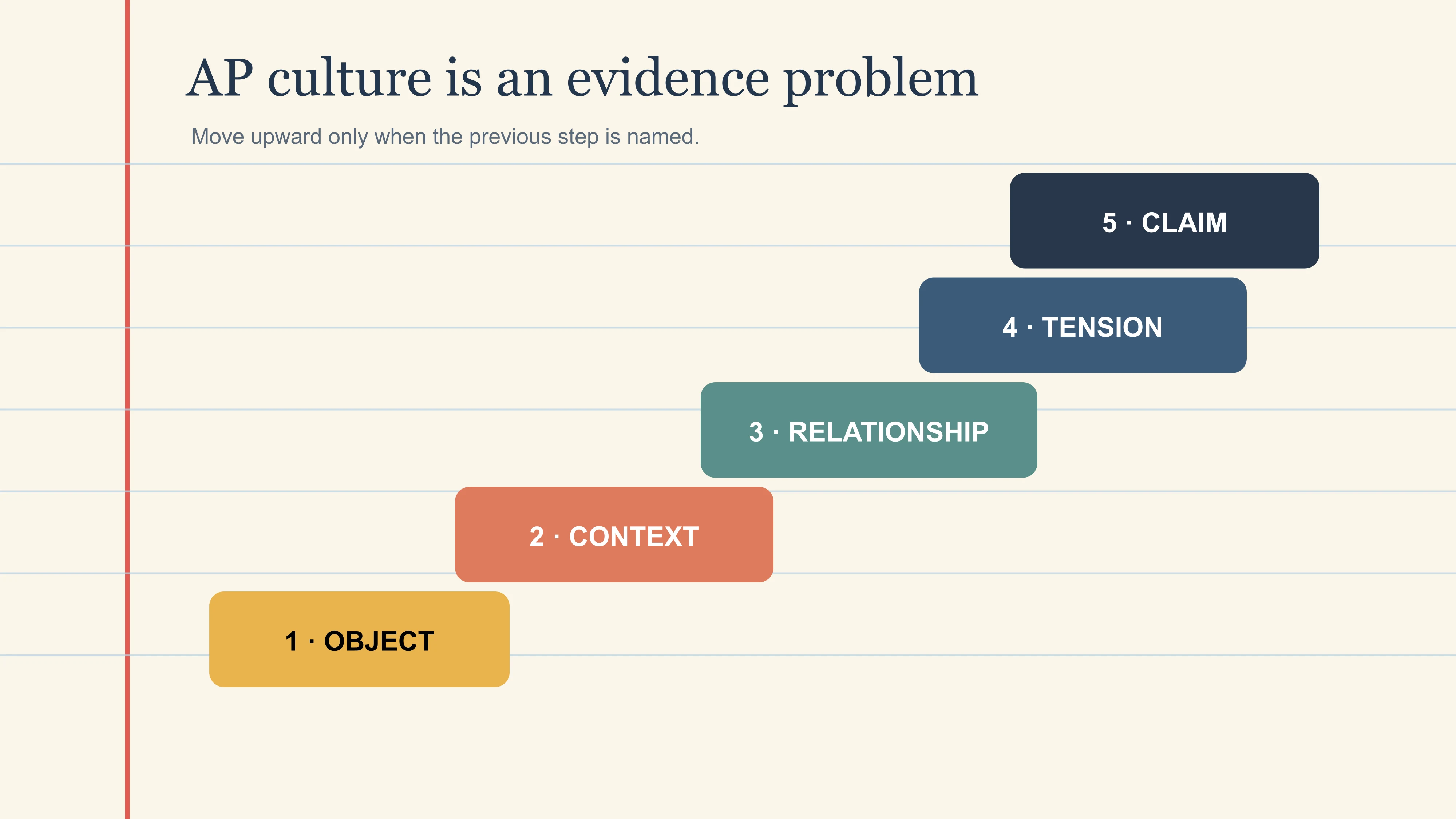
The ladder is an East Moment reasoning aid, not a College Board scoring rubric. It forces each cultural claim to earn its next step with named evidence and keeps a broad national conclusion from appearing before context.
Take a folding fan. “Fans represent traditional Chinese culture” names a category but explains no relationship. “A painted fan can carry a friend's inscription while remaining an object its owner opens and uses” gives us people, a practice and a consequence.
Now there is something to investigate. Was this particular fan a gift? Does the inscription name a recipient? Is the writing original, printed or added later? Without those answers, “friendship” remains a possible interpretation rather than the documented story of that object. Our Chinese folding fan guide shows why a frame, a painted leaf and an inscription can have different makers and dates.
Here is an original classroom practice contrast, not a model answer for the annual project:
Too broad: 中国人喜欢扇子,因为扇子代表中国文化。
Chinese people like fans because fans represent Chinese culture.
More useful: 这把扇子上有题字。要了解它是不是礼物,我还要看题字的内容和收扇人的名字。
This fan has an inscription. To understand whether it was a gift, I also need to examine the wording and the recipient's name.
The second version is less grand and more intelligent. It identifies what is visible, asks a question the object can help answer and refuses to invent its biography. Grammar and vocabulary can be refined with a teacher; the reasoning already has a direction.
Do not memorise these sentences. Replace the object with one you have actually examined and build your own explanation. A sentence that you cannot adapt when someone asks “Which fan?” is not yet yours.
The music project needs listening, not just a famous name
The announced music focus does not mean “pick a celebrity and recite their biography.” Before the packet arrives, build habits that will survive a more specific prompt: listen closely, read Chinese-language sources, identify the setting of a performance and distinguish an artist's words from a fan's interpretation. Your eventual project must follow the released instructions.
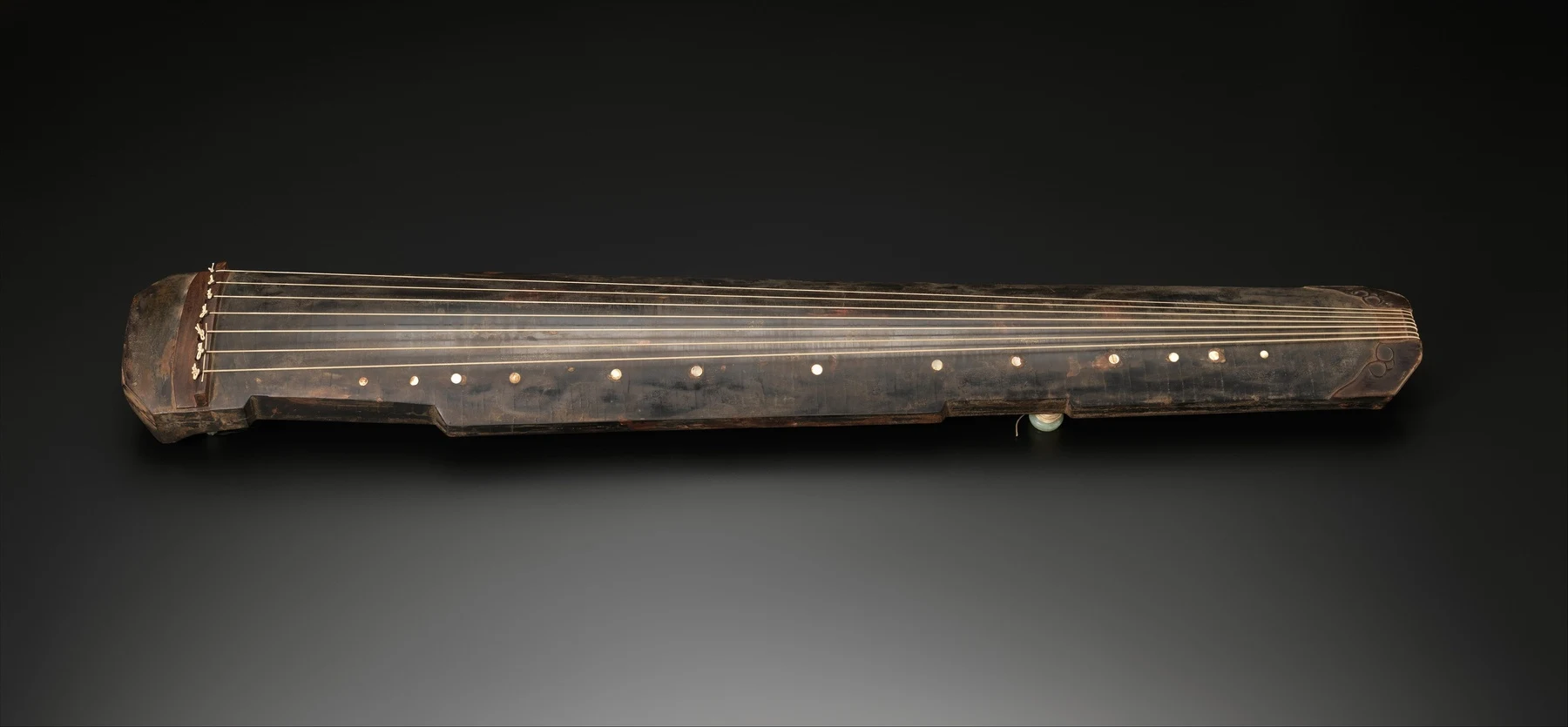
This qin dated 1634 is a useful practice object. The museum records wood, lacquer, jade and silk strings. The long body and arrangement of strings are visible. A photograph cannot let you hear how a musician articulates a phrase. That gap tells you what source to seek next: a properly identified performance, not another photograph of an instrument.
Suppose you want to discuss restraint in a performance. Find the actual passage where a note fades or a pause changes the phrase. Explain what you hear before calling it “peaceful.” Then ask whether your claim describes that performance, a particular practice or an entire tradition. Those are different scales. One quiet recording cannot establish that all Chinese music values quietness.
For contemporary material, begin with a work you can stay with long enough to describe. Our Jay Chou page connects songs to different parts of his career; it is an orientation, not a substitute for listening or for the Chinese-language source work your course requires. Name the song and version. A studio track, concert arrangement and short social clip may place different sounds in the foreground.
I care much more about a learner explaining one musical choice than praising a singer as globally influential. “The accompaniment drops away here, so the voice feels exposed” offers something another listener can test. “His music bridges East and West” often postpones every interesting question.
The museum label and this English guide can help you find your bearings. They do not, by themselves, satisfy a requirement to research in Chinese. Keep Chinese-language titles, creator statements and source details with your own notes so that the eventual explanation rests on material you have understood.
The object is the beginning of the argument, not its conclusion
Cultural description often jumps from an attractive image straight to a national value. An inkstone appears; suddenly the speaker announces that Chinese people respect education. There is too much missing between those two sentences.
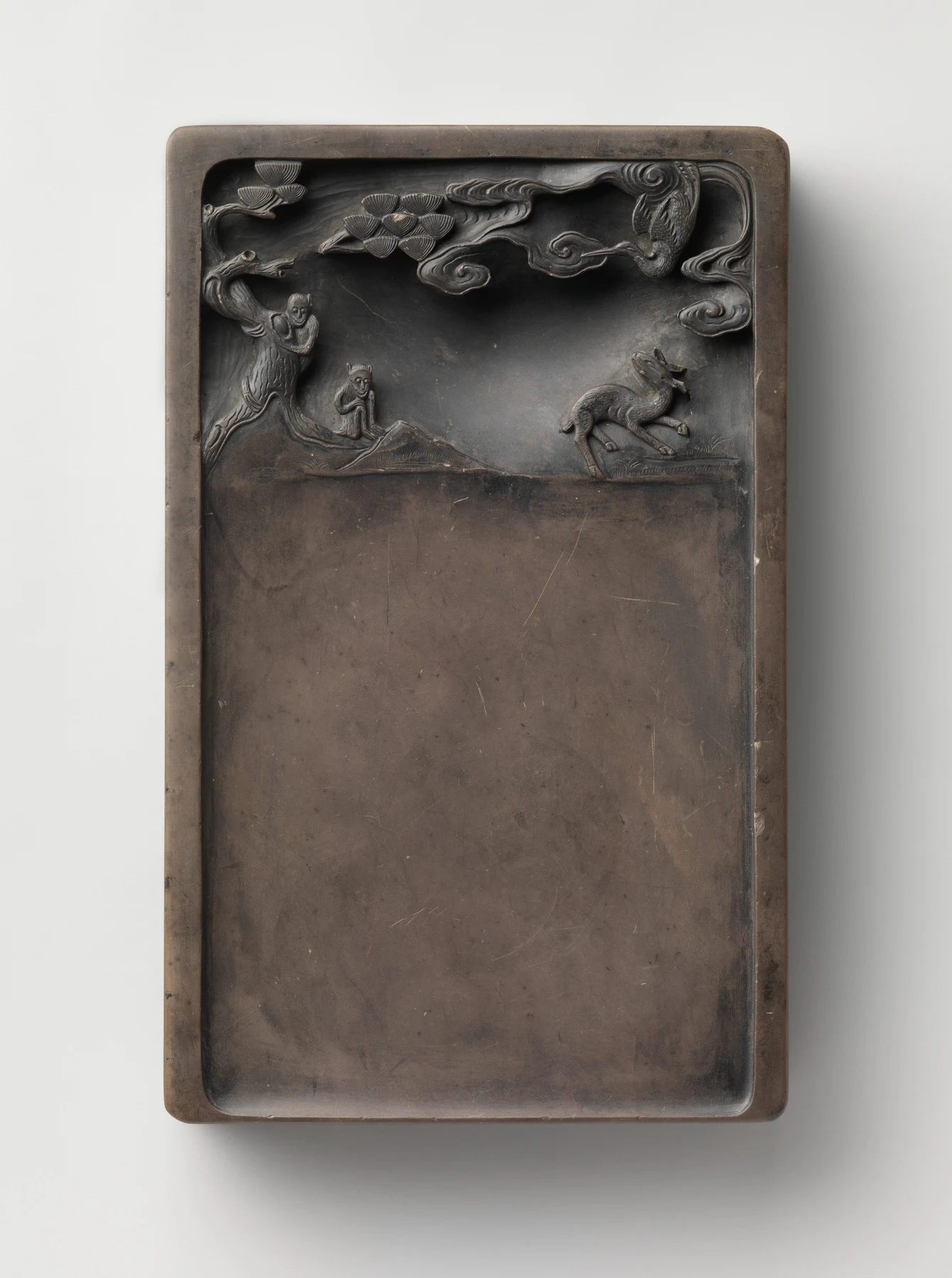
The Met's inkstone record identifies Duan stone as the material. Start there. The photograph shows a broad plain area below a much busier carved scene: figures, an animal and curling forms gather toward the top. Decoration and working space occupy the same stone without doing the same job. An inkstone provides a surface for preparing ink from an inkstick and water. Now you can ask who used it, with what other tools, and in which setting. The object alone does not tell you that everyone in a society shared the same education.
For Chinese calligraphy, the more revealing practice is copying a model while learning how its strokes and spaces relate. A learner can compare an early attempt and a later one. Which component moved? Which gap opened? That comparison gives “discipline” a concrete meaning instead of treating it as an inherited national personality.
A museum record is valuable because it limits the story as well as enriching it. If a date is not established, leave the date out. If a later object quotes an old style, explain the difference between the date of the object and the age of the tradition. Good cultural writing becomes sharper when it loses false certainty.
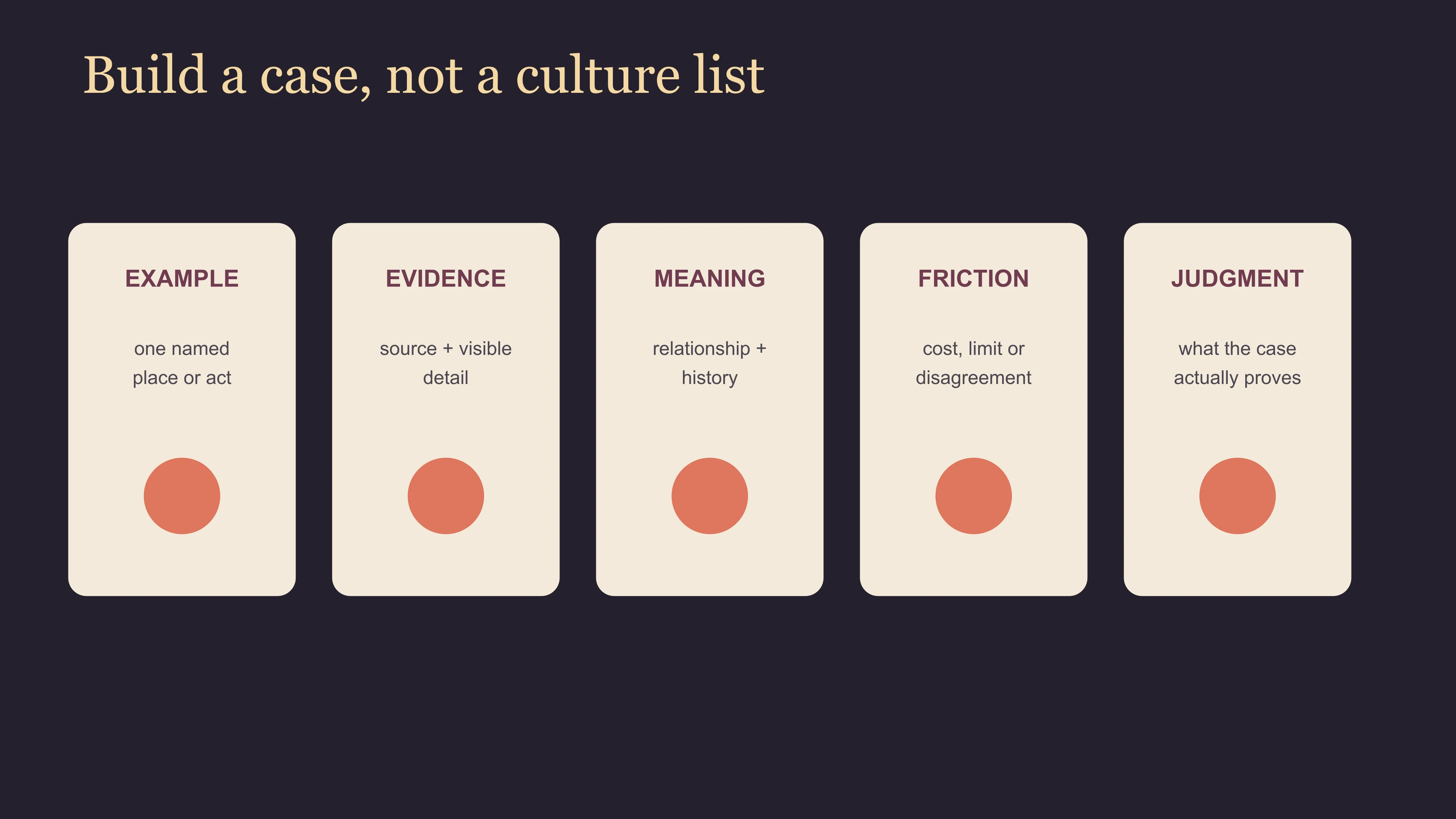
This original planning strip turns one observed case into an argument another person can test. It does not reproduce an annual project prompt, guarantee a score or replace the instructions released for the current course year.
These fan and writing-tool exercises train observation and explanation. They are not proposed substitutes for the 2026–27 music project. Keeping that boundary visible protects both the art and the student's time.
Translation must carry the relationship as well as the information
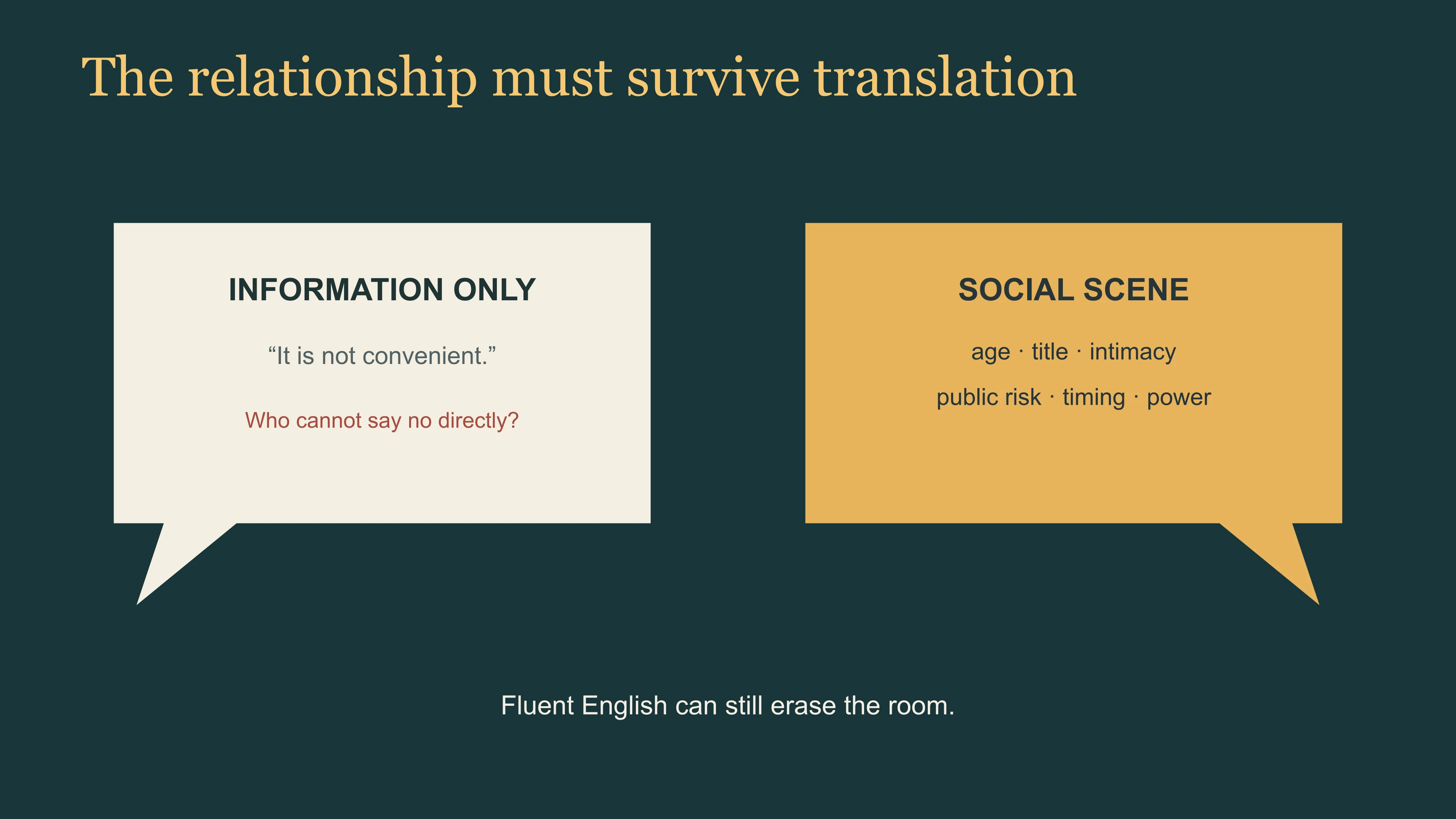
Imagine replying to an invitation in a practice email. “I cannot come” supplies the main information. It does not yet acknowledge the invitation, explain the obstacle or help the relationship continue. Those missing parts may be exactly what the task asks you to communicate.
An original practice reply might say: 谢谢你邀请我。星期六我已经有安排了,星期天下午可以吗? The speaker thanks the other person, explains that Saturday is already occupied and proposes Sunday afternoon. This is not a secret national code for politeness. It is a clear response to a particular person with a practical next step.
Now change the recipient. A message to a close friend need not sound like a formal request to a teacher. Compare the greeting, address and closing rather than mechanically inserting 您 into every sentence. Formal vocabulary without a suitable relationship can sound distant, not respectful.
Kinship terms reveal the same issue. 伯伯 and 叔叔 can distinguish an older and a younger paternal uncle; everyday address can extend family terms beyond literal relatives. Explain the actual usage in your example. Do not turn every “auntie” into proof that an entire culture treats strangers as family.
The broader Chinese language guide separates speech, script and register. Mandarin proficiency is important in this course, but it is not a test of someone's cultural authenticity. A heritage learner can know a family language well and still need practice reading formal prompts or organising a written response. That is a skill gap, not a personal failure.
Four kinds of practice that expose different weaknesses
A single favourite activity can hide a problem. Reading subtitles is not the same as following speech without them; speaking comfortably at home is not the same as answering a tightly framed question. Give each mode its own job.
Listening: choose a short, clearly sourced Chinese passage at an appropriate level. Listen once for who is speaking and what has happened. Listen again for a reason, change or disagreement. Only then check the transcript. If you miss a sentence, identify whether the problem was sound recognition, vocabulary or following the speaker's logic. “My listening is bad” is too broad to repair.
Reading: mark what the question asks before hunting for familiar characters. Is the passage announcing a change, persuading someone, describing a process or telling a story? Copying a striking phrase into your answer does not demonstrate that you understood its function. Paraphrase the point in simpler Chinese and check whether you kept the relationship between cause and result.
Writing: narrate an original practice sequence with a clear beginning, a change and an outcome. Name people consistently. Make it clear when an event happened and why the next action followed. For an email, answer every actual request before polishing the opening. A beautiful paragraph that ignores half the message is still an incomplete reply.
Speaking: explain a familiar topic without reading a script, then ask a partner to interrupt with one fair follow-up. “Why this example?” and “What would be different elsewhere?” reveal whether you understand your own claim. Keep notes on the question you could not answer. The next practice session should target that gap, not rehearse the opening for the twentieth time.
These are learning exercises, not additional official exam rules. Use your teacher's feedback to correct language. A confident argument with a recurring grammar problem still needs correction; careful grammar without an answer still needs a better argument.
Stop using China as the subject of every sentence
“Chinese people value family.” “Chinese people respect tradition.” “Chinese people enjoy festivals.” These claims may sound safe because they are familiar. They also erase the people whose choices could make an explanation interesting.
Try a smaller subject: this household, this school event, this musician, this shop sign, this person writing to an older relative. Then identify a change or friction. Does the practice take time? Does someone disagree about it? Does the same object mean something different to the giver and receiver?
A useful counterexample strengthens a claim by locating its boundary. A printed souvenir fan does not cancel the history of inscribed gifts. It shows why you must identify the fan before assigning that history to it. A person who rarely writes by hand does not disprove the importance of calligraphy; they complicate a claim that the practice is universal today.
That is my standard for talking about Chinese culture: a reader should meet a recognisable human decision. I do not want a softer version of a slogan. I want the precise detail that makes the slogan unnecessary.
What to prepare now, and what to return for
Keep a modest working collection: a Chinese-language source you can explain, an exact passage or detail that matters, your own initial claim and one question you cannot yet answer. Add the date and context privately. More saved tabs will not compensate for a source you have not read.
For the current AP project, check the January packet when it is released and follow your teacher's guidance on the required reference and your own work. College Board's project and AI guidance makes the student responsible for developing their presentation. Do not submit an example from this page, or an AI-written speech, as your own assessed work.
For ordinary practice, the test is simple: can another person point to the evidence behind your sentence? Can you explain it in Chinese appropriate to your level? Can you answer a reasonable follow-up without retreating to “because it is traditional”? If not, shrink the claim and learn the missing part.
For Chinese language and culture AP, study culture and communication together. Learn the current task, listen and read closely, and let specific people and objects challenge what you thought you knew. The goal is not to sound like a museum label. It is to say something accurate that another person actually wants to ask you about.
In the comments, share a non-assessed practice claim you revised after checking a detail. What changed your mind? In Moments, post your own before-and-after wording and the question that helped; keep assessed submissions and private family material out. Come back with a revision after a reader challenges one assumption. That exchange is more valuable than collecting another list of “Chinese values.”