Love's Ambition is worth watching because it understands something most glossy romances avoid: looking successful is work, and the bill is paid in attention, memory and intimacy. Zhao Lusi's Xu Yan is not interesting because she has ambition. She is interesting because she has built a life in which one forgotten detail can expose the distance between who she is and who she must appear to be.
Love's Ambition is not a fantasy of success; it is the invoice
Viu's official English trailer establishes the glossy modern setting and central relationship. What matters to me is the cost hidden by that gloss: every controlled room asks Xu Yan to remember which version of herself is allowed to speak.
Love's Ambition (许我耀眼) is a contemporary Chinese relationship drama led by Zhao Lusi and William Chan. The official Viu trailers establish its polished world: tailored clothes, expensive rooms, carefully controlled faces. If you are searching for the cast, that is the short answer. If you are deciding whether to watch, the more useful answer is this: watch it for the maintenance work behind the glamour, not for the glamour itself.
I recognised the exhaustion before I trusted the romance. Xu Yan enters rooms already calculating what version of herself will be accepted there. That calculation is familiar far beyond wealthy relationships. It is the same fatigue as remembering which colleague knows which family story, deciding whether a new purchase looks confident or irresponsible, and smiling through a dinner because admitting disorder would make other people renegotiate your value.

This image proves the production's public-facing visual strategy, not Xu Yan's motive. The motive has to emerge from what she protects when the surface is threatened.
Competence is what keeps the fabrication alive
Xu Yan's success feels inevitable because the writing combines ambition and ability. Ambition alone is not admirable; ability is what makes it survivable.
That distinction matters. Xu Yan should not be read as a fraud who accidentally climbed into a better life. A person can fabricate part of a background and still be observant, disciplined and frighteningly competent. In fact, competence may be what allows the fabrication to continue. She notices more, prepares more and makes fewer casual mistakes because she cannot afford the ordinary carelessness of someone whose belonging is assumed.
One skeptical reply asked, in effect, "Which real case proves this?" It is the right interruption. A popular post is not sociological proof, and a drama is not a documentary. What the discussion does prove is an audience disagreement worth taking seriously: do we admire Xu Yan's ability, or are we using ability to excuse the damage caused by the identity she built?
My answer is deliberately uncomfortable. Ability explains her success. It does not settle the moral account.
Every room asks Xu Yan to become a different person

The useful detail in this official trailer frame is not chemistry. It is divided attention. Two people occupy the same expensive space without necessarily sharing the same reality.
Watch the rooms in this drama as if they were different audiences. At work, Xu Yan's control can look like professionalism. With family, the same control may become concealment. With a partner, it becomes a test of whether intimacy means being known or merely being presented well together.
This is where many English-language explanations flatten the idea of "face." Face is not simply caring what strangers think. It can be the practical structure connecting family expectation, class mobility, professional credibility and the fear that private disorder will be used to downgrade public competence. Xu Yan's problem is not vanity. It is that she has built a system in which every relationship protects a different piece of the story.
The drama earns its title only when those rooms begin to leak into one another.
Love begins only when the audience disappears
William Chan's character has a difficult dramatic job. Control and good tailoring can create presence, but they cannot create a relationship. The romance becomes valuable only when he stops functioning as the most important spectator of Xu Yan's performance and becomes someone whose own conduct must change.
Tencent Video's official soundtrack film sells intimacy through polished close-ups and music. I use it as visual evidence of the romance the production wants us to desire, not as proof that the relationship has earned forgiveness. Promotion can establish the fantasy; only complete scenes can reveal who gives up control when the fantasy becomes expensive.

Do not ask only whether he discovers the truth or whether they remain together. Ask who absorbs the consequence after discovery. Does he demand honesty while preserving all of his own advantages? Does she treat vulnerability as another technique for controlling the outcome? Does either person give up status, certainty or the right to define the other?
That is my ending test, and it remains spoiler-light because detailed episode verification is still pending. A reconciliation means very little if the old labor arrangement survives: she performs, he evaluates, and the camera calls the result love.
Who should watch, and who should skip it?
Watch Love's Ambition if you enjoy:
- female ambition that cannot be reduced to greed;
- relationships shaped by class performance and information control;
- Zhao Lusi moving between charm, calculation and panic without treating them as separate personalities;
- a drama you can argue with rather than simply approve.
Skip it if you want a transparent comfort romance or a verified episode-by-episode ending guide. The current page does not invent ending details that the available trailer evidence cannot support.
My verdict: success is real, and so is the damage
I do not think Xu Yan becomes compelling by being declared "right" or "wrong." She becomes compelling when the drama lets both truths exist: she has the ability to build an extraordinary life, and she has built parts of it in a way that makes ordinary tenderness dangerous.
I admire that her ability can keep pace with her ambition, but the missing sentence matters: when ability is used mainly to prevent exposure, success becomes a job with no day off. That is the human reason to watch Love's Ambition.
In the comments, name the scene where you first felt the cost of Xu Yan's success rather than merely seeing its surface. Then join the East Moment community to compare whether ambition, deception and competence can be judged separately. Continue with our Zhao Lusi guide or the Chinese television collection for a wider viewing route.
Love's Ambition works only when polish becomes a weapon
The useful question is not whether the leads look expensive together. It is who controls the story other people are allowed to see. Clothes, rooms and public manners become instruments for maintaining a bargain. Romance begins inside that bargain, not outside it.
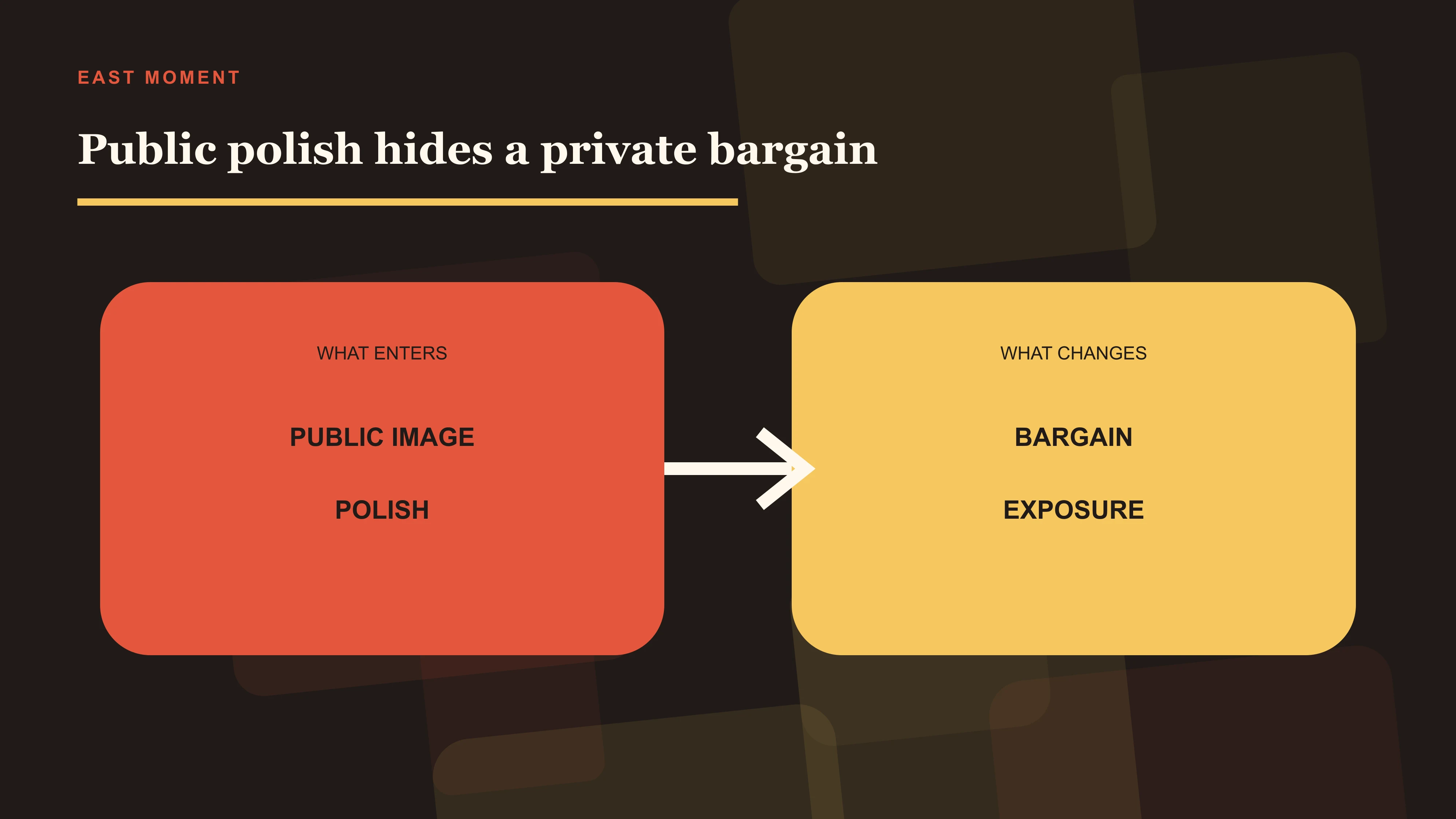
Xu Yan's constructed image gives her access and protection, but construction is not the same as falseness. People manage class signals because institutions and relationships reward some histories while punishing others. The drama becomes sharp when it shows the labour of maintaining that image: remembering what can be said, reading who has noticed a crack, and deciding which truth is more dangerous than the lie.
Shen Haoming must therefore be judged by what he does with information, not by how intense his gaze appears. If knowledge becomes leverage, the relationship is coercive even when the frame remains beautiful. If both leads surrender control and accept consequences, intimacy becomes possible. Chemistry cannot answer that ethical question by itself.
A room can be more honest than dialogue
Watch who enters first, who owns the space and who can leave without explanation. Public rooms reward performance; private rooms expose the cost of sustaining it. A doorway can turn a romantic composition into a negotiation because one person controls whether the scene continues.
This spatial reading also protects the page from becoming a recap. The plot tells us that a secret may be revealed. The room tells us who has the power to make revelation survivable.
The limitation: suffering does not automatically produce depth
Luxury melodrama can mistake escalating pain for psychological complexity. A character is not deep merely because the screenplay keeps hurting her. Each new injury must change strategy, trust or self-understanding. Otherwise the series is consuming distress while preserving the same relationship dynamic.
My verdict is demanding: Love's Ambition earns its title only when ambition includes the right to author one's own public self. If romance requires one person to surrender that authorship while the other keeps the power to expose her, the ending may be emotionally satisfying but the relationship has not become equal.
For the performer rather than the plot, continue to Zhao Lusi. For another drama where a woman turns reputation into strategy, compare The Double. Name the exact scene where an image stops protecting Xu Yan; that moment is more useful than a general verdict on the couple.
The class story is visible in what must be rehearsed
Public polish is often misread as vanity because the viewer sees the finished surface but not the social penalty for getting it wrong. Accent, clothing, table manners, family biography and professional confidence can all be read as class signals. Xu Yan's ambition becomes credible when the series shows her monitoring those signals under pressure.
That does not make every deception admirable. It makes the motive legible. The ethical line arrives when image management removes another person's ability to consent to the relationship they are actually in. Privacy is not the same as manipulation; disclosure is not the same as public punishment.
I would judge the drama through three revelations. First: the moment the audience understands what Xu Yan is protecting. Second: the moment Shen Haoming understands enough to choose leverage or care. Third: the moment Xu Yan can tell the truth without surrendering authorship of herself. If the third never becomes possible, the love story has confused possession with intimacy.
The supporting characters matter because they provide alternate audiences. A friend may know the older self; a colleague may reward the performed one; a family member may turn origin into obligation. Each relationship changes what truth costs.
This is also why a glossy still is useful but limited. It can prove that the production builds a controlled public world. Only a sequence can show the maintenance work and the crack. The page should keep both: visual pleasure and moral pressure, without pretending one cancels the other.
The ending therefore owes Xu Yan more than forgiveness. It must show whether she can keep ambition without living permanently inside defence. A relationship that accepts only the unguarded woman is another demand for performance. Love becomes credible when both the constructed self and the history that made construction necessary can be spoken without becoming weapons.
That is the scene I would return for: not exposure, but what happens after both people know enough to stop managing the other person's reality.
Only then can ambition stop functioning as an accusation. Wanting status, safety and authorship is not the moral failure; treating another person's vulnerability as property is. The drama's deepest possible ending would preserve desire while ending the right to control the other's narrative.