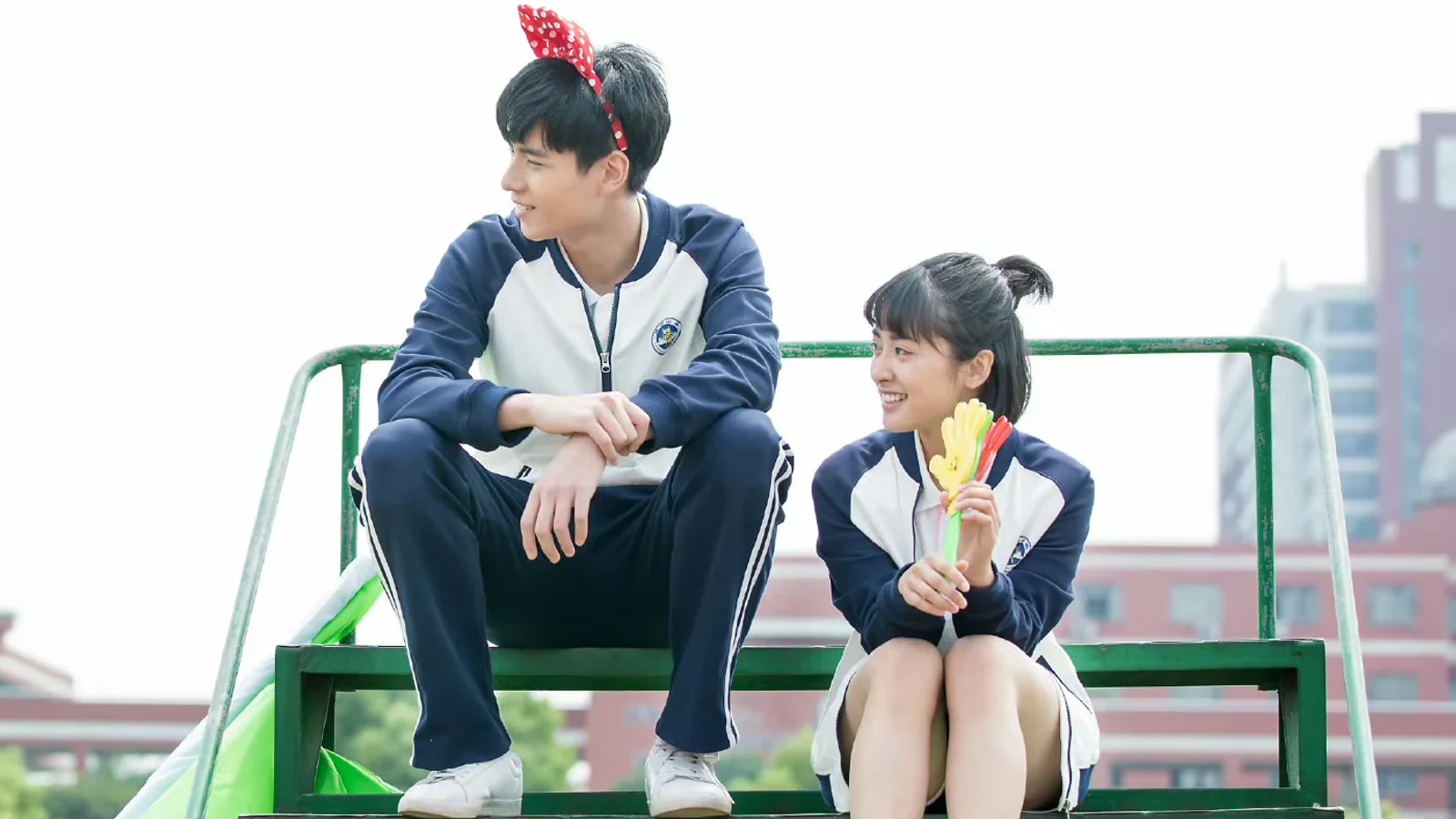
A Love So Beautiful is still worth watching, but the best reason is not Jiang Chen's cold-genius appeal. It is the crowded, embarrassing life around Chen Xiaoxi: borrowed notes, sports-day loyalties, exam pressure, classroom gossip and friends who witness each other becoming adults. The drama preserves school memory better than it justifies the romance. Watch it for the five-person youth ensemble; keep a critical eye on how often Xiaoxi must make herself smaller to keep chasing one boy.
A Love So Beautiful: the quick decision
| Question | East Moment answer |
|---|---|
| Chinese title | Zhi Wo Men Dan Chun De Xiao Mei Hao (致我们单纯的小美好) |
| Version covered | The 2017 original Chinese drama, not the later Korean or Thai adaptations |
| Leads | Shen Yue as Chen Xiaoxi; Hu Yitian as Jiang Chen |
| Essential ensemble | Gao Zhiting as Wu Bosong, Wang Ziwei as Lin Jingxiao, Sun Ning as Lu Yang |
| Best quality | School life feels socially inhabited rather than built only for two leads |
| Main weakness | Repetition can turn Jiang Chen's reserve into a reward and Xiaoxi's devotion into unpaid emotional labor |
| Ending | Happy and conclusive for the central couple |
| Who should watch | Viewers who want warm youth texture and can tolerate a persistent chase dynamic |
Give it three episodes. Continue if you enjoy how the classroom reacts as a group and if Shen Yue makes Xiaoxi's embarrassment feel active rather than merely cute. Stop if emotionally unavailable male leads make you impatient: the basic imbalance is not a temporary misunderstanding that disappears after Episode 3.
The corridor matters more than the confession
The usual summary says that cheerful Chen Xiaoxi has long loved her brilliant neighbor Jiang Chen. That is true and almost useless. It reduces a school world to one arrow pointing from a girl to a boy.
What makes the original drama durable is circulation. Xiaoxi moves between desk, corridor, home, sports field and friend group. Every space gives her a slightly different self. She can be academically insecure beside Jiang Chen, shamelessly inventive when she wants his attention, protective with a friend and suddenly quiet when a joke lands too close to the truth. Adolescence appears not as a clean identity but as constant adjustment under other people's eyes.
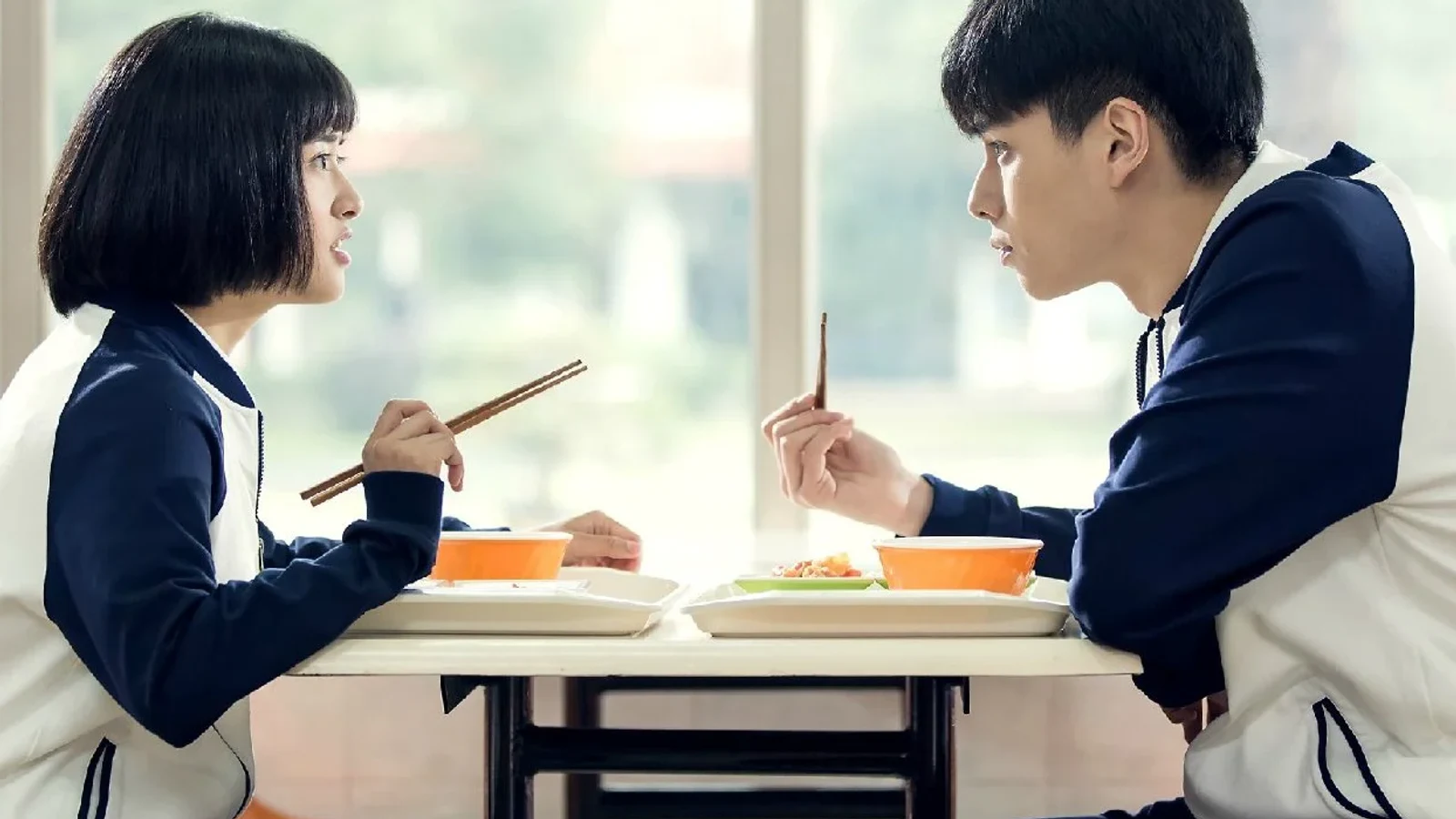
The cafeteria table proves why the school environment matters. Trays, uniforms and a shared public room keep the pair inside ordinary student life; neither character can turn the exchange into a private fantasy without classmates and routine pressing in from outside the frame.
That is the China-specific texture an overseas synopsis misses. The class is not scenery. Seating, test scores, teacher attention and the route home organize intimacy. A confession is never only private when classmates already know who waits for whom. Academic ranking also changes how confidence is distributed: Jiang Chen's competence is treated as natural authority, while Xiaoxi is asked to turn persistence and sociability into her value.
The memory becomes concrete through passing love letters, going to an internet cafe, memorizing vocabulary, listening to a teacher nag and Xiaoxi playing Bai Suzhen. That list supports my argument better than a platform popularity slogan: the drama survives in memory through mundane school actions. It cannot prove that every viewer feels nostalgic or that the romance is healthy.
He really does look like the boy someone once secretly liked. That feeling explains what a generic word such as “relatable” hides: an unfinished personal memory can settle over Jiang Chen's face. The projection is real human feeling, but it is not evidence that Jiang Chen is an ideal boyfriend. My reading keeps the memory and the relationship judgment separate.
My judgment is that the drama understands the emotional weather of school better than it understands equality in love.
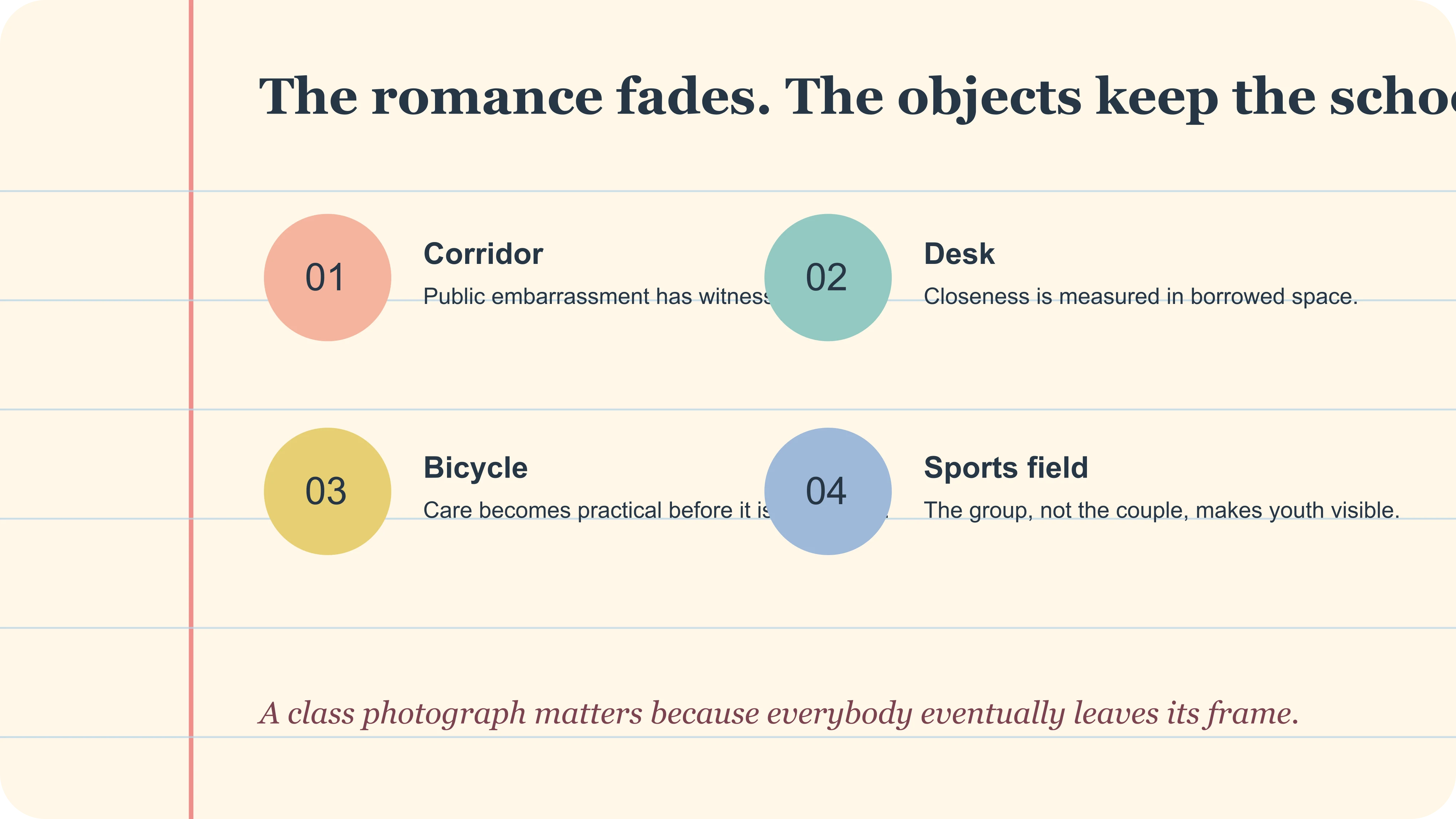
These objects are not nostalgia props. Each one changes who can see the relationship and who can act. A desk creates forced proximity. A corridor turns private hope into public risk. A bicycle converts affection into a practical decision about waiting. The sports field gives Wu Bosong a form of authority the exam ranking cannot supply. The drama feels truthful whenever an object performs that social work instead of merely decorating a warm color grade.
Chen Xiaoxi is not foolish; she is socially brave
Calling Xiaoxi naive misses Shen Yue's best work. The character repeatedly risks public embarrassment. She approaches, fails, improvises and returns to the group. That is not intellectual brilliance, but it is a form of courage that school hierarchies often undervalue.
Watch the half-second after Xiaoxi realizes other people have seen her hope. Shen Yue frequently lets the face fall before rebuilding the smile. The rebuild is important: comedy is how Xiaoxi remains in the room after rejection. Her brightness is therefore not an empty personality label. It is a survival method.
The limitation is that a survival method can become a script. When the story repeatedly asks Xiaoxi to pursue while Jiang Chen controls recognition, her energy stops opening possibilities and starts servicing his mystique. A stronger version would let her curiosity attach to work, art, friendship and ambition as forcefully as it attaches to him.
This is why the dedicated Shen Yue guide should be read separately. This page owns the drama's relationship and ending; her wider career page asks whether later roles stretch the approachable screen identity that began here.
Jiang Chen's silence is attractive until it becomes power
Hu Yitian gives Jiang Chen an economical presence. Height, stillness and a restrained response make him legible before he says much. Beside Xiaoxi's movement, this restraint creates clean romantic contrast.
But viewers should distinguish performance from relationship ethics. Silence can suggest private feeling; it can also force the other person to do all the interpretive work. Intelligence can make a teenage character compelling; it does not make his choices automatically mature. Jealousy can reveal attachment; it is not a substitute for communication.
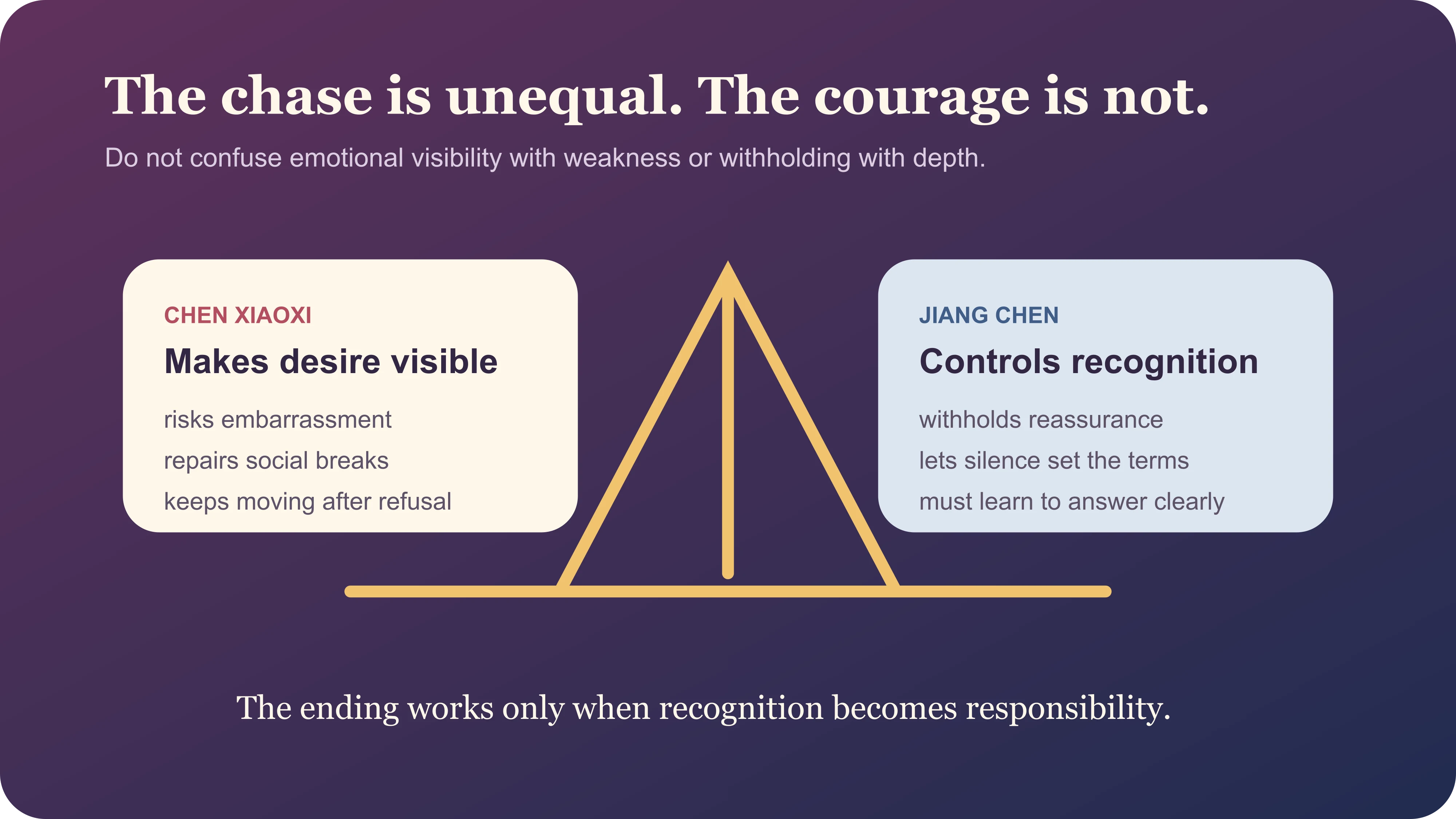
The imbalance is why I refuse the easy reading that Xiaoxi is simply foolish while Jiang Chen is naturally deep. She repeatedly risks a visible answer. He often controls when feeling becomes legible. Her method can become exhausting and his can become unfair, but courage belongs to the person accepting social risk, not automatically to the person who looks calm. The adult ending improves only when recognition finally becomes responsibility rather than a reward kept behind silence.
That distinction is the drama's most useful adult rewatch. It lets affection survive without turning every unequal behavior into destiny.
Viki's official trailer packages the attraction efficiently: her visible pursuit, his controlled face, the friends around them. Use it as an identity check, then ask a harder question while watching the full drama: when does Jiang Chen take a risk equal to Xiaoxi's? The romance becomes satisfying only when his interior feeling becomes accountable action.

This does not require a modern character to speak like a therapist. It requires consequence. If one person withdraws, who repairs? If jealousy creates pressure, who names it? If a future decision affects both lives, who gets to choose?
Wu Bosong, Jingxiao and Lu Yang keep the youth story honest
Wu Bosong is often reduced to “the second lead who deserved better.” His real function is larger. Sport gives the group another measure of achievement, and his direct warmth exposes how much emotional scarcity the central romance asks viewers to romanticize. He is not automatically the correct partner because he is kinder. He is evidence that Xiaoxi's world contains other forms of recognition.
Lin Jingxiao and Lu Yang are even more important to the show's memory. Their presence prevents every school event from becoming a disguised date. Friendship has its own awkwardness, protection and future. The ensemble also shows that the same institution feels different depending on grades, health, family expectation and social confidence.
That is why I would recommend When I Fly Towards You next. It develops the five-person friendship fantasy more evenly; the Zhou Yiran profile tests whether Zhang Lurang's quietness becomes reciprocal action rather than merely a surface for affection. Choose Hidden Love instead when you want a more concentrated romantic point of view and are willing to test a different life-stage imbalance.
The objects remember school more honestly than the romance does
What stays with me is rarely a grand line. It is the thickness of an exercise book, the panic of a folded note changing hands, a bicycle waiting after class and the strange public silence when a teacher has exposed something everybody already knew. These objects carry the drama's best truth: school love feels private while taking place inside a system that gives teenagers almost no privacy.
The internet cafe matters for the same reason. It is not retro decoration. It is temporary territory outside home and classroom, a place where young people can try a different voice before adults call them back. A sports field gives Wu Bosong competence the academic hierarchy cannot measure. The route home gives Xiaoxi and Jiang Chen a repeated intimacy that does not need an official date.
This is why the Chinese original travels so well even when subtitles flatten some jokes. Overseas viewers may not share the exact timetable, exam system or neighborhood layout, but they recognize the emotional physics of supervised youth: tiny freedoms feel enormous, witnesses make embarrassment permanent, and an ordinary object can hold a whole unfinished feeling.
Does A Love So Beautiful have a happy ending?
Yes. The adult timeline brings Chen Xiaoxi and Jiang Chen into a stable, explicit future together. The ending closes the central romance rather than leaving an ambiguous separation.
The more interesting question is what adulthood repairs. Professional life gives both characters identities beyond the classroom, and Jiang Chen must become more explicit about choosing the relationship. That improves the balance. It does not erase the long period in which Xiaoxi supplied most of the visible pursuit.
So the happy ending works emotionally if you read the school years as incomplete people learning to act. It works less well if you read every cold response as secret proof that Jiang Chen was always the ideal partner. Later commitment can demonstrate growth; it cannot retroactively make every earlier behavior generous.
Where to watch and what to notice
Use the Viki title page to check current availability and subtitles in your country. Catalogs and free-versus-member access can change. East Moment does not direct readers to unauthorized mirrors.
On a first watch, follow three details:
- Who witnesses the moment? A classroom reaction often changes the meaning of a private feeling.
- Who repairs the distance? Count actions, not implied affection.
- What survives outside romance? Notice the friends, family routines and school pressures you remember after the couple's scene ends.
My final verdict is affectionate but not uncritical. A Love So Beautiful deserves its place in the international C-drama entry canon because it catches how enormous small school events once felt. Its romance is sweeter when treated as growth, not as proof that persistent girls should wait for silent boys to reveal a hidden reward.
Continue through the Chinese television guide. In the comments, bring one scene that feels uncannily true to school life and one behavior you would not romanticize now. The community becomes useful when nostalgia and criticism can occupy the same conversation.