Shen Yue's strongest quality is not that she looks “ordinary.” It is that she can make a romantic heroine occupy ordinary scale: awkward rooms, unfinished sentences and feelings that arrive before a polished response. The same familiarity becomes a limit when every role receives the same rhythm.
Shen Yue is persuasive when relatability becomes behavior
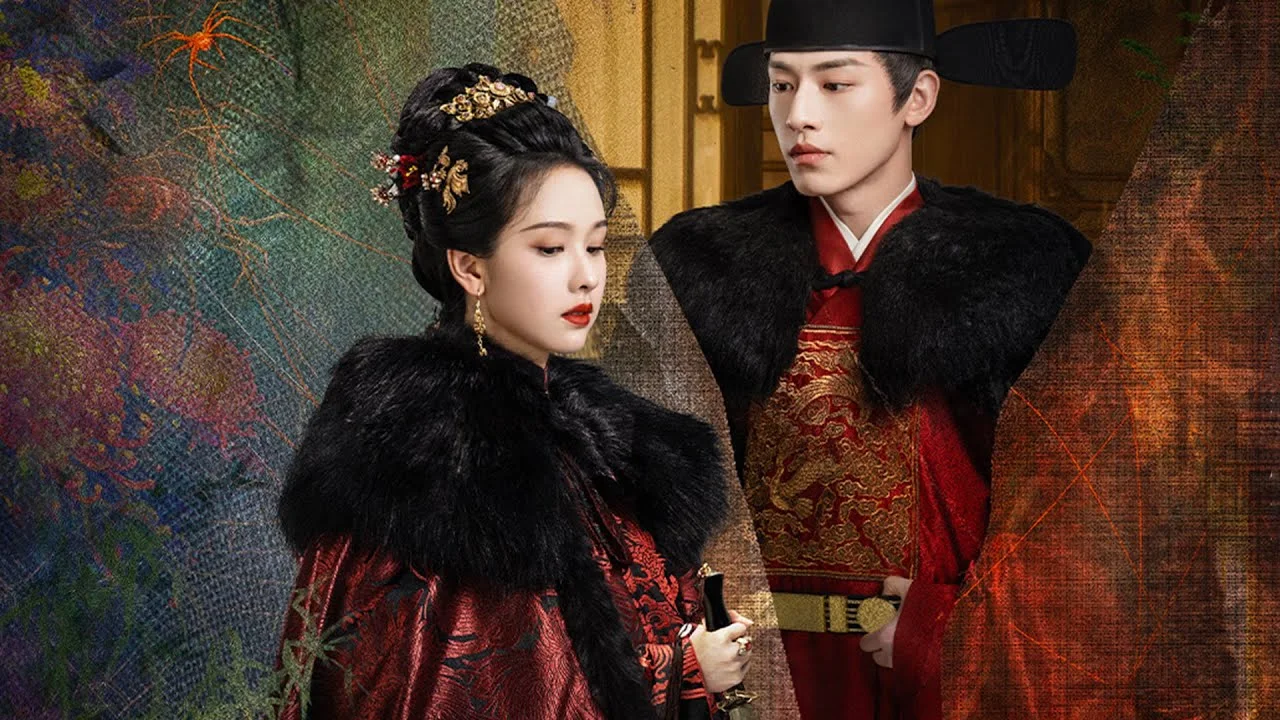
Netflix's official Meteor Garden trailer establishes the oversized romantic world around Shen Yue's Shancai. The useful performance question is how she keeps an ordinary human scale when the production keeps trying to enlarge every feeling.
Shen Yue (沈月) is a Chinese actor internationally known for A Love So Beautiful and the 2018 Meteor Garden. Start with those two because they explain her screen identity, then move to Mr. Bad and later work to see whether the familiar rhythm stretches.
If you searched for Shen Yue dramas because you want a quick starting point, do not begin with a popularity list. Begin with A Love So Beautiful for social timing, use Meteor Garden to test that timing against spectacle, and then watch one adult role to ask the harder question: can the same openness carry work, money, fatigue or responsibility without becoming a preset reaction?
Relatability is often discussed as if casting an accessible face completes the job. It does not. Shen Yue's useful choices are behavioral: entering a conversation too quickly, failing to hide disappointment, recovering dignity after a comic beat. Her early heroines feel young because social timing is unfinished, not because the script announces innocence.
Meteor Garden enlarges the world around her
Netflix's series page identifies Shen Yue as Dong Shancai in the 2018 adaptation. Meteor Garden surrounds that character with wealth, beauty and melodramatic scale. Shen Yue's task is to keep conflict human when the premise becomes operatic. Her stubbornness works when it feels like a person protecting a boundary, not when escalation is merely required for the next romantic reversal.
The adaptation carries inherited expectations before Shen Yue enters the frame. Shancai is not merely a new heroine; she is a role that viewers already know how to compare. That pressure makes every protest louder. In a classroom-sized romance, a quick flare of temper can feel like youthful defense. Inside Meteor Garden, the same rhythm can look mechanically assigned because wealth, violence and romantic spectacle have already enlarged the room.
This is not a reason to blame the actor for the entire production. It is a better test of scale. Shen Yue is convincing when Shancai's defiance begins in a practical boundary—work, dignity, friendship, the right not to be handled. She is less convincing when the scene demands a generic burst of stubbornness and cuts away before consequence settles. The gap tells us exactly where relatability becomes craft and where the adaptation spends it as a shortcut.
Read our Meteor Garden guide for the adaptation history and our Dylan Wang profile for the opposite side of its star-making chemistry.
A Love So Beautiful made unfinished youth feel complete
The power of A Love So Beautiful is not that Xiaoxi behaves like an ideal student or a perfectly mature first love. She does not. The school corridors, passing notes, small jealousies and badly timed courage feel alive because Shen Yue allows embarrassment to remain visible after the joke has landed.
The emotional evidence arrives in sequence: Xiaoxi risks being seen, realizes that hope has become public, loses the smile for half a second and then rebuilds it so she can remain with the group. I recognize that recovery. At school, embarrassment rarely ends when the scene ends; you still have to return to the same desk the next morning. The dedicated drama page keeps the classroom stills because those images prove the work's social space; this actor page needs to show what happened after that space stopped defining her.
That mattered to a generation watching Chinese youth drama travel overseas. The series did not need palaces or fantasy rules to explain its world. A classroom seat, a test result and the distance between two desks carried the stakes. Shen Yue's scale matched those objects. She could make a tiny social disaster feel enormous without pretending it was historically important.
The limitation arrived with success. Once “relatable girl” became a marketable identity, every later role risked inheriting the same quick protest, rounded disappointment and comic recovery. A screen personality can open the door; it cannot be allowed to write every character.
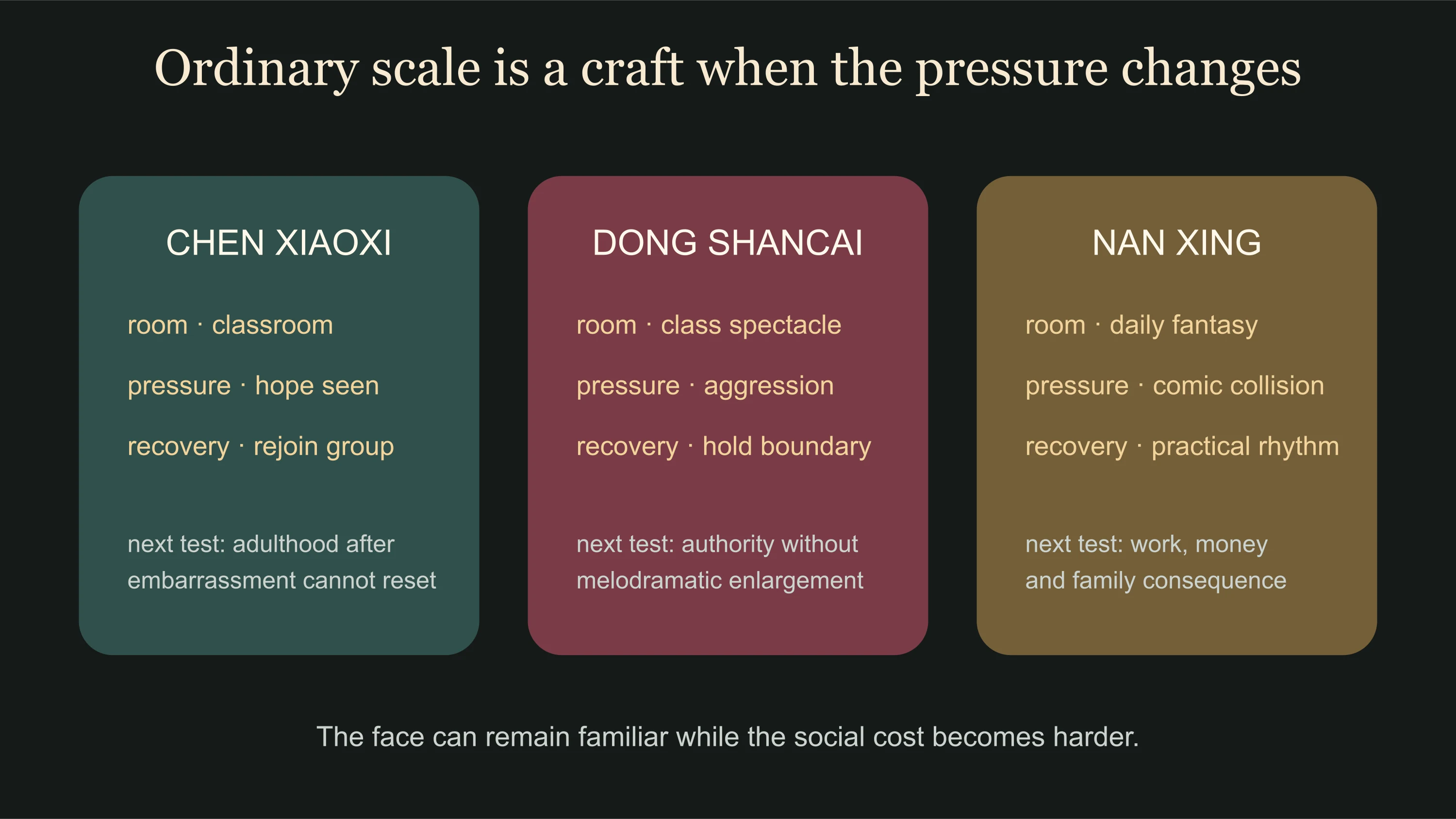
The diagram is my route through her work, not a scorecard. Xiaoxi is tested by public embarrassment inside a friend group; Shancai by class spectacle and romantic aggression; Nan Xing in Mr. Bad by the collision between fantasy confidence and practical daily rhythm. What I want next is a role in which work, money or family duty prevents the familiar comic reset.
Later roles must disturb the familiar rhythm
Mr. Bad knowingly plays with fantasy and romantic expectation. It is a useful test because comedy can expose whether a familiar reaction is precise timing or a reusable mannerism. A later role succeeds when the same accessible energy acquires a new social cause: work, grief, class, family or adult compromise.
My affection, nostalgia and skepticism toward Shen Yue can coexist. I separate defense of her personhood from criticism of her work: a person deserves dignity, and a performance can still be examined.
Smile Code gives this argument a better adult test than another school romance. Gu Yi performs stand-up at night while trying to survive Shanghai working life by day. The verified WeTV series page identifies a woman who uses humor as labor, not merely as a cute reaction. That difference is decisive. A comic beat now has a bill behind it, an audience that may reject it and a private wound that cannot be repaired by a school bell.
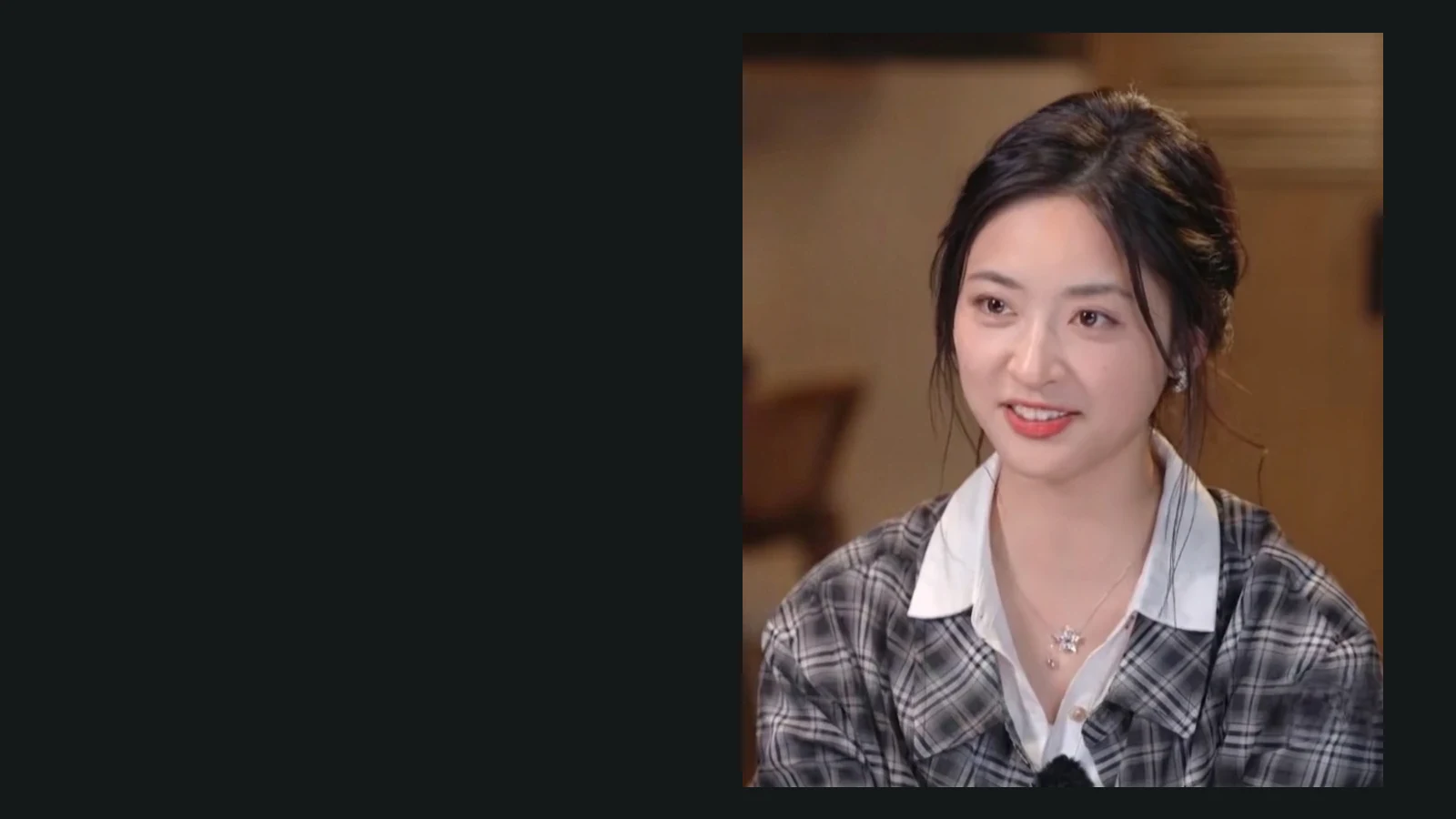
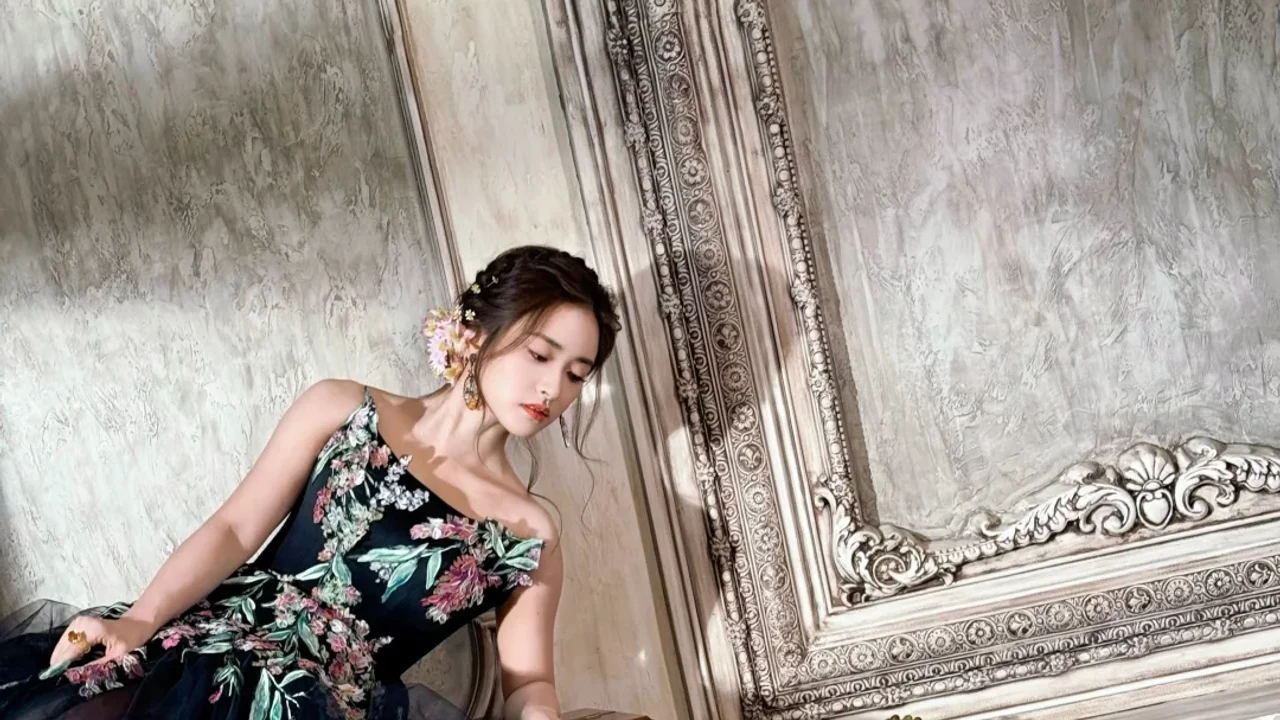
This 2026 frame matters because it interrupts the frozen schoolgirl image with a present-tense adult face in conversation. It proves the dated public appearance and gives us a current visual reference; it cannot prove her private personality or the quality of a scripted performance. The value is temporal: a serious actor page must show the person now, not preserve her forever in the role that first made international viewers notice her.
The role does not magically erase old habits. It does something more useful: it exposes whether Shen Yue can control them. When Gu Yi performs, quickness is professional equipment. When she leaves the stage, the same quickness can become avoidance. I want to see that switch clearly. Comedy becomes acting range when the laugh protects one thing in public and betrays another thing in private.
Adulthood should change the temperature, not erase the charm
I do not want Shen Yue to become solemn simply to prove maturity. Comedy is one of her strengths. The more interesting development is letting adult consequences alter the recovery. A schoolgirl can survive an awkward confession by running away; a working adult may have to return to the same room, finish the meeting and live with what was said.
That is the role I am waiting for: not a rejection of the early heroines, but an extension of them. Keep the speed, openness and instinct for embarrassment. Add professional competence, money, family obligation and the knowledge that charm does not reset a damaged relationship. Then familiarity becomes history rather than repetition.

This casual photograph matters more to my reading than another frozen romantic close-up. The body is already telling a joke: one arm reaches out of the frame, the smile is too large to be ornamental, and the bag is allowed to remain part of the moment. It proves neither acting quality nor private personality. It does show why “approachable” follows her across roles. The camera does not have to manufacture access; she knows how to make a pose feel like an interruption from a lively friend.
That gift is rare, and it can be a trap. A performer who makes access look effortless is repeatedly asked to sell access. Casting begins to confuse the actor's usable public energy with a complete character. My standard is therefore demanding precisely because the gift is real: every new heroine must have a private logic that could survive without Shen Yue's smile.
Small rooms are where her acting becomes large
Shen Yue's scale is especially effective in kitchens, classrooms, rented rooms and crowded family spaces. She does not need a throne room to make status visible. A delayed answer, an object held too long or a body trying not to inconvenience someone can tell us who feels entitled to the room. This is why “relatable” should be treated as spatial intelligence rather than a compliment about appearance.
The risk is repetition. Awkwardness cannot always begin with the same blink, half-smile or lowered voice. Adult roles should give her new reasons to remain quiet: professional calculation, care fatigue, money, anger that cannot safely be released. The rhythm may stay gentle while the stakes become less forgiving.
My ideal next step is not a glamorous transformation. It is a character whose ordinary face must carry authority, appetite and a decision that other people genuinely dislike. Familiarity becomes durable range when the audience recognizes the person but cannot predict the response.
There is also cultural value in refusing to treat “ordinary” as a lesser form of stardom. Shen Yue's early success helped overseas viewers enter Chinese youth drama through classrooms, cheap meals, group teasing and the humiliating courage of liking someone first. Those details are not smaller than fantasy world-building. They are a different archive of contemporary Chinese growing up. Her long-term challenge is to let that archive age with her instead of preserving youth as a permanent commercial pose. That is why I would rather see her play an overworked woman who has to keep a promise than another heroine whose biggest problem is whether she should run away blushing.
Three camera distances reveal more than three fan adjectives
The fairest way to test Shen Yue is not “cute, natural or limited.” Those words are verdicts without evidence. Watch the same character at three distances.
In close-up, ask whether a thought arrives before the expression. Her strongest close-ups contain a brief social calculation: she understands that she has revealed too much, then decides whether to repair it. If the smile, blink or lowered gaze arrives on schedule regardless of the other actor, relatability has become a reusable signal.
In a two-shot, watch exchange. Does her rhythm change because the other person withholds, interrupts or moves closer? A Love So Beautiful works here because embarrassment belongs to a group, not to an isolated beauty shot. Smile Code raises the difficulty: adult intimacy should alter the performer who is professionally trained to turn discomfort into a joke.
In a full-body beat, look for status. Who occupies the doorway? Who approaches and who makes room? Shen Yue's accessible screen energy is most precise when the body wants to join the group but pride delays the final step. This distance also exposes repetition fastest; a familiar bounce, retreat or comic reset cannot hide behind editing.
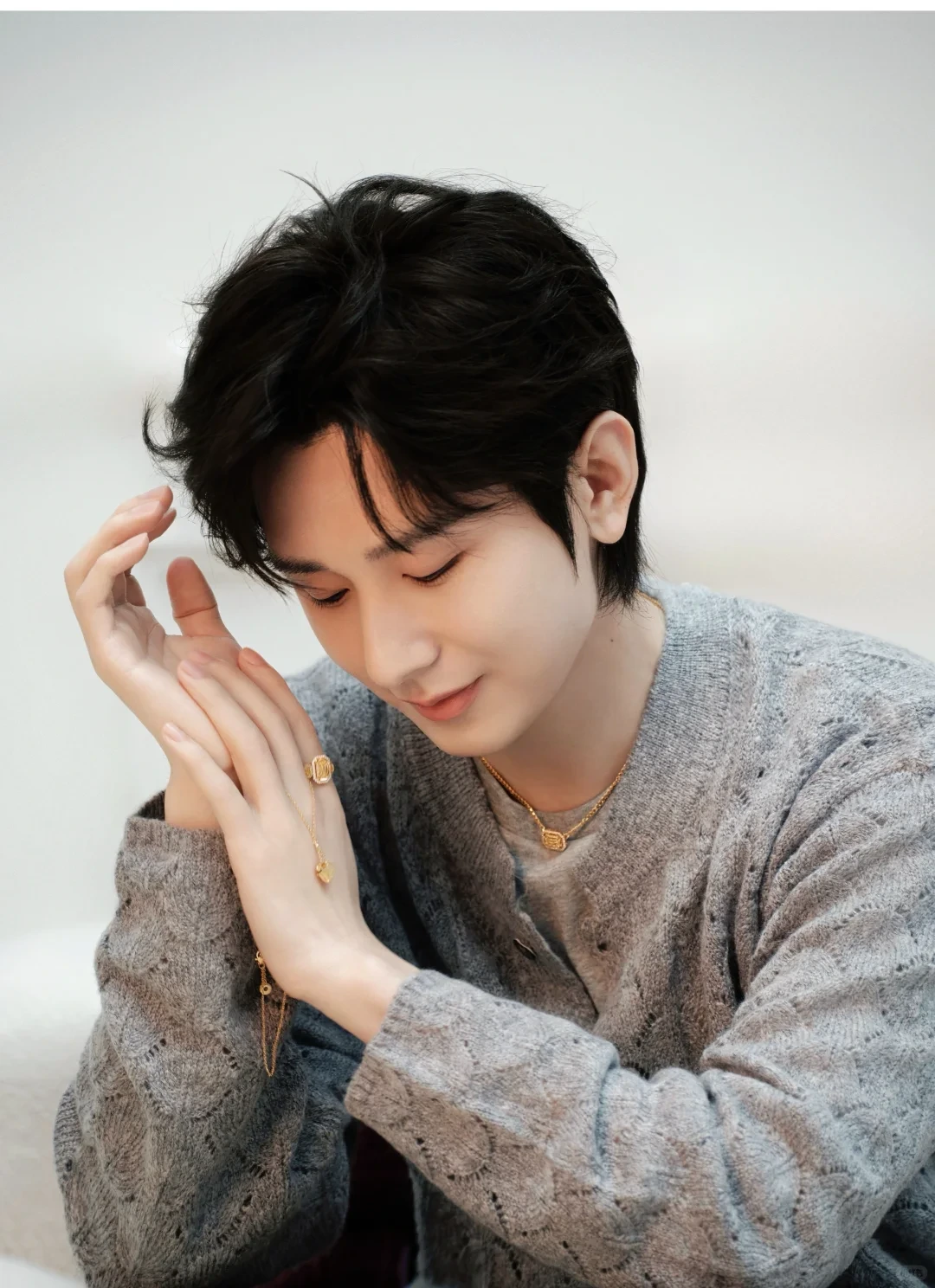
I would rather keep one honest two-shot than ten decorative portraits. A face can confirm identity. A relationship image shows what the actor is doing. That is why the two documentary-style photographs on this page have different jobs: the festival portrait records public star construction, while the casual frame shows how quickly she can make a camera feel socially close. Neither proves range. The scenes must do that.
From schoolgirl speed to adult consequence
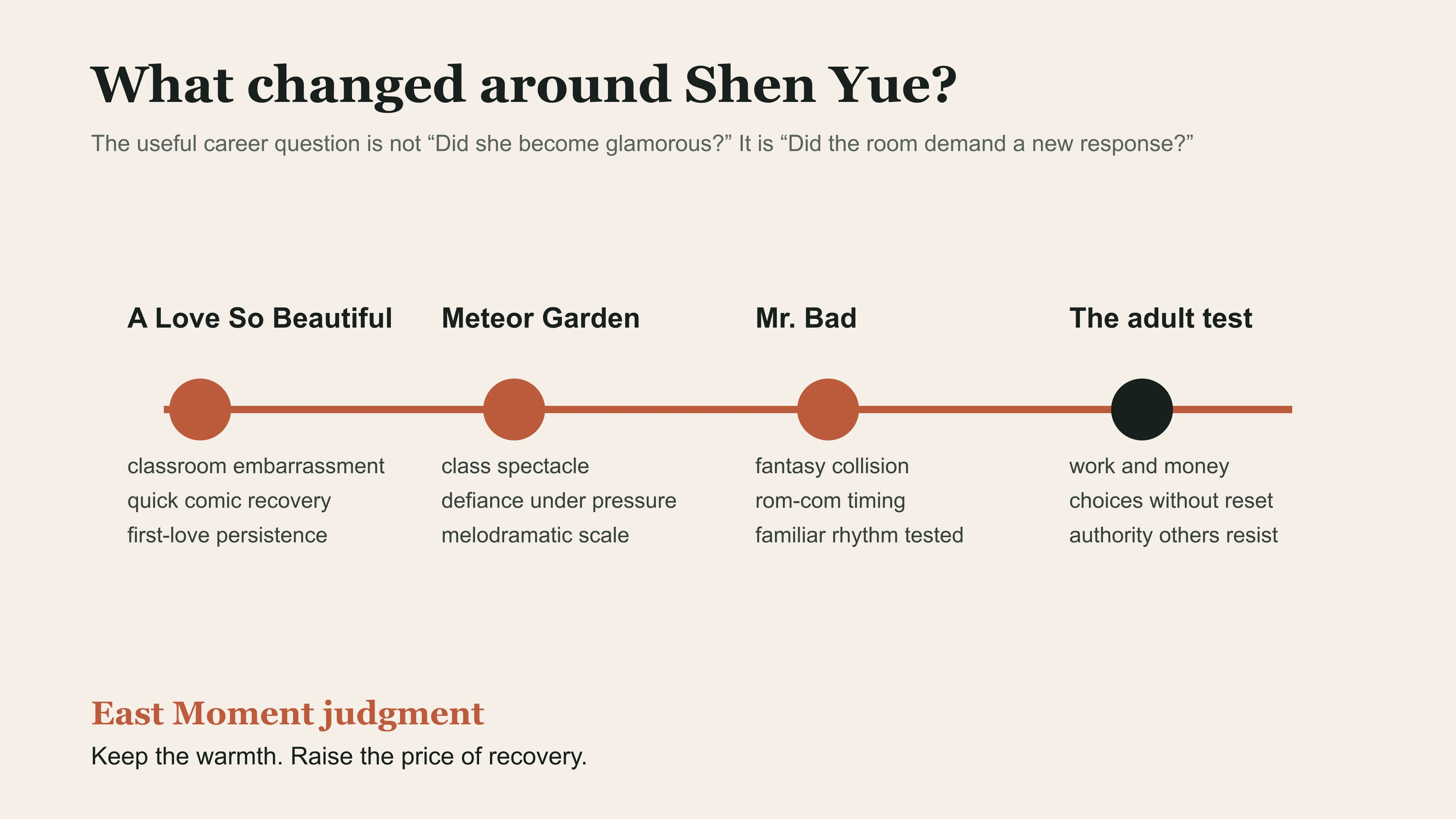
The four stops above are not a ranking. They track what the room demands. Xiaoxi can run from embarrassment and return the next day. Shancai has to resist a class spectacle designed to make her smaller. Nan Xing turns fantasy collision into comic timing. Gu Yi must make humor function as work while the rest of her life refuses to become a clean punchline.
This is why a filmography list cannot answer the real search intent. Yes, viewers want to know Shen Yue's best dramas. They also want to know whether the actress they loved in a school uniform grew with them. My answer is firm: the growth is visible whenever the consequence lasts beyond the reaction. It remains incomplete whenever a production borrows the old brightness without giving it a new cost.
I do not need a grim role to certify adulthood. That is another lazy industry habit: put a familiar romantic actor in grey light, remove the smile and call the result transformation. Shen Yue's harder path is to keep the speed and warmth while making them socially expensive. A joke should save a meeting and wound a relationship. An approachable face should win trust from the wrong person. Optimism should become a decision somebody else resents. Those contradictions would not replace her screen identity; they would finally give it adult consequences.
The most valuable next role would place her inside an ensemble where charm cannot control the room: a newsroom deciding what not to publish, a family business with unpaid debt, a teacher facing a student she cannot rescue, or a woman whose romantic decision harms somebody she still loves. None of these require a “dark transformation.” They require social resistance. The audience should understand her impulse and still fear what it will do.
My verdict and route
Shen Yue is best when ordinary scale becomes exact behavior. Begin with A Love So Beautiful for youthful timing, use Meteor Garden to see that timing against spectacle, then choose a later role and ask whether adulthood changes how the character occupies silence, conflict, embarrassment, responsibility and irreversible choice.
Continue through the Chinese actors collection and compare another contemporary-romance route in the Chen Zheyuan guide. In the comments, name one role where familiarity became a specific person, with a room, pressure and consequence you can describe. Join the East Moment community to compare complete scenes without appearance-based scoring.