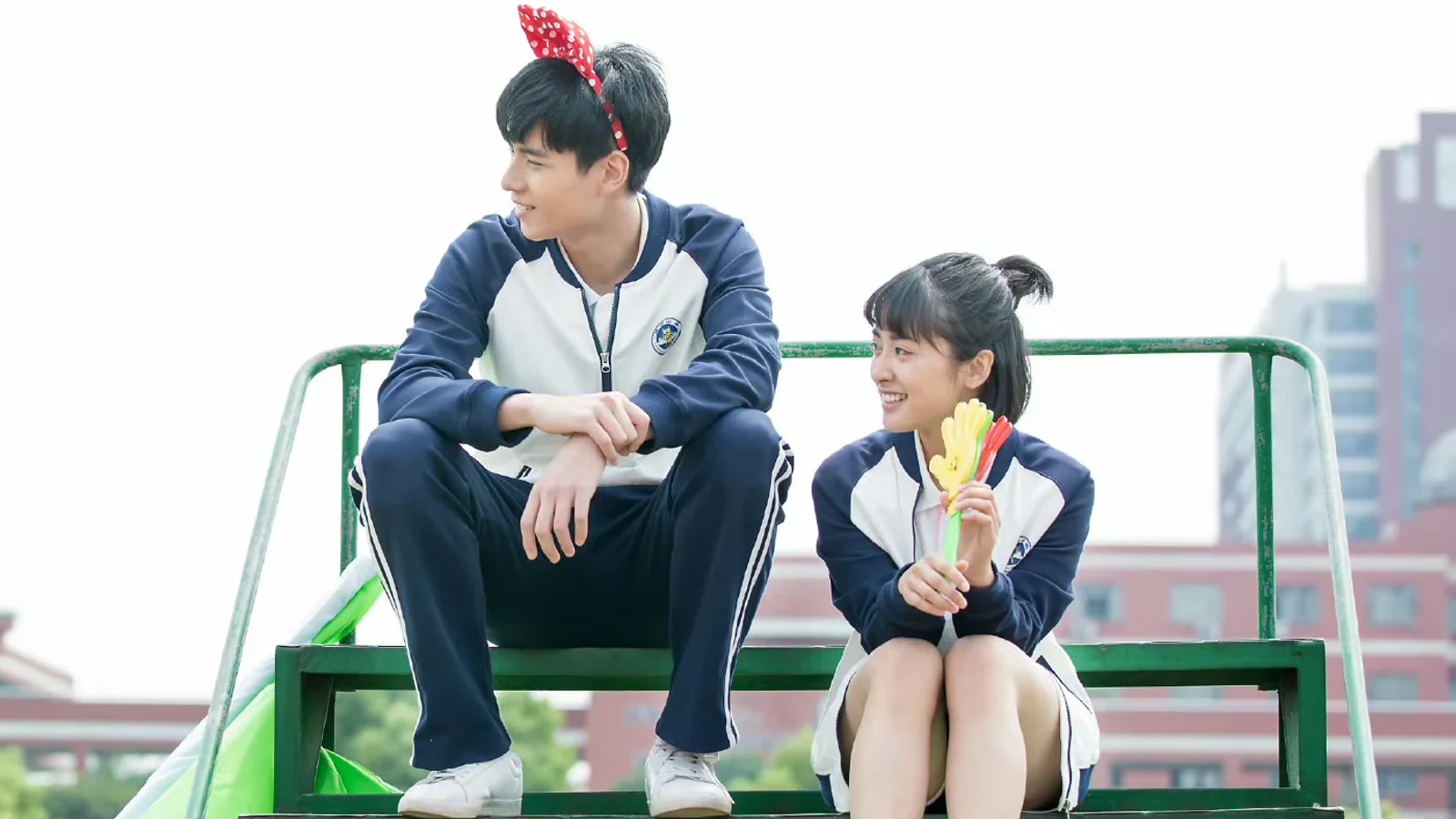
When I Fly Towards You is worth watching, but not because it is “healing” in some vague, frictionless way. Its real subject is who gets to define a young person. Zhang Lurang's family reads him through comparison with his younger brother. Su Zaizai's camera reads him through attention. He matures when he stops living as the object of either gaze and begins to answer, choose and finally narrate himself. That is why the sweetness has weight. The five-person friendship prevents this recovery from becoming the fantasy that one girlfriend can fix an entire life.
When I Fly Towards You in 60 seconds
| Question | Short answer |
|---|---|
| Chinese title | Dang Wo Feiben Xiang Ni (当我飞奔向你) |
| What it is | A 2023 Chinese school and coming-of-age romance |
| Leads | Zhang Miaoyi as Su Zaizai; Zhou Yiran as Zhang Lurang |
| Director | Mao De Shu, often credited in English as Cat Tree |
| Core group | Su Zaizai, Zhang Lurang, Gu Ran, Jiang Jia and Guan Fang |
| Why it became a comfort favorite | It turns small acts of attention into visible changes without using cruelty as plot fuel |
| Main limitation | Its protected emotional world softens class, exam and family consequences |
| Ending type | Happy and conclusive for the central couple; details below are spoiler-marked |
| East Moment verdict | Watch if you want emotional safety with real character logic, not high-stakes melodrama |
The series is an easy recommendation for comfort-drama viewers, but “cute” is not a critical explanation. Its achievement is formal as well as emotional: phone recordings, remembered details and repeated group spaces show one life being re-edited. A boy introduced through somebody else's verdict gradually becomes a person capable of giving his own answer.
The decision: should you watch all 24 episodes?
Watch the first three episodes, then make a deliberate decision.
- Continue if you respond to reaction shots, interrupted conversations, remembered preferences and group rhythm. This drama pays in accumulation, not shocks.
- Stop if you need a strong antagonist, large reversals or sustained social pressure. The series does not later become a darker school drama.
- Skip directly to something else if persistent pursuit makes you uncomfortable even when the other person retains room to respond. Su Zaizai's initiative is the engine, not a brief opening device.
My judgment is specific: the series earns its 24-episode length because the relationship changes in small increments while the ensemble remains alive. It would not survive 40 episodes; its emotional scale is exactly the reason it works.
What the story is about, without spoilers
Su Zaizai meets Zhang Lurang around the beginning of a new school chapter and is immediately curious about him. She is expressive, socially direct and willing to risk embarrassment. He is restrained, academically capable and accustomed to measuring himself against his younger brother Zhang Luli. What looks like a familiar bright-girl/quiet-boy pairing gains weight from that asymmetry: she can state interest without treating it as weakness; he receives interest as something he does not yet know how to trust. At home, comparison has taught him that competence is always provisional: another result can cancel it.
Their classmates Gu Ran, Jiang Jia and Guan Fang turn the premise into an ensemble. School is not merely the corridor between romantic scenes. It is where friendship, teasing, study, family expectations and small failures give everyone a social position.
There is no need to approach the series as a puzzle. The central question is not whether Su Zaizai likes Zhang Lurang. It is whether Zhang Lurang can stop interpreting affection as a mistake that will be corrected once someone sees a better version of him.
Lijun's reading: the camera is the most important object in the drama
Su Zaizai's recordings are often treated as cute packaging for nostalgia. I think they contain the drama's clearest idea.
A family comparison compresses Zhang Lurang into a ranking: better or worse, promising or disappointing. A romantic camera could become another form of possession, turning him into the beautiful silent boy in somebody else's private film. The series avoids that outcome only when the recorded person develops the power to respond.
This gives the ending its meaning. The camera is not valuable because it preserves youthful faces. It records the movement from being described to participating in the description. Su Zaizai first makes Zhang Lurang visible to herself. The relationship becomes adult when visibility is no longer one-way.
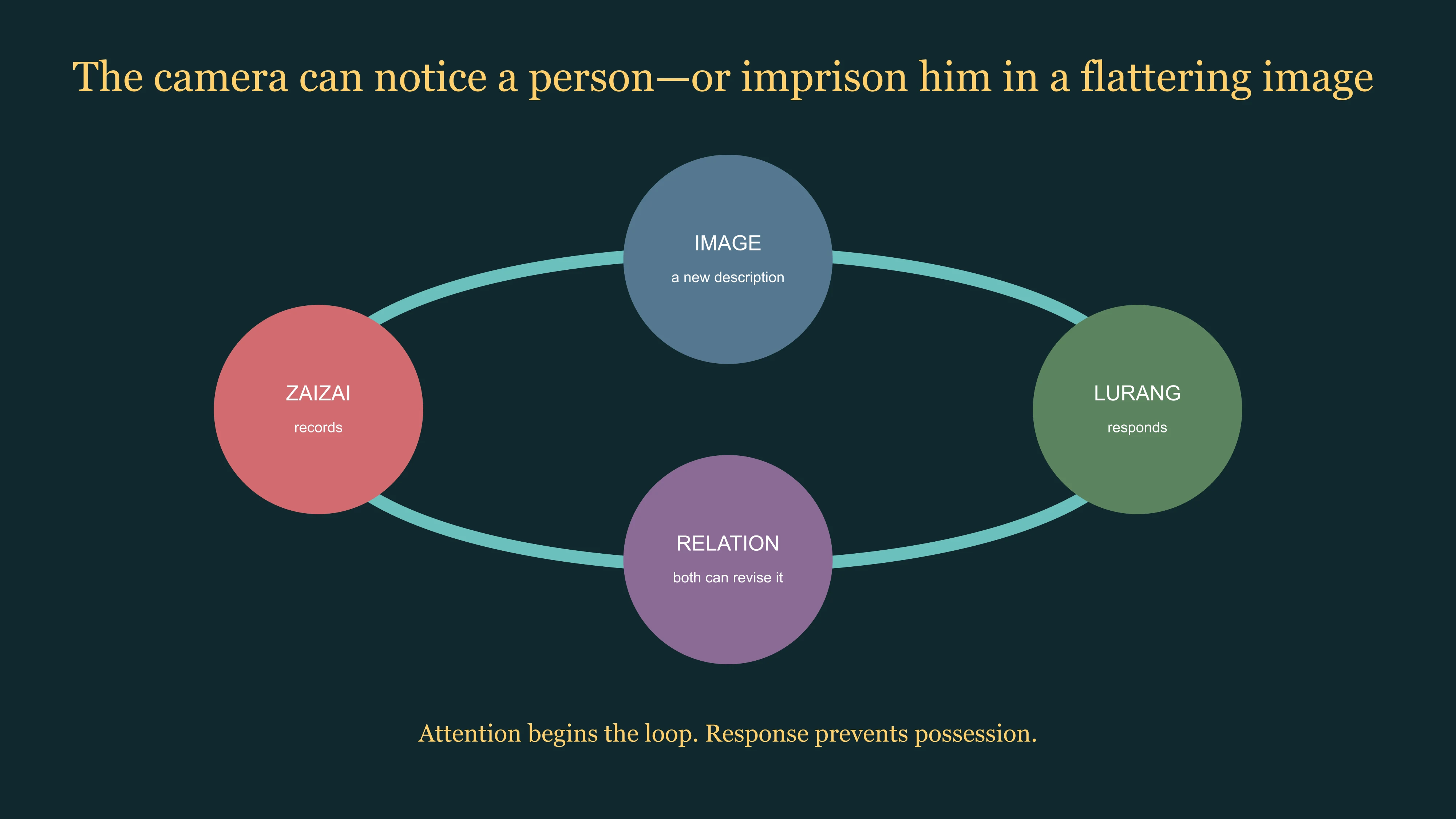
That is also my reason for rejecting the weakest description of the show: “a cheerful girl heals a depressed boy.” It makes Su Zaizai a treatment and Zhang Lurang a patient. The drama is better than that. She offers a counter-reading; he must still decide whether to live inside it.
The romance works because attention becomes reciprocal
Su Zaizai's pursuit could have become exhausting if the drama treated persistence as entitlement. It mostly avoids that trap by making her attention specific. She notices mood, hesitation and effort. Her openness is not a demand that Zhang Lurang instantly match her emotional speed.
Zhang Lurang's half of the romance is quieter and therefore easier to miss. Growth appears when he begins to remember what matters to her, make space for her presence and act before a crisis forces him. These are small choices, but they change the direction of the relationship. She is no longer the only person crossing the distance.
That distinction is the page's central verdict: a healthy reading of the drama depends on response, not pursuit. Su Zaizai's confidence starts the motion. Zhang Lurang's developing agency makes it mutual.
YOUKU's official relationship collection places the pair inside the classroom rather than isolating them in a fantasy landscape. Watch the linked scenes for changes in who initiates, who waits and who reorganizes a choice around the other person.
Four tests for whether the relationship feels reciprocal
Do not judge reciprocity by confession alone. Look for four observable changes:
- Initiation: Zhang Lurang begins an interaction that Su Zaizai did not engineer.
- Memory: he retains a preference or concern and uses it later without being prompted.
- Public position: his behavior toward her remains legible when friends or family enter the scene.
- Future tense: he makes a decision whose meaning extends beyond the emotional reward of that moment.
These tests separate a mutual relationship from a script that rewards persistence merely because the pursuer is charming.
Zhang Lurang's real conflict is comparison
The common description “cold top student” is too shallow. Zhang Lurang is not simply aloof because the trope requires mystery. Comparison with Zhang Luli has trained him to treat achievement as evidence that remains permanently insufficient. A successful result does not settle anything when another person has already been installed as the standard.
This is why Su Zaizai matters. She does not evaluate him as a failed version of his brother. More importantly, the story is strongest when Zhang Lurang does not merely borrow her confidence. He begins to produce evidence for himself: he can choose, contribute, be funny and be wanted without first winning an invisible contest.
The series is not clinical psychology, and viewers should not use its romance as a mental-health prescription. As drama, however, it understands a useful truth: reassurance changes a person only when repeated experience gives that reassurance somewhere to land. Its weaker choice is to resolve this injury more cleanly than many real families permit. The show recognizes the wound more sharply than it represents the long work after recognition.
Su Zaizai is active without becoming invulnerable
Su Zaizai's directness is sometimes reduced to “sunshine heroine” energy. That misses the discipline in Zhang Miaoyi's performance. Enthusiasm can turn into social pressure if a character never reads the room. Su Zaizai remains likable because her speed includes observation. She can move toward someone while registering when the answer is not ready.
Her vulnerability is embarrassment rather than passivity. She risks being obvious. That creates a form of courage particularly suited to adolescence: not battlefield courage, but the willingness to let other people know what matters before she controls the result.
This does not make every boundary perfect. Viewers sensitive to pursuit tropes should still watch how the early episodes frame persistence. The useful test is whether Zhang Lurang retains meaningful room to refuse, delay and initiate. When he does, the sweetness feels earned rather than imposed.
The five-person friendship is the drama's best protection against emptiness
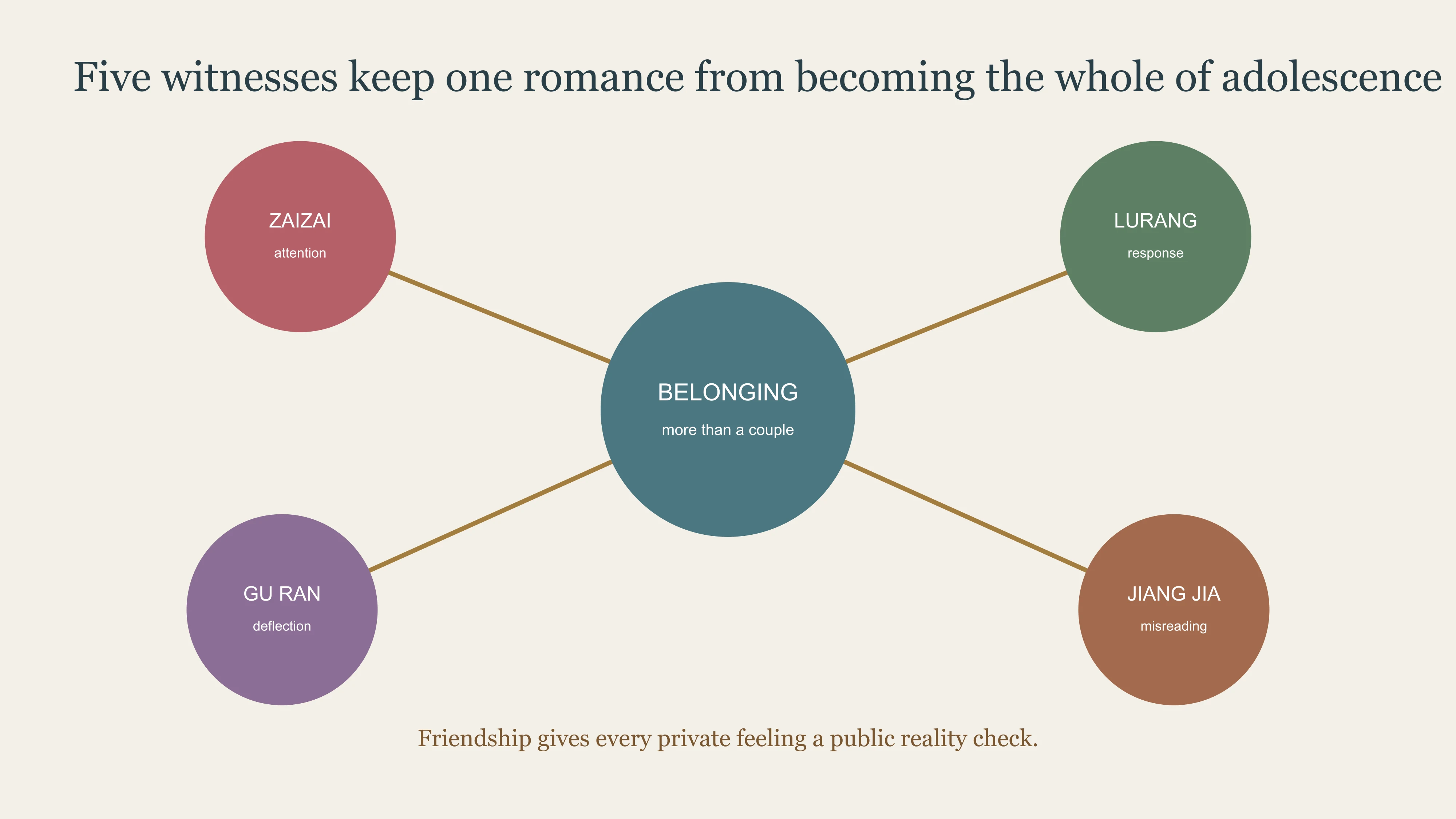
Many school romances give the leads friends who exist to deliver information or cheer the couple. Gu Ran, Jiang Jia and Guan Fang do more. They change the group's rhythm and prevent one romance from becoming the only meaningful event in adolescence.
Gu Ran and Jiang Jia introduce a different emotional tempo: more misdirection, friction and delayed recognition. Guan Fang carries family tenderness and loyalty without needing a romance to justify his place. Their presence also lets Su Zaizai and Zhang Lurang be observed in ordinary social life. Chemistry becomes more credible when a couple can exist inside a group rather than only in isolated close-ups.
The ensemble explains much of the show's rewatch value. A plot twist works once. A believable group rhythm can feel hospitable again because viewers remember not only what happened, but what it felt like to occupy that table, classroom or walk home.

The official YOUKU youth collection makes the ensemble visible as the drama's unit of memory. The five do not carry equal plot weight, but each prevents the central couple from becoming the only available form of belonging.
What each friend contributes to the structure
| Character | Structural job | What would disappear without them |
|---|---|---|
| Su Zaizai | Initiates attention and records experience | The story would retreat into Zhang Lurang's inherited self-description |
| Zhang Lurang | Learns to answer rather than only endure | Sweetness would have no internal resistance or change |
| Gu Ran | Hides sincerity behind comic timing | The group would lose its second, less direct model of affection |
| Jiang Jia | Tests the cost of misreading attention | Friendship would become pure support with no competing desire |
| Guan Fang | Connects loyalty to family and ordinary care | The group would look designed only to produce couples |
This is where the drama has more value than a compilation of romantic clips. It argues that adolescence needs several witnesses. A partner may see one part of you clearly; friendship prevents that one gaze from becoming total.
I understand why this friendship feels like a recovered memory even for viewers whose real school years were harsher. It gathers military training, exams, walks home, group jokes and quiet crushes into a world where embarrassment rarely destroys belonging. That is emotionally true and socially selective. The series remembers the warmth many people wanted, then edits out much of the class pressure, bullying and family exhaustion that made the same years painful. I love the table they build; I refuse to call it an average Chinese classroom.
Use Episode 1 as a practical test
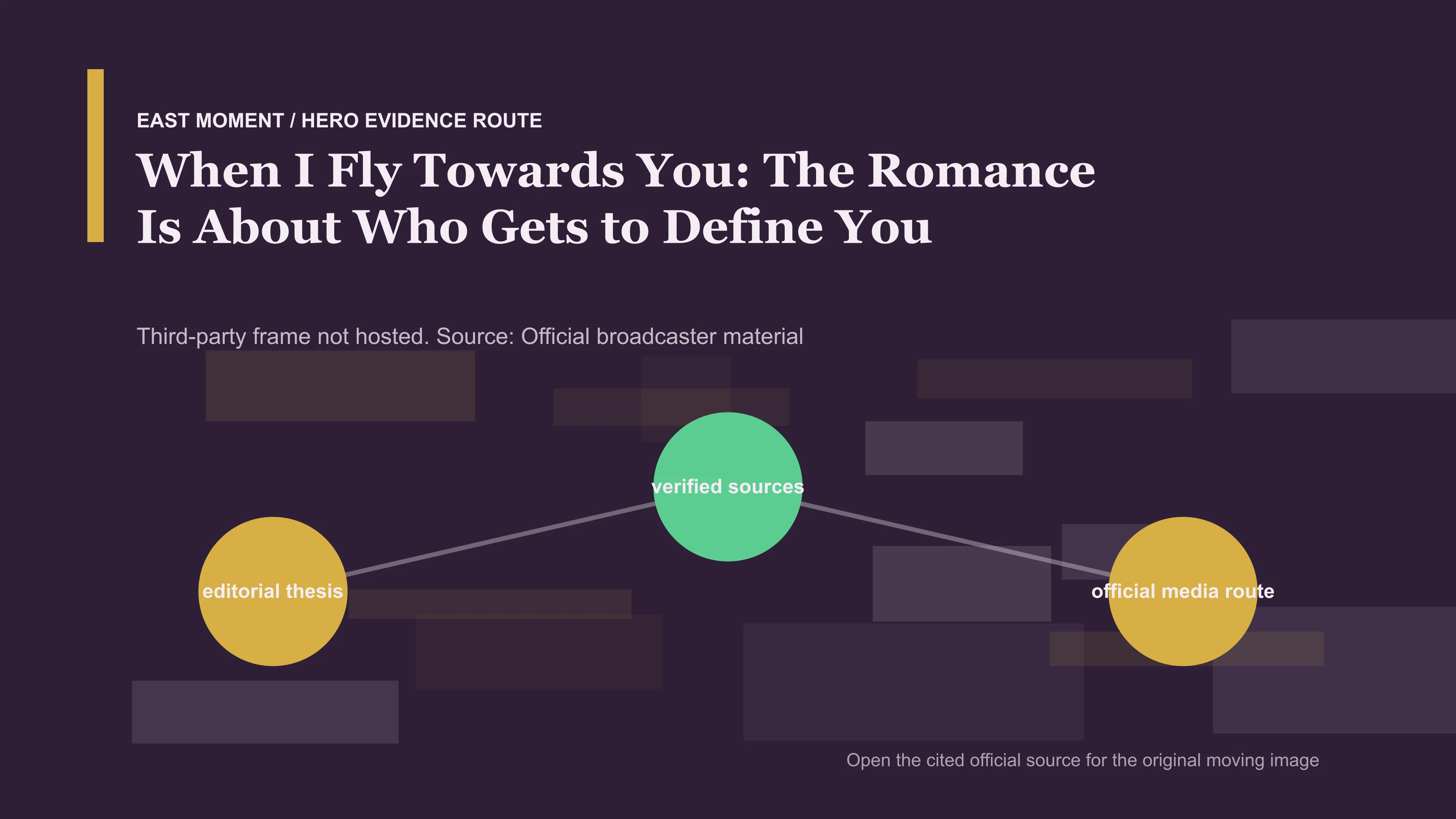
Open YOUKU's official English-subtitled Episode 1 in place and test the acting rhythm and social distance for yourself. The hero thumbnail identifies the video but does not prove the analysis.
Watch three things:
- How Su Zaizai looks before she speaks. Does her interest include observation, or is it only scripted excitement?
- How Zhang Lurang changes around the group. The smallest shift in timing can tell you more than a romantic speech.
- Whether ordinary scenes have texture. Food, weather, study and waiting should create a lived rhythm rather than filler between milestones.
If that rhythm feels too gentle after one episode, later affection will not transform the genre for you. If it feels precise, the series is likely to become more rewarding as responses accumulate.
Where the drama is less convincing
The series protects its emotional world. Major misunderstandings rarely become cruel for long, friendship remains unusually available and the visual memory of school is cleaner than many people's actual experience. That is a creative choice, not automatically a defect.
It becomes a limitation when comfort removes consequence. Family comparison, academic pressure and social uncertainty can feel legible without being explored to their hardest edge. Viewers looking for class conflict, institutional detail or difficult moral compromise will find a smaller drama than the praise may imply.
The right expectation is therefore emotionally coherent idealization, not documentary realism. Its school setting is a designed memory space: specific enough to inhabit, protected enough to revisit.
Three absences matter:
- Academic competition creates mood and identity but rarely produces irreversible material loss.
- Family comparison wounds Zhang Lurang, yet the repair does not require the prolonged boundary-setting that similar families often demand.
- The group has conflict, but belonging itself is rarely placed in sustained danger.
These are not reasons to dismiss the series. They explain why it comforts. The drama preserves the emotional truth of being judged while removing much of the institutional machinery that makes judgment hard to escape.
When I Fly Towards You cast: who carries what
- Zhang Miaoyi as Su Zaizai: supplies speed, openness and the social intelligence that keeps initiative from becoming one-note.
- Zhou Yiran as Zhang Lurang: makes reserve readable through timing and reaction; his key task is showing response before the character can verbalize it.
- Bian Tianyang as Gu Ran: adds comic deflection and a contrasting route toward emotional honesty.
- Jiang Zhinan as Jiang Jia: gives the secondary relationship its own perception and limits rather than serving only as Su Zaizai's confidante.
- Guo Zhe as Guan Fang: anchors the friend group through loyalty and family feeling outside the main romance.
This page owns the work and its character system. Future actor pages should own full biographies and careers, so the same keyword intent is not repeated across multiple URLs.
Does When I Fly Towards You have a happy ending?
Spoiler-light answer: yes. The central relationship receives a happy, conclusive future rather than an ambiguous separation or tragic reversal. The finale confirms that the drama's long-term argument is commitment built from accumulated attention.
Mild spoilers: the ending carries Su Zaizai and Zhang Lurang beyond school and gives their relationship an adult commitment. It also returns to the act of recording and remembering, connecting the youthful gaze of the opening to a shared account of what their relationship became.
The ending satisfies because it does not reveal that affection was secretly meaningless. Its weakness is the reverse: resolution arrives with less adult friction than a more socially demanding drama would require. Viewers primarily searching “ending” to avoid heartbreak can proceed safely; viewers seeking a detailed episode recap should use a separate future page only if search demand justifies that distinct intent.
Is there a season 2?
The existing story is complete; you do not need a second season to receive a resolved central relationship. As of this August 12, 2026 review, the official YOUKU sources checked for this guide did not supply a verified Season 2 announcement. Do not treat fan edits, recycled clips or unverified social posts as one. East Moment will add a dated update only if YOUKU or the production side announces it officially.
When I Fly Towards You vs Hidden Love: which should you watch?
| Choose | When I Fly Towards You | Hidden Love |
|---|---|---|
| Main emotional unit | Five-person school friendship plus romance | A more concentrated private romantic perspective |
| Core tension | Being defined by family comparison and learning to respond | Long-held affection, age and life-stage distance, and changing recognition |
| Best for | Viewers who want ensemble warmth and school texture | Viewers who want stronger romantic concentration |
| Likely objection | Too protected and low-conflict | The early relationship framing may make some viewers uncomfortable |
My recommendation is not that one is universally better. Start with When I Fly Towards You when friendship is part of the desired fantasy. Start with Hidden Love when you want the camera to stay closer to one developing attachment and are willing to examine how age and life stage shape that attention.
For a fantasy-romance contrast, Love Between Fairy and Devil makes reciprocity physical through a body swap and shared injury. The scale is completely different, but the useful comparison is the same: attraction becomes meaningful only when each person must answer the other's experience rather than merely admire an image.
Where to watch When I Fly Towards You
The most direct verified international route in this review is YOUKU:
- Watch official Episode 1 with English subtitles through the player above.
- Continue through the official YOUKU English playlist.
- Check the YOUKU International title page for the catalog available in your country.
Platform catalogs, subtitle tracks and free-versus-member access can change. Verify inside the official service in your region. East Moment does not link to unauthorized mirrors or download sites.
Final verdict: who should watch it
Watch When I Fly Towards You if you want:
- a romance in which initiative gradually becomes mutual;
- a five-person friendship with value beyond matchmaking;
- low-conflict comfort that still has an intelligible emotional structure;
- a happy ending without a last-minute tragedy.
Skip it if you need:
- strong social realism or sustained institutional pressure;
- morally difficult conflict and lasting interpersonal damage;
- fast plot escalation;
- a school world that resists nostalgia rather than refining it.
My conclusion is definite: this is one of the more successful comfort romances because it understands that attention can challenge a verdict, but only response can create a relationship. Su Zaizai's camera supplies a new way to see Zhang Lurang; his choices keep him from remaining an image inside her story. Its limitations come from the same protective design that makes it easy to return to.
If you want the opposite youth-romance pressure test, continue to Lighter and Princess. Its technical brilliance and adult ambition make attraction more combustible, but they also expose the emotional debt that this drama's protected school world largely avoids.
Continue through the Chinese television guide for the wider viewing route. In the comments, identify one exact scene where Zhang Lurang begins to answer rather than merely receive attention. If the idealized school world lost you, name the moment and what consequence was missing.