Love Between Fairy and Devil is worth watching because its body swap is not disposable comedy. It forces Orchid and Dongfang Qingcang to bear the physical, emotional and political consequences of each other's lives before either can make a meaningful sacrifice. The romance succeeds when empathy changes how power is used. It weakens whenever the production asks beauty, music or a grand death to do the work that consequence should have done.
Love Between Fairy and Devil in 60 seconds
| Question | Short answer |
|---|---|
| Chinese title | Cang Lan Jue (苍兰诀) |
| What it is | A 2022 Chinese xianxia fantasy romance |
| Episodes | 36 |
| Leads | Esther Yu as Xiao Lanhua/Orchid; Dylan Wang as Dongfang Qingcang |
| Essential supporting lead | Zhang Linghe as Changheng |
| Central mechanism | A body and soul connection that makes emotion and injury impossible to keep private |
| Strongest achievement | Turning unequal power into an embodied problem rather than only a romantic obstacle |
| Main limitation | Its final resolution is much shorter than the sacrifice and waiting used to reach it |
| Ending | Happy in outcome; full spoiler analysis below |
| East Moment verdict | Watch for what the body swap teaches, not only for the couple's visual chemistry |
The English title sounds like a simple opposition: innocent fairy, dangerous devil. The drama is more interesting than that. Its strongest conflict is not good woman versus evil man. It is the collision between a person whose low status makes every life visible and a ruler whose overwhelming power has allowed most lives to become abstract.
Should you watch all 36 episodes?
Watch the first four episodes, then decide.
- Continue if the body-swap performances make you curious about how identity is carried through posture, voice, fear and social permission.
- Continue if you enjoy romance as part of a larger conflict among duty, clan loyalty, grief and the use of power.
- Stop if Esther Yu's early vocal and comic register makes Orchid unreadable to you. The character grows, but the performance does not abandon its deliberate contrast entirely.
- Stop if elaborate fantasy terminology and repeated sacrifice feel like decoration rather than stakes. The series becomes emotionally larger, not narratively simpler.
My judgment is specific: Episodes 1-4 establish the mechanism that determines whether the whole drama will work for you. If swapping bodies feels like empty sketch comedy, later tragedy will probably feel inflated. If it reveals how differently the two characters are allowed to occupy a room, the relationship gains a structure that can sustain 36 episodes.
What the story is about, without major spoilers
Xiao Lanhua, usually translated as Orchid, is a low-ranking orchid spirit responsible for destiny records in the immortal realm. Dongfang Qingcang is the feared Moon Supreme, leader of the Moon Tribe and an enemy whose power threatens the existing order. An accident connects them through a body swap and a deeper link: her harm can affect him, and emotion can cross a boundary he thought he had eliminated.
Changheng, the immortal God of War, represents another possible future for Orchid and another model of duty. Ronghao's devotion to his master Chidi Nvzi extends the story's central question beyond the main couple: when does love recognize another person's life, and when does it preserve an image at any cost?
The plot grows into conflict among the immortal Shuiyuntian realm, the Moon Tribe's Cangyan Sea and forces that exploit grief. You do not need a glossary before watching. You need one distinction: these factions are not a simple heaven-versus-hell map. Each contains loyalty, violence, affection and political self-interest.
“Fairy” and “devil” are useful marketing words, not exact translations
An overseas viewer can misread the whole drama before Episode 1 if the English title is treated too literally.
Orchid is not a winged fairy from European folklore. She is a plant spirit within a Chinese xianxia world, where cultivation, spiritual forms, immortal offices, reincarnation and multiple realms supply the fantasy grammar. “Fairy” is readable English shorthand, but it flattens the character's place in that system.
Dongfang Qingcang is not the Christian Devil. He is the Moon Supreme, a ruler associated with the Moon Tribe. Subtitles and promotional copy may use demon or devil language to make the opposition immediate, but the character is not Satan and the Moon Tribe is not a theological hell.
This correction changes the viewing experience. The romance does not redeem an embodiment of absolute evil through female purity. It confronts a ruler formed by war, emotional mutilation and a political system that rewards domination. That still leaves him responsible for violence; cultural vocabulary should add precision, not excuse him.
What xianxia means here
Xianxia is a modern fantasy genre built from Chinese ideas and literary traditions surrounding immortals, cultivation, spirits, magical weapons, sects or realms, karmic consequence and transcendence. Every drama recombines them differently. Love Between Fairy and Devil is not evidence that all Chinese people share one religious cosmology, and it is not a documentary account of Daoist practice.
The practical point is simpler: death, identity and the body do not operate under ordinary realist rules. A spirit may change form, memory may be separated from identity and sacrifice may reorganize life rather than end it. The viewer should still demand internal rules. “It is xianxia” does not repair any contradiction the script creates.
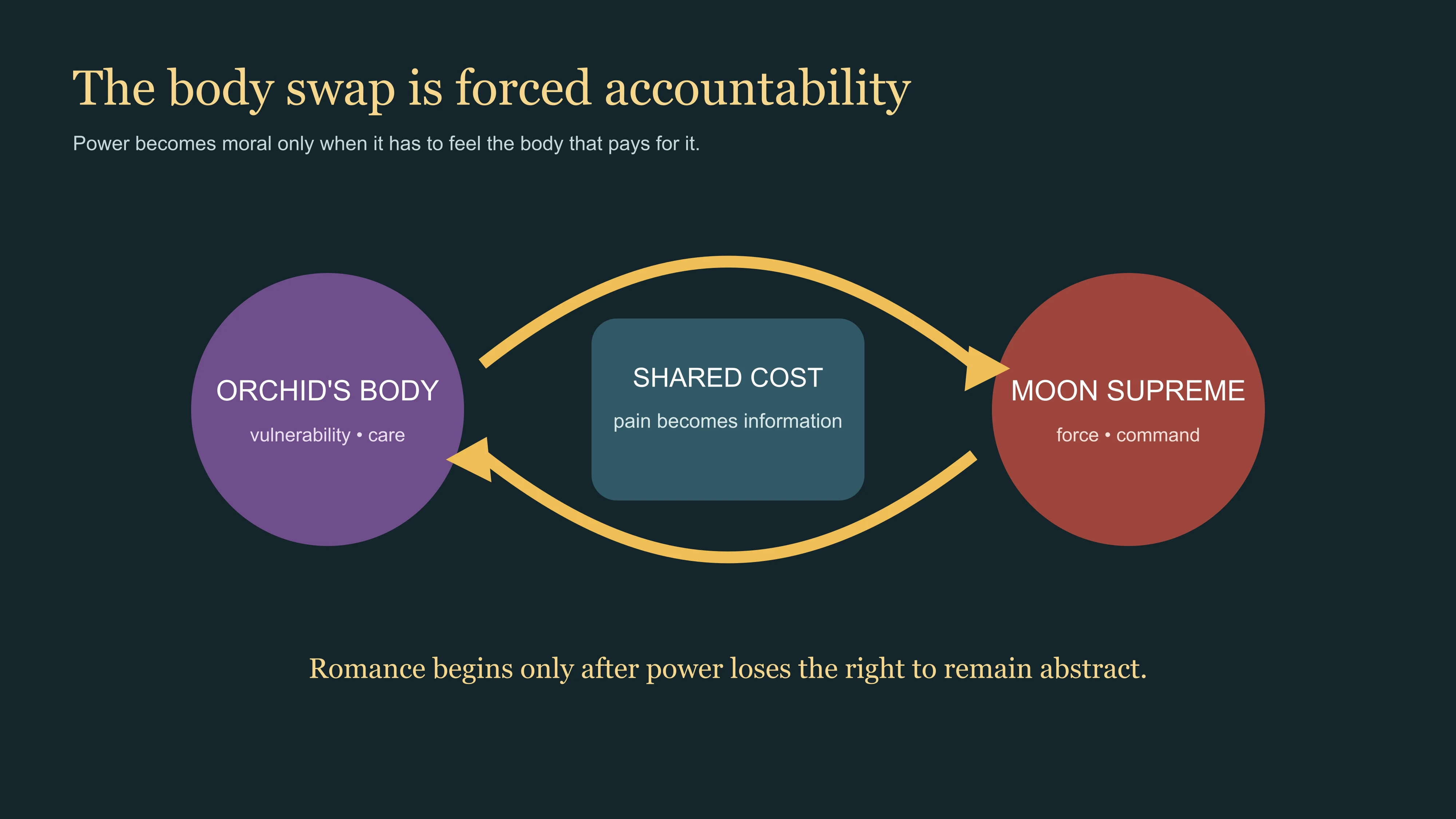
The body swap is a system of forced accountability
Most body-swap stories begin with comic imitation. This one does too, but comedy is only the first layer. Dongfang Qingcang cannot treat Orchid's body as irrelevant while he is trapped inside it. Orchid cannot imagine his power as uncomplicated freedom once she must carry its social meaning.
Open iQIYI's official Episode 1 in place. Watch how each actor changes posture, gaze and movement during the swap. The thumbnail identifies the episode; only the moving performance can show whether one identity remains legible inside the other body.
The connection imposes three consequences:
- Physical consequence: injury is no longer something the powerful character can observe from a distance.
- Emotional consequence: feeling becomes information even when speech is withheld or manipulated.
- Political consequence: each character sees how institutions respond to the other's rank, body and name.
This is the drama's strongest idea. Empathy is not presented as agreeing with an argument. It begins as losing the privilege of remaining untouched.
The performance test: can identity survive the other actor's body?
Body swapping gives Esther Yu and Dylan Wang a practical acting examination. The goal is not a broad impersonation. A successful switch preserves recognizable intention while adjusting to a different physical instrument.
Watch the following details:
- Use of space: Dongfang Qingcang expects a room to yield; Orchid negotiates for room.
- Eye line: authority tends to look directly and wait; low status scans for permission and danger.
- Hands and shoulders: control limits unnecessary movement, while anxiety leaks through smaller adjustments.
- Vocal tempo: power can afford silence; Orchid's early speed often fills a social gap before someone else defines her.
Dylan Wang's imposing stillness is effective because the swap gives it a comic negative. Esther Yu's brighter physical register is effective because the same mechanism later exposes how much vigilance exists beneath apparent innocence. Each actor becomes a measuring device for the other.
Orchid is not important because she is cute enough to cure him
The weakest description of the drama is “a sweet fairy teaches a cold devil to love.” It turns Orchid into medicine and Dongfang Qingcang into the only character allowed a transformation.
Orchid's real value is judgment. She is socially minor but repeatedly decides whose suffering counts. Her strength is not secret combat superiority during the early story. It is the refusal to let rank determine whether a life deserves attention.
That is also where a shallow reading of the role fails. Orchid does not acquire responsibility after receiving a noble identity; she acts responsibly before status confirms her importance. A great female lead is defined by mature judgment rather than force or rank. Weak writing substitutes noble identity for noble character; this drama is stronger whenever it remembers the difference.
Those responses do not prove that every viewer reads Orchid this way. They identify the exact question the drama must answer: does the story let her decisions create value, or does it retroactively claim that she mattered because she was secretly important all along? My answer is that the early Orchid is already the moral author of the story. The later identity should enlarge the cost of her choices, not explain why she deserved to make them.
That does not make every choice wise. Compassion can become self-erasure when the story rewards her mainly for absorbing pain. The useful test is whether Orchid chooses with adequate knowledge and whether her sacrifice changes the people and institutions around her. If everyone admires her purity but continues using the same violent rules, the plot has consumed her goodness rather than learned from it.
Esther Yu's high, youthful vocal register is central to disagreement about the character. Some viewers hear artificial childishness; others hear a deliberately protected and low-status person whose apparent softness hides persistent moral agency. My view is conditional: the performance works when a decision interrupts the cuteness. It fails when the production lets vocal texture replace interior development.
Dongfang Qingcang changes only when power changes direction
Dylan Wang gives Dongfang Qingcang an immediately readable outline: lowered voice, still torso, direct gaze and the expectation of obedience. The visual system supports him with dark costume, scale and controlled entrances. None of that is character growth.
Growth begins when feeling changes what he does with power. Protecting only the person he desires can remain possession. A larger transformation requires him to recognize lives, loyalties and grief that do not reward him romantically.
This produces four stages worth tracking:
| Stage | Visible use of power | What has not yet changed |
|---|---|---|
| Control | Other bodies are tools, threats or obstacles | Suffering remains abstract |
| Forced connection | Orchid's pain creates direct consequence | Concern may still be self-protection |
| Chosen care | He acts for her good even when control would be easier | The wider political ethic remains untested |
| Responsible sacrifice | Power accepts cost without owning the beneficiary | The drama must still show what survives afterward |
The emotional arc is persuasive because the performance gradually violates its initial stillness. The danger is that romance can make tyranny look acceptable once it becomes tender in private. The series is strongest when private care expands into a different public use of power.
Love is tested by whether it preserves a person or an image
The main couple is not the only love story. Ronghao's attachment to Chidi Nvzi offers a darker comparison: devotion can become refusal to let another person remain dead, changed or beyond one's control. Changheng's duty offers another: love can be sincere while still subordinated to an institution's timetable.
These parallel relationships sharpen the central distinction:
- Recognition allows the loved person to make a choice that may wound or exclude you.
- Possession preserves the version of that person that keeps your own world intact.
- Sacrifice is meaningful only when it serves the other's life rather than purchasing permanent gratitude.
iQIYI's official “You Are My Life” trailer concentrates the romantic promise. Use the linked scenes to ask whether protection leaves Orchid more agency or merely places her inside Dongfang Qingcang's power.
This is why the drama has more value than a compilation of beautiful couple scenes. It gives several people a reason to call control “love,” then asks the audience to distinguish them by consequence.
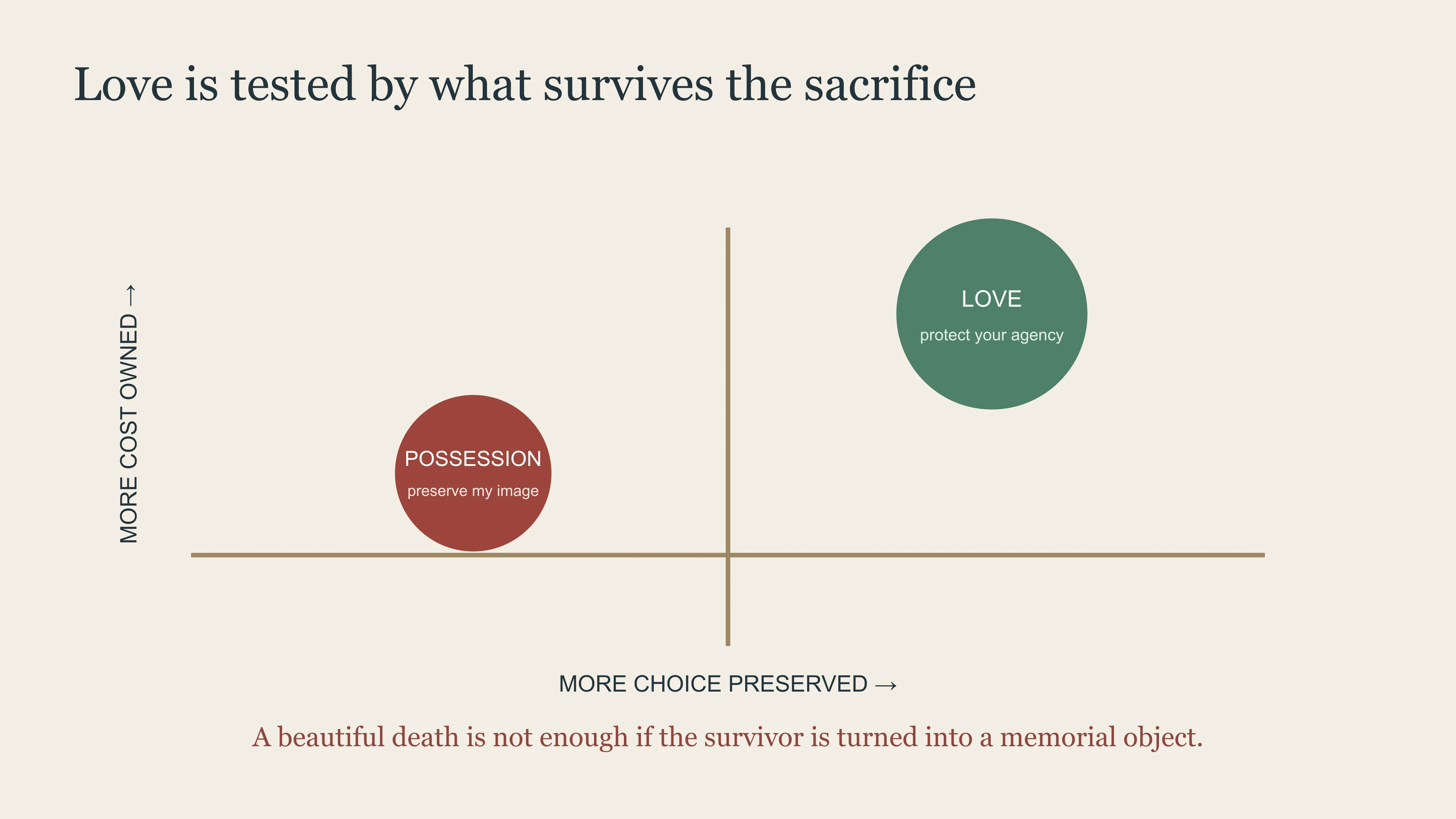
The late-story disagreement around Dongfang Qingcang is not fandom noise to be averaged away. If love makes him abandon public responsibility and reduces power to private grief, the arc has shrunk him. I accept tenderness as growth only when it increases the number of lives he can recognize. A ruler becoming soft for one person is romance; a ruler changing the direction of power is transformation.
The Three Realms are political positions, not personality labels
Shuiyuntian is not automatically morally correct because it is associated with immortals. The Moon Tribe is not automatically depraved because subtitles use demon language. Both communities contain inherited injury and narratives that justify violence.
The story becomes politically useful when a character encounters the enemy's ordinary life. War stops being an exchange among rulers and becomes lost relatives, restricted choices and memory. This does not erase responsibility or claim both sides are identical. It prevents faction names from completing moral judgment before actions are examined.
At its best, the production makes realm design part of this argument. Architecture, costume, color and crowd composition tell viewers who is allowed individuality and who appears first as a mass. The visual beauty matters when it changes what can be known, not when it merely enlarges the wallpaper.
Love Between Fairy and Devil cast: who carries what
- Esther Yu (Yu Shuxin) as Xiao Lanhua/Orchid: carries moral persistence, comic contrast and the risk that softness will be mistaken for passivity.
- Dylan Wang (Wang Hedi) as Dongfang Qingcang: turns physical authority into a structure that emotion must visibly disrupt. Read the dedicated Dylan Wang guide for the wider career comparison.
- Zhang Linghe as Changheng: gives duty a sympathetic face and tests whether honorable restraint can still cause harm. His lead-role range belongs to the Zhang Linghe profile.
- Xu Haiqiao as Ronghao: shows devotion becoming a system of violence when grief refuses another person's finality.
- Guo Xiaoting as Chidi Nvzi: connects sacrifice, memory and the unequal consequences of being made into someone else's purpose.
The cast is not valuable as a list of attractive alternatives. Each major character carries a different answer to the question: what are you permitted to do in the name of love?
Where the drama is less convincing
The series sometimes spends sacrifice too easily. A character's willingness to die creates immediate emotional scale, but repeated death-and-return structures can weaken consequence unless the surviving world remains altered.
Three limitations matter:
- Orchid's suffering can become proof of goodness. The story does not always give equal space to her anger, recovery or changed boundaries.
- Dongfang Qingcang's private transformation can outrun political repair. Loving one person is not the same as answering every life affected by rule and war.
- The final reunion is brief. The outcome is clear, but the drama gives less time to shared life after transformation than to the losses that produce it.
These limitations do not cancel the achievement. They identify where xianxia scale can hide unfinished emotional work.
Does Love Between Fairy and Devil have a happy ending?
Spoiler-light answer: yes. The central couple receives a happy reunion rather than permanent death or separation. The ending is conclusive in outcome but compressed in screen time.
Fuller spoilers: Orchid survives through her restored identity and power. Dongfang Qingcang's sacrificial confrontation removes him from her life, but his primordial spirit remains recoverable. After a long period of waiting and cultivation, he returns. The final scene confirms reunion instead of showing a long epilogue about how they live afterward.
The official Episode 36 clip confirms Dongfang Qingcang's return. It is placed after the spoiler warning and establishes the ending type, not whether the brief resolution gives every consequence enough space.
My verdict on the ending is mixed but clear: the return is emotionally consistent with the drama's spirit-and-cultivation rules, so it is not a random reversal. The weakness is duration. After asking Orchid and the audience to inhabit waiting, the series offers reunion as confirmation rather than a new shared reality.
Is Love Between Fairy and Devil Season 2 confirmed?
No official live-action Season 2 confirmation was found in the iQIYI sources checked for this August 12, 2026 draft. Be careful with search results for Cang Lan Jue 2 or 苍兰诀2. Douban's work records distinguish the 2022 live-action drama from a 2022 animation and a separate 2025 animation titled Cang Lan Jue 2.
An animation sequel is not confirmation that Esther Yu, Dylan Wang and the live-action cast are returning. Treat a live-action continuation as real only when iQIYI or the identified production side announces it directly.
The existing 36-episode drama does not require Season 2 to reveal the couple's fate. A sequel could expand the political aftermath, but that is a critical opportunity, not a production fact.
Love Between Fairy and Devil vs My Journey to You
| Choose | Love Between Fairy and Devil | My Journey to You |
|---|---|---|
| Main engine | Body swap, emotional connection and realm conflict | Assassin infiltration, family succession and withheld identity |
| Visual function | Makes cosmic and emotional power immediately legible | Turns architecture and position into controlled information |
| Romance test | Whether power becomes accountable through embodiment | Whether intimacy changes what each person may know |
| Ending expectation | Happy outcome with a brief reunion | Deliberately unresolved, cliffhanger-like outcome |
| Best for | Viewers who want emotional scale and transformation | Viewers who want darker ambiguity and room-reading |
Choose Love Between Fairy and Devil for a completed emotional arc and a fantasy system that externalizes feeling. Choose My Journey to You when beauty, suspicion and spatial control matter more than romantic closure.
Where to watch officially
- Watch iQIYI's official Episode 1 through the in-page player above.
- Use the iQIYI International title page for the current catalog and subtitle options in your country.
- Check the Netflix title page inside your regional account.
Platform catalogs, subtitle tracks and free-versus-member access change by country and date. East Moment does not link to unauthorized mirrors or episode downloads.
Final verdict: who should watch it
Watch Love Between Fairy and Devil if you want:
- a body swap that changes the moral structure, not only the comedy;
- xianxia romance with a clear emotional conclusion;
- performances that can be compared through posture, voice and exchanged identity;
- a fantasy where faction labels are challenged by lived consequence.
Skip it if you need:
- restrained vocal and visual style from the opening episode;
- permanent death to be the only acceptable cost;
- a long post-reunion epilogue;
- fantasy politics explored with the institutional detail of a historical drama.
My conclusion is definite: the drama earns its romance when embodiment makes indifference impossible. Orchid should not be reduced to a cure, and Dongfang Qingcang should not be rewarded merely for becoming tender in private. Their love has value when carrying the other's pain changes what each person is willing to do with life and power.
Continue through the Chinese television guide for the wider viewing route. In the comments, bring one body-swap or sacrifice scene where a character truly bears the cost of the other's world. If the drama lost you, identify the exact consequence that beauty or music was asked to replace.