My Journey to You is worth watching if you can accept a mystery whose visual intelligence often exceeds its plotting intelligence. Its best idea is not simply “an assassin falls in love.” The Gong residence is a machine that assigns every body a place: front mountain or back mountain, heir or spare, insider or bride, weapon or protected person. Intimacy becomes dangerous because moving closer to someone also changes what they may learn about you. The drama weakens when this spatial intelligence turns into decorative slow motion or when its women assassins become beautiful evidence inside a succession story still organized around men.
My Journey to You in 60 seconds
| Question | Short answer |
|---|---|
| Chinese title | Yun Zhi Yu (云之羽) |
| What it is | A 2023 Chinese costume mystery, wuxia romance and family succession drama |
| Episodes | 24 |
| Leads | Esther Yu as Yun Weishan; Zhang Linghe as Gong Ziyu |
| Essential parallel pair | Lu Yuxiao as Shangguan Qian; Ryan Cheng as Gong Shangjue |
| Most discussed third point | Tian Jiarui as Gong Yuanzhi |
| Strongest achievement | Turning architecture, formation and withheld touch into readable power |
| Main weakness | Mystery logic and pace do not consistently earn the visual solemnity |
| Ending | Deliberately unresolved and cliffhanger-like, not a closed happy ending |
| East Moment verdict | Watch three episodes for the world; stay for the relationship system, not airtight deduction |
This is not a recommendation for viewers who need every clue to survive forensic reconstruction. It is a recommendation for viewers who enjoy reading a room: who stands above, who waits outside, who is permitted through a door and who cannot touch without revealing a side.
The decision: give it three episodes, not one beautiful trailer
Use the opening three episodes to test four things:
- Can you follow the institutions? Wufeng, the Gong family, bride selection and succession pressure must feel like connected forces, not a glossary.
- Does slow motion reveal information? A delayed look should change suspicion, alliance or knowledge. If it only extends beauty, the pace will frustrate you.
- Do you believe Gong Ziyu can grow? His softness is the starting material, not an error the viewer must forgive forever.
- Are you interested in more than the main couple? The drama's durable tension is distributed across Gong Shangjue, Shangguan Qian, Gong Yuanzhi, Gong Zishang and the wider household.
If only the costumes hold you after Episode 3, stop. The production stays beautiful, but beauty alone cannot repair a mystery you do not trust.
What My Journey to You is about, without spoilers
Yun Weishan is an assassin sent by Wufeng into the secluded Gong residence under the identity of a prospective bride. She wants freedom, but her route toward it begins with another assignment and another constructed self. Gong Ziyu is a Gong son whose apparent softness and lack of preparation become politically dangerous when family violence forces responsibility onto him.
Around them, Gong Shangjue represents disciplined authority, Shangguan Qian enters with her own hidden purpose, and Gong Yuanzhi attaches fierce loyalty to a family hierarchy he understands better than many older players. The story is therefore not one infiltration. It is a competition among people whose assigned roles no longer contain what they want.
The spoiler-free question is simple: can a person trained to survive by performing trust recognize the difference between being believed and being known?
Lijun's reading: the Gong residence is a political diagram
The most useful way to read the drama is to stop treating the Gong residence as a moody set.
Its divisions turn geography into permission. Front and back are not neutral directions. Gates, corridors, bridges, halls and elevated seats decide who can approach knowledge and under what supervision. Succession is therefore visible before it is explained: authority occupies the center, uncertainty waits at the edge, and a suspected outsider is made to cross space under observation.
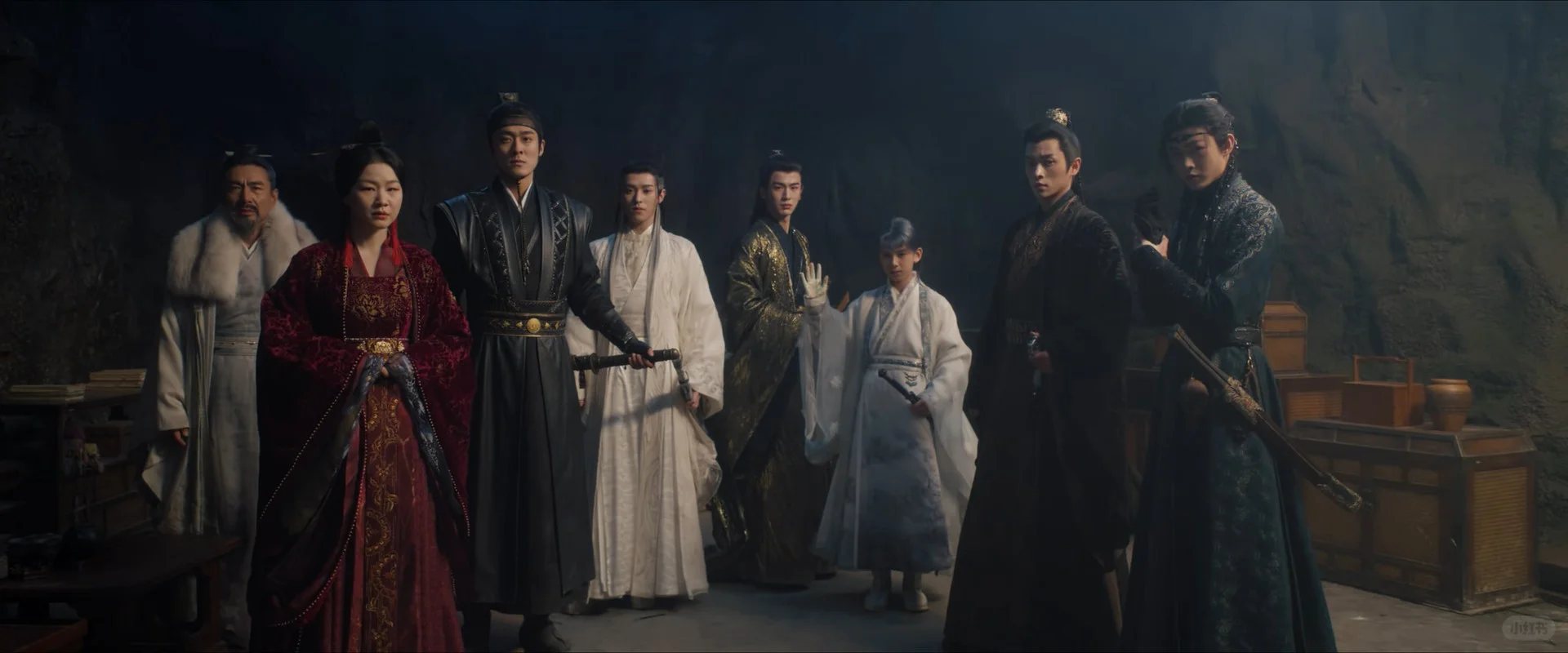
This is why the production's famous “standing formations” sometimes work. A formation can compress a relationship map into one frame. Distance shows mistrust; a body blocking another shows control; a character left outside the group becomes a political fact.
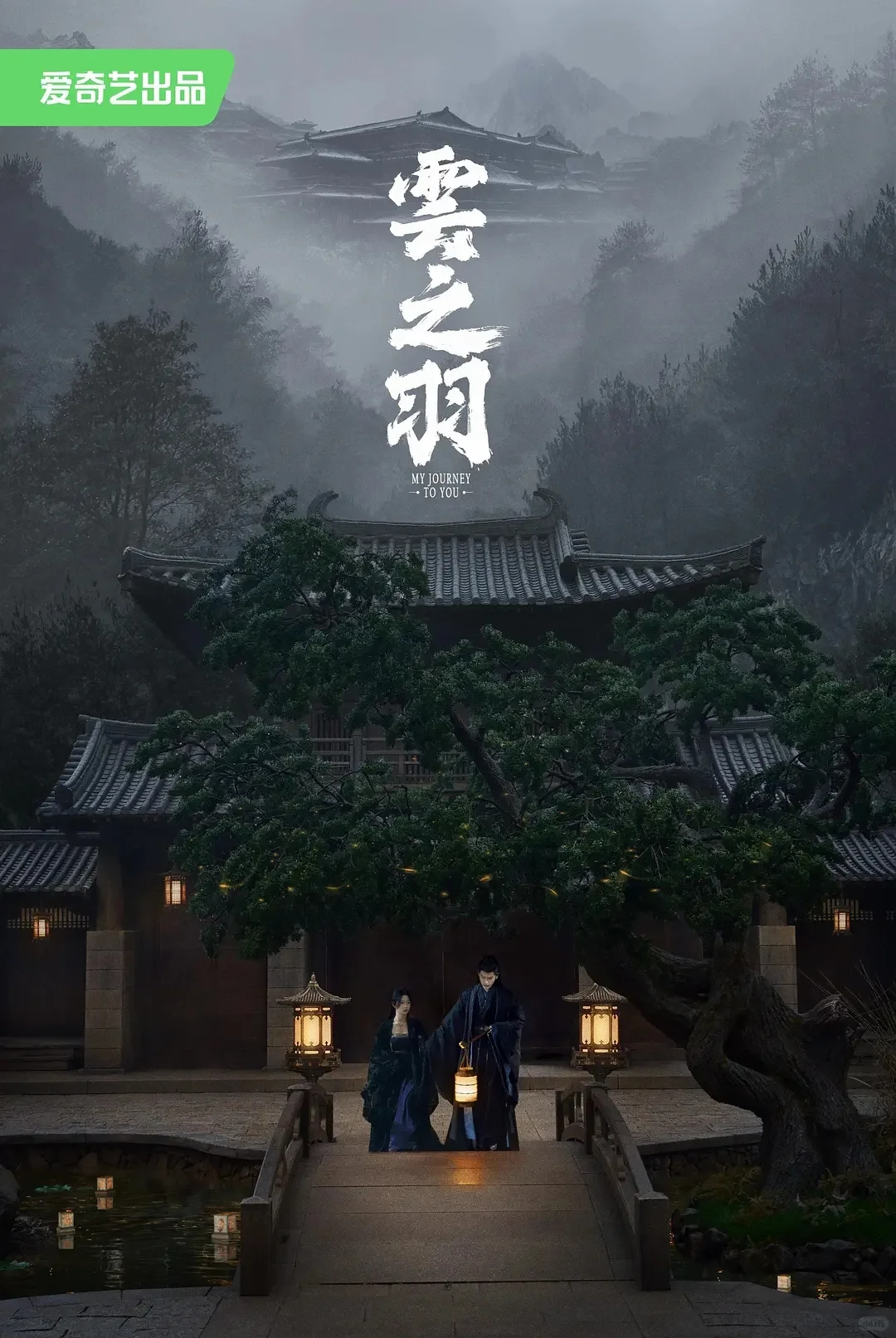
In this promotional image, the figures are small because the residence is the real subject. Bridges, gates and elevated roofs make every approach visible. It illustrates the show's spatial hierarchy; it does not prove the motives of the people moving through it.
But the method has a failure condition. If characters form a perfect tableau without the position changing what anyone knows, risks or chooses, composition becomes a signature rather than storytelling. I admire the positioning aesthetics and still find writing and pace to be the real weaknesses. Repeated slow motion made me want to change playback speed after two episodes.
My conclusion is stricter: beauty earns its time only when arrangement produces consequence.
Yun Weishan's problem is not whether she can love; it is whether she can own a self
Calling Yun Weishan a “cold female assassin” misses the coercion inside the role. Wufeng has made identity instrumental. A face, a biography, a gesture and even vulnerability can be deployed as equipment.
The interesting conflict is not that love makes her soft. It is that a person trained to treat every self as temporary begins to encounter choices that cannot be completed as assignments. Freedom is not merely escape from Wufeng. It is the ability to make a promise that belongs to the person speaking it.
This is also where the drama sometimes retreats. Yun Weishan begins with the potential to reorganize the whole story around female survival, training and tactical knowledge. Yet succession, male lineage and the emotional development of Gong Ziyu increasingly absorb narrative weight. Her agency remains visible, but it is not always allowed to define the scale of the drama.
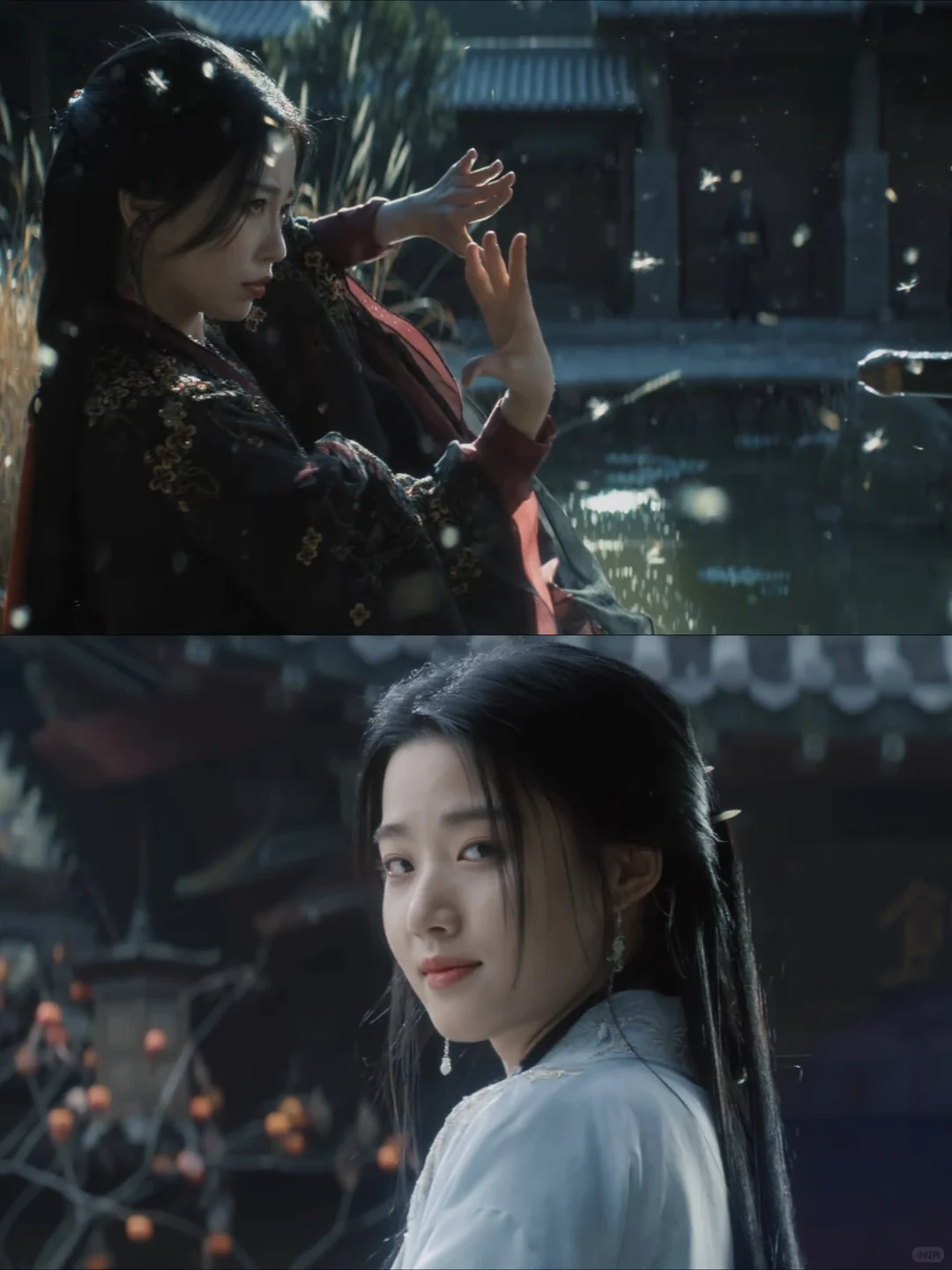
The paired images make costume behave like an identity switch: one body is asked to read as threat, then as acceptable softness. That contrast supports the drama's performance-of-self problem; it cannot tell us which feeling is sincere.
Gong Ziyu works only if softness becomes accountable power
Gong Ziyu is not Gong Shangjue with less competence. Reading him that way makes his arc a failed imitation. His dramatic question is whether empathy can become a governing method without remaining naivety.
Softness is valuable only when it survives responsibility. He must learn when trust exposes other people, when protection becomes favoritism and when refusing the family's cruelty still requires a decision. Zhang Linghe's useful performance is in this transition: uncertainty becomes listening, then judgment, then an authority that does not need to copy Gong Shangjue's stillness.
The full acting comparison belongs in the Zhang Linghe guide. This page owns Gong Ziyu's function inside this work.
Why Gong Shangjue, Shangguan Qian and Gong Yuanzhi dominate discussion
Years after release, this relationship system still holds me. The “Jue-Qian-Zhi” combination has unusual authority, while Gong Shangjue's love feels like wanting to touch, then withdrawing the hand.
The reason is structural, not merely fan preference.
- Gong Shangjue treats control as protection and suspicion as duty. Any softness risks contradicting the identity that keeps the family secure.
- Shangguan Qian must make vulnerability readable without surrendering the advantage of ambiguity. Her performance asks whether anyone can distinguish strategy from need.
- Gong Yuanzhi turns loyalty into territorial feeling. He is not simply jealous of romance; he fears that a new intimacy will rearrange the hierarchy that gives him meaning.
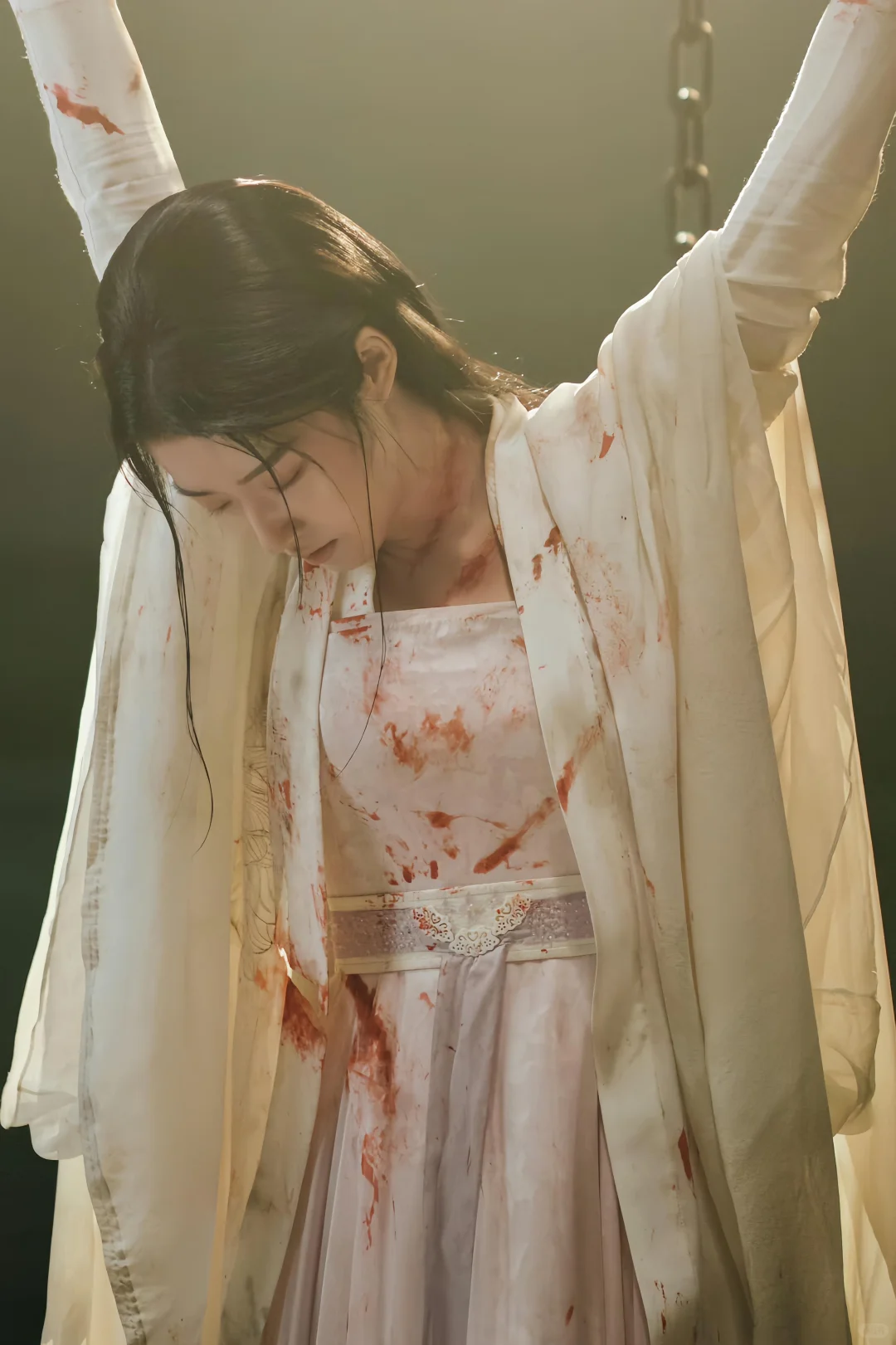
White cloth, blood and restraint make suffering visually legible while keeping Shangguan Qian composed for the gaze of others. The image shows how the production aestheticizes vulnerability. It cannot settle whether the vulnerability is tactical, genuine or both.
Their scenes often carry more voltage than the main romance because affection never suspends the security problem. Every tender gesture can be true and tactical at the same time.
Character relationship map: who wants what
| Character | Institutional position | Private desire | Main contradiction |
|---|---|---|---|
| Yun Weishan | Wufeng assassin entering as a bride | Freedom and an owned identity | Survival requires performing the trust she begins to want |
| Gong Ziyu | Unprepared Gong heir | Connection without inherited cruelty | Trust can endanger the people he must govern |
| Gong Shangjue | Proven family authority | Security, loyalty and controlled intimacy | Love creates an exception inside a system built against exceptions |
| Shangguan Qian | Infiltrator with hidden aims | Agency, survival and leverage | Genuine feeling cannot be cleanly separated from strategy |
| Gong Yuanzhi | Younger Gong specialist and loyalist | Recognition and an undisturbed bond | Loyalty becomes possessive when hierarchy changes |
| Gong Zishang | Gong daughter constrained by family expectations | Serious recognition and chosen love | Comic framing can hide her technical and emotional intelligence |
This table is more useful than a genealogy alone because the plot moves through conflicting permissions, not just blood relations.
Cast: who carries which part of the drama
- Esther Yu (Yu Shuxin) as Yun Weishan: carries the gap between a performed identity and a self that wants continuity.
- Zhang Linghe as Gong Ziyu: must make softness develop into judgment rather than suddenly switch into authority.
- Ryan Cheng (Cheng Lei) as Gong Shangjue: supplies disciplined stillness; the danger is always that restraint becomes more compelling than the plot around it.
- Lu Yuxiao as Shangguan Qian: makes ambiguity emotionally legible without resolving it too early.
- Tian Jiarui as Gong Yuanzhi: turns youthful loyalty, pride and fear of displacement into a third force in the secondary relationship system.
- Jolin Jin as Gong Zishang: uses comic rhythm while preserving the intelligence and hurt that the household underestimates.
The ensemble is not balanced by screen time, but the drama's afterlife shows that secondary characters often preserve the most discussable contradictions.
Why the mystery disappoints some viewers
The strongest criticism is easy to understand: the solemn presentation promises a more intricate scheme than the plot always delivers. The people are beautiful, but slow motion and repeated arrangements can obstruct pace. That gap between visual authority and narrative pressure is the real reason the series divides me.
The problem is not that the plot contains melodrama. It is that a mystery asks the audience to spend attention as if every delay will later become information. When a withheld answer produces only another pose or late explanation, the viewer discovers that atmosphere was borrowing credibility from deduction.
Use this test while watching: after a reveal, can you point to an earlier decision that now means something different? If yes, the mystery has paid. If the reveal merely adds lore, it has expanded without deepening.
Does My Journey to You have a happy ending?
Spoiler-light answer: no conventional closed happy ending. Episode 24 leaves major emotional and plot questions unresolved. Do not start the series expecting every couple and conspiracy to receive a settled conclusion. The open ending is a search-intent issue, not a minor footnote: it should decide whether you begin the show at all.
Spoilers: the final movement separates certainty from hope. Yun Weishan's return route and what Gong Ziyu encounters are staged as a cliffhanger rather than a completed reunion. Shangguan Qian's fate and her connection to Gong Shangjue also preserve consequential ambiguity. The ending behaves like a bridge to continuation even though the season must be judged as the only completed text currently available.
The correct verdict is not simply “bad because open.” An open ending works when uncertainty completes the theme. Here, some uncertainty fits a world where identity is never fully verified, but the volume of unresolved machinery also makes the finale feel structurally incomplete.
I reject the defense that every unresolved fact becomes profound merely because the frame is beautiful. This ending withholds more than reunion; it withholds the causal payment for decisions the audience has tracked for twenty-four episodes. Mystery is a promise that earlier attention will become more valuable later. When the final reveal only opens another locked door, the production has spent that attention without returning enough information.
That is the practical dividing line for a new viewer. If you can live with the central relationship remaining unsettled because the drama has already given you a complete argument about trust, the finale may feel coherent. If you need the infiltrators' choices and the Gong family's deductions to reach a fully explained result, it will feel like an interruption. I fall into the second camp on plot, while still admiring what the last images do with separation.
Is My Journey to You Season 2 confirmed?
As of October 16, 2026, the official iQIYI title page lists the completed 24-episode series but does not announce a second season. That is not proof that one will never happen. Search suggestions and social posts show interest, not production confirmation; treat any claimed release date as unverified until iQIYI or the production side publishes a dated announcement.
Where to watch My Journey to You
- Use the official iQIYI international title page for current regional availability and subtitles.
- Start with official Episode 1 before committing to all 24 episodes.
- Treat AI-dubbed, Thai-language and subtitle variants as distinct platform versions; choose deliberately rather than assuming the same audio experience.
Catalogs and free-versus-member access can change by country. East Moment does not link to unauthorized episode mirrors or downloads.
Final verdict: who should watch it
Watch My Journey to You if you want:
- a costume drama where architecture and blocking make power visible;
- women infiltrators whose desire for freedom complicates romance;
- secondary relationships built from restraint, loyalty and suspicion;
- a large ensemble worth discussing after the central plot ends.
Skip it if you need:
- tightly causal deduction;
- fast action without repeated slow motion;
- a closed ending;
- visual beauty that never calls attention to its director.
My conclusion is firm: the drama's images understand the Gong system better than its mystery plot does. At its best, a doorway or withheld hand tells us who is allowed to belong. At its weakest, everyone stands beautifully in place while the story waits for the composition to finish.
Continue with Pursuit of Jade to compare two very different Zhang Linghe power arcs. Then compare the memory-and-control romance in Story of Kunning Palace or the family-recognition problem in Love Like the Galaxy. Return to the Chinese television guide when you want a completed emotional arc rather than another beautiful cliffhanger. In the comments, bring one frame where placement changes power, or one tableau that looks important but changes nothing.