Story of Kunning Palace is worth watching, but not because Jiang Xuening gets a clean second chance. She remembers a first life spent chasing the palace and the people she hurt to reach it. Foreknowledge helps her change events; it cannot erase the debt. Bai Lu makes that tension watchable, while Zhang Linghe's Xie Wei turns the romance into a test of who gets to decide. I admire the drama most when Jiang Xuening uses memory to protect someone without controlling them. I trust it least when intensity passes for repair.
Story of Kunning Palace: the decision before spoilers
| Question | East Moment answer |
|---|---|
| Chinese title | Ning An Ru Meng (宁安如梦) |
| What it is | A 2023 Chinese costume romance and political drama built around a remembered first life |
| Leads | Bai Lu as Jiang Xuening; Zhang Linghe as Xie Wei |
| Other essential relationships | Wang Xingyue as Zhang Zhe; Zhou Junwei as Yan Lin; Liu Xiening as Shen Zhiyi |
| Strongest quality | Foreknowledge turns ordinary conversation into strategy and moral pressure |
| Main weakness | Romantic intensity and political explanation can overwhelm quieter consequences |
| Ending | Answered in the clearly marked spoiler section below |
| Best for | Viewers who enjoy morally compromised leads, court strategy and intense romance |
Watch at least through Jiang Xuening's entry into the palace-school environment. The opening death-and-reset premise is only a mechanism. The series becomes distinctive when a familiar room contains two timelines for her: what everyone believes is happening and what she fears will happen again.
Memory is leverage, but it is also an accusation
Many second-chance stories make foreknowledge a fantasy of competence. Buy the right asset. Avoid the wrong spouse. Defeat the rival before the rival moves. Jiang Xuening's knowledge is less comfortable because much of it comes from complicity.
She once wanted the palace. She understands how affection, status and vulnerability can be exchanged because she participated in those exchanges. Returning to youth does not restore innocence. It gives her the burden of seeing consequences before the people around her can consent to the choices meant to prevent them.
This creates the drama's best moral test: does she save someone because she now values that person, or because changing the event makes her own memory easier to carry? The motives can coexist. Redemption is not purity; it is repeated action taken even when the rescued person may never understand what the action cost.
Bai Lu is effective here because Jiang Xuening often changes tactics in public. The eyes register an old danger; the face then chooses a younger, safer expression. Read the Bai Lu profile for the wider pattern across roles. Here, the technique belongs to a woman living in two versions of the same conversation.
I do not call this wisdom. Wisdom is what she may build from memory; memory itself is only an archive. It contains accurate warnings, old vanity, unresolved shame and conclusions formed by the woman she used to be. The danger is obvious: if Jiang Xuening assumes that remembering a person means knowing them, she turns everybody in the second life into a copy of somebody from the first.
That is the trap beneath the fantasy. She wants to avoid the palace, but avoidance can still be another attempt to control the board. She wants to protect Yan Lin and Shen Zhiyi, but protection can become manipulation when she withholds the reason they are in danger. She wants a morally clean future with Zhang Zhe, but the desire for cleanliness risks using him as evidence that she is no longer the woman who became empress.
The series is alive whenever her good action has an impure motive and remains worth doing.
Five relationships, five versions of what she owes
The drama becomes clearer when its romantic field is not treated as a contest for the heroine.
- Yan Lin represents loyalty harmed by ambition and by events Jiang Xuening once failed to stop.
- Shen Zhiyi turns female friendship into a direct test of whether palace knowledge produces care rather than competition.
- Zhang Zhe represents the morally clean future Jiang Xuening may desire but cannot enter without bringing the past with her.
- Xie Wei recognizes strategy and damage because he carries his own dangerous archive.
- Jiang Xuening herself must decide whether a second life belongs to repair, escape or another attempt to control outcomes.
Each relationship exposes a different limit of foreknowledge. She may know what happened; she does not automatically know what another person currently feels. Treating memory as certainty can reproduce the same arrogance as the first life.
The relationship map is more precise than a choice between three suitors. With Yan Lin, Jiang Xuening has to confront the cost of loyalty she once took for granted. With Zhang Zhe, she reaches for a version of herself that might be judged clean. Xie Wei sees the calculation she would rather hide, but his ability to see it does not entitle him to direct her life. This gives me a scene test: does each relationship reveal another capacity, or does the script merely change her personality to fit a different pairing?
One person drives everyone into obsession: that is the fatal attraction of this anti-heroine. Not every character is literally “crazy.” Jiang Xuening is the gravitational center of several desires and injuries rather than a prize passed among male leads. I test that energy against what each relationship actually asks her to owe.
This is the local reading overseas recaps often flatten. Palace drama is not only a chain of schemes. Forms of address, teacher-student hierarchy, clan obligation and access to the inner court decide what can be said directly. A modern-sounding honest conversation is not always socially available. Strategy becomes a language, but that does not make every manipulation admirable.
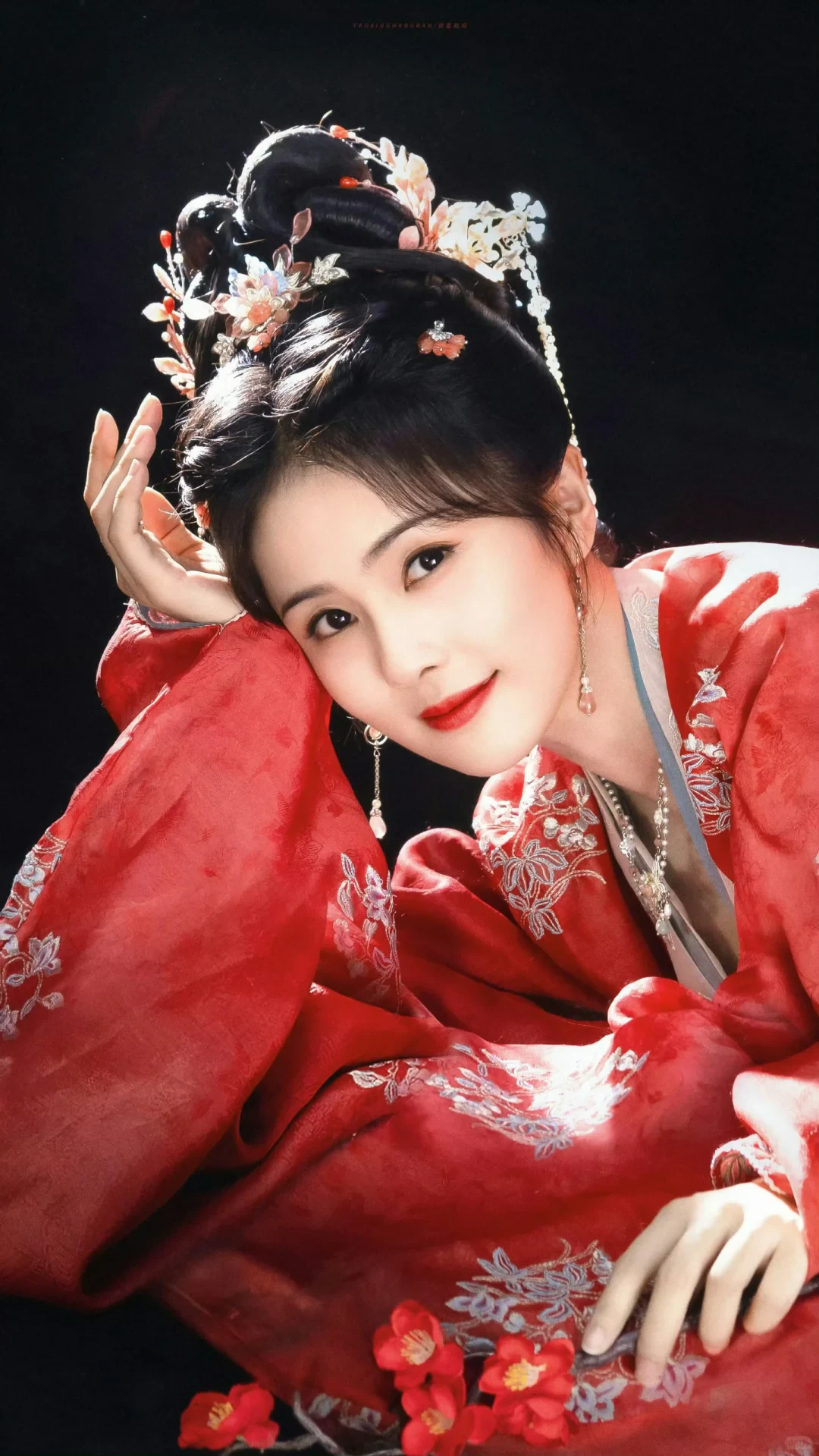
The red-costume portrait opening this page is useful for a different reason. It does not prove that Jiang Xuening is beautiful, powerful or universally loved; those are empty conclusions. It shows how deliberately the character can present herself to a watching world. The smile is inviting, the costume is ceremonial and the black background removes ordinary context. That is exactly the danger of her second life: a convincing public surface can make control look like sincerity until another character refuses to accept the pose.
I read this portrait as evidence of how the character is presented to an audience, not proof of acting or a biography. It illustrates a composed public image; it cannot establish Jiang Xuening's private motive, the exact scene context or the health of any relationship.
The qin classroom turns intimacy into an argument about authority
The palace-school and qin lessons are not decorative pauses between schemes. They give Xie Wei a legitimate reason to control posture, rhythm, repetition and attention. He is the teacher; Jiang Xuening is expected to listen. Yet she arrives with knowledge he cannot see and fear he cannot grade.
The qin is therefore a perfect object for their relationship. Music demands control, but it dies if control becomes only force. A phrase needs attack, weight, delay and release. Xie Wei is strongest at attack and weight. Release is the part he does not trust. Jiang Xuening hears danger beneath instruction because in her memory his authority already has an ending.
Watch their physical distance in these scenes. Who stands while the other sits? Who interrupts? When does correction become threat? When does Jiang Xuening obey because the lesson is useful, and when does she perform obedience because refusal would reveal too much? The romance grows inside an unequal instructional space. Pretending that hierarchy does not exist makes the chemistry easier but the story poorer.
My position is sharp: a teacher-student frame is not automatically romantic just because both characters are beautiful and equally intelligent. The series earns intimacy only when Jiang Xuening can disagree without the threat of Xie Wei's authority deciding the outcome. Recognition must eventually produce room, not simply more accurate control.
Xie Wei is not a red-flag quiz; he is institutional power under strain
Xie Wei is easy to package through danger: controlled voice, severe clothing, an enclosed room, jealousy that threatens to become force. Zhang Linghe's screen scale makes that danger immediate.
Reducing him to “toxic but attractive” is shallow in both directions. It ignores the political and traumatic systems that taught him control, and it excuses choices by turning harm into an aesthetic category.
The useful question is what happens to other people's agency when Xie Wei feels threatened. Does his intelligence create more choices for Jiang Xuening, or fewer? Does protection require information and consent, or does he decide that superior knowledge entitles him to act? Does intimacy soften his authority, or merely move that authority into private space?
The internet's “red flag” vocabulary is too small for him. It can identify behavior we should not romanticize, but it often stops exactly where analysis should begin. Xie Wei's control is personal, political and procedural. He knows how rooms work, how institutions conceal violence and how a calm voice can make coercion look inevitable. His danger is not a personality sticker. It is competence shaped by injury and backed by access.
That does not excuse him. In fact, it makes accountability more necessary. A man with greater knowledge and institutional reach bears more responsibility for the choices he removes from others. Trauma explains the impulse to control; power determines how much damage that impulse can do.
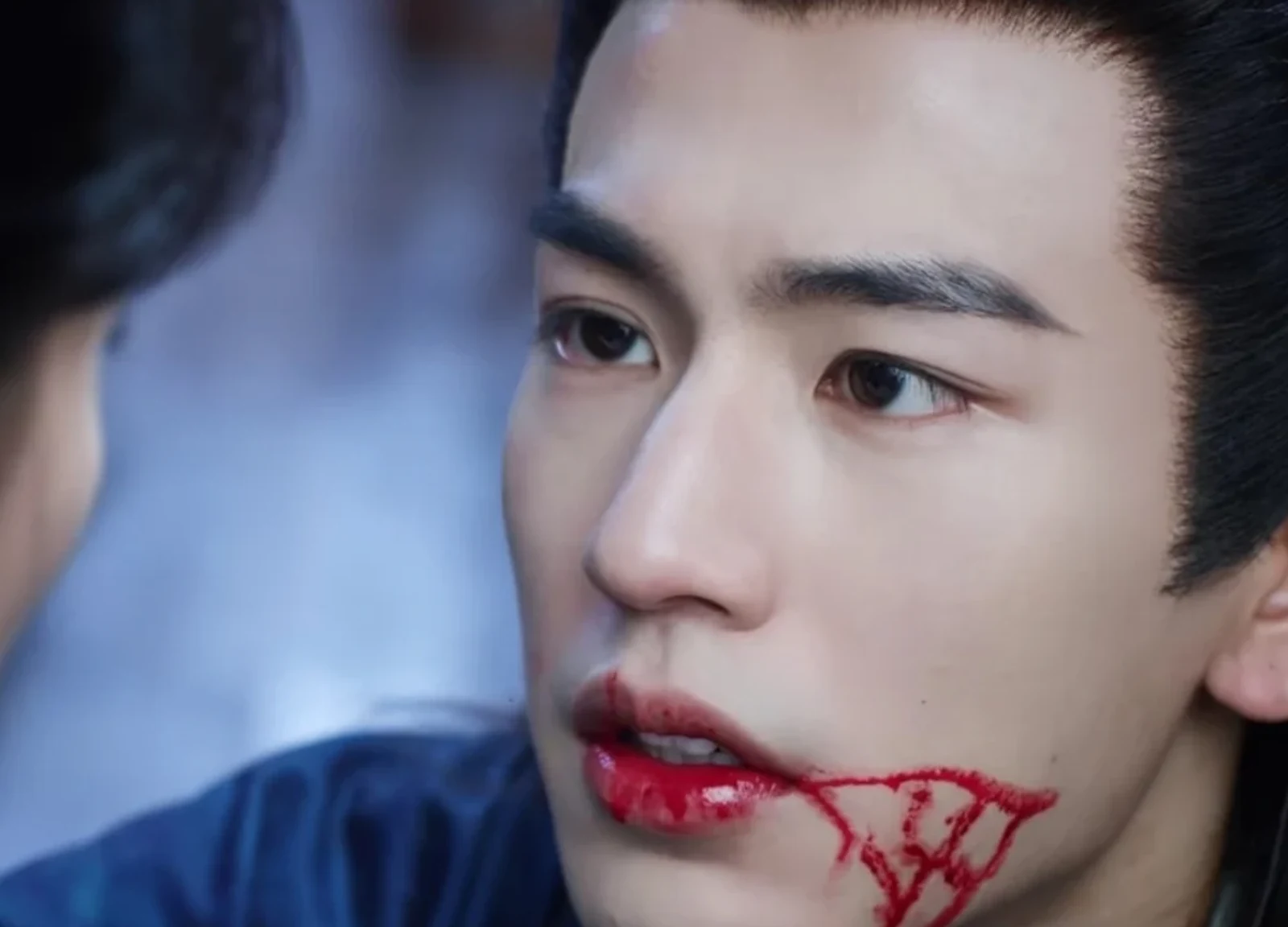
This close-up is useful because it ruins the polished fantasy of perfect control. Blood has crossed the boundary of his mouth; Jiang Xuening occupies the blurred foreground; his gaze is still fixed on her. The image does not prove that violence equals love, and I refuse that shortcut. It proves something narrower and more important about the performance: Xie Wei's authority becomes legible at the instant his body can no longer maintain its calm public surface. Attraction enters the scene, but so do danger and consequence. Any reading that crops out one of those three has made him simpler than the drama does.
The dedicated Zhang Linghe guide compares Xie Wei's controlled menace with Gong Ziyu's softer uncertainty in My Journey to You. This page stays with Xie Wei's function inside Jiang Xuening's second-life debt.
Why the romance works, and where it becomes too easy
Jiang Xuening and Xie Wei make sense together because neither can maintain a clean self-image in front of the other. He notices calculation. She notices the cost beneath control. Their scenes have pressure because recognition is dangerous: being understood may produce intimacy, exposure or coercion.
The romance works when recognition changes behavior. Xie Wei must learn that understanding Jiang Xuening's fear does not grant ownership of her decision. Jiang Xuening must stop using idealized moral alternatives to deny the person she has become. Both need to choose without pretending the past vanished.
The confrontation carries real physical tension, yet the restless camera, excessive seriousness and strained acting can turn the same intensity into production overstatement. My conclusion rests on what the scene changes between the characters, not on fandom size.
It becomes too easy whenever intensity substitutes for repair. A forceful gesture can produce a memorable clip while leaving the power problem untouched. Trauma can explain why a character reaches for control; it cannot serve as a permanent waiver. A happy ending must be tested through ordinary decisions after crisis, not only through willingness to die during it.


The additional episode still belongs beside the palace-school discussion because it shows the social setting before later choices become romantic shorthand. The image is evidence of context, not a substitute for the argument.
The snow portrait gives Jiang Xuening the opposite visual sentence. She is not framed as somebody waiting to be completed by the man who looks at her. The umbrella draws a literal perimeter around one body, while the falling snow keeps the world active beyond it. That is how I want the romance judged: can Xie Wei approach this boundary without treating protection as permission to cross it? Her stillness is not emptiness. It is a position she has chosen and must be allowed to revise herself.
For a revenge-driven heroine whose public performance is a weapon, compare The Double. Jiang Xuening's distinction is not revenge. It is responsibility toward people who do not remember the version of her that wronged them.
Compare her also with Dou Zhao in Blossom. Dou Zhao converts remembered pain into material independence; Jiang Xuening converts remembered guilt into interventions in other people's lives. Both can become controlling. The difference is what they believe the second life is for: building options versus repairing a moral account.
Ending explained: is it happy?
Spoilers begin here.
Yes. The political conflict is brought to resolution, and Jiang Xuening and Xie Wei receive a shared domestic future. iQIYI's official series listing describes its Episode 38 couple scene, so this is a happy ending rather than an ambiguous reunion.
The ending satisfies the romance search intent, but its deeper value lies in changed scale. The first life defined success through the palace and ended in isolation. The second life can end in relationships not organized entirely by imperial rank. Domestic warmth is therefore not merely fan service; it rejects the old measure of achievement.
Still, closure should not be mistaken for erasure. The people harmed in the first timeline existed in Jiang Xuening's memory even if the revised timeline spares them. Her growth matters because she carries that knowledge forward, not because the narrative proves the first life was unreal.
Where to watch and how to read the first episodes
Start with iQIYI's official Story of Kunning Palace series page, which currently identifies the 2023 production, 38-episode run and principal cast. Subtitle, membership and regional access can change, so use the title catalog visible in your location. East Moment does not link to unauthorized mirrors or paid clips disguised as free embeds.
Track three things on a first watch:
- The pause before Jiang Xuening answers: what future event has entered the present conversation?
- Information ownership: who knows enough to choose, and who is being “protected” through ignorance?
- Changed action: what does she do differently when no reward or gratitude is guaranteed?
My verdict is definite: Story of Kunning Palace is not valuable because it lets a clever heroine win twice. It is valuable because a second life makes knowledge morally heavier. The drama earns its romance and redemption whenever memory creates responsibility rather than entitlement.
If family recognition rather than palace guilt is the wound you want to follow, continue to Love Like the Galaxy. Otherwise use the Chinese television guide to choose another emotional problem, not merely another costume.
In the comments, audit one choice in both timelines: what did Jiang Xuening do the first time, what does she change, and who gains or loses agency because of that revision? Post the paired scenes as a Moment. Return after she enters the palace school; if your judgment of her motive has not changed by then, the drama has not yet done its real work.