The Blossom Chinese drama gives Dou Zhao a second life, but here is the question I cannot put aside: if she can anticipate so much danger, why can Song Mo still lose so much? The answer decides whether this is a story about hard-won judgment or merely a beautiful way of protecting the plot.
I have a blunt rule for rebirth dramas: if the heroine only remembers the exam answers, she has not grown. She has been given spoilers. Blossom (《九重紫》) is worth watching because Dou Zhao often turns painful memory into property, information and the freedom to refuse. Yet the show's hardest test is not whether she can save herself. It is what she owes someone else once she knows his losses may be coming.
I admire the marriage that grows out of two capable people revising their plans together. I do not automatically excuse a convenient tragedy because the couple look magnificent in the snow. Both reactions belong in an honest review.
Blossom Chinese drama: cast, story and my direct verdict
Blossom Chinese drama is a 2024, 34-episode Chinese costume series starring Meng Ziyi as Dou Zhao and Li Yunrui as Song Mo. The official WeTV series page identifies the principal cast, complete episode run and central alliance: a young woman protecting herself and her family estate meets a man trapped inside the mystery of his own family's collapse. They marry first as allies and become intimate by surviving decisions together.
| If you searched for… | The useful answer |
|---|---|
| the cast | Meng Ziyi leads as Dou Zhao; Li Yunrui plays Song Mo. Kong Xueer, Xia Zhiguang and Zhang Meng are among the key supporting cast named by WeTV. |
| the premise | Dou Zhao gets another chance after a disastrous life. She protects assets, changes household relationships and enters an alliance with Song Mo while both investigate family danger. |
| whether it is worth watching | Yes for a strategic heroine, mutual competence and a marriage that functions as partnership. No if you need airtight court politics or dislike foreknowledge smoothing away uncertainty. |
| whether the ending is happy | Yes for the central pair. The more important victory is that Dou Zhao builds a life larger than mere survival. |
| where to watch | Start with the official WeTV series page; episode access and subtitles vary by region and membership. |
My verdict is not “strong female lead, therefore good.” That phrase has become nearly useless. Dou Zhao is compelling because she builds the unglamorous infrastructure of freedom before the script asks us to admire her: a place to live, control over information, relationships she can test, and the ability to refuse one bad bargain without falling straight into another. Whether she uses those advantages consistently is a much more interesting argument than whether she looks powerful.
Why Blossom is more satisfying than a normal revenge drama
I watched Blossom with the suspicion I bring to most second-life stories. Rebirth can make a heroine look clever without making her brave. If she already knows every betrayal, every disaster and every winning move, the suspense has been removed and replaced with applause.
What kept me watching was the slower, less glamorous work. Dou Zhao does not simply return and announce that she will defeat everybody. She starts paying attention to the conditions that made her vulnerable: who controls money, who controls information, who can isolate a woman inside a household, and who gets believed when a family needs a convenient villain. That is a much better fantasy than watching a heroine deliver perfect revenge speeches.
My strong preference is clear: I prefer the scenes where Dou Zhao prepares a fallback to the scenes where she humiliates an opponent. Humiliation gives the audience a quick sugar rush. A fallback changes the balance of power. It means the heroine is not waiting for one powerful man to rescue her from the next powerful man.
This is also why the Chinese title, 九重紫, feels more useful than the generic English label Blossom. The story is not only about beauty blooming after winter. It is about layers of household, kinship and authority stacked on top of one another. Dou Zhao has to move through those layers without allowing the audience to mistake elegance for safety.
The first life is not backstory; it is evidence left in her body
The opening death must remain ugly. If Dou Zhao's first life were merely an unfortunate romance, returning to youth would become wish fulfilment dressed as wisdom. Instead, the series makes private betrayal, family authority and public power converge until a woman has almost no safe direction left.
What interests me is not that she remembers names. It is the way memory changes her tempo. She delays trust. She observes who benefits from confusion. She knows that affection without control over practical resources can disappear the moment a household changes its mind.
Meng Ziyi gives that caution a visible surface. Dou Zhao often looks finished before a conversation has finished with her. The poise is beautiful, but beauty alone would flatten the role. The performance becomes human when a pause exposes fatigue, disgust or the terror of recognizing an old pattern in a new room. Our Meng Ziyi profile follows how that public composure works across her career; here it is not an aura. It is equipment.
Meng Ziyi makes calculation feel like emotion
Dou Zhao cannot spend the whole drama showing the audience that she is afraid. She has to survive rooms in which showing fear would become information somebody else could use. Meng Ziyi's best choice is to let calculation appear in the same place where another actress might put a reaction shot.
I notice the eyes first. Dou Zhao listens while already measuring the consequences of agreement. Then I notice the body: the stillness is not empty, because it keeps her from giving the other person a free signal. This is why I do not want the role described only as “cold” or “strong.” She is often frightened, but she has learned that fear can be managed as a practical problem.
The danger is that composure can become repetitive. A character who is always the smartest person in the room stops feeling alive. The performance works when Dou Zhao's control cracks for a second, or when a decision costs her something that foreknowledge cannot replace. I trust those moments because they stop the second life from becoming a power fantasy with perfect lighting.
Dou Zhao's real power is the option she creates before she needs it
Revenge scenes are easy to clip. Capacity is harder to dramatize. Blossom understands, at least in its best stretches, that independence is not a personality trait. It is a material condition.
Dou Zhao's household choices deserve as much attention as the court plot. She treats property, money, reputation and servants' knowledge as connected systems. A hostile relative can exploit dependence long before anyone draws a weapon. A marriage can look protective while quietly moving every decision into somebody else's hands. A rumor can alter the market value of a daughter's future because the family controls the language used to describe her.
This is why I reject the common reading that Dou Zhao is simply “cool” or “smart.” Coolness is an image. Her achievement is redundancy: if one relationship fails, another resource remains. If one prediction proves wrong, she still has room to move. The second life matters because she stops betting her entire future on one person's mercy.
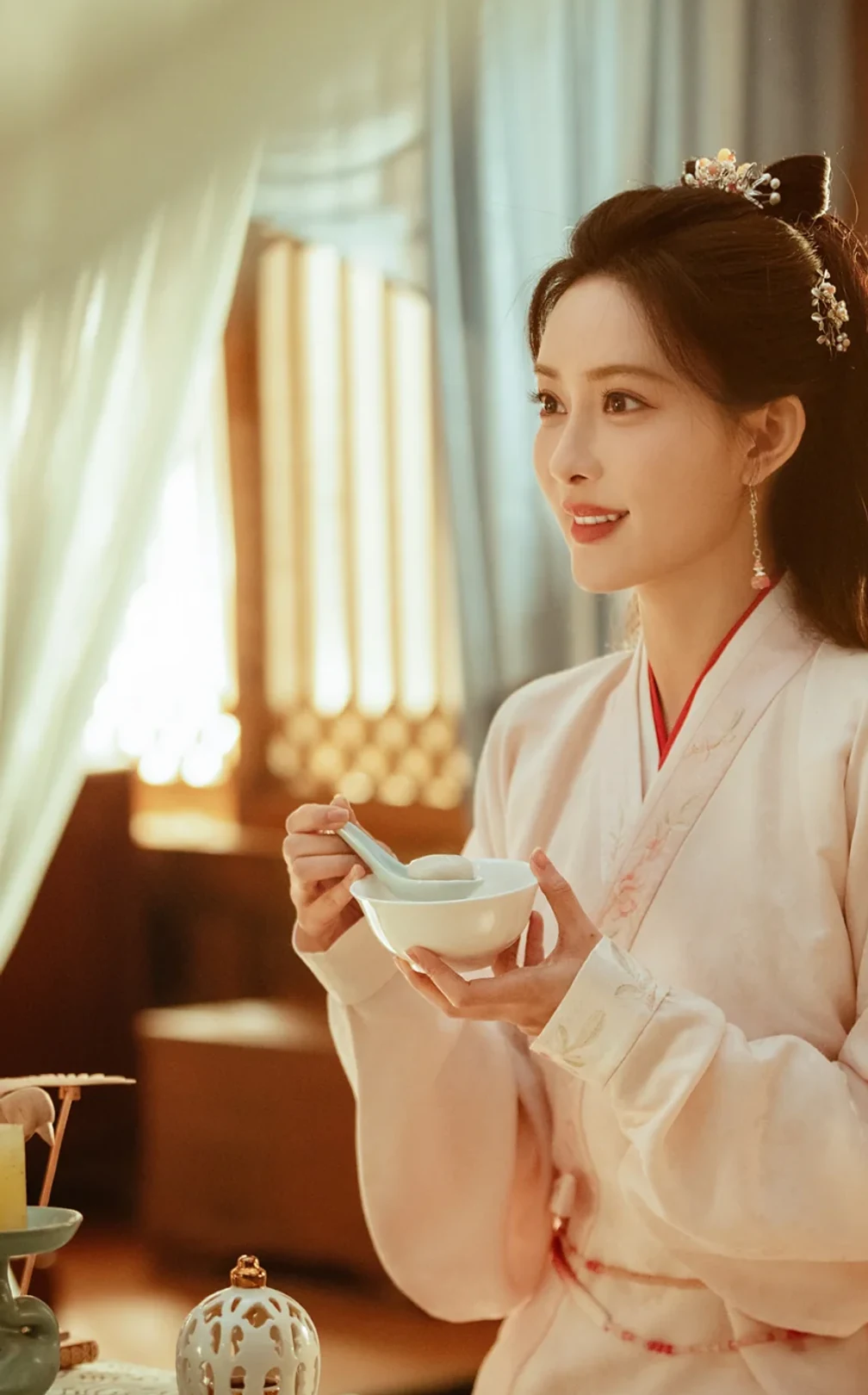
I chose this quiet image instead of another revenge face because it shows what the story is really defending. Dou Zhao can sit inside warmth without surrendering the bowl in her hands, the pace of the meal or the right to read the room for herself. Domestic calm is not a decorative prize awarded after the plot. For a woman whose first life taught her that a household can withdraw safety overnight, ordinary comfort becomes political. Her second life succeeds when she can inhabit a home without owing her survival to its mood.

The second image gives the domestic argument a different kind of evidence: Dou Zhao is not only receiving comfort, she is measuring the room before deciding how much of herself to reveal. That is the practical intelligence the series asks viewers to notice.
There is a useful comparison with Jiang Xuening in Story of Kunning Palace. Jiang Xuening returns carrying moral debt toward people she previously used. Dou Zhao returns carrying an engineer's suspicion of structures that already failed. One asks, “What do I owe?” The other asks, “What must exist before I can safely choose?” They are not interchangeable rebirth heroines.
Song Mo is not the prize at the end of female suffering
Song Mo works because he is a changing variable, not a reward. He has military competence, physical authority and access to institutions Dou Zhao cannot simply summon. She has domestic intelligence, foreknowledge and an ability to read how private cruelty becomes public disaster. Their attraction becomes convincing when those abilities change the next action.
Li Yunrui plays Song Mo with a useful alertness. He can enter like a man accustomed to command without making listening look like surrender. That matters. Too many costume romances call a couple “equal” while every consequential decision still belongs to the man. Here the alliance is alive when Song Mo hears Dou Zhao, tests the information and revises his route.
The romance weakens whenever the drama turns him into a perfectly calibrated protector. Protection is not equality if one person retains the right to decide what the other is allowed to know. The sharper question is not “Would he die for her?” Costume dramas answer that every week. It is “Will he alter a plan because her judgment has changed what he understands?”
That is why the marriage-of-alliance structure is so satisfying. They do not fall into safety. They negotiate a working arrangement, discover what the other can do and gradually risk more truth. Love grows from tested reliability. I believe that more than instant devotion.
I am also more demanding of Song Mo than many viewers are. Being handsome, loyal and physically brave is not the same as being a good partner. The real test is whether he can absorb information that changes his plan without punishing Dou Zhao for having information he did not possess.
Li Yunrui plays the useful contradiction: Song Mo enters scenes with the authority of a man used to deciding, but the romance improves only when that authority becomes revisable. I do not need him to become soft. I need him to become responsive. A rigid protector is still a man who controls the room. A partner can keep his strength and let another person's judgment alter the next move.
I would rather watch them revise a decision across a table than exchange another grand vow about dying for love. Death is dramatic; changing a plan is evidence.
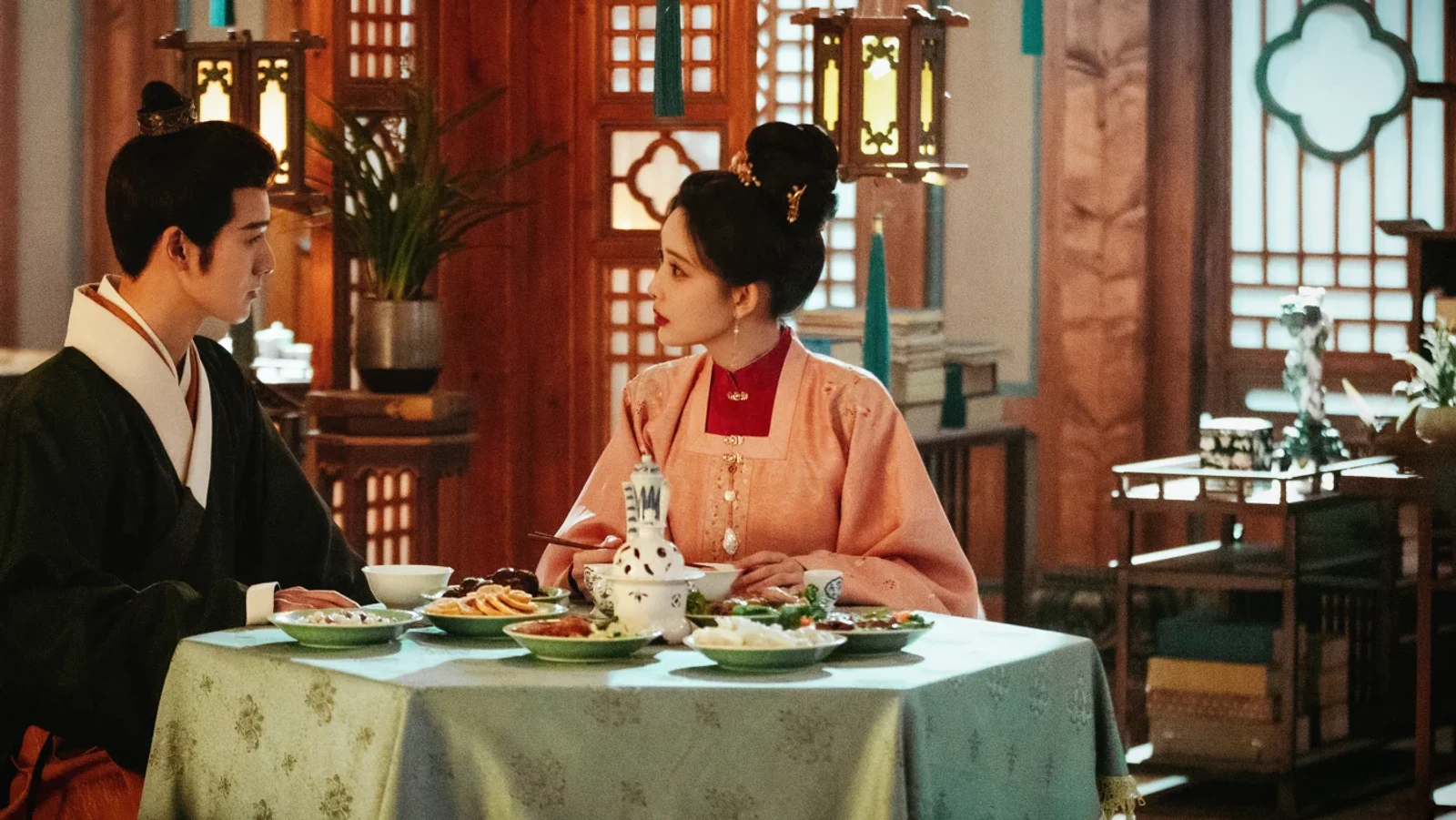
The photograph opening this guide makes the equality claim testable. They have not been collapsed into a kiss or arranged as protector and protected. Food, cups and the physical width of the table remain between them while both hold the other's gaze. This is partnership as a practical negotiation: two people keep their own seat, bring resources into the same room and decide whether the next move can be shared. If the series had offered only sacrifice and rescue, I would not believe the marriage. The seated conversations are what earn it.
The crowded family tree is a feature—and occasionally a failure
Viewers repeatedly need a relationship map for Blossom. Questions as basic as why Song Mo's father seems to wish him harm, how the switched-child suspicion works, who belongs to which Dou branch and why a supporting figure knows the heroine are not signs that audiences are inattentive. They reveal the show's central design: power travels through kinship. They also reveal where the storytelling becomes too dense.
The distinction matters. A complex clan is not automatically confusing. Complexity becomes meaningful when the viewer understands what a title, marriage or birth order permits a person to do. It becomes clutter when the plot asks us to remember names without making their leverage visible.
Song Mo's father is not just a “bad dad” inserted to generate trauma. Paternal hostility matters because lineage, legitimacy and inheritance give private rejection institutional force. The wound does not stay in a bedroom. It can decide who commands, inherits, speaks for a household or survives an accusation. Song Mo's rage therefore belongs to a structure, not only a childhood.
But I will not excuse every knot as sophisticated politics. When a viewer needs an external chart merely to identify why a scene should hurt, the adaptation has underwritten the relationship. Blossom is strongest when one gesture—the refusal to acknowledge a child, the protection of an asset, the withholding of a name—makes the hierarchy legible without a lecture.
The uncomfortable Blossom question: why does Song Mo still suffer?
Plot spoilers begin here. I agree with the sharpest criticism in this Zhihu discussion of Blossom: the script cannot praise Dou Zhao's foresight whenever she protects her own future, then treat that foresight as irrelevant when Song Mo's family is in danger. That inconsistency bothered me more than the crowded family tree. It asks me to admire her intelligence without letting me examine its limits.
I would not demand that a woman with a memory of the future stop a court catastrophe by sheer will. Song Mo's uncle's fate is entangled with institutions she cannot command. But once Dou Zhao has built contacts and has reason to care for Song Mo, the question changes. What does she know at that point? What can she warn him about? What can she investigate without exposing them both? The show sometimes moves past those questions faster than it moves past the grief that follows.
That does not mean I think Dou Zhao could save everyone. An unprovable warning inside those households might expose them both. But I refuse the convenient answer that every missed intervention was simply “fate.” Show me a concrete action she considered, the concrete risk that stopped her, and what her choice cost Song Mo. Then I can respect her limitations. When the drama skips that work and moves straight to his grief, it makes his suffering feel too useful to the romance.
Elsewhere the series lets foreknowledge behave like a private search engine: Dou Zhao recognizes danger, the editing confirms her, and uncertainty vanishes before judgment becomes difficult. Opponents can shrink into functions—the jealous one, the greedy one, the politically convenient one. Court turns arrive with more confidence than causal detail. The selective uncertainty makes her failures harder to evaluate: is this a limitation she must face, or a pause the script needs?
My test is severe and simple:
- If the first life supplies the answer, the scene proves memory.
- If Dou Zhao creates a fallback before the answer is known, the scene proves capacity.
- If Song Mo or another person behaves differently because she changed the conditions, the scene proves growth.
- If every changed condition still leads exactly where she predicted, the series is flattering her, not challenging her.
The third category is the reason to watch. Rebirth should make the world less predictable, not more. Once Dou Zhao moves one piece, everybody else has a chance to respond differently. The future stops being a script and becomes a negotiation.
Blossom ending explained: the victory is not simply staying alive
Major spoilers begin here. The ending is happy for Dou Zhao and Song Mo: they survive the family and court dangers and remain together. But “happy ending” is too small a description of what the drama is trying to complete. The first life taught Dou Zhao to avoid catastrophe. The second life asks her to decide what a life should contain after catastrophe has been avoided.
That is why I do not read the resolution as a reward for suffering. She is not valuable because she endured enough pain to earn a good husband. The relationship matters because the couple has built a structure in which her judgment, his authority and their shared future can exist at the same time. The romance is strongest when it feels like the result of changed conditions rather than compensation.
The show still moves too quickly through some political consequences. I felt that compression. A court victory can arrive with the speed of a plot requirement even after the domestic sections have taught us to respect preparation. This is the point where I have to disagree with the most generous version of the drama: not every loose political knot becomes sophisticated because the costumes are beautiful.
Even so, the emotional destination holds. Dou Zhao does not end as a woman who knows the answer to every future question. She ends with more choices, better allies and a clearer ability to reject the old terms. That is a meaningful definition of rebirth. Memory opens the door; judgment decides whether to walk through it.
How to watch Blossom without reducing it to a romance recap
Use four checkpoints rather than waiting for kisses or revenge payoffs:
- First-life collapse: identify what Dou Zhao lacked—money, information, a credible ally or permission to refuse.
- The rural household: note which capacities she builds before Song Mo can solve anything for her.
- The alliance: watch for the exact moment one person's judgment changes the other's decision.
- The court endgame: separate victories earned through earlier preparation from victories produced by narrative speed.
Who should watch Blossom, and who should skip it
Watch Blossom if you want:
- a heroine whose intelligence is expressed through resources and timing, not only sharp dialogue;
- a romance built around mutual usefulness before emotional surrender;
- domestic politics, inheritance pressure and family hierarchy as part of the love story;
- an ending that treats survival as a beginning rather than the final prize.
Skip it, or lower your expectations, if you need every political faction to receive the same depth as Dou Zhao and Song Mo. The family tree is part of the pleasure, but it is also the production's biggest burden. Some supporting characters carry structural importance while receiving less psychological space than the main couple.
That tradeoff does not cancel the series. It tells you how to watch it. I would never recommend Blossom as a perfectly engineered court thriller. I recommend it as a relationship drama in which two people learn to turn memory, suspicion and authority into a shared working life.
If you want another drama where family neglect shapes every later form of love, go next to Love Like the Galaxy. If you want performance as revenge and identity repair, compare The Double. Then use the Chinese TV shows collection to choose by emotional problem rather than costume.
My final judgment is firm: Blossom succeeds when Dou Zhao's intelligence produces options, not applause. The memorable fantasy is not knowing the future. It is reaching the same trap and discovering that this time you own a door.
In the comments, put one decision on trial: was Dou Zhao saved by memory, by a resource she built, or by somebody finally treating her judgment as consequential? Submit the scene as a Moment linked to this guide and return after episode 18; that is where your first answer should become harder, not easier.