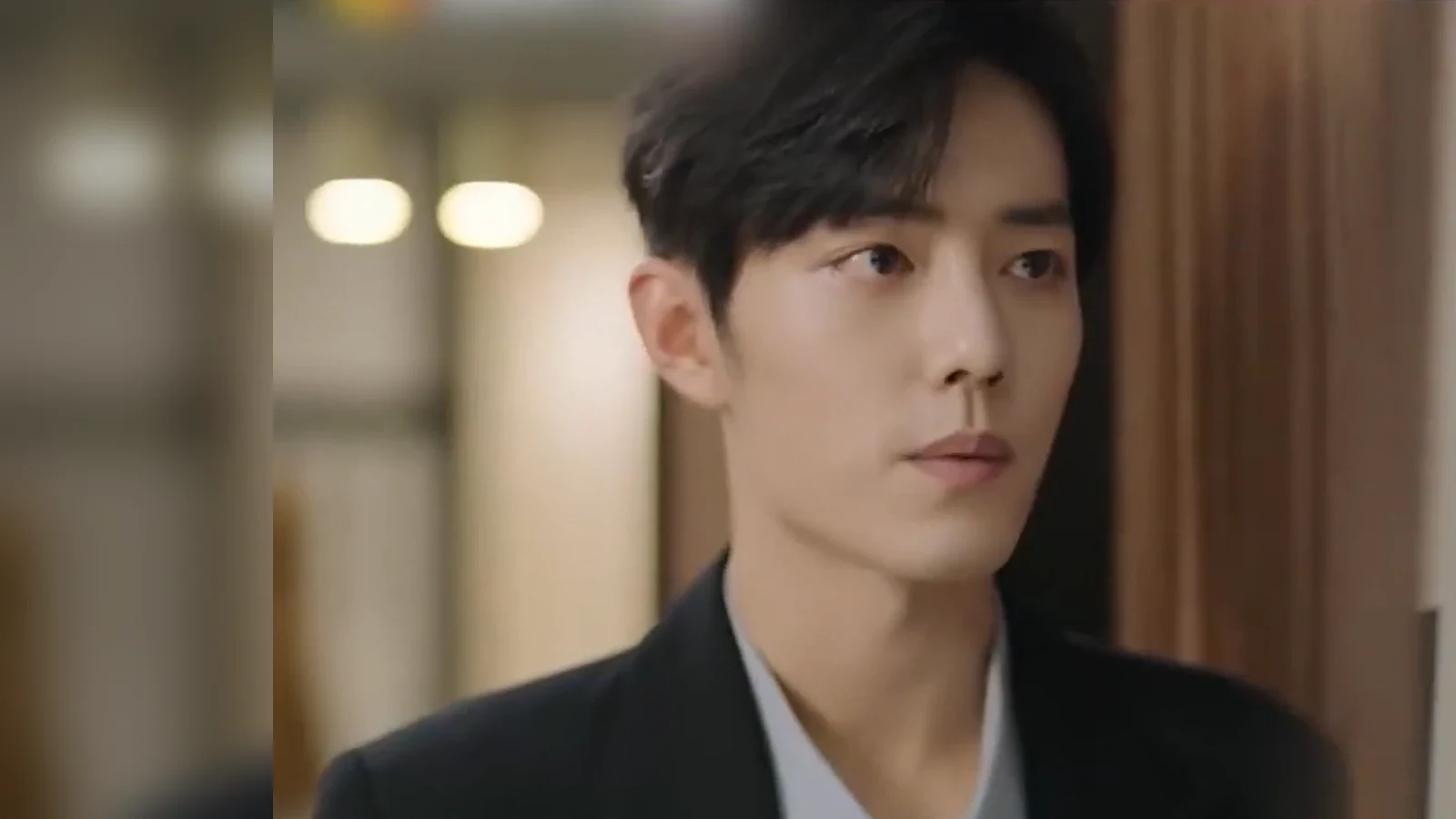
Xiao Zhan's importance cannot be separated from Wei Wuxian, but his quality cannot be decided by that role. The real story is how a performer built around openness and emotional speed learned to carry calculation, ordinary adulthood and consequence.
Xiao Zhan must be watched across time, not defended in one clip
Tencent Video's official The Untamed Episode 1 fixes the role that made Xiao Zhan globally legible. The rest of this page refuses to freeze him there, comparing how openness, calculation and adulthood operate in later work.
Xiao Zhan (肖战, also Sean Xiao) is a Chinese actor and singer whose international recognition accelerated through Wei Wuxian in The Untamed. Start there because the role explains the scale of attachment. Then move deliberately: Sunshine by My Side for contemporary adulthood, The Longest Promise for a more contained costume register, and newer work to test whether control has become thought rather than stiffness.
Wei Wuxian survives translation because the performance changes temperature quickly. Mischief can become vigilance before a subtitle finishes. Physical ease makes later isolation hurt: the audience remembers a body that once occupied space without fear. The role is not simply charismatic; it is structured around the cost of remaining morally alive when a community changes the meaning of your actions.
That openness is why the performance became personal for so many viewers. Wei Wuxian enters a room as if relationship is possible, even when the room has already prepared judgment. I do not experience that as generic brightness. I experience it as courage with terrible consequences. Xiao Zhan's face lets thought escape quickly; the gift is immediacy, and the risk is that every later emotion can look as if it is arriving for the audience instead of for the person opposite him.
The hardest sequel was not another season
The hardest task after The Untamed was escaping the emotional contract viewers formed with Wei Wuxian. A star can repeat the same openness and satisfy recognition, or close down completely and call it range. Neither is enough.

The Longest Promise places him inside ceremonial restraint. The useful question is whether stillness has a changing cause: duty in one scene, fear in another, withheld affection later. Sunshine by My Side removes the robes and asks for ordinary social friction. Here charm must coexist with work, age difference, embarrassment and unequal confidence. The smaller scale is not less serious; it denies him the protection of myth.
The transition cannot be measured by asking whether the later role makes me feel as much as Wei Wuxian. That is an unfair test because memory, music and cultural discovery are already fused around the breakthrough. The fairer question is whether a new role produces a different human mechanism. Shi Ying should not be Wei Wuxian with fewer smiles. Sheng Yang should not be Wei Wuxian in office clothes. Restraint and adulthood need their own causes.

The official iQIYI series record identifies Sheng Yang as a young advertising worker opposite Bai Baihe's more established Jian Bing. That professional imbalance gives Xiao Zhan a better range test than another tragic costume entrance. He must be attractive without behaving as if the room already belongs to him; hopeful without making persistence feel entitled; ambitious while still revealing how little workplace power the character holds.
What stays with me is not a “mature look.” It is the awkward labor of adulthood: being corrected, watching a better idea come from someone else, returning to work after romantic embarrassment. Wei Wuxian can transform a public room through charisma. Sheng Yang often has to survive a room whose hierarchy will not bend for him. The contrast makes both performances easier to see.
What I want from the contemporary role is friction too ordinary to become a heroic pose: a client who does not care about sincerity, an older colleague who recognizes the shortcut, a romantic boundary that cannot be conquered through persistence. When Xiao Zhan lets Sheng Yang absorb correction before responding, adulthood appears not as styling but as delayed reaction. That delay is valuable because emotional speed was once his defining strength.
What the audience argument reveals
The current conversation around Xiao Zhan's acting is intensely scene-specific. I understand the risk clearly: if a physical reaction works, it becomes the drama's essence; if it fails, it becomes material for critics. That is why I judge the complete scene, not the isolated close-up.
That is a useful description of exposure, not proof of excellence. Close-ups magnify both controlled reaction and audience projection. My test is consequence: does the reaction alter the next breath, line, distance or decision? A trembling face without changed behavior is a clip. A small reaction that reorganizes the scene is acting.
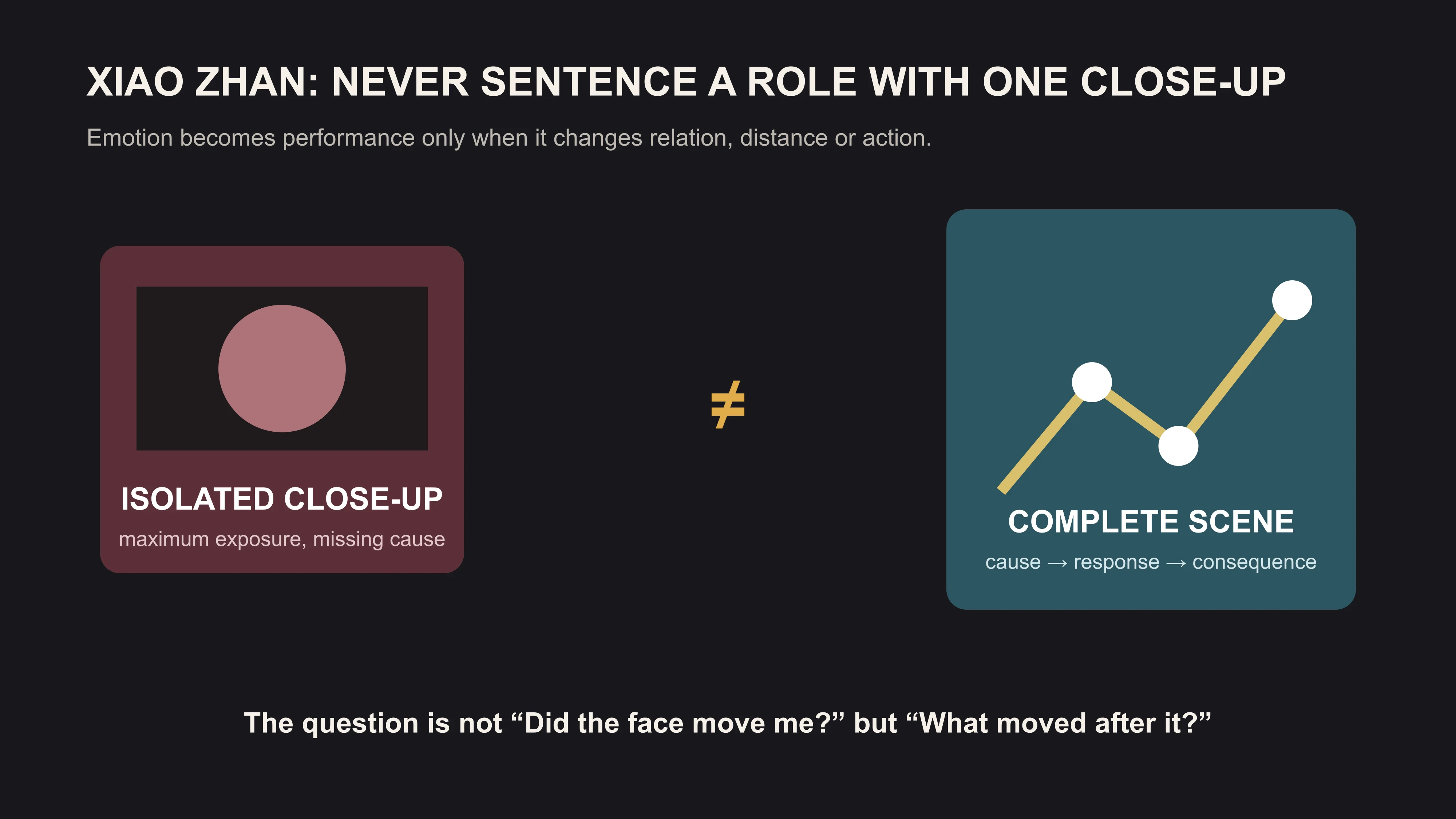
This rule protects the actor as much as it disciplines the viewer. A hostile edit can repeat one awkward second until effort becomes the whole performance. A worshipful edit can detach tears from cause and call intensity proof. Both destroy sequence. I will take one imperfect complete scene over twenty immaculate reaction clips because a scene makes the performer negotiate another human being.
A route through the whole person

I read the career as four pressures rather than four popularity eras. Wei Wuxian turns openness into moral risk. Shi Ying in The Longest Promise turns restraint into an obligation that can harden the body. Sheng Yang puts charm inside work, money and unequal experience. The next convincing role must make calculation visible without merely removing warmth. It should leave a new physical memory rather than asking old attachment to perform all the emotional work.
The career becomes clearer when I separate four kinds of presence. Wei Wuxian requires emotional velocity: thought reaches the face quickly. A restrained costume role tests whether stillness contains changing pressure. Contemporary drama removes the protection of robes, clan rules and tragic music; awkward work conversations have to feel inhabited. Music and live stages test a different contract, because the performer addresses an audience as himself while still controlling what remains private.
This is why “Sean Xiao” is useful as an alternate search name but not a separate international persona. The overseas viewer is meeting the same public career through different distribution systems, subtitles and fandom histories. A good profile should connect those doors without turning popularity into proof of acting quality.
My personal measure is whether a role leaves a new physical memory. I already remember Wei Wuxian's loose occupation of space. Later work must give me another image just as exact: a pause shaped by adult embarrassment, a decision hidden behind courtesy, or a body that cannot escape consequence by smiling. Range is not a list of costumes. It is the accumulation of distinct human pressures.
The newer challenge is calculation. Emotional openness gives the audience fast access; calculation requires us to feel thought without being handed its result. If every pause announces “watch me think,” control becomes laborious. If the face closes completely, the star has confused opacity with depth. The performance must let strategy alter timing while preserving the warmth that made the audience trust him in the first place. That balance—not darker lighting or slower speech—is the career test I care about.
Xiao Zhan is also a singer and stage performer, but this page does not pretend one drama song summarizes that work. His music matters because voice and live performance preceded and then accompanied the acting career. The same public openness that suited Wei Wuxian has to survive a music industry and celebrity system that continually turns expression into evidence about the private person.
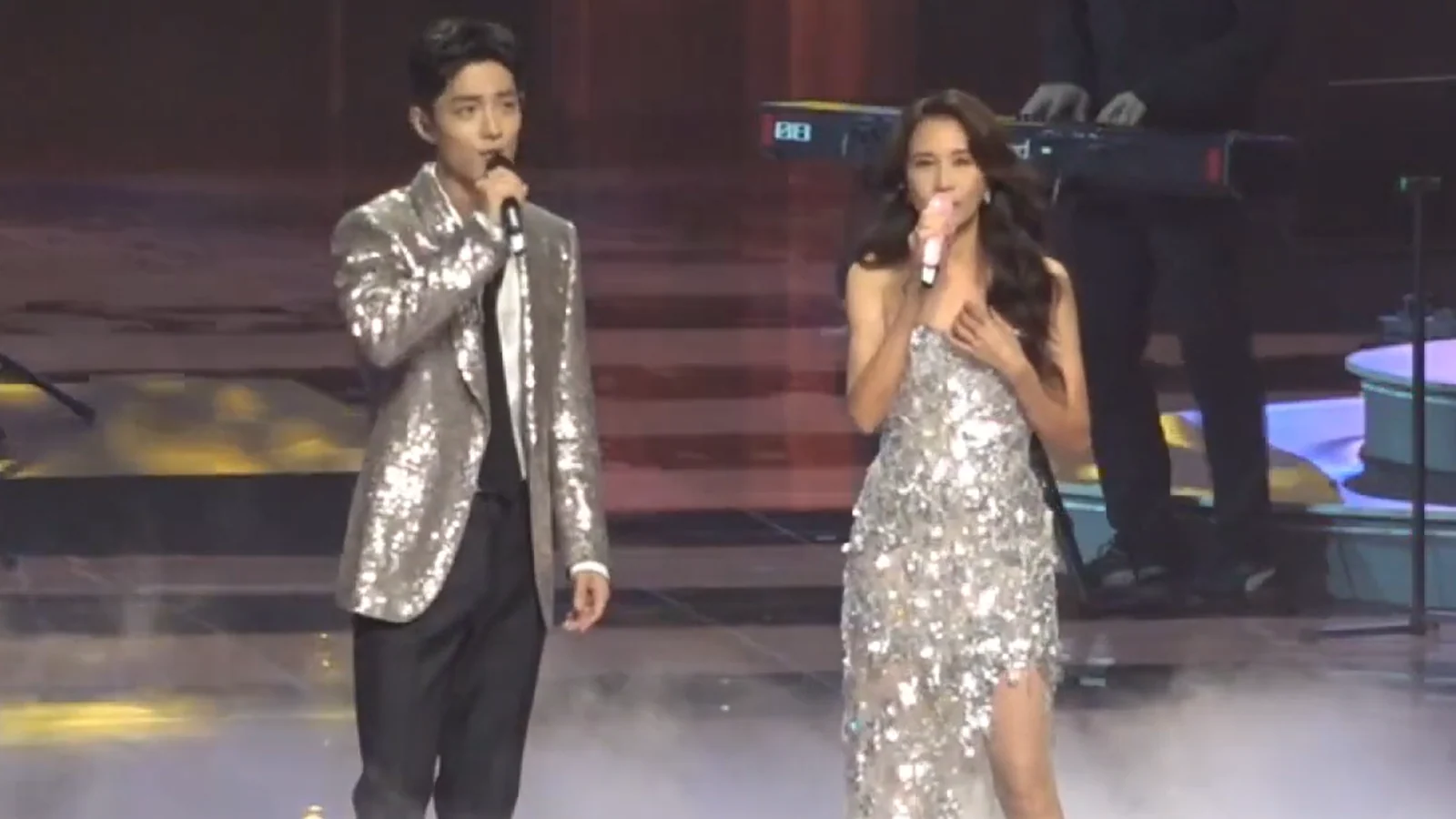
The gala frame does something a portrait cannot: it shows shared timing. He is not alone beneath a spotlight; he has to match another singer, a live arrangement and the scale of a televised stage. That does not settle his acting range, but it completes the public performer whom a drama-only biography would erase.
That is why a responsible profile stops at public work. The performer is available for analysis; imagined intimacy is not.
My verdict
There is one final discipline for viewers: separate attachment from evidence without becoming ashamed of attachment. Wei Wuxian can matter personally and still be analyzed precisely. A later role does not have to defeat him in a fan ranking; it has to ask Xiao Zhan for another arrangement of voice, body, thought and consequence. That keeps the career open instead of turning its breakthrough into a permanent courtroom.
For that comparison, the Chinese actors collection matters as more than navigation. It places Xiao Zhan beside performers facing different burdens: some must escape beauty, some a variety persona, some an iconic role. His burden is unusual because the emotional contract is so powerful. The only honorable way forward is not to deny it, but to build something equally specific beside it.
I will know the transition has worked when I stop congratulating Xiao Zhan for being unlike Wei Wuxian. Difference is only the beginning. The later character must become memorable on his own terms: a particular way of withholding information, failing at work, using affection or accepting blame. Growth is complete when comparison becomes optional, not when publicity declares a transformation.
I would revisit one early scene and one later contemporary scene with the sound low. Watch who initiates distance, where the hands settle and how quickly feeling becomes action. Then restore the dialogue and ask what the voice adds. This two-scene comparison gives more useful evidence of growth than popularity totals, awards lists or isolated crying clips.
Start with The Untamed, but do not finish there. Xiao Zhan's strongest career question is whether emotional immediacy can mature without disappearing. The answer is visible only across roles: mythic openness, ceremonial restraint, ordinary adulthood and the newer pressure of characters who must calculate before they speak.
Read the full The Untamed guide and compare Wang Yibo's opposite physical grammar in our Wang Yibo profile. In the comments, bring one complete scene that proves growth. Join the East Moment community to test it against another role.
Wei Wuxian is the necessary first pressure test
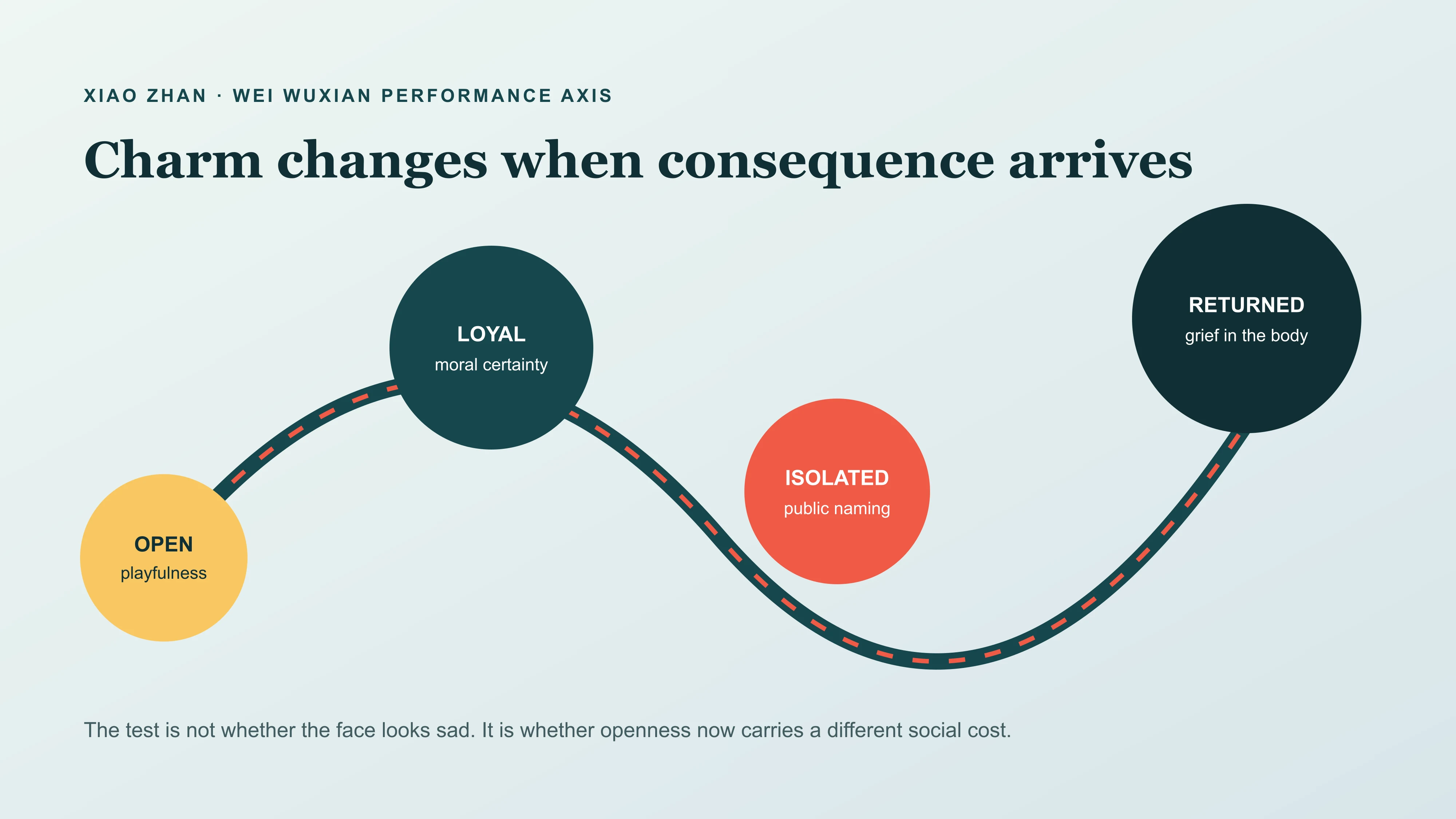
Wei Wuxian matters because charm repeatedly creates consequence. Playfulness builds intimacy and disguises danger; moral certainty isolates him; grief changes the body that once moved easily through a group. The role is not proof that every later performance succeeds, but it establishes the full problem his career must keep answering.
That is why I reject both automatic defence and automatic dismissal. Compare the complete scene before the fall with the complete scene after return. Then ask whether a later role creates a different social cost for the same openness. Star image is the pressure; changed behaviour is the evidence.
A performance page should not ask readers to love or punish the celebrity. It should ask them to watch cause, response and consequence. The person becomes fuller when a beloved role is placed beside work that resists the same charm, not when every title is recruited as proof of greatness.
Wei Wuxian remains the beginning because the role contains joy, arrogance, loyalty, isolation and return. The next role matters only when it rearranges those pressures rather than borrowing their emotional credit.

.png)