Ling Cage is not disturbing because its ruined Earth has monsters. Many science-fiction stories have monsters. It is disturbing because the Lighthouse can explain, in calm practical language, why care is inefficient, why memory is dangerous, and why a person should accept a smaller life in order to keep a machine of survival running.
Ling Cage is a Chinese sci-fi donghua about a society that treats human feeling as a resource problem
The premise is immediately legible. Humanity survives on the Lighthouse, a vertical city above a devastated world. The surface is dangerous. Resources are limited. A governing order promises security by regulating work, intimacy, birth, class and grief. Mark is a hunter from the more protected upper structure; Ran Bing and others make the social cost of that hierarchy impossible to ignore.
That sounds like familiar post-apocalypse architecture. What makes Ling Cage worth watching is its refusal to let the architecture remain background. The show keeps returning to a question that is less spectacular than a monster attack: when authorities say a cruel rule is necessary for collective survival, how do ordinary people decide whether necessity is true, exaggerated, or simply convenient for those in charge?
The current Bilibili International catalogue is the strongest English-facing starting point for the first season, while Made By Bilibili's official season-two preview confirms the later visual and story direction. Catalogue, language and membership access vary by region, so check the live page instead of trusting an old fan playlist.
The emergency is real. The moral question begins when classification and repetition turn one response into the only response anyone is allowed to imagine.
Ling Cage release status, English titles and official route
| Question | Direct answer |
|---|---|
| What is the Chinese title? | Ling Long (灵笼). |
| Why do I also see Spirit Cage: Incarnation? | International catalogues and fan discussions have used Ling Cage, Ling Cage: Incarnation and Spirit Cage: Incarnation. Check the Chinese title and YHKT / Bilibili production identity before assuming they are different shows. |
| Who made it? | Wuhan-based animation studio YHKT Entertainment produced the series for Bilibili. |
| Is there a second season? | Yes. Made By Bilibili published official season-two material in 2025, and Ling Cage – Season 2 appeared in Annecy's official TV-film selection. |
| Where should I check availability? | Begin with Bilibili's live series catalogue and the verified Made By Bilibili channel. Regional episode, subtitle and membership access can differ. |
| Is this page spoiler-free? | It explains the Lighthouse's institutions and early character pressures without revealing the later resolution. |
The Annecy International Animation Film Festival listing matters as an independent institutional source: it identifies season two as a YHKT production selected in the festival's TV-film program. It does not prove that every viewer will like the writing, or that a particular streaming route works in every country.
Is Ling Cage for you?
| If you want… | What Ling Cage gives you | The honest caution |
|---|---|---|
| Large-scale 3D science fiction | Weathered metal, industrial scale, body horror and a hostile surface | It can look more complete than its character writing feels in an early episode |
| A political survival story | Class, labour, reproduction, ritual and authority are built into the Lighthouse | The worldbuilding can arrive faster than emotional attachment |
| Moral tension | Rules are presented as systems before they are presented as villains | Some viewers find the early exposition too insistent |
| A human relationship inside a cold world | Mark and Ran Bing give institutional violence a personal cost | Do not expect romance to solve the social argument |
| Chinese animation outside cultivation fantasy | A distinct modern-industrial visual vocabulary | It is not a light, comforting entry to donghua |
My short verdict: watch it if you enjoy asking how a world works after the chase scene ends. Leave it if you need every dystopian mystery answered quickly or every rule translated into a clean good-versus-evil conflict. Ling Cage is most alive when it makes the uncomfortable answer feel plausible for a moment.
The Lighthouse is frightening because it has a vocabulary for mercy
The obvious reading of the Lighthouse is prison. That is true but incomplete. A prison run only through violence would be easy to reject. The Lighthouse is more unsettling because it calls its restrictions order, balance, efficiency and protection. Its language is designed to turn human needs into management problems.
Who eats, who works, who may form an attachment, who is treated as expendable, who is asked to leave: each decision can be presented as a calculation. A calculation can sound impartial even when its costs fall on the same bodies every time. The series' strongest idea is that oppression does not always arrive screaming. Sometimes it arrives as a meeting, a ritual, a safety protocol, a slogan repeated until the people harmed by it begin to use the same words.
That is why the Lighthouse needs ordinary spaces. A corridor, a meal queue, a work uniform and a private hesitation show more than a speech about tyranny. They tell us whether people can make unplanned contact, whether a lower-status person can interrupt an official, whether affection has to hide in gestures too small to be named. The world becomes credible when survival has altered social reflexes, not only the skyline.
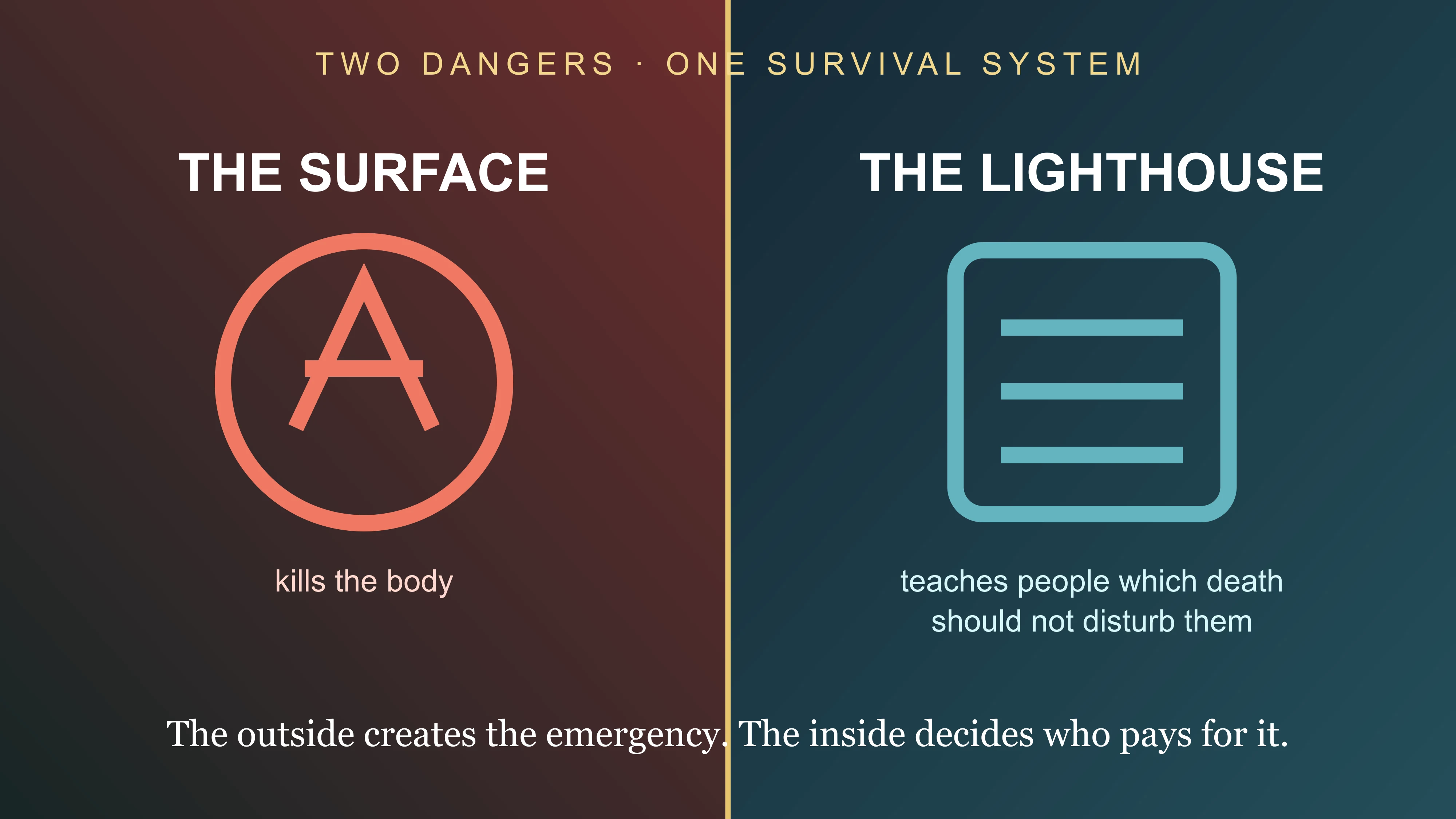
The surface threatens the body. The Lighthouse controls the meaning of whose body may be lost. The series is strongest when those dangers cannot be separated.
A cruel system still has to make causal sense
I do not excuse a broken rule because the production design is beautiful. The Lighthouse can be hypocritical, unfair and self-protecting; real institutions are all three. But the story must show who benefits from an exception, who authorizes it, and what the exception costs. Otherwise a resource rule is strict in one episode and porous in the next only because the plot needs another emotional scene.
This is the sharpest criticism raised in detailed viewer discussion: classifications such as resource value, status and “far travel” cannot remain impressive vocabulary. They must alter food, labour, mobility, punishment and the choices available to a named person. If a supposedly scarce society repeatedly ignores its own accounting without consequence, the Lighthouse stops feeling frightening and begins feeling like set decoration.
My standard is not perfect bureaucracy. It is visible causality. When a senior person bends a rule, I need to see the privilege. When a lower-status person breaks the same rule, I need to see the asymmetry. When the institution changes a category, I need to know whether new evidence forced the change or power simply renamed its preference. A dystopia becomes credible when its contradictions reveal power—not when contradictions are edited out of memory by the next action sequence.
Mark matters only if strength does not make him innocent
Mark is built to attract a familiar kind of admiration: physical capability, field experience, competence when the world becomes violent. A weaker story would make those traits automatic proof that he understands the system better than everyone else.
Ling Cage becomes more interesting when strength is treated as a position with blind spots. A skilled hunter may be admired by the people who depend on him while still benefiting from a structure that decides whose danger counts. The test is not whether Mark can defeat the threat outside. The test is whether he can see the threat embedded in the normal life he was trained to defend.
This is the distinction between a protagonist and a moral shortcut. A protagonist has to encounter evidence that changes him. A moral shortcut only needs the camera to stand behind him. When watching, notice who bears the cost of his choices, who can refuse him, and whether the show lets their refusal remain intelligent rather than making it an obstacle to a heroic reveal.
Ran Bing should never become a symbol that other people talk through
Ran Bing carries an important counterweight to Mark's perspective. Her value is not that she can soften a hardened man or make the audience care about his future. Her value is that she has her own relationship to danger, duty, memory and the rules of the Lighthouse.
In a survival story, women are too often asked to become evidence that men are still human. That is a narrow job. A stronger story lets a character disagree with the terms of care themselves: what counts as loyalty, what kind of risk is bearable, whether a promise protects or controls, and how much of a self can survive when a system decides intimacy is wasteful.
The scenes that stay with me are therefore not simply declarations of love or sacrifice. They are moments of attention: one person notices the rule another person has learned to endure; someone refuses the language of “necessary loss”; a private relationship becomes evidence that the public system cannot account for everything valuable.
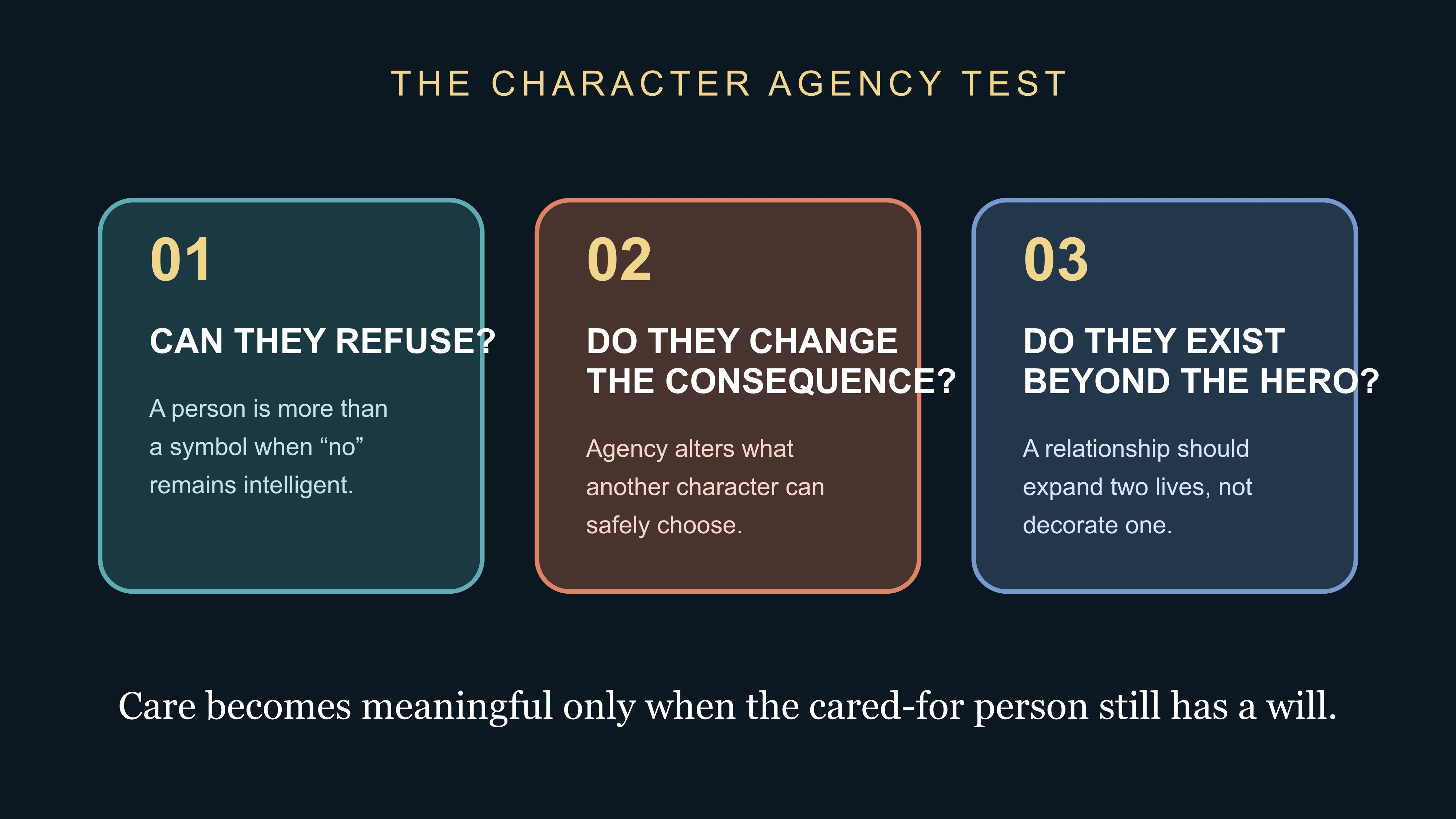
This is the standard I use for Ran Bing, Mark and every relationship around them: refusal, consequence and a life beyond the protagonist.
The surface monsters matter less than the institutional monster above them
The creatures outside provide momentum, scale and bodily terror. Their design helps the series make the Earth feel hostile rather than merely abandoned. But the surface alone cannot carry the argument. If every danger comes from outside, then the Lighthouse's brutality becomes understandable background management.
The series is sharper when the two dangers contaminate one another. The outside provides a real emergency. The inside decides who may define that emergency, what information circulates, whose life is calculated into the solution, and which feelings are declared unaffordable. A monster can kill a person. An institution can teach everyone else why the death should not disturb them.
That is a heavy claim, and the show needs scenes rather than slogans to earn it. The best dystopian science fiction lets rules fail in small, visible ways: a person is misclassified, a ritual produces grief rather than stability, a necessary lie asks for one lie too many. Each crack makes the world more frightening because it demonstrates that the system was built by people and therefore could have been built differently.
Beauty is not the same as storytelling
The animation's industrial environments, lighting, texture and scale are a real achievement. Ling Cage can make an elevator shaft, a damaged suit or a distant exterior feel expensive and considered. That visual confidence explains why viewers often stop first for the atmosphere.

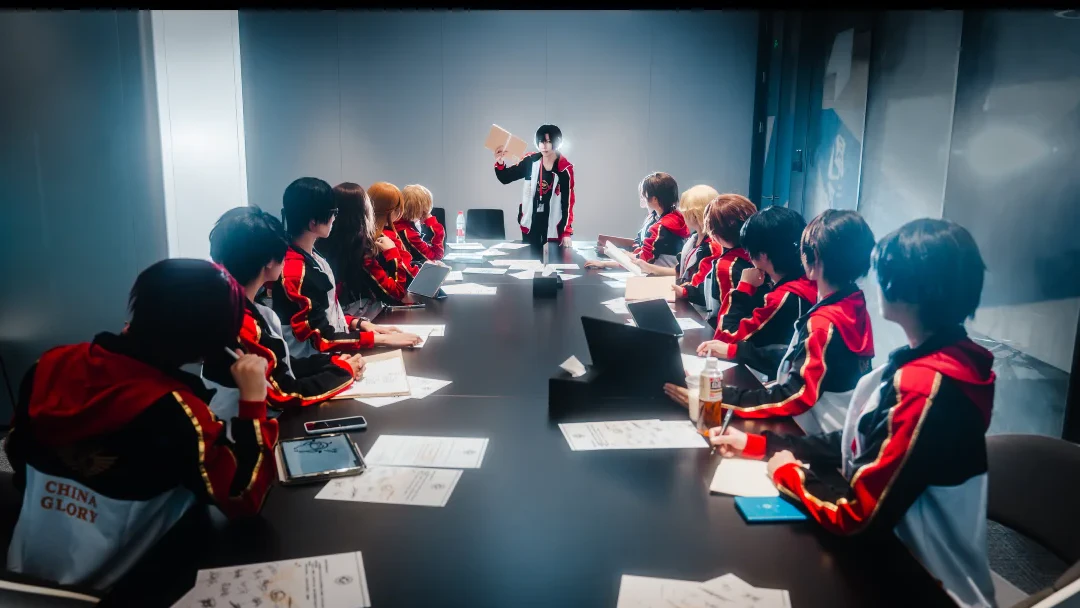
At Shanghai BW, Bai Yuekui's cropped jacket, high ponytail and combat-ready posture remain legible even outside the animation. That is real visual authorship: a fan can rebuild the silhouette in a crowded pink booth and the character still arrives before an explanation does.

The next table made the franchise physical: hands had to place cards, read limited spaces and make choices inside a glowing grid. It proves that visitors at Shanghai BW were invited to handle a rule-bound version of the world rather than only pose beside a poster. It cannot prove that the game's rules reproduce the Lighthouse faithfully, but it makes one thing visible—the audience's relationship with this story already extends beyond passive watching.
But I do not think “the 3D looks good” is an adequate verdict. High-resolution surfaces cannot decide what a scene wants us to feel. A dramatic camera move must still answer: whose fear is this, what information has changed, and what action becomes impossible after this moment? The most beautiful shot is not necessarily the largest one. It may be a face held too long after a rule has been explained, or a quiet room revealing that two people no longer know how to speak freely.
This is why Ling Cage belongs beside, rather than inside, the existing cultivation route. Swallowed Star uses scale to ask how home survives expansion. Ling Cage uses scale to ask how human intimacy survives administration. Both are 3D donghua; their emotional engines are different.
A first-watch route that protects the mystery
Start with one complete episode, not a lore video. Let the Lighthouse establish its procedures before you seek a glossary. On the second episode, make a small inventory: which rules are enforced through fear, which through habit, and which through a promise of safety? Then ask whose perspective the episode has withheld.
Avoid “explained ending” material until you have decided whether the central social pressure interests you. The plot has mysteries, but the best early discovery is ethical rather than factual. You do not need to know every name in the hierarchy to notice that hierarchy is changing the way people look at one another.
For a different form of Chinese animation tension, continue with Link Click, where private empathy becomes dangerous through time, or step back into the Chinese anime collection before choosing another visual world. Best Chinese Anime narrows that choice by emotional appetite rather than ranking. Black Myth: Wukong offers another useful contrast: it turns inheritance and danger into an authored mythic journey; Ling Cage turns the future into an argument about who gets to call a life necessary.
The East Moment verdict: watch when a rule begins to sound too reasonable
Watch Ling Cage for the Lighthouse, not only the monsters. Stay if its small social rules begin to unsettle you more than its action sequences. The show is worth your time when it makes survival look organized enough to be persuasive—and then asks what that organization has quietly taken from the people it claims to save.
When a scene made you question a rule that initially seemed sensible, bring it to East Moment's community. That is the conversation this series deserves: not “who is strongest?”, but “what should nobody have to surrender in order to be safe?”