Manhua is not simply “Chinese manga.” It is a moving comics culture: print magazines, newspaper satire, web serials, vertical scrolls, licensed adaptations and independent panels all sit inside a history that keeps changing. The useful question is not whether a title looks Japanese, Korean or cinematic. It is what the page is doing with time, language, bodies and the reader's scrolling or turning hand.
What is manhua?
Manhua (漫画) is the usual English term for Chinese comics. The word can describe historical print cartoons, serialized comics, web comics and digital-first work. It is a medium label, not a guarantee of one art style, genre or publication platform.
That distinction matters for overseas readers. A title may be marketed through a global webtoon app, adapted into donghua, turned into a live-action drama or circulated through fan translation, but the work still belongs to a particular Chinese production context. Ask who made it, where it was published, which language carries the joke and whether the adaptation has changed the reading rhythm.
The public-domain Shanghai Manhua cover in this page's opening image is useful precisely because it prevents a narrow definition. Historical manhua could be satirical, fashionable, literary or urban. Contemporary manhua can be romantic, fantastical, political, domestic or action-driven. The medium is wider than cultivation heroes.
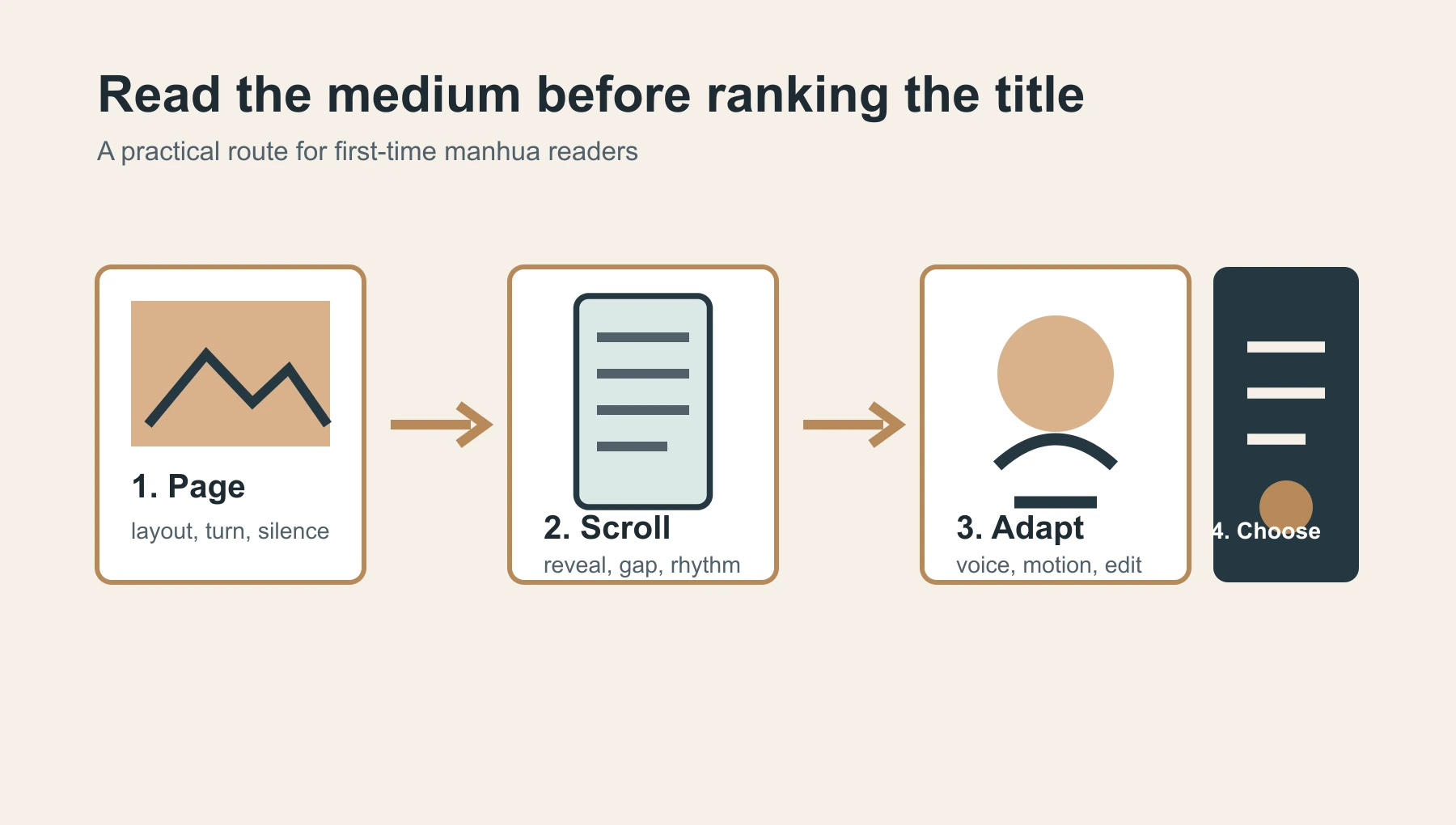
The route in this diagram is deliberately modest. I want a reader to identify the physical form first, notice how the work asks for attention, compare an adaptation only after understanding the source rhythm, and then decide whether the title deserves a recommendation. That order keeps a platform label from doing the work of criticism. It also gives an overseas reader a way to talk about a series without pretending that one screenshot represents its whole craft.
The four reading decisions that matter most
| Decision | What to notice | Why it changes the experience |
|---|---|---|
| Page or scroll | Panel composition, page turn, vertical reveal and phone rhythm | Suspense is built differently in print and digital formats |
| Speech or image | Dialogue density, captions, silence and visual repetition | Translation can preserve plot while losing timing |
| Genre or everyday life | Power systems, family work, romance, school, city streets | “Chinese comics” is too broad to predict tone |
| Original or adaptation | What the comic shows before donghua or live action | A famous screen version can hide the original pacing |
I prefer a first reading that stays small. Read ten to twenty chapters without opening a ranking list. Notice whether the artist can make a room, meal, street or pause memorable before the story begins escalating. A title that only works when the power scale becomes enormous may be entertaining, but it is not necessarily strong comics.
Manhua is not one visual style
Historical cartooning, painted fantasy, clean digital linework, realistic romance, ink-influenced action and deliberately awkward comedy all belong to different manhua traditions. Even within one series, the art can change as deadlines, assistants, platforms and adaptation expectations change.
The phrase “Chinese webtoon” is sometimes useful for describing a vertical reading format. It becomes misleading when it suggests that every series follows Korean platform conventions or that print history no longer matters. Format travels; production culture remains specific.
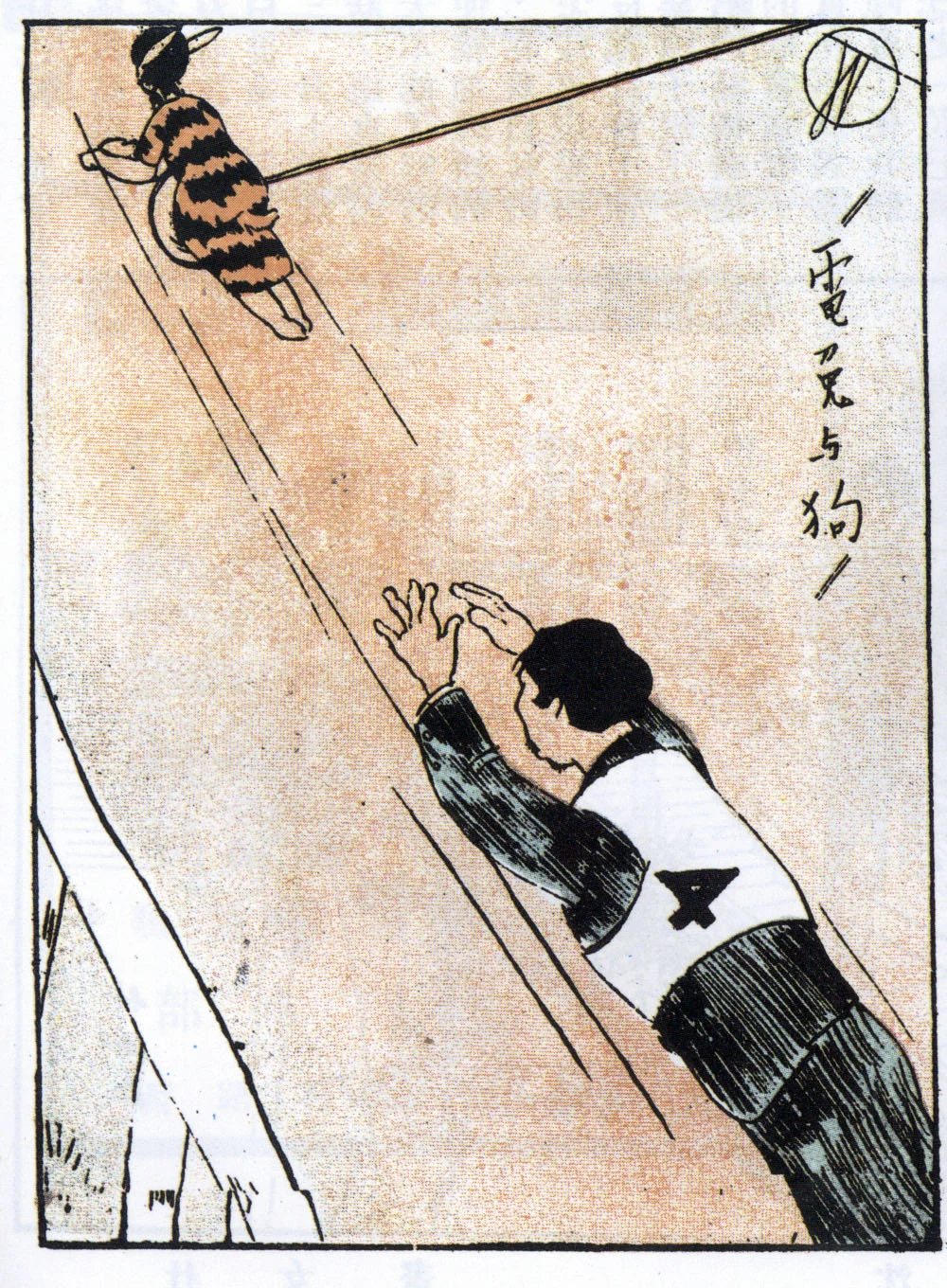
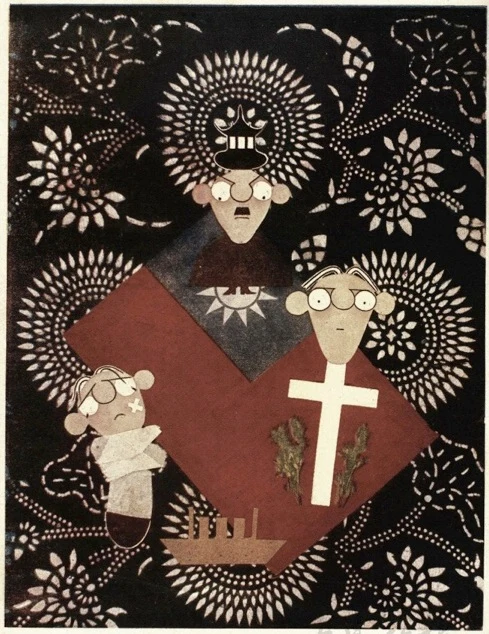
This page is a useful correction to the idea that manhua began with mobile scrolling. The image belongs to an earlier print economy, with its own humor, pace and audience. I would rather begin with that history than let a current app define the whole medium.
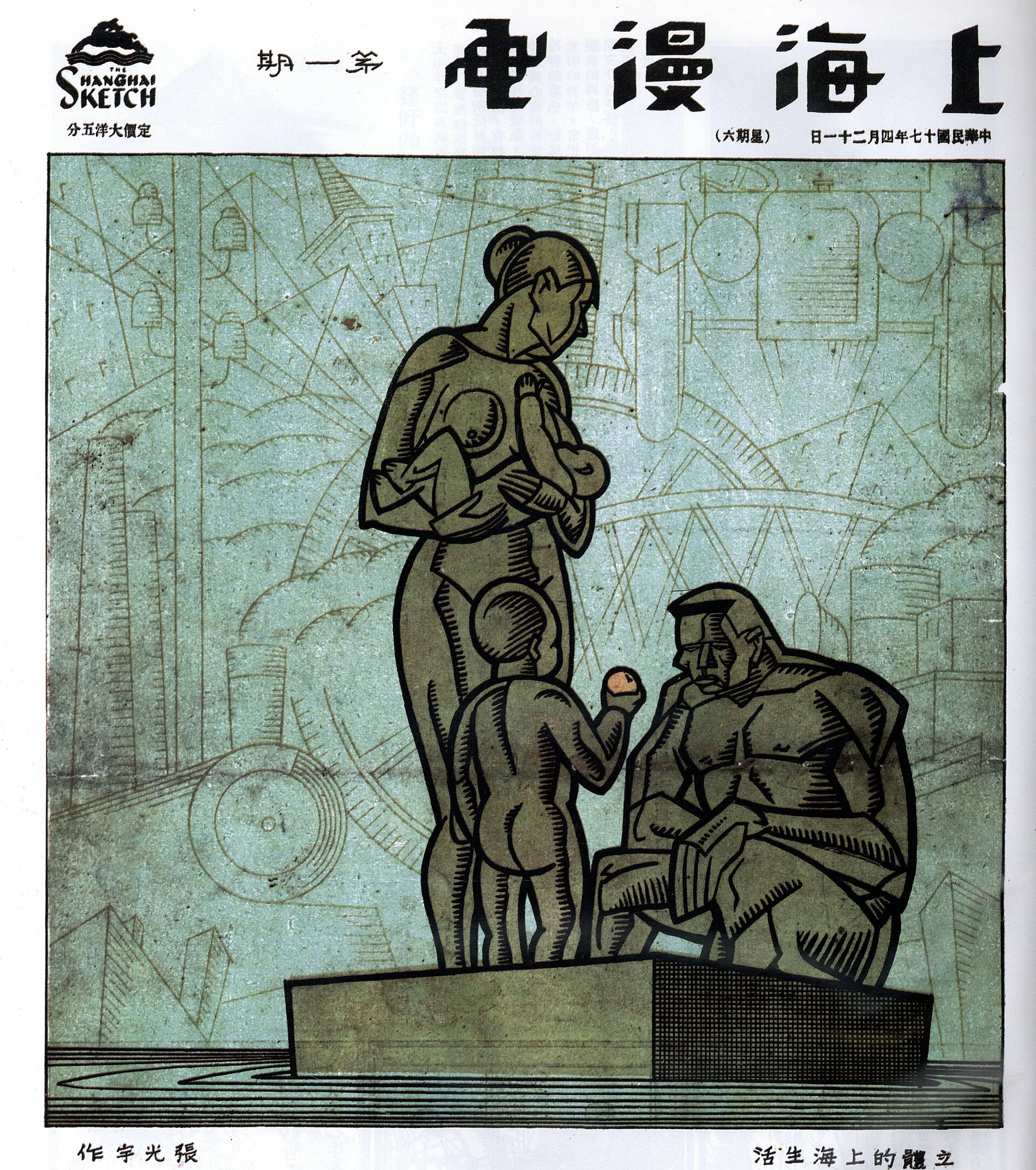
The drawing style is not a template for contemporary manhua. It is evidence that cartooning can be socially specific: the joke depends on posture, setting and the reader's knowledge of the city.
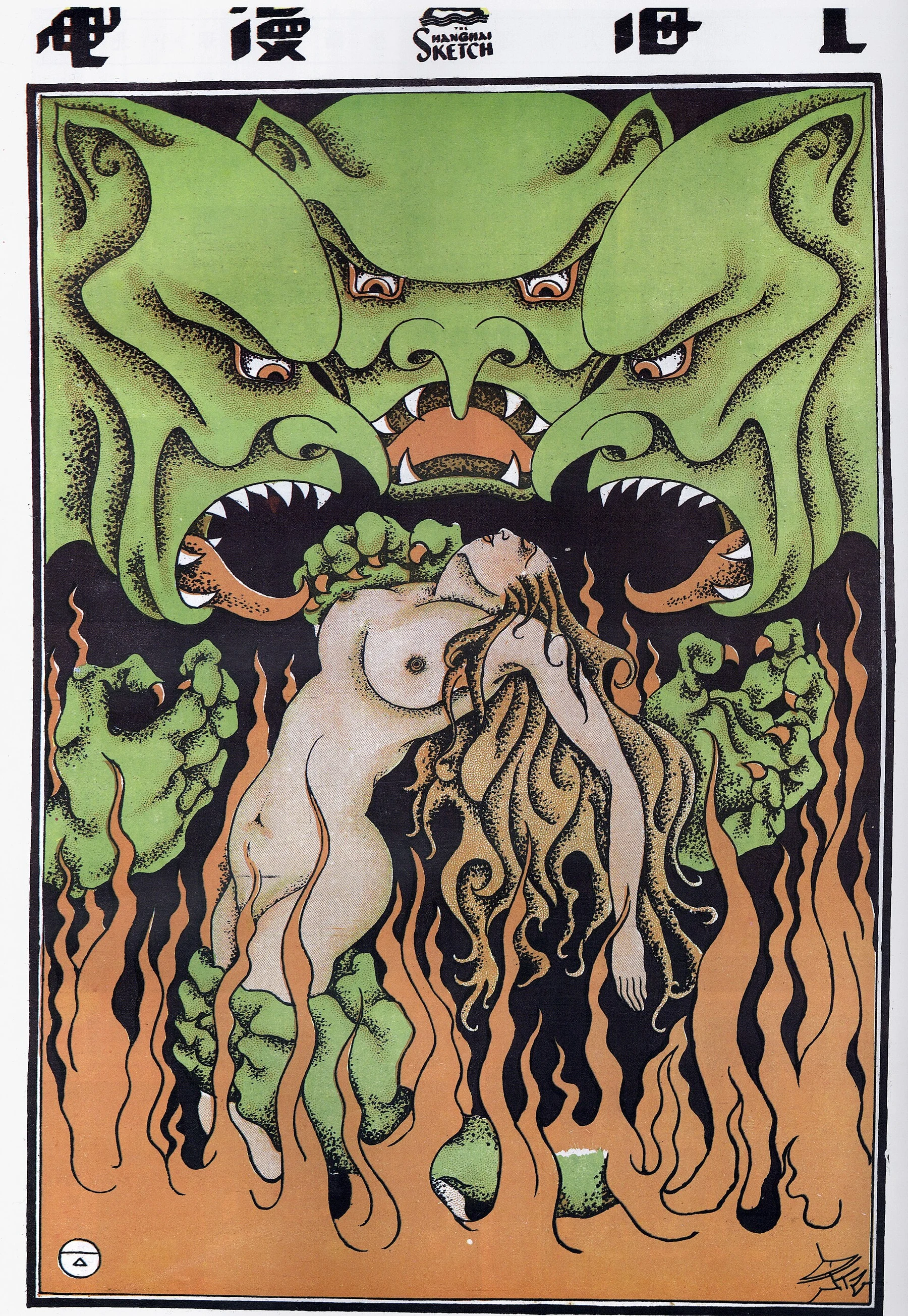
Historical manhua was not visually conservative by default. Its artists borrowed, tested and argued with modern forms. That matters when a reader assumes “Chinese comics” must look like ink brush painting or cultivation fantasy.
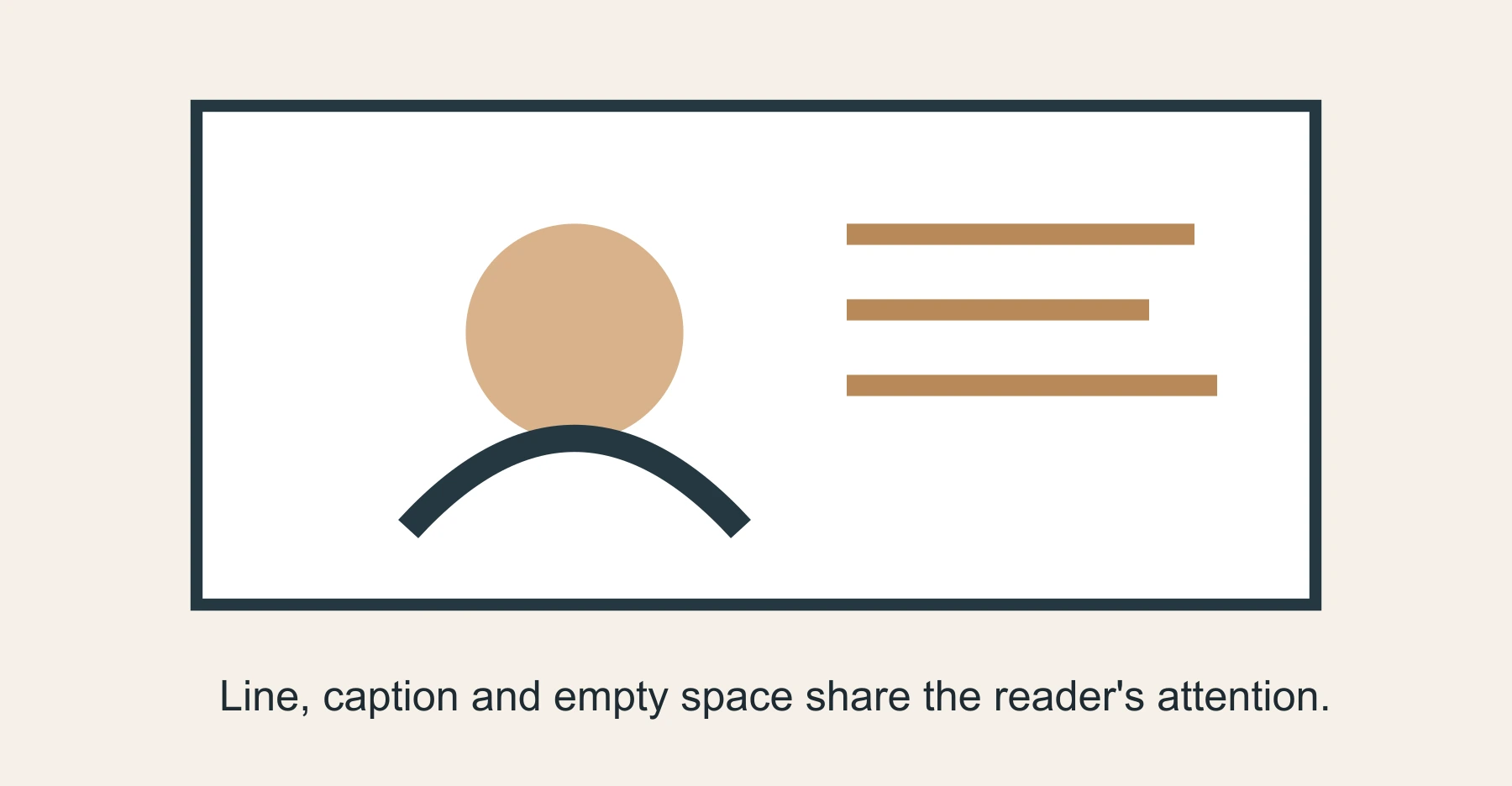
Comparing pages is more useful than naming one national style. Notice where the eye pauses, how text shares the frame and what the artist leaves unsaid.
Look for:
- how a panel controls the eye;
- how much blank space a platform can afford;
- whether sound effects are translated or redesigned;
- how faces change between speech and action;
- whether the series trusts a quiet scene;
- whether color carries weather, cultivation energy, memory or only decoration.
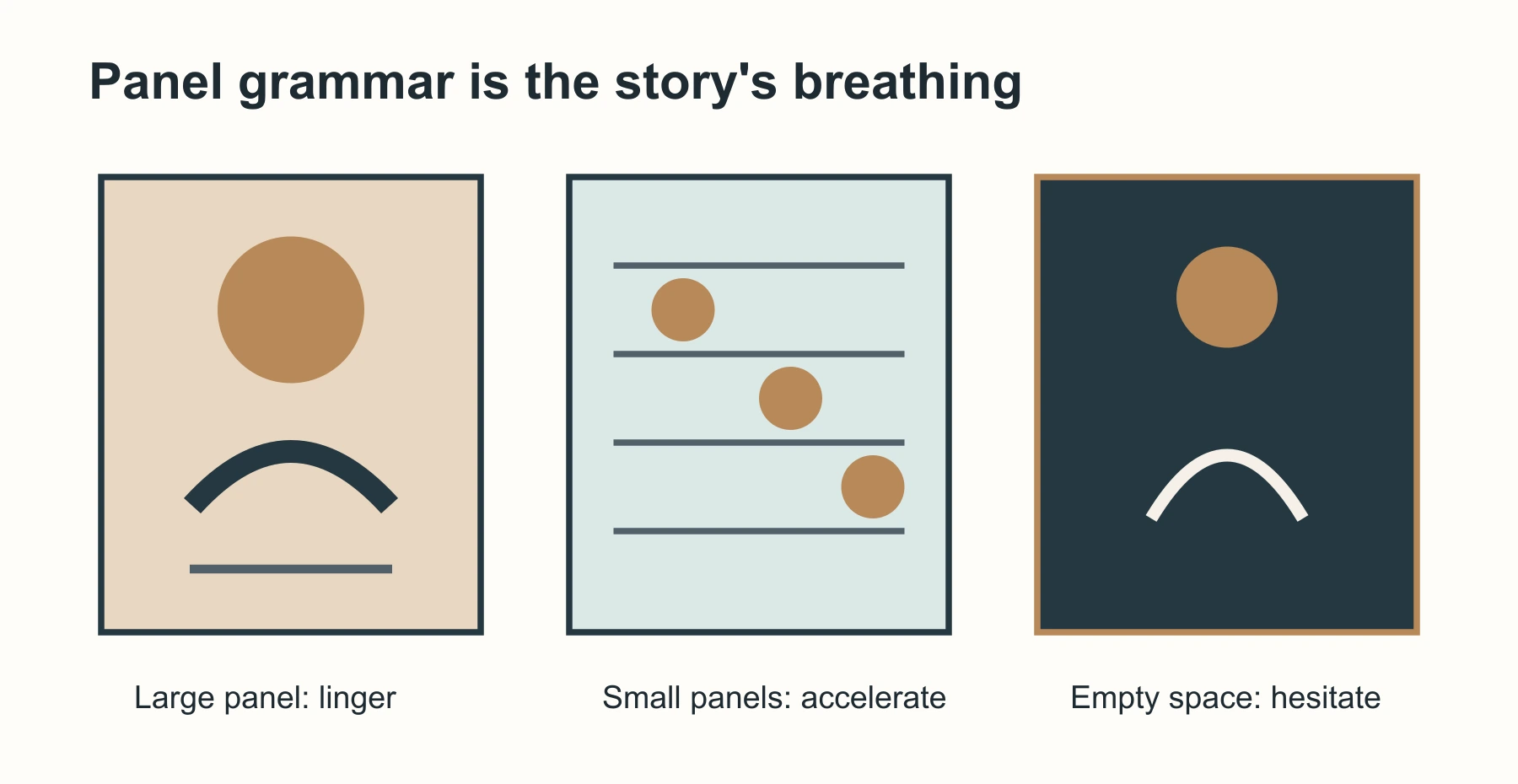
Panel size is not a neutral container. A wide silent panel can make a character's delay feel longer than a paragraph of explanation. A dense stack can compress a chase, a joke or an argument into breath. Empty space can be a room, a fall, a glance that the translation cannot easily name. When I review a manhua, I note these decisions before I judge whether the drawing looks “beautiful.” Beauty without timing is only a poster.
A beginner's route through manhua
1. Start with contemporary life
Short school, workplace, food, family or city comics are good entry points because the social details do not require a large glossary. They also reveal how humor, politeness, status and family expectations move through ordinary dialogue.
2. Move to wuxia
Wuxia manhua uses martial skill, wandering, loyalty, debt, sects and moral choice. Read it beside our wuxia meaning guide so “martial arts” does not get reduced to flying poses or tournament brackets.
3. Try cultivation
Cultivation manhua makes training, realms, medicines, teachers, sects and breakthroughs visible across a very long narrative. Our cultivation manhua guide is the focused route for series such as A Record of a Mortal's Journey to Immortality and Battle Through the Heavens. This page keeps cultivation inside the larger medium.
4. Compare manhua and donghua
Animation adds voice, motion, music, color grading and a fixed runtime. It can clarify a fight or flatten a slow emotional beat. Read enough of the original to ask what the adaptation gained and what it removed; do not judge the comic only through its screen version.
How to judge a manhua beyond popularity
Popularity proves that a work found readers. It does not prove that the translation is good, the ending is complete or the adaptation preserves the original.
| Test | Strong evidence | Warning sign |
|---|---|---|
| Character | Choices change relationships and costs | Power level replaces personality |
| World | Institutions, food, speech and work feel located | Names are Chinese but every place is generic fantasy |
| Paneling | Movement and silence are legible | Dialogue explains what the image already says |
| Pacing | Escalation has consequence | Every chapter ends with the same threat |
| Translation | Jokes, honorifics and names retain context | Terms are flattened into random fantasy English |
| Adaptation | Changes are visible and discussable | Marketing claims the film or donghua is the original |
My own test is simple: after a dramatic chapter, can I remember a person standing in a room, waiting for an answer, rather than only a glowing attack? Manhua becomes alive when the panel carries a human interval.
Manhua, donghua and live action are different readings
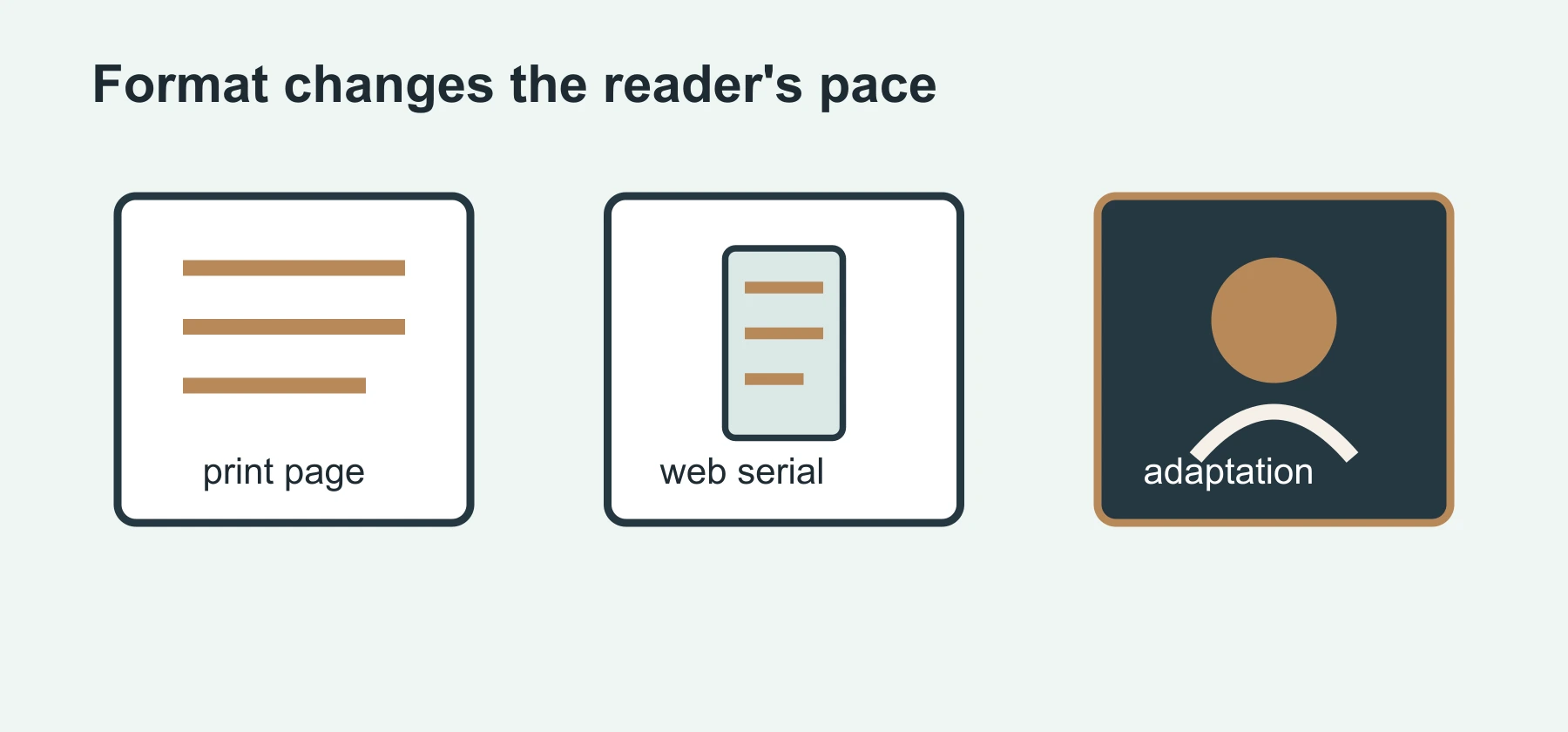
The same story can become three different objects. Manhua controls the reader's speed through panel size and scrolling. Donghua fixes timing through editing, voice and music. Live action adds the weight and limitation of actual bodies. An adaptation may improve one problem while creating another.
| Version | What it controls | What to compare |
|---|---|---|
| Manhua | Panel order, page turn, silence and reader pace | Facial acting, layout and how information is delayed |
| Donghua | Voice, camera, sound, color and fixed duration | Which inner thoughts become action or disappear |
| Live action | Actor presence, sets, costume and physical limits | Whether the story's moral pressure survives realism |
This is why I do not use an adaptation's popularity as a shortcut to recommend the original. A reader who wants world-building may prefer the comic. Someone who wants movement may prefer donghua. Someone who wants performance and chemistry may prefer live action. The page should help readers choose, not tell them that one format is the adult version of another.
Where manhua belongs in Chinese culture
Manhua sits between literature, illustration, commercial publishing and platform labor. It can carry dialect jokes, historical memory, internet slang, family expectations and political satire. A romance comic may teach a reader how a city imagines work and marriage; a fantasy comic may recycle an old legend while inventing a new emotional vocabulary.
The Chinese mythology collection is a useful companion because many manhua borrow deities, dragons, immortals and underworld officials. Borrowing is not the same as preserving a canonical story. Name the source tradition, then explain what the comic changes.
How to find a first legal reading route
Start with an official publisher or platform, check whether the translation is licensed, and read enough chapters to see the series' actual rhythm. Avoid choosing only from thumbnail art. Search by genre, creator, completed status and adaptation relationship. If you are reading in Chinese, keep the original title beside the translation because romanization and English titles can vary.
The cultivation manhua guide is the next click for long fantasy progression; the martial arts anime guide helps when the movement has already crossed into animation. For readers who want history rather than platform discovery, a museum's Chinese comic collection offers a slower beginning.
A practical genre map
| Genre route | Typical promise | First question to ask |
|---|---|---|
| Contemporary life | Recognition, humor and social detail | Does the setting feel lived in, or only labeled Chinese? |
| Romance | Emotional timing and changing relationships | Do choices alter the relationship, or only delay a confession? |
| Wuxia | Martial skill, wandering and moral consequence | What does loyalty cost when institutions fail? |
| Xianxia and cultivation | Training, realms and long-form transformation | Does power gain a human cost? |
| Historical | Research, costume, institutions and memory | Which period is being reconstructed or invented? |
| Comedy and satire | Social observation through exaggeration | Who is the joke protecting, and who is it exposing? |
Genre labels are navigation tools, not quality scores. A title can begin as a school romance and become a family story; a cultivation series can become a meditation on labor; a historical comic can deliberately use anachronism. Let the work explain its own mixture before forcing it into a ranking.
Reading translated manhua
Names, honorifics and idioms carry social information. A translation that turns every older man into “uncle,” every teacher into “master” and every threat into the same English insult may preserve plot while erasing relationships. Keep a glossary for recurring names, sects, offices and place names. If a title offers both official Chinese and English versions, compare them when a joke or ritual becomes confusing.
Vertical-scroll reading also changes how much a panel can conceal. A long empty gap may represent hesitation, distance or a fall. A rapid stack of small panels may imitate breathless speech. Read on a screen size close to the intended platform before deciding that the art is sparse or repetitive.
When a manhua page becomes evidence
An image can prove that a character is drawn with a sword, that a city is rendered with a certain architecture or that a series uses a particular color language. It cannot prove historical accuracy, martial effectiveness, a creator's private intention or the quality of an entire adaptation. That boundary is essential when a popular panel begins circulating without its chapter context.
A creator's page is also a working environment
Manhua is made under deadlines, platform rules and reader feedback. Assistants may help with backgrounds, coloring or lettering. A series can change visual density when a schedule tightens, and a creator can simplify a panel to protect a later emotional beat. Readers often notice the result before they know the production reason.
This does not excuse weak craft. It changes the kind of criticism that is useful. Instead of saying “the art became bad,” identify what changed: fewer backgrounds, repeated faces, compressed action, weaker lettering or a faster reveal. Specific criticism gives other readers a better way to decide whether to continue.
What I want from a manhua recommendation
Tell me the premise, format, completion status, official reading route and the cost of entry. “It is popular” is not enough. A reader overseas may need to know whether the translation is complete, whether the first chapters are free, whether the story is still publishing and whether the adaptation has overtaken the original.
Most importantly, tell me what kind of attention the work rewards. Some series reward remembering a huge cast. Some reward looking at clothing, architecture or food. Some reward emotional patience. A good recommendation names that contract before promising a “must-read.”
Copyright and reading responsibly
Use official platforms, licensed editions, library copies and creator-approved samples whenever possible. Screenshots and fan translations may help a community discuss a work, but they should not replace the legal release. Image rights are especially important for article illustrations: a poster or panel is not automatically free to reuse because it is easy to find.
Frequently asked questions about manhua
What does manhua mean?
Manhua is the common English romanization for Chinese comics. It can refer to print comics, web comics and digital serials created for Chinese-language audiences, while titles, platforms and visual formats vary widely.
Is manhua the same as manga or webtoon?
No. Manga, manhua and webtoon identify different cultural or distribution contexts, although creators and platforms borrow formats across borders. A Chinese vertical-scroll series can look webtoon-like without ceasing to be manhua.
What manhua should a beginner read first?
Choose by interest: cultivation for long progression, wuxia for martial ethics and wandering, romance for relationship pacing, historical stories for social worlds, or short contemporary comics for everyday observation. Start with a route rather than a universal ranking.
A medium, not a checklist
Manhua is best understood as a set of reading contracts. A print page asks you to turn. A vertical series asks you to scroll. A cultivation epic asks you to remember systems. A city comic asks you to notice repetition. A wuxia story asks what skill costs when honor meets hunger.
Start with one route, read slowly enough to notice the page, then return to the wider Chinese animation collection. The strongest recommendation is not the longest list. It is the title that gives you a reason to keep looking at the next panel.