Cultivation manhua means Chinese comics about training toward greater power, longer life or an immortal realm. If you want to start reading rather than watch an adaptation, begin with Tales of Demons and Gods for a second-chance story, Battle Through the Heavens for a public humiliation and comeback, or Martial Peak for a patient underdog climb. My test for all three is the same: does a new level change a person's choices, or does it merely make the next fight louder?
The artwork above is an original East Moment concept illustration, not a panel from any of those comics. It shows the promise and the problem of the genre: a mountain may be glorious, but the interesting question is what the apprentice has to carry up the steps.
Cultivation manhua: what are you actually reading?
Manhua means Chinese comics. Cultivation is the recurring practice of strengthening the body, mind or spiritual power through training, techniques, pills, teachers and dangerous trials. A cultivation manhua puts that process on a page: the reader sees a person attempt, fail, bargain, study and eventually cross a threshold. Not every Chinese fantasy comic is cultivation, and not every cultivation story is about literal immortality.
This matters because a search for “cultivation manhua” often returns animation stills, novel rankings and scan sites mixed together. A comic has panels and a reader-controlled pace. Donghua is animation; a web novel is prose. The same property can travel among all three, but a good adaptation in one medium does not automatically make the others good. Our broader manhua guide covers the medium, while the Chinese anime collection helps if you came here from an adaptation. This page is for choosing a cultivation comic worth opening tonight.
The words sect and realm can look more intimidating in English than they feel in a story. A sect is usually a training institution, power network and social hierarchy at once. A realm is a stage of advancement, though different series name and order stages differently. A breakthrough is the move into a new stage. I do not begin by memorizing a chart. I ask who controls training, who gets the scarce resource and who has to pay for a failed attempt. That is where fantasy hierarchy becomes human drama.
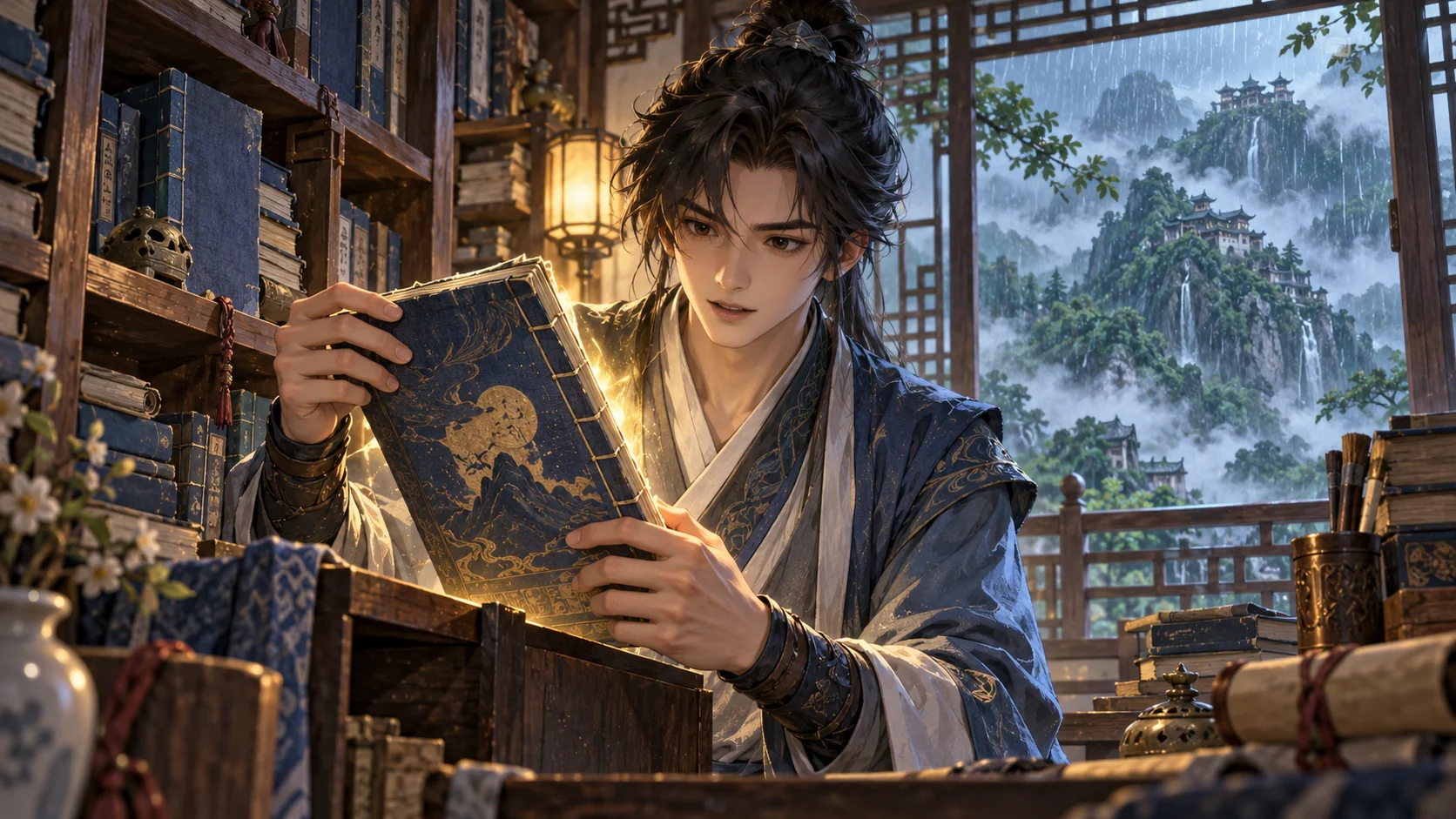
Original East Moment concept illustration, not a published comic panel. The book and the distant mountain put opportunity and obligation in the same frame; no real series, technique or historical object is being depicted.
Why I care more about the cost than the power level
Cultivation comics sell escalation brilliantly. A humiliated beginner can outgrow a school, a city and eventually an entire world. That promise is addictive. But if each victory simply produces a larger enemy, the story has mistaken numerical growth for change.
The better question is what advancement does to belonging. Does the protagonist abandon a friend who cannot keep up? Does a master offer protection in exchange for obedience? Does a new ability make it easier to protect home or easier to forget it? When a comic lets those pressures sit in the panels, a breakthrough feels earned. When it skips them, I feel as though I am watching a progress bar disguised as a person.
That judgment is also why I would not hand a newcomer a universal “top 20” list. You are choosing a rhythm of attention. Rebirth and planning, wounded pride, and the long grind from the bottom offer three very different first evenings, even when all three eventually reach spectacular fights.
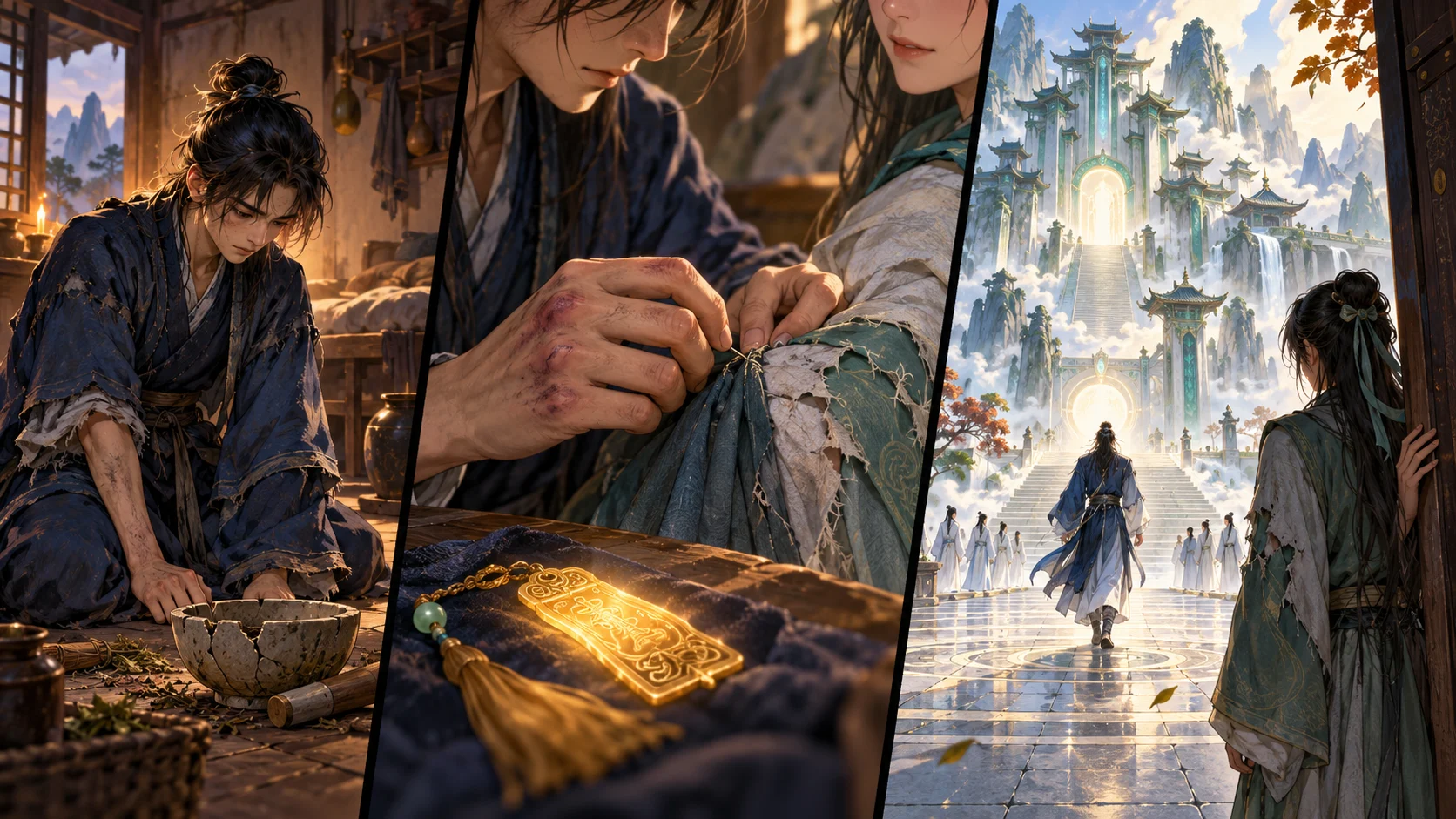
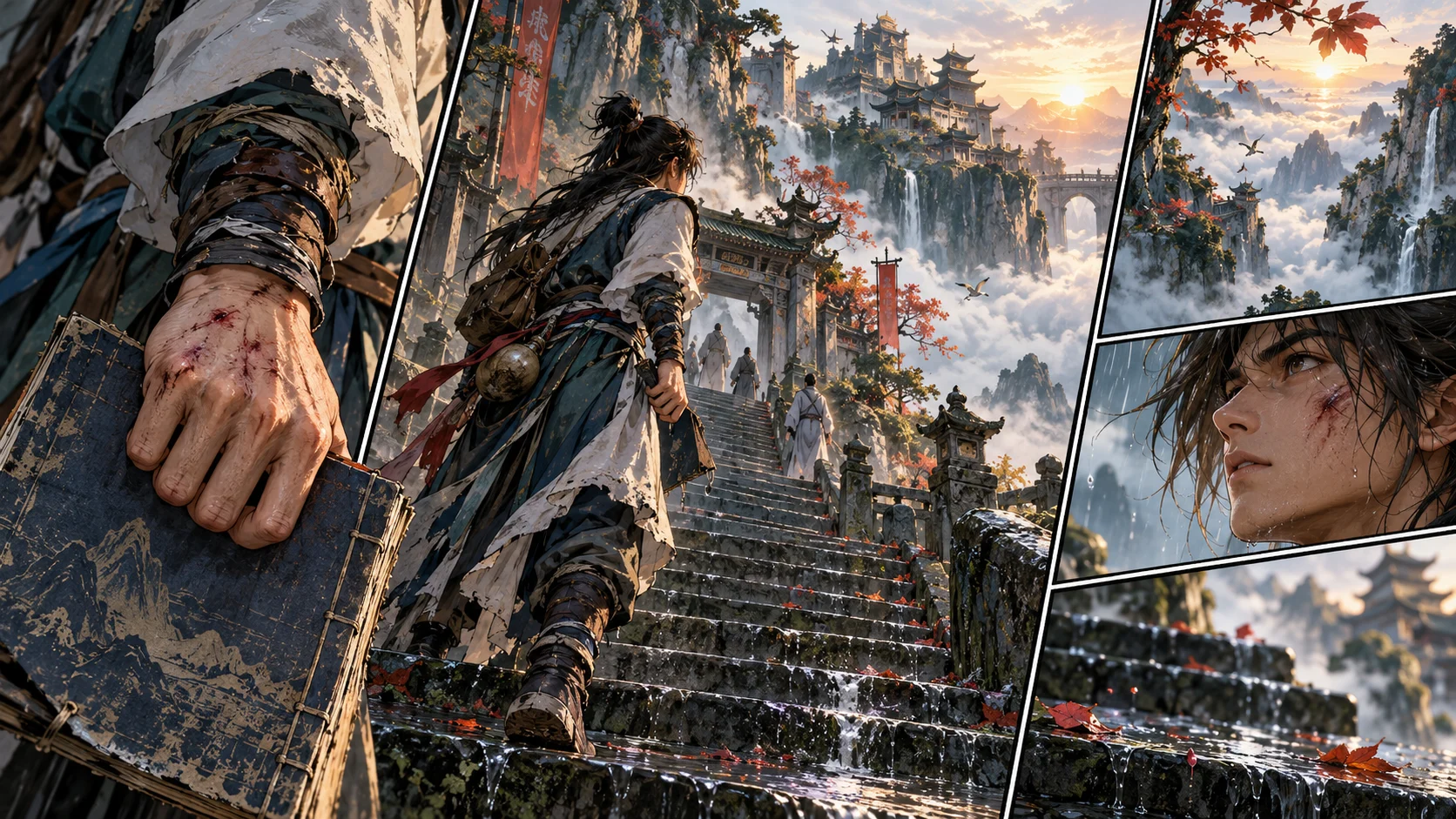
Original East Moment concept illustration, not a panel from any named title. The repaired sleeve is the clue: a breakthrough becomes interesting when it changes how two people face each other.
Give a cultivation comic ten chapters, then ask three questions
Ten chapters are not a magic threshold; they are enough to test the promise before committing to a very long serial. I keep three questions beside me:
- What does the lead fear losing besides a fight? Nie Li's return in Tales of Demons and Gods is not just a chance to win earlier. The premise gives him knowledge of a destroyed future and people he wants to save. If a comic can name no stake beyond “I hate being weak,” its power system may be carrying a character who has not yet arrived.
- What does advancement cost before it rewards? Xiao Yan's loss of status in Battle Through the Heavens gives his training a social wound. I want to see the apprenticeship, embarrassment, dependence or sacrifice between insult and triumph, not only the triumphant panel.
- Who else has a goal? A friend, mentor or rival should not exist solely to hand over the next technique or applaud the next realm. If ten chapters introduce a crowd but no other person can make a meaningful choice, that world may be a queue of future opponents.
There is no rule that a comic must answer all three immediately. Some deliberately begin with a shock and reveal character later. But if it cannot make me curious about anyone's decision after ten chapters, I would leave without guilt. A thousand chapters cannot repay an opening that asks for faith but gives no reason to care.
Which cultivation manhua should you read first?
Tales of Demons and Gods: a future the hero wants to repair
Start here if you want a clear emotional hook. Nie Li is a legendary fighter who dies and wakes in his younger body with knowledge of the disaster ahead. That is the premise presented on WebNovel's official comic listing. The question is not only how fast he can exploit a second chance; it is whether knowledge makes him more responsible to the people who did not get one.
I like that this beginning gives an unfamiliar reader a reason to learn the system. The training is not floating lore. It is a possible answer to a future catastrophe. But rebirth can also become a shortcut: when the lead already knows everyone and everything, other characters may feel like pieces on his private board. Watch for moments when a friend surprises him or refuses the role he expected. Those are more valuable than another demonstration of foreknowledge.
Read this if you enjoy planning, friendship under pressure and the uneasy advantage of remembering a life no one else remembers. Skip it as a first pick if reincarnation premises exhaust you; the chapter has to work for you, not the other way around.
Battle Through the Heavens: wounded pride with a clock on it
Choose Battle Through the Heavens if you want a louder comeback. WebNovel's comic catalog, credited there to Zhiyin Comic & Animation Company, opens with chapters such as “Fallen Prodigy,” “Divorce,” “Master and Disciple” and “Training.” Even that early sequence tells you the shape of the promise: Xiao Yan's lost standing is public, and recovery will have to be witnessed.
This is a more combustible first read than Nie Li's long-range rescue plan. Humiliation turns training into a reply. A mentor changes what the hero can attempt. The pleasure is not simply watching a flame get larger; it is seeing whether a person can grow without allowing one insult to dictate every later choice.
I enjoy the forward drive, but I would read with one objection in mind: revenge stories can reduce women, rivals and teachers to steps on a male protagonist's achievement ladder. If a side character matters only until the hero surpasses them, the comic loses some of the human world that made the original injury matter. Our Battle Through the Heavens guide follows that broader franchise and its animated form; the comic catalog is the evidence for this reading recommendation.
Martial Peak: the almost-endless climb from the floor
Try Martial Peak if you want the apprenticeship itself to become the main pleasure. Its official WebNovel comic listing describes Yang Kai as a disciple-on-trial and floor sweeper whose discovery of a Wordless Black Book changes his path. The humble job matters. Before “peak” means anything, the story gives him a position near the bottom of an institution that ranks people relentlessly.
That makes it a useful contrast to the reborn expert. Yang Kai's appeal is persistence through a structure that has little reason to expect greatness from him. But the very length that rewards serial readers can wear down a newcomer. If you want a compact arc or a guaranteed ending soon, do not choose this first. Read a short stretch, decide whether you still care about Yang Kai's decisions when the scale expands, and put it down if the answer becomes no.
These are three comic entries, not three claims that an English edition is free, complete or available in every country. Catalog status, region, pricing and translation can change. Use the linked publisher pages to check your current route before paying or following a third-party mirror.
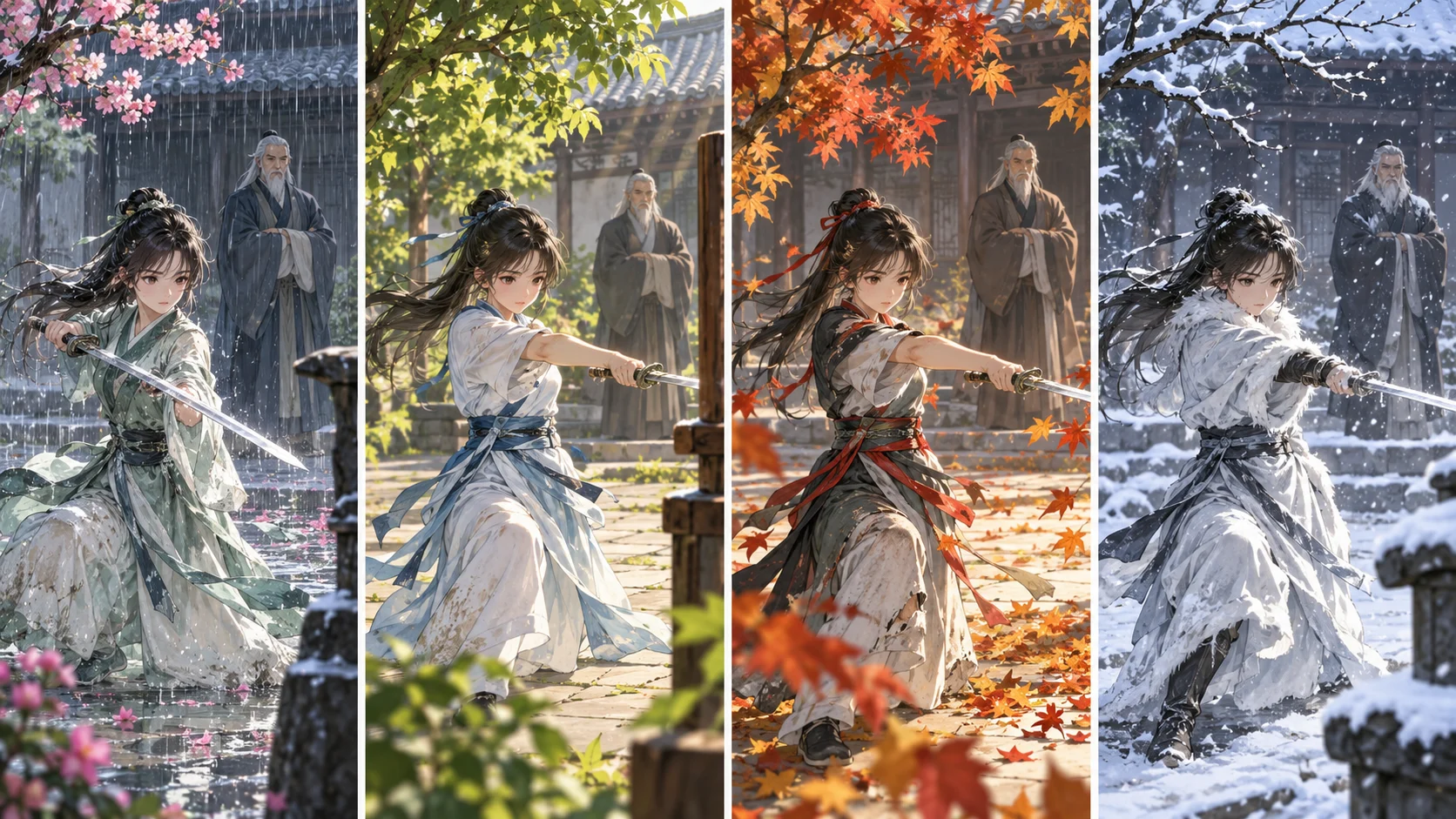
Original East Moment concept illustration, not a panel from a listed comic. Repeating one movement through rain, sun, leaves and snow makes elapsed effort visible; the image explains the reading test rather than documenting any title.
What a comic can do that a cultivation animation cannot
The same story may exist as a novel, manhua and donghua, but the experience is not interchangeable. A comic lets you stop on one glance, a torn sleeve or a teacher standing outside the frame. A panel can refuse to reveal the person on the other side of a door until you choose to continue. Repeated compositions can make training feel repetitive in a productive way: the reader notices the tiny difference after months have passed.
Animation controls duration for you. Movement, music and voice can make a breakthrough overwhelming. That is a different pleasure, not a superior replacement. If you found this page after watching A Record of a Mortal's Journey to Immortality, our series guide is the relevant next stop. This page does not call its animated images comic panels or promise that its comic adaptation tells the story the same way.
The novel is the route for interior thought and slow world detail. The manhua is the route for selective attention and visual pacing. The donghua is the route for performed time and sound. Begin with the medium you want, then cross over deliberately. The mistake is to search “best cultivation manhua,” open a list of animated shows and believe you have made a reading decision.
What to notice in a cultivation comic's visual grammar
A strong page does more than draw an impressive attack. Notice the interval between panels. Does a pause make a decision heavy? Is a body small against an institutional building, or has every background become a generic burst of energy? Can you tell who is vulnerable before the character's power ranking appears? Those questions are more revealing than whether one illustration is suitable for a wallpaper.
Cultivation is especially suited to visual repetition. The same courtyard can show a beginner under rain and an experienced fighter years later. A hand that once trembled can repeat a seal steadily. The artist can make progress visible without narrating every step. That is why the four-season image above is a concept illustration rather than a fake screenshot: it demonstrates a reading question while leaving the real works and their artists to speak on their official pages.
I also watch what a comic chooses not to enlarge. Some works spend their biggest panels on combat but treat injury, grief or a changed friendship as transitional text. That tells me what kind of pleasure it is selling. Spectacle is not a defect. Treating every human consequence as an inconvenience is.
Cultivation is not the same as wuxia
Read Xianxia vs wuxia when the labels start to blur. Wuxia usually keeps the moral camera close to the jianghu: teachers, rivals, promises and reputation. Cultivation manhua can begin there, then expand into reincarnation, immortal courts, demons, heavenly laws and lifespans that exceed a human family.
The overlap is productive. A cultivator may still be moved by one promise made in a village. A wuxia hero may dream of escaping the limits of one body. Genre names describe the dominant scale, not an airtight border.
Where can you read cultivation manhua legally?
Search results often mix official chapters, fan translations, scraped scans and pages that redirect readers through unsafe ads. A high-volume keyword should not become an excuse to send people toward unlicensed copies.
Start with the named comic page on the publisher platform, not with an image result or a site that labels every scan “official.” The three WebNovel catalog entries above establish real comic editions and let you inspect current chapter access. They do not guarantee that every chapter is free, that the same translation is available in your country or that a third-party mirror is licensed. Check chapter price, account requirements and region before you commit to a thousand-chapter reading project.
If your favorite animation sends you looking for a comic, verify that a comic edition actually exists. A novel-to-donghua adaptation does not imply a matching manhua in English. That small check saves a surprising amount of time and avoids building an opinion of the comic from unrelated fan art or promotional stills.
Build a cultivation reading route that can survive a long serial
Long serials do not fail because they are long. They fail when every chapter asks for attention but gives none back except the promise of a larger enemy. Build an intentional route instead of opening five unfinished series at once:
- Start with one emotional contract. Nie Li's chance to repair a future, Xiao Yan's wounded ambition or Yang Kai's apprenticeship is enough. Do not begin with a twenty-title ranking.
- Keep a small note of names that carry a relationship. Record a mentor, friend, rival and place—not every realm. If those four entries stop changing, the serial may have become a progress log.
- Pause after a completed emotional beat. A reunion, failed breakthrough, debt settled or promise broken is a better stopping point than the next cliffhanger.
- Use a character map after, not before, a chapter. It can restore orientation; reading it first often converts discovery into spoilers and people into labels.
- Leave without guilt when the story stops asking anything of you. Completion is not proof of taste. The right series is the one whose next transformation still changes how you feel about someone.
This is why I avoid promising a universal “best cultivation manhua.” A newcomer who wants a rebirth puzzle needs a different door from someone seeking revenge or a patient climb. Search intent is personal here: you are choosing a rhythm of attention, not simply a franchise.
The right first chapter should make you want to notice, not merely make you afraid of missing a later reveal.
The cultivation manhua worth your time earns its next realm
The best cultivation manhua makes progress feel expensive. A new realm should change a relationship, a body or a promise, not only add a larger number to a character card.
Start with Nie Li if you want a second chance, Xiao Yan if you want a comeback, or Yang Kai if you want the climb itself. After ten chapters, tell East Moment's community which decision made the next breakthrough matter. Name the title and chapter rather than reposting a copyrighted panel you do not own. I would rather hear why you stayed with one person than see another ranking of the strongest cultivators.