Throne of Seal is not at its best when Long Haochen acquires another title, weapon or burst of light. It is at its best when power makes a promise harder to keep: protect somebody, lead people who may be stronger than you, and remain recognizably human when the world rewards force.
Throne of Seal is a Chinese fantasy donghua about a knight learning what protection demands
Throne of Seal—also known by its Chinese title Shen Yin Wang Zuo—takes place in a world under pressure from demons. Long Haochen enters the knight order, trains for strength, meets Cai'er and gradually becomes part of a larger group whose battles have consequences beyond one talented child. That description is accurate, but it misses the reason to watch.
The show is not fundamentally about whether a gifted protagonist can become special. It is about whether a gifted protagonist can become responsible without turning everyone around him into furniture. Its best scenes give protection a physical cost: someone has to wait, lose safety, admit fear, trust another player in the formation, or carry the consequences after the impressive move ends.
WeTV's official listing identifies Throne of Seal as a mainland-Chinese fantasy series. Its episode access, subtitles and membership labels can differ by region and change over time, so verify the live official WeTV route before treating any old “where to watch” list as current. The legal donghua viewing guide gives the exact region, episode-order and subtitle checks to run before paying or pressing play.
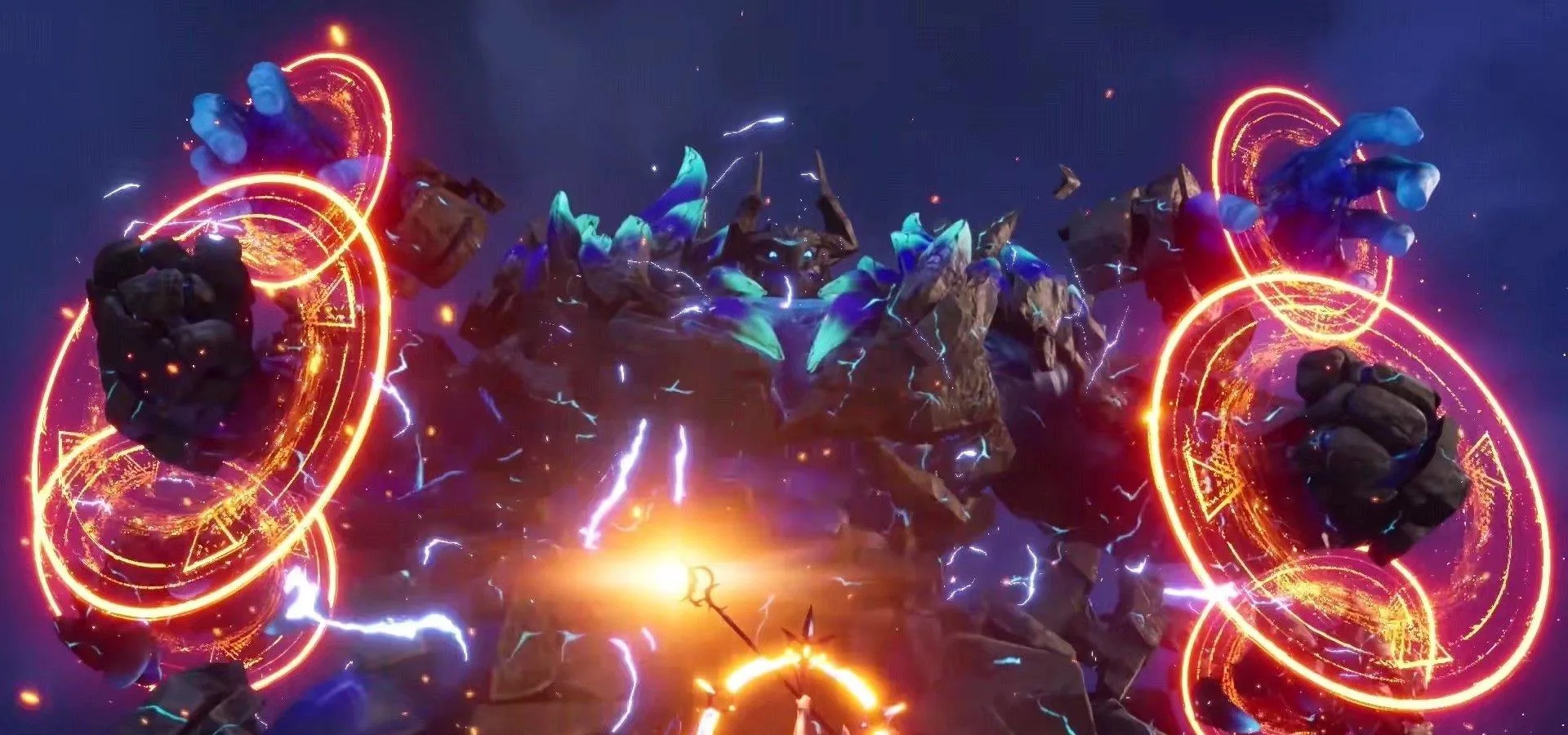
The battle image above shows the production's sense of scale: the stone creature fills the frame while circles of light make the attack visible. It does not prove that every later fight carries equal emotional weight. That distinction is the standard for the rest of this guide.
Should you watch Throne of Seal?
| You want | What the series offers | What to know first |
|---|---|---|
| A long-running 3D fantasy world | Knights, demon conflict, magical systems and expanding stakes | It asks for patience with terms, ranks and serial escalation |
| A lead with clear ideals | Long Haochen begins from a strong wish to protect | His idealism has to be tested by difficult choices to stay interesting |
| A relationship inside an action story | Cai'er is central to the emotional vocabulary of safety and trust | Do not reduce her to proof that the hero is kind |
| A team journey | Companions make leadership, strategy and sacrifice visible | The story works less well when a fight makes everyone wait for one savior |
| Spectacle with a moral center | Light, armor and scale can make duty visible | Visual grandeur alone cannot replace character consequence |
My recommendation: try it if you like fantasy stories where the team matters as much as the selected hero. If all you want is a fast stream of new abilities, other long-form donghua may suit you better. If you want to see whether a young knight can make gentleness credible under pressure, give it time.
Long Haochen's kindness is only interesting when it creates a harder problem
It is easy to write a good boy. Give him a pure motive, make everyone praise him, then let the world reward the purity with power. It is much harder to write a person whose goodness changes the difficulty of every decision.
Long Haochen becomes convincing when protection is not a shortcut to moral certainty. Protecting one person can expose another. Trusting a companion can require giving up control. Refusing cruelty can leave you vulnerable to someone who has no such restraint. A leader cannot simply be the person who is strongest in front. A leader is also the person whose confidence changes whether others are allowed to speak, fail and return. Tencent Video Animation's official episode 27 trailer, in which Haochen pleads for a rival, is useful precisely because it frames strength as a morally inconvenient choice rather than another clean victory pose.
That is the emotional test I use while watching. After a big scene, ask: did somebody's relationship to Long Haochen change? Did he learn the price of the promise he made? If the answer is only that his attack became brighter, the story has treated virtue as a visual effect. If the answer includes another person's agency, fear or trust, the light has done narrative work.
Cai'er should be a person with choices, not a reward for sincerity
Cai'er carries some of the series' most important pressure. The romance works when it is not merely a certificate saying that Long Haochen deserves love. She has training, danger, silence and a relationship to survival that cannot be solved by the hero's optimism.
Their connection is compelling when each changes the terms of the other's isolation. A promise to protect her is meaningful only if it also respects what she can protect, decide and refuse. Otherwise, the language of devotion becomes possession wearing soft music.

The sunset scene makes the promise legible without another power chart. Long Haochen's damaged face, Cai'er's direct gaze and the sword standing between them turn “protection” into proximity and injury. This image makes a stronger case than many larger attacks because neither child looks victorious. The scene asks whether care can survive fear, not who has the brighter effect.
This is a useful standard for fantasy romance generally. Do not ask only whether two characters are loyal. Ask whether the relationship makes both characters more able to act. Does one person become more than a wound to be healed? Does the other learn that care is not the same as command? Throne of Seal has its most human moments when it allows those questions to remain difficult.
A team is the real argument against the chosen-one story
The knight group prevents the series from becoming a private myth about one miraculous boy. Every companion brings a different relationship to confidence, fear, humor, status and risk. The point is not that every member receives identical screen time. It is that a formation changes what heroism means.
In a solo power story, the final answer is often “the strongest person arrived.” In a team story, the better answer is “each person made an action possible that none could complete alone.” That is why I care about the pauses between combat beats: who checks on whom, who objects to a plan, who brings laughter without making fear disappear, and who is allowed to be useful before becoming exceptional.
The team feeling is also a guard against the story's most obvious danger. Long-running fantasy can become a staircase of higher ranks. A good companion gives the staircase horizontal life: old debts, new loyalties, conflicting strengths and reasons to return to the same people after the spectacle has ended.
The formation is also where the series can escape its bloodline problem. Talent, inherited position and exceptional potential organize much of this world. If every decisive action still returns to the best-born or most gifted person, the team becomes a decorative queue behind hierarchy. A companion earns a place by changing the available choice: a defensive action buys time, a refusal exposes a bad plan, humor interrupts panic, or a specialist sees the problem the knight cannot.
I do not need equal power. I need unequal people to remain consequential. That is a much tougher test, and it is the one that prevents “team spirit” from becoming another slogan printed over a solo victory.
Hao Yue matters when strangeness is allowed to stay morally inconvenient
Hao Yue is not interesting merely because a strange companion promises hidden power. The more interesting question is what the bond asks the characters to carry when the thing they love does not fit comfortably inside a clean moral category.
Fantasy often introduces an extraordinary creature as a future upgrade with eyes. That move is easy and empty. A real bond changes the hero's self-image: it creates responsibility without guaranteeing innocence. The series becomes richer when it lets wonder remain unsettling and asks whether loyalty can survive knowledge that cannot be made convenient.
This is the same reason the demon conflict needs more than visual threat. A world divided into pure light and pure darkness can be exciting, but it has little room for moral discovery. The story gains depth whenever a character must decide what protection means after the categories they relied on begin to fracture.
The pacing test: can a quiet scene carry the same weight as an attack?
Long-form donghua lives or dies by rhythm. A production can make armor gleam, monsters tower and every upgrade arrive with a powerful score, but none of that makes a hundred episodes feel necessary. I watch for the smaller scenes: a shared meal after training, a person explaining a rule without being mocked for not knowing it, a companion joking because the room is frightened, a parent or teacher revealing that their own certainty is incomplete.
Those scenes are not a delay before the real story. They are what give a later battle a human unit of measurement. If a character falls, what daily habit disappears? If a team separates, who loses the person who understood their silence? If a victory changes nothing except the number attached to a rank, the episode may be loud without becoming memorable.

This is the kind of scene I refuse to call filler. Long Xingyu stands above young Long Haochen in a quiet, leaf-strewn courtyard; the space between father and son carries more tension than a combat pose would. The image does not show a meal or prove what either character says next. It does show the family's uneven distance, under scattered autumn light rather than combat fire. That restraint matters: a promise to protect has little weight if the story never pauses to show whom the boy hopes to reach.
My pacing verdict is therefore deliberately uneven. Keep the meal, the disagreement, the longing and the pauses in which Cai'er has an interior life. Compress a generic monster exchange if it repeats information the viewer already has. “Faster” is not automatically better editing. A long-running donghua needs acceleration in repeated action and patience in the scenes that create the reason to fight.
This is also where the adaptation has to earn its additions. An expanded action scene can be welcome when it clarifies a character's decision, gives a companion a distinct task or lets the setting reveal a social cost. It becomes empty when it only stretches anticipation around a reward the viewer already expects. The useful question is not whether an episode differs from a novel chapter; it is whether the change gives the animated form a reason to exist.
A good entry route does not require knowing every title
Do not pause the opening to memorize every knight order, demon name or power category. Begin with three anchors: Long Haochen wants to protect; Cai'er has reasons to guard her own distance; the team will show whether that ideal can become shared practice. Everything else can arrive through use.
For the first few episodes, pay attention to posture more than terminology. Who stands between danger and another person? Who waits for permission? Who chooses the practical solution while somebody else speaks in ideals? Fantasy systems become much easier to follow once you see which relationship each rule is testing.
That approach also protects the enjoyment of a first watch. Avoid spoiler-heavy power rankings and future-form videos until the opening team has had time to become a real group. The best question after an episode is not “what level comes next?” It is “whose trust changed, and what will that trust now cost?”
How it compares with other long-form donghua
If you like the group bonds in Soul Land, Throne of Seal offers another version of team-based fantasy, but its knightly language puts duty and guardianship closer to the center. Perfect World is the revealing opposite: its hero keeps being pulled from intimate belonging toward cosmic solitude. If you prefer planetary scale and technical escalation, Swallowed Star is a different kind of long-form momentum. If patient survival and cautious preparation matter more to you than a radiant idealist, start with A Record of a Mortal's Journey to Immortality.
Those are not rankings. They are different promises about attention. Throne of Seal asks you to care about someone who believes protecting others is possible before the world has proved him right. The question is whether its world can keep making that belief costly enough to remain alive.
The East Moment verdict: watch for the moment power stops being private
Watch Throne of Seal for the gap between a bright ideal and the complicated people who have to live inside it. Stay when the team makes Long Haochen's strength less solitary, and when Cai'er, Hao Yue and the others are allowed to change what “protect” means.
Begin with the Chinese anime collection if you need a broader route. When a quiet act of loyalty mattered more to you than the finishing blow, bring it to East Moment's community.