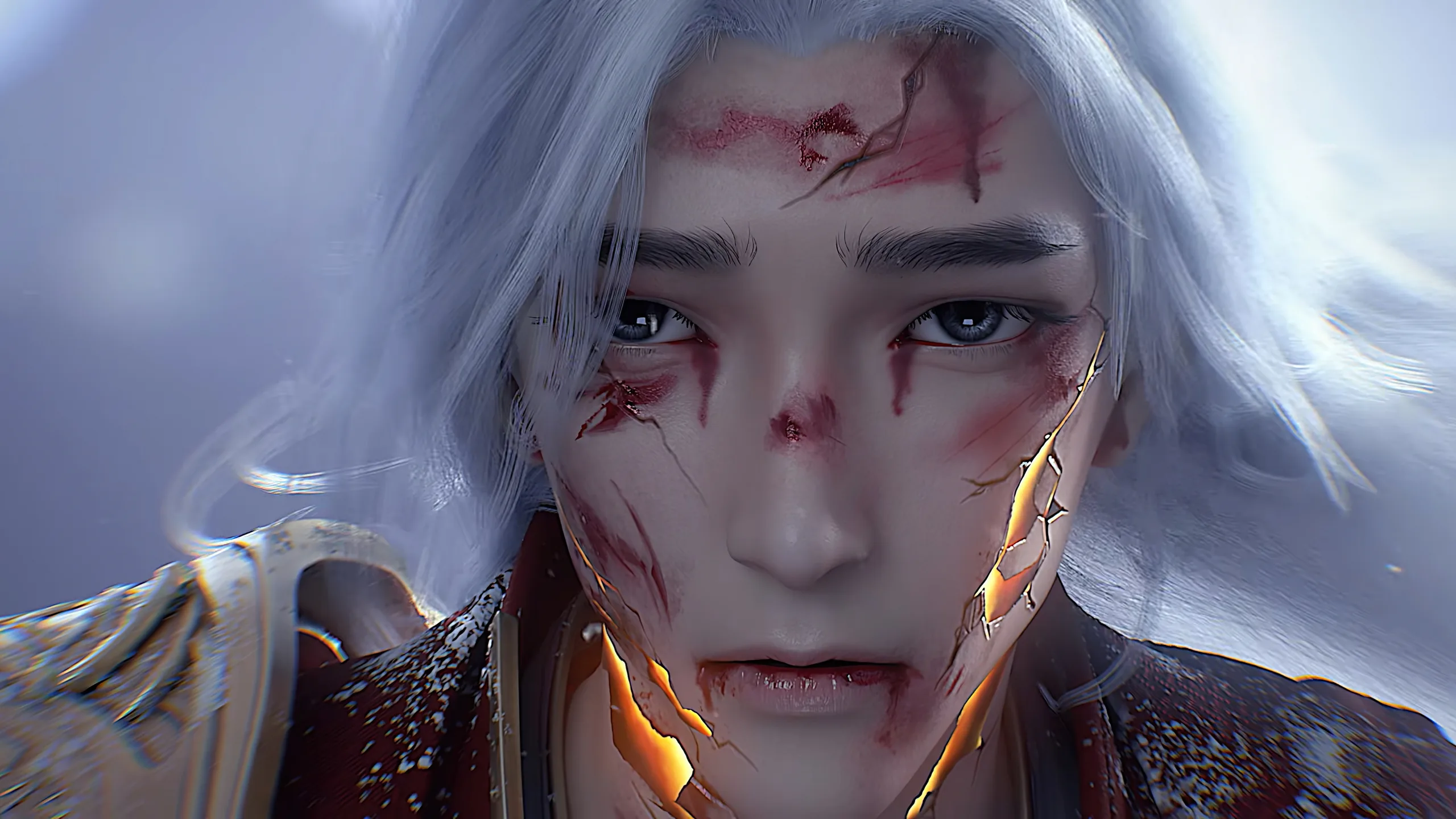
The title Perfect World sounds like a promise. The donghua begins by breaking a child. Shi Hao's Supreme Bone is taken inside his own family, and Stone Village gives him what the grander worlds repeatedly fail to offer: belonging without a price. The plot then widens from family conflict to rival clans, higher realms and wars that can make its human starting point hard to see. I think the series is worth watching precisely when its spectacular adult Shi Hao still feels answerable to that child.
Perfect World donghua is about whether power can repair a stolen childhood
Shi Hao grows into someone who can cross realms, challenge ancient powers and carry history on his body. The scale becomes enormous. Yet the most important image is still small: a child in Stone Village, protected by people who value him before they know what he may become.
That distinction separates home from institution. His first family conflict treats the Supreme Bone as transferable capital. Stone Village treats the damaged child as a member of the community. Liu Shen, the village's recovering willow guardian, opens a path toward the larger world without demanding that Shi Hao surrender the village inside himself.
Later Shi Hao can look almost untouchable. The useful question is not how impressive the form is, but whether the scene still carries the child who once needed a village to survive.
This is my standard for the entire donghua: spectacle earns its place when it enlarges an old emotional question. It becomes exhausting when scale is used to avoid one.
What the title means, who Shi Hao is and where to begin
| Question | Direct answer |
|---|---|
| What is Perfect World? | A Chinese 3D cultivation-fantasy donghua adapted from Chen Dong's web novel Wanmei Shijie (完美世界). |
| Who is Shi Hao? | The protagonist, raised in Stone Village after the theft of his Supreme Bone. He later uses names and titles including Huang and Emperor Huang. |
| Who is Liu Shen? | The willow guardian of Stone Village and one of Shi Hao's foundational mentors. Liu Shen connects his intimate home to a far larger history. |
| Is it called anime or donghua? | It is donghua, meaning Chinese animation. “Perfect World anime” is a common search phrase, but it does not change the work's country of production. |
| Is this a cultivation-level guide? | No. Realm names help orient the story, but this page is about character, adaptation and a useful viewing route. |
| Where should a new viewer start? | Begin at Shi Hao's childhood and Stone Village. A late battle clip shows production scale but removes the emotional contract. |
| Where can it be watched? | Use the official WeTV series page; access, subtitles and episode grouping vary by region. |
Perfect World donghua plot: four turns that keep the story readable
First, a child is injured by a family that values his gift more than his life. Shi Hao is born with the Supreme Bone, an extraordinary inherited power. The theft of that bone links him to his cousin Shi Yi and makes the family conflict more than an early excuse for combat. It asks whether blood relations have any moral force when adults treat one child as material for another child's future.
Second, Stone Village gives him another definition of family. People care for him before he can repay them. Liu Shen, the village's willow guardian, protects and teaches without simply taking ownership of his talent. This is the emotional starting point. Do not skip it to reach a famous white-haired battle: without the village, later victories have no measure beyond their size.
Third, the map keeps widening. Shi Hao moves through kingdoms, inheritances, powerful institutions and eventually Upper Realm conflicts. Each new setting gives him a harder opponent and a new explanation of who is entitled to rule. The plot is not just a climb through cultivation ranks. Shi Hao has to discover whether the authority of a clan, sect or ancient being deserves his loyalty.
Fourth, power becomes large enough to threaten the story's scale of feeling. Relationships with Huo Ling'er and Yun Xi, and the memory of Liu Shen, are not detours before the next fight. They are the evidence that time, separation and obligation cannot be defeated by a stronger technique. The donghua is at its best when the return to a person costs more attention than the destruction of a realm.

Here Shi Hao is not winning a duel; he is holding another person upright. The snow and their closeness make the relationship legible at a human scale before the next realm or technique takes over.
This is a plot route, not an episode-by-episode recap. The adaptation can compress transitions, and regional episode grouping changes. If a late clip leaves you asking who Huang is or why a willow matters, return to the village and the family injury before reaching for a complete power chart.
Five names and terms a new viewer actually needs
| Term | Meaning in this story | Why it matters |
|---|---|---|
| Shi Hao (石昊) | The child from Stone Village who becomes the central cultivator | His later titles do not erase the person who was once vulnerable. |
| Supreme Bone (至尊骨) | An exceptional bodily inheritance taken from Shi Hao | It is the object at the center of the family violation, not a complete explanation for his later strength. |
| Shi Yi (石毅) | Shi Hao's cousin and early rival | Their conflict is also a question about the adults and institutions that permitted the theft. |
| Liu Shen (柳神) | Stone Village's willow guardian and Shi Hao's mentor | Protection here opens a future instead of claiming a gifted child as property. |
| Lower and Upper Realms | Broad stages of the world's expanding geography and power | A change of realm changes the institutions Shi Hao faces; it does not automatically make them wiser. |
I would learn those five before memorizing any cultivation ladder. The realm names are orientation aids. They do not tell you why a decision hurts.
Stone Village is not the prologue you graduate from
Cultivation fiction often treats the village as a temporary tutorial zone. Perfect World makes it a moral vocabulary.
Stone Village is materially limited, but its people know how to share danger, food, memory and protection. Shi Hao learns strength there, yet he also learns that strength belongs inside obligation. A gifted body does not exist for a clan elder to redistribute. A child does not become valuable only after passing a test.
This is why I reject the lazy description of Stone Village as a “newbie village.” A game tutorial teaches controls and becomes irrelevant. Stone Village teaches Shi Hao what a human being is worth before rank, bloodline or prophecy can price him. The distinction survives every later power jump. Whenever the donghua lets him return, remember, eat, tease or protect someone without calculating their usefulness, the village is still alive inside the epic. Whenever every face becomes an admirer, enemy or resource, the story has betrayed its best education.
That is why Liu Shen matters. The recovering willow is powerful without behaving like a recruiter. Guidance arrives through patience, distance and protection rather than constant control. Shi Hao's later independence feels possible because his first mentor does not consume him.
When the story moves into grander institutions, I keep comparing them with the village. Which sect sees a person? Which clan sees a resource? Which alliance survives after advantage disappears? The village turns world-building into judgment.
The Supreme Bone conflict is family violence disguised as destiny
“Born with a special bone” can sound like a convenient fantasy fact. The important part is what adults do after discovering it.
Shi Yi's natural double pupils already make him exceptional. The decision to take Shi Hao's Supreme Bone is therefore not necessity. It is an escalation produced by a family that cannot tolerate enoughness. Another child's body becomes available because ambition has learned to speak as lineage.
The later rivalry matters, but reducing it to “who is stronger?” repeats the logic that created the wound. The honest question is what responsibility belongs to Shi Yi, what belongs to the adults around him and whether victory can restore what childhood violence removed.
Power cannot return lost time. The series becomes deeper whenever it admits that.
The adaptation fails whenever child Shi Hao already looks hardened
The opening asks us to believe that a wounded child can still be mischievous, trusting and hungry for ordinary affection. That makes the younger character model more than a cosmetic choice. If the eyes, brow and posture already carry the severity of the later warrior, the animation spends the innocence before the story has had time to lose it.
I am hard on this because the contrast is the entire engine. Adult Shi Hao should not look powerful merely because the model gains height, sharper armor and brighter effects. His later presence should hurt a little because we remember the soft face, appetite and unguarded curiosity that the world gradually taught to defend themselves. A child model that feels like a reduced adult weakens that memory.
The same standard applies to action. A spectacular technique must reveal more than budget. It should show how Shi Hao improvises, what he refuses to surrender, whom he protects, or which old wound has returned in another form. When the screen becomes a sequence of attacks whose names matter more than their consequences, Perfect World turns cultivation into advertising for the next effect. I do not confuse expensive motion with dramatic growth.
That is the adaptation's real challenge: Chen Dong's long-form progression can keep producing larger opponents, but animation must decide what the viewer is meant to feel between impacts. The answer cannot always be awe. Sometimes it has to be grief, absurdity, affection or the discomfort of watching a child become very good at surviving.
Shi Hao is most interesting when strength makes the room emptier
It is easy to remember the later Shi Hao as a catalogue of transformations: stronger body, rarer technique, larger enemy, higher realm. That is the viewing mode the series can encourage when a fight becomes a succession of radiant names. But the emotional cost of that rise is not simply that danger gets bigger. The number of people who can meet him without calculation gets smaller.
Stone Village knew him before he was useful to history. A clan measures inheritance; a sect measures talent; a realm measures force. Each is capable of offering protection, but each also makes belonging conditional. Shi Hao's loneliness is therefore not a soft detail pasted onto a battle hero. It is the pressure produced by becoming someone whose body, future and victories are always being claimed by a larger system.
This is why I do not read his refusal as uncomplicated coolness. Standing alone can be courage, but it can also be what remains after dependence has repeatedly been made dangerous. When a later scene lets Shi Hao be hungry, foolish, protective, angry or unable to repair what has happened, the protagonist regains a human scale. When every loss becomes merely fuel for a stronger attack, the story asks its hero to become the machinery that hurt him.
How to watch the long middle without turning it into homework
New viewers often meet Perfect World through spectacular late clips: white hair, impossible beasts, a character shouting a realm name while the sky breaks open. Those clips can be a fine visual invitation. They are a poor first explanation.
Use the early episodes to establish three anchors before worrying about power levels: who was allowed to care for Shi Hao without owning him; what the stolen Supreme Bone changed; and why Liu Shen's guidance feels different from clan authority. Once those anchors are clear, every larger setting has an emotional question attached to it. A new realm is not only a map expansion; it is a place where the old definition of family may be tested again. A new technique is not only a statistic; it changes what Shi Hao can protect and what it can no longer restore.
If names begin to pile up, pause at a relationship rather than opening a complete lore chart. Ask whether the scene is about home, debt, grief, desire, rivalry or institutional control. That question travels better than a spoiler-heavy realm list, and it keeps the production's scale from flattening every character into a temporary obstacle.
Huo Ling'er carries the cost of time better than a realm chart
Huo Ling'er begins with fire, confidence and the energy of early adventure. Her later story gathers separation, altered identity and waiting. The Fire Mulberry Forest becomes more than a pretty location because it holds time that Shi Hao cannot simply defeat.

The red costume identifies Huo Ling'er's Fire Nation visual language, but the expression prevents her from becoming only elemental branding.

The Fire Mulberry Forest gives reunion a physical memory. It is not just a romantic backdrop; it holds the distance between who the characters were and who returns.
The Mulberry Maiden phase is especially revealing. A cultivation epic can move so quickly toward the next cosmic threat that people left behind become symbols. Here, ordinary work and landscape resist that erasure.

Harvest, clothing and environment return Huo Ling'er to lived time. This quiet image carries a kind of consequence that a battlefield cannot.
I value the relationship most when it remains a record of missed life rather than a reward waiting for the hero. Love does not cancel the years a quest consumed.
Yun Xi shows how institutions enter a relationship
Yun Xi is tied to the Celestial Clan, and that affiliation makes closeness political. A relationship is never just two attractive people meeting in an empty world. Clan interest, duty, rank and movement between realms press against personal choice.

Violet hair and Celestial Clan styling help identify Yun Xi. They do not explain her choices; the surrounding institutions do.
The useful comparison is not “Which woman is best?” It is how each relationship exposes a different pressure. Huo Ling'er holds memory and time. Yun Xi carries institutional obligation. Liu Shen holds mentorship without possession. Stone Village represents belonging before achievement.
Together they reveal more about Shi Hao than another list of powers.
When cosmic scale works, and when it becomes noise
Perfect World can be visually astonishing: enormous creatures, radiant techniques, collapsing spaces and bodies remade by power. The production wants the viewer to feel that the known world is only one layer inside a much larger order.
That expansion is meaningful when it changes responsibility. A stronger Shi Hao can protect more people, but he can also leave more people behind. Entering a higher realm reveals that the hierarchy above is not morally higher. Ancient existence does not guarantee wisdom.
Scale fails when three things happen together: a new enemy appears before the old loss has settled, a breakthrough solves what should have remained relational, and visual escalation becomes the only evidence of importance. I do not need the story to stay in Stone Village. I need it to remember why leaving mattered.
A viewing route that preserves the human story
First, give full attention to Shi Hao's childhood, the Supreme Bone and Stone Village. Second, follow Liu Shen as the bridge between home and cosmology. Third, treat Huo Ling'er and Yun Xi as people whose institutions and lost time matter independently of Shi Hao. Only then let the realm expansion become the main event. If the many names become tiring, return to the four-turn plot route above; it tells you what changed without spoiling a catalogue of battles.
If you prefer a protagonist whose growth is tied to explicit humiliation and alchemical mentorship, continue with Battle Through the Heavens. If you want a team to remain central as the system grows, Soul Land offers a different emotional contract. Throne of Seal is the sharper comparison when you want protection to become a shared team duty instead of one survivor carrying the world alone. Browse the wider field through the Chinese anime guide.
For character identities, relationships and cultivation-reference depth, use XianLore's Perfect World archive. Then join East Moment's community with one precise answer: which later scene still remembers the child from Stone Village, and which one finally loses him beneath the spectacle?