Soul Land lasts because its deepest fantasy is not that one gifted boy becomes a god. It is that seven children with unequal talents can become a family strong enough to change one another's fate. Tang San gives that family method and loyalty. Xiao Wu gives it a moral crisis: if a soul beast can love, choose and grieve, then the soul-ring economy beneath every hero's progress is not neutral. I love the promises this story keeps. I do not think that love requires pretending its hero is always right.
What is Soul Land, and why does Tang San begin ahead?
Soul Land (Douluo Dalu, 斗罗大陆) is a Chinese 3D fantasy animation about Tang San, a boy reborn into a world where martial souls and rings gained from soul beasts shape a person's power. Start with the original Tang San series, not Soul Land 2: the sequel follows a later generation. The story's best reason to stay is not a longer ladder of powers. It is the collision between seven friends' loyalty and a system that treats living creatures as upgrades.
Tang San enters Douluo Continent twice-born.
Before he awakens Blue Silver Grass, meets Xiao Wu or studies under Grandmaster, he already carries memories and techniques from the Tang Sect of his previous life. He knows the Mysterious Heaven Skill, hidden weapons, poisons, movement methods and a craft tradition nobody around him can teach. Then this apparently weak village child reveals twin martial souls: Blue Silver Grass and the Clear Sky Hammer.
This is the first important correction to the usual underdog summary. Tang San works relentlessly, but he does not begin empty-handed. His social position is humble; his informational position is extraordinary.

Official episode artwork places two Tang Sans in one frame. That is the advantage the story can never fully subtract: one child's body already contains another life's knowledge. Check the episode's access terms in your region before watching.
I find him more interesting when the story admits this imbalance. Calling him a pure self-made genius makes his achievements flatter, not greater. He is a displaced expert forced to translate old knowledge into new rules. The pleasure is watching him discover which principles travel between worlds and which certainties must change.
His hidden weapons are the clearest example. To everyone else, they look like impossible inventions. To Tang San, they are memory made material. He must still gather metal, learn local conditions, train his hands and take risks, but the design problem has already been solved by a culture he remembers. He is not cheating the story; reincarnated knowledge is the story.

Blue Silver Grass looks modest in his hand. The image shows one visible ability, not the Tang Sect knowledge or hidden Clear Sky Hammer that also shape his advantage; those arrive through the story.
That combination also plants the seed of his later contradiction. Tang San distrusts institutions that hoard power, yet he benefits from secret techniques, rare bloodlines, exceptional teachers and inherited access. His loyalty makes those advantages feel earned. It does not make them equal.
Story, characters, watch order and current status
| Question | Direct answer |
|---|---|
| What is Soul Land? | A Chinese 3D cultivation-fantasy donghua adapted from Tang Jia San Shao's web novel Douluo Dalu (斗罗大陆). Tang San is reincarnated in a world where martial souls and soul rings shape ability and status. |
| Is it anime or donghua? | It is donghua, meaning Chinese animation. “Soul Land anime” is a common international search phrase, not its country of production. |
| Who are the central characters? | Tang San and Xiao Wu anchor the emotional story. Dai Mubai, Oscar, Ma Hongjun, Ning Rongrong and Zhu Zhuqing complete the Shrek Seven Devils. Grandmaster Yu Xiaogang is Tang San's formative teacher. |
| What is the basic story? | Tang San trains from village child to elite soul master, forms the Seven Devils at Shrek Academy, confronts Spirit Hall and eventually enters a war whose outcome leads toward divine inheritance and ascension. |
| What are soul rings? | Power obtained from defeated soul beasts. Ring age, color and compatibility affect a soul master's abilities. The system becomes morally unstable once the story establishes soul beasts as intelligent persons. |
| What is the watch order? | Watch the original numbered Soul Land episodes in order, then begin Soul Land 2: The Peerless Tang Clan. Clips, trailers, compilations and the live-action adaptations are separate. |
| Is the original animation finished? | Yes. The original Tang San animated storyline reached its finale. Tencent's official playlist remains the clearest episode archive, though access and subtitles vary by region. |
| Is Soul Land 2 a direct continuation? | It is set much later in the same world. Huo Yuhao leads a new generation while Shrek Academy, Tang Sect and Tang San's legacy have become institutions and history. |
| How do I check the latest Soul Land 2 episode? | Use the official numbered playlist and verify the date and access label there. A trailer number, a fan compilation and the next freely available episode are not necessarily the same thing. |
| Where should I watch? | Start with Tencent Video's official Soul Land playlist, then check the official Soul Land 2 playlist. Availability, subtitles and payment differ by territory. |
The length can feel intimidating. Do not begin with a late fight compilation. Episode one explains the old knowledge inside Tang San; the Notting Academy material establishes Xiao Wu; Shrek turns individual abilities into relationships. Without those foundations, later sacrifice becomes beautiful noise.
The Shrek Seven Devils turn progression into chosen family
The Shrek Seven Devils are the reason hundreds of episodes can still feel like one remembered youth.
Each member enters with a power that could have become a solitary gimmick. Dai Mubai has force and leadership but carries royal conflict. Oscar's food martial soul looks comic until logistics decide whether a team survives. Ning Rongrong arrives with privilege and an elite support system that cannot win alone. Zhu Zhuqing turns private pressure into discipline. Ma Hongjun carries appetite, embarrassment and explosive force. Xiao Wu's soft appearance conceals speed, violence and an identity the human world would hunt. Tang San can coordinate them because he notices sequence: who creates an opening, who protects recovery, who needs trust before technique can work.
The team is not memorable because seven names share a uniform. It is memorable because complementary weakness becomes strength. Oscar cannot dominate the front line, yet everyone eventually depends on what he produces. Ning Rongrong's enhancement matters only through another person's action. Zhu Zhuqing and Dai Mubai must confront a relationship that tactical compatibility cannot repair by itself. Tang San's plans become real only when six people accept risk they did not design.
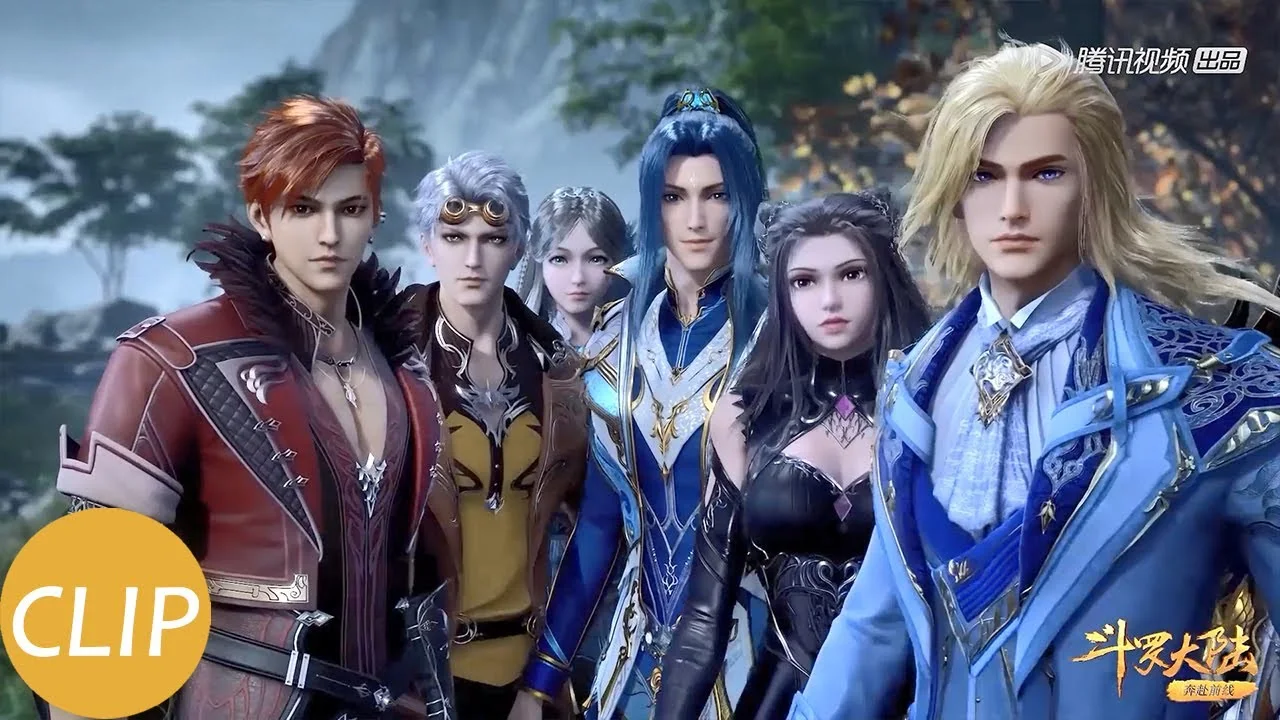
The adult reunion is moving because the polished costumes sit on top of remembered training, arguments and meals. They do not merely return as powerful people; they return as the children who learned one another's timing. Official clip artwork via Tencent Video.
I understand why viewers return to reunion scenes even after forgetting realm names. A ranking tells us who can defeat whom. A team formation tells us who believes another person will be where they promised.
That trust is the series' most persuasive answer to inherited inequality. The Seven Devils do not become equal in talent, wealth or family background. They make those differences mutually useful. Shrek's promise is not fairness at birth. It is that belonging can prevent birth from being the final verdict.
There is still hierarchy. Tang San receives more narrative permission, more solutions and eventually more authority than the others. “Chosen family” should not become a warm phrase that hides how often the group waits for its central genius. The best battles resist that gravity. They let support, recovery, timing and another member's judgment change the outcome rather than simply creating space for Tang San's final move.
Compare this collective growth with Han Li in A Record of a Mortal's Journey to Immortality. Han Li survives by keeping information private and exits open. Tang San survives by making his knowledge portable across a team. One protects the self from dangerous institutions; the other tries to build an institution out of friendship.
Soul rings make every beautiful breakthrough morally expensive
The soul-ring system is introduced with the clean confidence of game design. Defeat a soul beast. Absorb its ring. Gain an ability. Older rings offer greater power but carry greater risk. Colors make progress visible before anyone speaks.
Then Xiao Wu exists.
She is not a decorative exception to the rule. She is a hundred-thousand-year soul beast who can speak, joke, choose, become jealous, protect friends and imagine a future. Once we love her as a person, every ring acquires a missing biography. How intelligent was the creature? What relationships did it have? Did a soul master need this particular life, or did the culture make killing feel like the only imaginable path?

Their handclasp shows Xiao Wu inside a relationship, not as a ring or reward. The image cannot settle the ethics of soul-ring hunting; her choices elsewhere in the story make that question unavoidable.
The system is more disturbing because good people participate in it without thinking of themselves as cruel. Grandmaster treats ring selection as knowledge. Teachers protect children during hunts. Families celebrate successful absorption. The violence is distributed across education, status and necessity until no individual feels like its author.
That is why Spirit Hall cannot carry all the blame. Spirit Hall weaponizes power, surveillance and centralized authority, but the extraction economy precedes any one villain. Tang San's side also needs rings. Shrek also trains children to obtain them. A just victory over one organization does not answer what soul beasts are owed.
This is where Soul Land becomes larger than its mechanics. A fantasy system is ethically interesting when the protagonist's success exposes the people hidden inside its inputs. Xiao Wu turns “resource acquisition” back into a relationship between lives.
The story does not always follow that insight far enough. Spectacle can make the next rare ring feel exciting before grief has finished speaking. But I cannot unlearn Xiao Wu. After her, a glowing ring is never only a reward.
Xiao Wu and Tang San make love bodily, costly and unequal
Tang San and Xiao Wu begin with the playful closeness of children who choose sibling language before they understand romance. They study, travel, fight and grow side by side. Their bond works because duration comes before declaration. Tang San does not discover Xiao Wu after becoming powerful; she is present while his idea of home is still forming.
The moments that make the bond convincing are not only promises. They are reflexes. Tang San's attention changes when Xiao Wu is injured. Xiao Wu crosses fear when Tang San is threatened. Their bodies register danger to the other before either relationship speech catches up.
The image is gentle, but the pattern matters: danger repeatedly makes Tang San's protection visible. Love becomes convincing through repetition; it also risks defining Xiao Wu mainly by how urgently he must save her.
Xiao Wu's sacrifice is the emotional center because the soul-ring system finally enters the relationship without metaphor. The world can read her body as extraordinary power. She chooses to convert that body into Tang San's survival.

Xiao Wu's sacrifice is not proof that she was always meant to become Tang San's power. It is a decision made inside a system that has left her almost no safe form of giving. Official free clip via Tencent Video.
The scene moves me because love has a physical price. It also makes me uncomfortable when sacrifice is treated as the purest possible female devotion. Xiao Wu has ambitions, anger, humor, kinship and moral knowledge beyond being loved by Tang San. If every road returns her to his protection, then loyalty has swallowed the person it claims to preserve.
Tang San's response matters for the same reason. He does not accept power as adequate compensation for her loss. He tears away a soul bone and risks his own life to create a path back for her. The gesture rejects the economy that would convert Xiao Wu neatly into an upgrade.

Tang San's wounded face is the answer I need after the beautiful red light: he refuses to emerge from Xiao Wu's death merely stronger. Restoration must cost him too.
Their later reunion and marriage satisfy because the story returns a future to two people who repeatedly lost it. Yet the relationship is strongest when protection remains reciprocal, not when Tang San's power becomes the only room in which Xiao Wu is allowed to exist.
For a different fantasy romance built around seeing the person beneath a sacred identity, read Heaven Official's Blessing. Hua Cheng's devotion raises its own questions about worship; Tang San and Xiao Wu raise the question of whether protection can preserve agency inside an unequal world.
Tang San's loyalty is persuasive; his moral authority is selective
I do not think the most useful debate is whether Tang San is secretly evil. That turns moral analysis into another character ranking.
Tang San is loyal, disciplined, brave and capable of extraordinary reciprocity. He remembers kindness. He risks himself for family. He teaches companions, builds tools and refuses to treat Xiao Wu's death as personal profit. These qualities are not illusions.
They are also selective.
He condemns enemies for using power without consent while relying on advantages unavailable to ordinary people. He opposes Spirit Hall's domination but helps build Tang Sect authority around knowledge brought from another life. He understands soul-beast personhood intimately through Xiao Wu, Da Ming and Er Ming, yet his world still treats soul rings as the normal architecture of advancement. He challenges inherited hierarchy when it excludes him and later stands at the center of new hierarchies.
The contradiction is not that Tang San has principles and sometimes fails them. Every long hero does. The deeper problem is narrative insulation: the world increasingly confirms his judgment before another perspective can test it. Loyalty to his circle begins to resemble universal justice because the story places the circle at the center of history.
This is why I resist using “double standard” as a final verdict even though the phrase names something real. It can become a shortcut that avoids examining whose life counts inside Tang San's moral field. When harm reaches Xiao Wu, injustice becomes unbearable. When a system benefits his people, reform becomes less urgent. Love expands his courage and narrows his vision at the same time.
That is not a reason to turn every act of loyalty into hypocrisy. It is a reason to ask what loyalty leaves outside the circle. The more Tang San becomes able to define safety for friends, sect and world, the more the story must show the people who do not begin as friends, disciples or inherited allies. A hero's moral imagination is tested at the edge of recognition—when the suffering person is inconvenient, unfamiliar or entangled with an enemy name.
Wang Lin in Renegade Immortal offers a useful contrast. Wang Lin rarely pretends revenge is a neutral institution; the danger is that refusal becomes his prison. Tang San is more socially constructive, but construction grants him legitimacy. The danger is believing that a structure becomes just because a loyal hero built it.
I still want him to win. I simply want victory to leave the question alive.
The ending turns a friendship into an institution
The original Tang San story resolves its largest war through divine inheritances, battlefield returns and ascension. By then, the village child has accumulated family lineage, sect knowledge, teachers, companions, spirit-beast relationships and god-level authority. The scale is designed to feel conclusive.
Emotionally, the ending works when it returns to promises. A god is difficult to care about. The boy who refused to abandon Xiao Wu is not. The Seven Devils' final strength matters because we have seen them unable to coordinate, too proud to ask for help and young enough to think one victory would solve adulthood.
The limitation is that divinity can tidy politics too quickly. If the correct people inherit supreme power, institutions no longer need to become transparent or accountable; audiences are asked to trust character. Tang San's goodness carries the system.
That is precisely why Soul Land 2 is important. Time converts personal solutions into public structures. Shrek Academy is no longer only the place where seven unusual children found one another. Tang Sect is no longer only Tang San's recovered craft and loyalty. They become names a later generation inherits, enters, admires and may be constrained by.

A later generation stands inside a world shaped by old heroes. That distance is the real sequel question: what happens when somebody's beloved solution becomes everybody else's institution? This is artwork from an episode 167 trailer released in August 2026, not a marker of the newest episode.
Huo Yuhao should not be measured only by how closely he resembles Tang San. His era has different technologies, powers and inherited conflicts. The sequel becomes meaningful when legacy creates pressure rather than endless applause. A founding hero can be personally admirable while the institution bearing his values still needs criticism.
Use Tencent Video Animation's official Soul Land 2 playlist to check the numbered sequence. Episode 167 was a dated August 2026 reference for this reading, not an automatically updated release count. Public and membership access can differ; check the label on the episode you intend to play.
Watch Soul Land for promises, not only power levels
Start from episode one and allow the early school material to be young. The models and pacing change over a very long production; that visible growth is part of the experience. Learn only enough soul-ring vocabulary to understand a decision. Do not turn every first encounter into homework for a future realm chart.
Watch how abilities create relationships. Who needs time? Who gives it? Who can fight but cannot heal? Who knows something that the strongest person does not? The Seven Devils become legible when you stop treating support roles as smaller versions of attack roles.
Watch Xiao Wu as a person before watching her as a romance destination. Her identity changes the ethics of the whole world. If a recap discusses only sacrifice and revival, it has removed the woman whose choices make those events matter.
And watch Tang San with affection strong enough to survive criticism. His discipline, memory and loyalty explain why people follow him. His inherited advantages and selective moral field explain why following him should not end the conversation.
The visual production can be uneven. Early faces and movement sometimes feel stiff; later episodes can polish characters until skin and grief occupy different realities. Long battles stretch consequence. Exposition occasionally asks ring colors and titles to carry emotion they have not earned. Yet the animation also gives team formations real spatial intelligence, makes sacrifice painfully luminous and allows years of changing costumes and bodies to accumulate into memory.
The best image is still the Seven Devils standing together. Not because every member received equal narrative space. They did not. It matters because their formation preserves the series' most humane promise: talent may begin unequally, but destiny does not have to remain private.
That is my Soul Land verdict. The power system makes the plot addictive. Xiao Wu reveals its hidden violence. Tang San's contradictions keep the hero worth arguing with. The Seven Devils make the journey worth remembering.
Continue through East Moment's Anime & Donghua guide, or compare how Swallowed Star turns one hero's growth toward home rather than chosen family. Then bring one promise and one contradiction to Moments. I am less interested in your strongest-character list than in the scene that made you trust these people, and the later choice that made that trust difficult.