Renegade Immortal works because Wang Lin never gains the one power he actually wants. He can destroy enemies, cross worlds and oppose heaven, but he cannot return to the instant before his family dies. Revenge gives grief a direction. Li Muwan and the Hua Fan arc expose the harder question: after cruelty has begun to feel like clarity, can he still recognize an ordinary human life as something more than a weakness?
Renegade Immortal begins with grief that power cannot reverse
The easiest way to misunderstand Renegade Immortal is to call it a story about a cold hero becoming strong.
Wang Lin does become frightening. He calculates quickly, remembers injuries, refuses humiliation and eventually walks into traps as if the trap has misunderstood who is hunting whom. But ruthlessness is not his original personality. It is a tool built after powerlessness becomes unbearable.
He begins as an ordinary village boy whose cultivation talent is judged inadequate. His parents believe in him before the cultivation world does. That detail matters more than any later realm: the first people who give Wang Lin dignity are not powerful, useful or immortal. They simply love their son.
When Teng Huayuan's violence reaches Wang Lin's family, the loss does not become an inspirational obstacle. It reorganizes his mind. Every later refusal to kneel contains the memory of what happened when someone stronger could define justice by force.
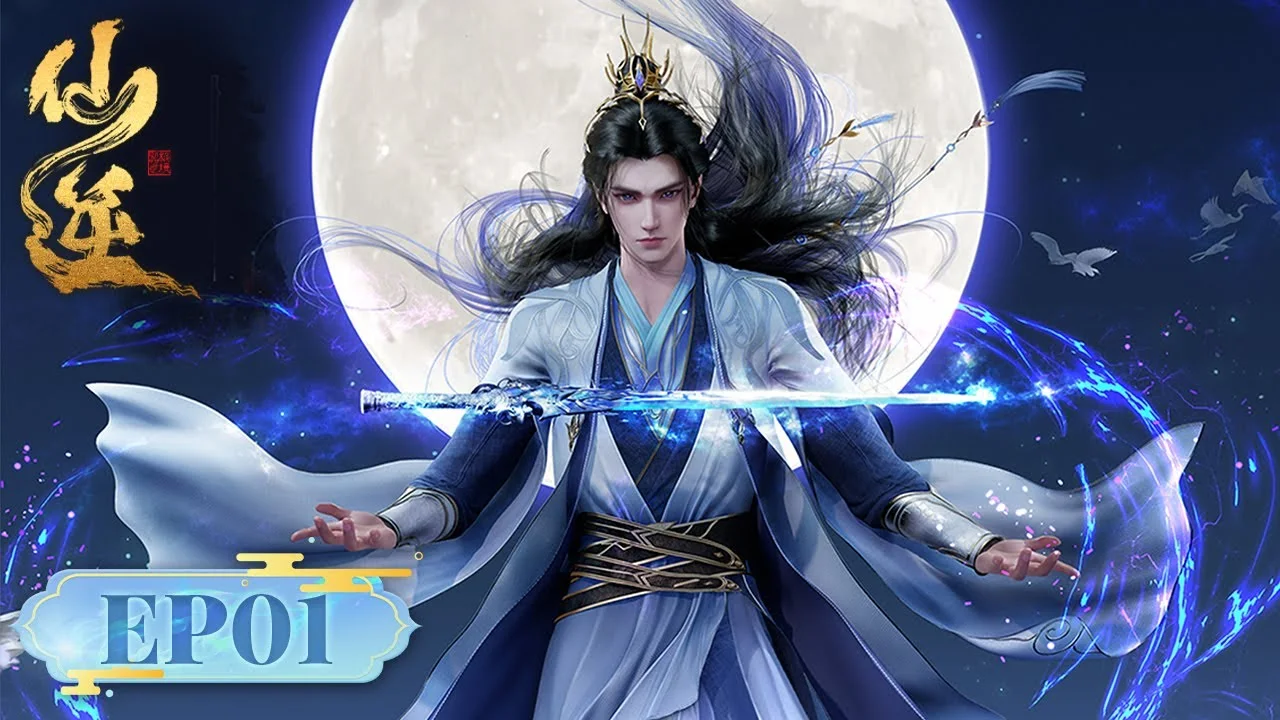
The official opening image gives us the composed immortal first. The story becomes more painful when we remember the ordinary son concealed inside that symmetry. Official artwork via Tencent Video Animation.
That is why the title Xian Ni (仙逆) carries more than “rebellious immortal.” Ni means to oppose, reverse or go against. Wang Lin is not only climbing the rules of cultivation more aggressively than other people. He is disputing a world in which talent, lineage and superior force are treated as moral permission.
The tragedy is that opposition can become its own captivity. If every relationship is sorted into debt, threat and protection, then Teng Huayuan continues to shape Wang Lin long after revenge is complete.
The story, Wang Lin and current status in one table
| Question | Direct answer |
|---|---|
| What is Renegade Immortal? | A Chinese 3D cultivation donghua adapted from Er Gen's web novel Xian Ni (仙逆), produced for Tencent Video. |
| Who is Wang Lin? | An ordinary boy with poor assessed talent who becomes a formidable cultivator through persistence, calculation, dangerous opportunities and refusal to accept assigned limits. |
| Is it anime or donghua? | It is donghua, meaning Chinese animation. “Anime” is a useful international search label, not its country of production. |
| What is the basic story? | Wang Lin enters cultivation, loses his family to a stronger enemy, pursues revenge and discovers that defeating people is easier than recovering the human life violence took from him. |
| Who is Li Muwan? | An alchemist whose shared time with Wang Lin becomes the story's clearest test of whether love can exist outside protection, loss and resurrection. |
| What does Hua Fan mean? | “Transforming into the mortal” or “experiencing the mortal.” It is a cultivation passage in which ordinary life, aging and perception matter more than another spectacular battle. |
| What is the watch order? | Start at episode one and follow the numbered episodes. Trailers, clips, compilations and theatrical projects are supplements, not replacements for the main order. |
| What is current in August 2026? | Tencent Video Animation's official channel was actively updating the series playlist and had published an EP154 trailer about learning rain-calling power and receiving an immortal inheritance. Full-episode access, subtitles and regional availability can differ. |
| Is the donghua finished? | No. It remains an ongoing long-form adaptation. |
For current availability, use Tencent Video Animation's official Renegade Immortal search. The official channel mixes free episodes, short public trailers and links to member viewing on WeTV; this page embeds only a free teaser.
The Teng family revenge is understandable and still morally dangerous
Wang Lin's revenge satisfies because the series makes the original imbalance impossible to forget. Teng Huayuan can kill a family because cultivation power has become social immunity. Institutions do not arrive to protect rural parents from a powerful elder. Wang Lin has no court above the court of strength.
So when he returns, the emotional logic is clean: the child who could not protect anyone is now the person before whom an entire powerful family must answer.
The moral logic is not clean.
Collective extermination turns inherited family membership into guilt. That resembles the same structure Wang Lin hates: power decides whose individual life deserves consideration. The revenge may end a specific enemy line, but it cannot be described as uncomplicated justice without erasing people who did not make Teng Huayuan's choices.
This tension is the page I want the animation to keep open. A weaker story would frame every death as applause for Wang Lin's determination. A better story lets the scene feel cathartic and horrifying at once. Grief explains why mercy feels insulting to him; explanation is not absolution.
Wang Lin's most important enemy is therefore not Teng Huayuan. It is the belief that helplessness can be cured by becoming the person nobody else can question.
That belief produces strength. It also makes intimacy almost impossible, because intimacy requires entering a space where another person's freedom matters as much as your plan.
“Against heaven” means refusing the limits assigned to you
Cultivation stories often make rebellion decorative. A hero shouts at heaven, receives a rarer bloodline and discovers that destiny secretly selected him for resistance.
Wang Lin is more interesting when rebellion remains procedural. He observes rules closely enough to find the place where obedience is assumed. He accepts that a formation, senior cultivator or inherited technique has logic, then asks what happens if he refuses to behave like the expected piece on the board.
That is why the best encounters do not merely show him overpowering a genius. They show him breaking the opponent's model of him. An enemy expects pride; Wang Lin retreats. The enemy expects retreat; he has already placed a second attack. The enemy expects fear of a forbidden method; he has measured the cost and decided the alternative is worse.
I understand the pleasure of watching a master strategist meet someone who will not follow the strategy's grammar. Wang Lin feels dangerous before he wins because the other person no longer knows which shared rule can predict him.
But “defying heaven” is not the same as real-world Daoism. The donghua borrows terms, visual symbols, meditation, alchemy and cosmological language from Chinese traditions, then transforms them into fantasy mechanics. Historical Daoist philosophy and religious practice cannot be reconstructed from immortal realms, magical souls or heavenly tribulations. Our guide to Taoism explains that living tradition outside cultivation fiction.
The cultural value of Wang Lin's rebellion lies elsewhere. In Chinese, shun (顺) suggests following, going with or submitting to an order; ni (逆) suggests going against it. “Following makes one mortal; opposing makes one immortal” turns cultivation into an argument about who has the right to define a person's ceiling.
The line becomes meaningful only if opposition protects more than ego. Otherwise rebellion is merely domination with better branding.
Li Muwan reveals what Wang Lin cannot solve by winning
Li Muwan is often summarized as Wang Lin's great love, the woman he will pay any cost to revive. That is true and incomplete.
Her deepest function is not to prove that the cold man can love. She makes ordinary shared time visible. Alchemy, shelter, waiting, reunion and the possibility of a life not organized around the next enemy place a different future beside Wang Lin. He does not have to defeat that future. He has to choose whether to inhabit it.

Li Muwan's stillness in wedding clothing carries the cost of decisions made around her. Official preview artwork via Tencent Video Animation.
The wedding confrontation is thrilling because Wang Lin refuses to let social arrangement close over the relationship. It is also worth asking how much space Li Muwan has inside the grand rescue. Protection can honor someone's will; it can also make the protector's determination so large that the protected person becomes the reason for his performance rather than a full participant.
That question becomes sharper with the coffin.
Wang Lin carrying Li Muwan's body is one of the story's most powerful images because devotion and refusal occupy the same object. He will not reduce her to a past tense. He also will not accept grief's most basic demand: that love may remain real even when recovery is impossible.
Resurrection gives cultivation romance a concrete project. Find the method. Gather the materials. Defeat the limit. Yet love is not only persistence toward a result. It is attention to the life that existed before the result became necessary.
For me, Li Muwan matters most in the quiet scale: the sense that Wang Lin could once sit down, drink, speak less and allow time to pass without converting every minute into preparation. The coffin is moving because it preserves that possibility. It is frightening because it can turn the person he loved into the final task his will must conquer.
Hua Fan is not filler; it is the point of immortality
The Hua Fan material is where Renegade Immortal stops asking whether Wang Lin can defeat another cultivator and asks whether he can still see.
“Mortal transformation” sounds like a temporary loss of power. That reading misses the reversal. Wang Lin has spent so long treating ordinary life as the vulnerable state he escaped that returning to it becomes advanced knowledge. A street, meal, cup, shop, season or aging face contains forms of change that no realm announcement can summarize.

Drinking is almost aggressively ordinary. That is why it belongs here: the body must receive the world through more than injury and combat. Official EP140 trailer artwork via Tencent Video Animation.
The arc works when everyday actions are not disguises between battles. Wang Lin observes labor, affection, irritation, aging and death among people who cannot bargain with centuries. Their lives are not lesser because they are brief. Brevity gives choices shape.
The point is not a slogan that life and death neatly cancel each other. Wang Lin first knows death as violation: a stronger person has taken the future his parents should have had. Hua Fan forces a harder recognition. A life can end through violence, illness, age or accident; no cultivation breakthrough makes those endings morally interchangeable. To understand mortality is not to become indifferent to it. It is to stop treating every finite person as an unfinished version of an immortal.
That is why the ordinary craft, meal and changing weather in this material carry more weight than an abstract realm explanation. They train attention on things Wang Lin cannot command into permanence. If he learns anything there, it is not that grief disappears into a beautiful cosmic cycle. It is that care has value precisely because it cannot guarantee possession.
That insight corrects a common cultivation fantasy. Immortality is often imagined as ordinary life with the inconvenient ending removed. But duration changes relationships. A person who can leave for decades and return unchanged does not share time equally with someone whose face, family and responsibilities transform while he is gone.
The aged face is more philosophically useful than another realm chart. Mortality becomes visible as texture, not a statistic.
The second mortal-descent teaser makes this theme current again. Life, death and continuing consequence are not side roads away from cultivation. They are the only reason cultivation power could matter.
Compare Wang Lin with Han Li in A Record of a Mortal's Journey to Immortality. Han Li protects a future through caution and retreat. Wang Lin often protects meaning through refusal. Han Li asks what survival will cost; Wang Lin asks whether any cost is acceptable if the alternative is submission. Hua Fan is where those logics almost meet: both men must decide what an extended life is actually for.
Wang Lin's body must keep the price of power visible
Long 3D cultivation animation has a visual temptation: polish the protagonist until injuries become temporary lighting effects. A beautiful model enters fire, releases a larger technique and returns to the next scene with hair arranged.
Renegade Immortal is stronger when Wang Lin's body refuses that fantasy. He vomits, collapses, loses control, drains reserves and looks physically altered by what he has demanded from himself. The damage prevents “ruthless” from becoming a clean fashion style.

The official EP145 clip makes power anatomical. Light passes through the body; endurance is not confused with comfort.
This is not realism in a medical sense. It is emotional accounting. A technique should leave evidence. If Wang Lin wins by using a method that could destroy him, the following scene should not behave as if the decision cost only special-effects budget.
Physical consequence also protects the character from becoming a machine. Vomiting after a fight is not weakness inserted to make the audience worry. It shows the distance between what his will commands and what his body can absorb. That gap is Wang Lin in miniature: refusal keeps him moving, but refusal cannot abolish the fact that he is a living person.
The 3D model has limits. Faces can appear too smooth for centuries of grief. Large environments can feel like expensive stages waiting for combat rather than places where people live. Yet the production is increasingly persuasive when it contrasts monumental scale with one strained body, one ordinary vessel or one face changed by time.
For pure hand-drawn motion and elemental texture, Fog Hill of Five Elements offers a useful contrast. Renegade Immortal earns its different visual language when digital spectacle records consequence rather than simply increasing brightness.
The 2026 immortal-palace arc risks making inheritance too easy
When reviewed on August 15, 2026, Tencent Video Animation's official channel had updated the Renegade Immortal playlist within the previous week and released an EP154 trailer. Its official wording centers on learning wind-and-rain power and receiving an immortal-emperor inheritance.

The current trailer offers inheritance as a luminous object. The dramatic question is whether Wang Lin receives only power or another history with obligations attached.
This is where a long cultivation adaptation must be careful. Inheritance is efficient storytelling: one ancient figure, one sealed space and one transfer can explain a spectacular leap. It can also weaken Wang Lin's identity if every new limit is solved by a greater predecessor selecting him.
The inheritance matters when it contains a relationship to the dead, a technique whose cost reshapes later choices, or knowledge that complicates the present order. It matters less when it functions as a gift box between battles.
Wang Lin's appeal is that assigned hierarchies fail to contain him. The story should not replace clan privilege with protagonist privilege and call the result rebellion. Every inheritance needs friction: What does he misunderstand? What obligation follows? Whose past conflict has entered his body? What part can he use without becoming another instrument of an older power?
The current immortal-palace material has the visual scale to answer those questions. The test is whether the series remembers that Wang Lin's most important inheritance is not a spell. It is grief, and grief has never obeyed his commands.
Watch the free Second Mortal Descent teaser for the right reason

Watch how the teaser places aging faces, ordinary landscapes and cosmic consequence in the same argument. The free official video is short; full-episode access remains with Tencent Video and WeTV.
Do not begin with a random late battle compilation. Start at episode one. The early family material gives moral weight to every later choice, and the changes in Wang Lin's face, clothing and control only mean something when you remember the boy who first entered the cultivation world.
If the length feels intimidating, watch in story arcs but preserve numbered order. Do not skip Hua Fan because a recap calls it slow. Slow time is the subject. Likewise, do not reduce Li Muwan's material to romance highlights; the pauses around action reveal what the action is trying to protect.
The East Moment verdict: rebellion matters only if Wang Lin can return to life
Renegade Immortal is worth watching if you want a cultivation protagonist whose power grows from an emotionally legible refusal. Wang Lin does not accept that poor talent, weak family background, senior authority or heaven itself should decide the size of his life.
Do not watch only for an invincible antihero. That reading turns the story's wound into branding. The Teng family revenge is powerful because it risks reproducing the moral structure Wang Lin opposes. Li Muwan is moving because she represents shared time, not simply a resurrection objective. Hua Fan matters because an immortal who cannot value mortal life has mistaken duration for meaning.
The series is not flawless. Its long release can make power systems heavy. Some faces remain smoother than the grief they carry. Inheritance arcs can feel like mechanisms for escalation. Li Muwan's agency must remain visible inside Wang Lin's enormous determination. And the story must not ask moral questions only to let spectacle erase them five minutes later.
Still, Wang Lin stays with me because he is not merely “cold.” Coldness is the scar tissue around a son who learned that love without power could be destroyed. The real journey is not becoming strong enough to oppose heaven. It is becoming human enough to stop letting the enemy define what strength is for.
Continue through the Chinese anime and donghua collection, then compare another rebel against cultivation institutions in Mo Dao Zu Shi. Wei Wuxian protects people the moral majority has abandoned; Wang Lin protects his right to refuse the majority's order. For another Chinese fantasy work that turns inherited myth into a fight over agency, visit Black Myth: Wukong.
For a navigable companion to the long release, XianLore's Renegade Immortal world archive maps Wang Lin, Li Muwan, story arcs, cultivation stages and episode routes.
Then bring one decision to East Moment's community. Tell us when Wang Lin's refusal felt brave, when revenge became morally harder to celebrate, or which ordinary Hua Fan moment made immortality look less important than a short human life. Use spoiler labels for later arcs.