Mo Dao Zu Shi begins after the world has already agreed on its villain. Wei Wuxian is dead, his name is a warning, and even the people who benefited from his courage have learned to describe him as a disaster. The mystery is not only how he died. It is how a cultivation society turned fear, debt and political convenience into moral consensus. Lan Wangji's love matters because he eventually stops asking whether Wei Wuxian obeyed the rules and starts judging whether the rules deserved obedience.
Mo Dao Zu Shi begins with a verdict, then tests the evidence
The first episode gives Wei Wuxian no dignified entrance. The feared Yiling Patriarch returns inside Mo Xuanyu's sacrificed body, surrounded by cruelty, resentment and a ritual he did not request. He is alive, but even his face is not publicly his own.
That premise changes how the flashbacks work. We are not watching a neutral biography slowly become tragic. We have already heard the verdict: arrogant cultivator, forbidden path, mass danger, deserved death. Every younger version of Wei Wuxian becomes evidence the verdict must absorb or suppress.
The smiling disciple who steals liquor and breaks curfew is not innocent because he is charming. The later commander is not guilty because black smoke makes him look frightening. Mo Dao Zu Shi keeps asking a harder question: who gets to name an action righteous after power has changed hands?

The first-season ensemble image places smiles, swords and family positions around the two leads. The tragedy needs this web; it is never only a duel between two men and the world. Official episode art via Tencent Video Animation.
This is why a synopsis cannot carry the page. The plot contains possession, corpses, clans, mysteries and a dismembered body. Its deeper structure is a retrial.
The story, 35 episodes and watch order in one place
| Question | Direct answer |
|---|---|
| What is Mo Dao Zu Shi? | A completed Chinese animated cultivation mystery adapted from Mo Xiang Tong Xiu's danmei novel. The English market also uses Grandmaster of Demonic Cultivation and The Founder of Diabolism. |
| Who are the leads? | Wei Wuxian, the resurrected cultivator once condemned as the Yiling Patriarch, and Lan Wangji, the disciplined Gusu Lan cultivator who recognizes him. |
| How many main episodes are there? | 35: season one has 15 episodes, season two has 8, and the final season has 12. A separate chibi series is optional rather than part of the main 35-episode order. |
| What is the correct order? | Watch seasons one, two and the final season in release order. The flashback is intentionally framed by Wei Wuxian's return; do not reorder it into chronology on a first watch. |
| Is the donghua finished? | Yes. Tencent labels the third run the final season. That completes this animated adaptation, although the wider IP has novels, audio drama, manhua and live action. |
| Is it BL? | The source novel is danmei and the central relationship is romantic. The animation communicates that bond through recognition, protection, music, symbols and shared life rather than reproducing every novel scene. |
| Is it the same as The Untamed? | No. Both adapt the same novel, but the animation and live-action drama reorganize events, character emphasis, supernatural rules and romantic expression differently. |
| Where can I watch it? | The official Tencent Video Animation channel carries English-subtitled episodes and clips in supported regions. Availability and membership rules can change. |
The nonlinear structure is initially demanding. One person may have a birth name, courtesy name and title; clans use colors and emblems before you know their politics; the present mystery opens into a long past. Do not stop every minute to memorize a glossary. Follow recognition: who knows Wei Wuxian, who fears the name, who owes the person, and who benefits when those categories remain separate.
He was seventeen before he became everyone's warning
The most painful way to read Wei Wuxian is not “powerful antihero” or “misunderstood genius.” It is to remember how young he is when the cultivation world begins transferring adult failures onto his body.
Before the black robes and Chenqing flute become an icon, he is a teenager moving too quickly: clever, noisy, hungry, eager to provoke Lan Wangji and certain that ability can repair any rule he breaks. That energy matters. If we remember only the Yiling Patriarch, we help the story's institutions erase the boy they used.
The sentence that stays with me is simple: but he was only seventeen. It changes the temperature of every later accusation. A young person survives war, loss, physical violation and impossible responsibility, then receives public judgment from elders whose institutions failed first. His humor does not prove he is unhurt. It is one of the ways he keeps a self available after the world has started consuming it.

The body finally contradicts the confident face. Lan Wangji does not solve the injury; he makes it unnecessary for Wei Wuxian to hide the full weight alone. Official final-season clip.
This does not make every Wei Wuxian decision correct. He withholds truth, assumes he can carry costs for other people, and sometimes turns self-sacrifice into a decision nobody else is allowed to question. Youth explains his isolation; it does not erase agency.
What it destroys is the comfort of treating his fall as one proud man's natural punishment.
The cultivation world fears power it cannot own
Wei Wuxian's unorthodox cultivation is genuinely dangerous. Resentful energy, fierce corpses and the Yin Tiger Tally can injure people beyond his intention. The story would become thin if every warning came only from hypocrites.
But danger is not the whole accusation. The established clans accept extraordinary violence when lineage, ritual and command structure authorize it. Wei Wuxian becomes intolerable because his method escapes that ownership. He can protect people a victorious coalition has declared disposable. He can expose how much “orthodoxy” depends on who controls the weapon and the story told afterward.

The final season repeatedly makes one body tiny beneath supernatural scale. Power is never only an ability; it is the pressure under which judgment must still be made. Official Tencent Video Animation clip.
The Burial Mounds reveal the political problem clearly. The surviving Wen civilians carry a defeated surname. Protecting them threatens the coalition's clean division between victors and guilty enemies. Wei Wuxian does not merely disagree with a policy. His presence proves that individual lives remain after a group has been morally labeled.
That is why public opinion turns so efficiently. Fear of his weapon is real. Envy of his independence is real. Grief after violence is real. Ambitious people combine those truths into a total identity called “Yiling Patriarch,” and the laughing young man becomes irrelevant to the case.
Understanding Wei Wuxian is not the same as acquitting every choice
The story becomes shallow when the audience is asked to choose one of two easy courts: Wei Wuxian was a pure victim whom every consequence must excuse, or he was a dangerous man whose public destruction proves the order was right. Neither court can hold the evidence.
He makes choices that expose other people to danger, withholds truths that affect their lives and repeatedly assumes that he can bear a cost alone. Those actions deserve moral pressure. At the same time, the cultivation clans create the conditions under which a teenager's private error can be magnified into a public scapegoat, while collective punishment and elite self-protection are described as order.
I return to the question of alternatives. What could Wei Wuxian have said sooner? What could Jiang Cheng, Lan Wangji, the Jin leadership or the so-called righteous sects have done before violence became the only language left? This moves the viewer beyond character prosecution. Responsibility in the series is distributed unevenly, but it is distributed. That is why the later retrial matters: not to discover one innocent body under every accusation, but to see how many people preferred a simple villain to the work of changing a system.
Everyone reaches for the tally; Lan Wangji reaches for Wei Wuxian
I understand Lan Wangji through one contrast: when the room reaches for the Yin Tiger Tally, he reaches for Wei Wuxian.
This is not romantic because protection is automatically pure. Early Lan Wangji sees rule-breaking more clearly than loneliness. He has been formed by thousands of Gusu Lan precepts, a controlled body and a belief that correct conduct can preserve a moral world. His failure is not lack of feeling. It is believing that feeling can remain private while institutions act publicly.
The transformation happens through details. He recognizes a song when Wei Wuxian's borrowed face should make recognition impossible. He stands on the wrong side of respectable consensus. He cooks, carries, waits, ties and returns. Love becomes credible because it changes where his body is placed when safety, reputation and judgment split apart.

A symbol of Lan discipline enters a playful, intimate act. The ribbon matters because restraint is no longer serving distance; Lan Wangji chooses what and whom it binds him to. Official final-season clip.
The forehead ribbon makes that arc visible. It begins as inherited discipline and protected boundary. In Wei Wuxian's hands, it can become provocation. In Lan Wangji's hands, it can become chosen closeness. The symbol does not lose its seriousness; its meaning becomes personal rather than merely institutional.
This is why I resist calling him simply the perfect devoted man. Perfection removes the delay that gives his love moral weight. He did not prevent the first catastrophe. He had to learn that being privately right beside a condemned person is not the same as opposing the system that condemns him.
Ordinary care is the relationship's strongest evidence
Spectacular devotion is easy to clip: a sword drawn against a clan, a body shielded, a name defended after years. The small acts persuade me more.
Food is placed within reach. An injury is noticed before pride can explain it away. A person accustomed to turning pain into a joke is permitted to lean. Lan Wangji's steadiness is attractive not because it makes Wei Wuxian weak, but because it interrupts the habit of surviving alone.

The official final-season image chooses bowls, eye contact and an ordinary shared action. After a story full of public names, domestic scale becomes a form of return.
There is a line of feeling I agree with completely: love appears in the details. But details are not valuable because they let us build a scorecard of the ideal partner. They matter because each action answers the specific damage Wei Wuxian carries. Someone who was useful to everyone is cared for when usefulness has ended. Someone whose choices were narrated by enemies is listened to. Someone who gave away parts of himself without permission to grieve is fed.
That is more intimate than making every scene a coded confession.
Jiang Cheng keeps a ledger that love cannot balance
Jiang Cheng is where easy moral readings fail. He and Wei Wuxian grow as brothers without the security of equal status. Affection, competition, parental pressure and clan obligation occupy the same home. When that home is destroyed, each begins sacrificing for the other in ways the other cannot fully know.
The golden-core revelation is devastating because it exposes a gift that was also a theft of shared truth. Wei Wuxian gives Jiang Cheng the foundation of cultivation and hides the cost. The act is generous. It also makes genuine consent impossible and leaves Jiang Cheng building identity on an absence he cannot explain.
When Wen Ning finally forces the truth into the open, the fact does not erase years of anger. Jiang Cheng learns that the person he blamed had already surrendered something immeasurable for him. Wei Wuxian still has to face the arrogance inside unilateral sacrifice: he decided what his brother could bear, then asked silence to protect them both.
Their tragedy is not that one loved and the other did not. It is that both turn love into debt, and neither knows how to speak without collecting.
The Wen survivors expose the difference between justice and a winning side
Wen Ning and Wen Qing prevent the story from becoming a private romance surrounded by disposable politics. Their surname marks them as members of the defeated Wen clan; their actions show why collective guilt is morally lazy.
Wei Wuxian protects them because he remembers concrete help when everyone else prefers an inherited label. That decision isolates him, but it is also where his ethics become clearest. He is not defending an abstract principle from a safe distance. He makes a community with people his allies would rather treat as residue of war.
The animation sometimes rushes this community. Its 35 episodes must carry resurrection mystery, long flashback, clan conflict, romance, horror and final revelation. Burial Mounds life needs more ordinary duration because meals, labor, fear and affection are what prove the survivors are not a moral argument wearing faces.
Even so, the central challenge survives compression: a righteous order that punishes children, healers and civilians for a surname has confused victory with justice.
The animation gains speed and loses some interior space
The donghua is a strong first route for viewers who need movement, voices and visual distinction between clans. Wei Wuxian's red-black palette, Lan Wangji's pale blue-white stillness, Chenqing's flute and Wangji's guqin give moral tension a sensory language. Music is not decoration; it can identify a person when face, body and public name are unreliable.
Action arrives faster than in the novel, sometimes brilliantly. Corpse movement, talismans and spiritual weapons become readable forces rather than vocabulary a new reader must imagine. The cost is compression. Political motives can flatten, minor relationships lose oxygen, and emotional transitions sometimes arrive as conclusions rather than lived time.
The licensed Seven Seas edition of the novel restores interiority, adult romance and details the animation reorganizes. It is not a correction key that makes the donghua worthless. It is a different experience of evidence: the animation lets posture, color, music and action speak; the novel lets thought, desire and social nuance remain longer in the room.
The official English titles also create friction. Grandmaster of Demonic Cultivation, The Founder of Diabolism and the romanized Mo Dao Zu Shi do not carry identical tones. “Demonic” can make Wei Wuxian sound religiously evil before the story begins. Treat these as distribution and translation conventions, not proof that the fantasy system maps neatly onto Western demonology or historical Chinese religion.
Mo Dao Zu Shi and The Untamed should not replace each other
Viewers often arrive from The Untamed and ask which version is better. That question becomes useful only when it names a criterion.
The animation preserves more explicit supernatural machinery and can make Wei Wuxian's power visually frightening. The drama gives fifty episodes to faces, pauses, ensemble bonds and the social weather around each choice. Broadcast adaptation changes how the central relationship and cultivation path can be expressed. Neither should be used as footage illustrating the other.
If you entered through Wang Yibo or Xiao Zhan, our profiles of Wang Yibo and Xiao Zhan separate the actors from roles that became globally defining. In the donghua, return to the characters without borrowing the performers' bodies. Notice what voice, drawing and editing make newly possible.
Watch one free official clip for the argument, not a paid episode
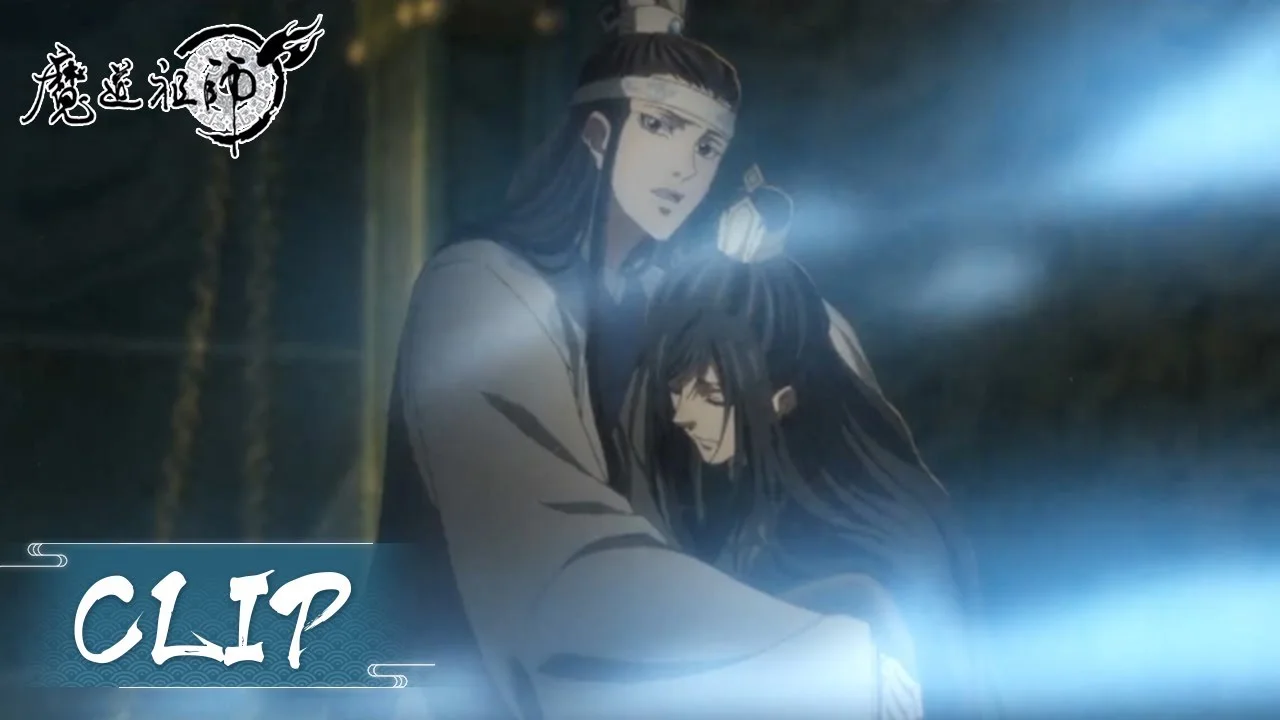
Watch Lan Wangji holding Wei Wuxian when he can no longer stand alone The free official clip contains the page's argument in one physical choice: recognition becomes support. Watch how little Lan Wangji needs to announce before his position is clear.
This page does not embed a full episode. Some official episodes are publicly available while others may be restricted by membership, country or changing catalog rules. Use the official channel for current access rather than treating a third-party upload as permanent availability.
The East Moment verdict: the villain was a story society needed
Watch Mo Dao Zu Shi for more than Wei Wuxian and Lan Wangji looking beautiful across opposite color palettes. Watch how institutions turn a dangerous but morally independent person into a complete public explanation for failures they share.
Wei Wuxian's power causes real harm. His secrecy injures relationships. His courage saves people a victorious society has decided not to see. All three facts must remain in the same judgment. The series is deepest when it refuses both official condemnation and painless absolution.
Lan Wangji's answer is not blind loyalty. It is late moral adulthood. Rules taught him discipline; loss teaches him that discipline without independent judgment can become cooperation with injustice. When everyone reaches for the tally, he finally reaches for the person.
Continue through our Chinese anime and donghua collection and compare this story with Heaven Official's Blessing, where the same novelist asks what remains of a person after public worship collapses rather than public blame.
Then reopen one part of the case in East Moment's community. Bring an action, silence or unresolved debt, not a character verdict. Tell us when Lan Wangji's obedience became judgment for you, or which Wei Wuxian decision remains difficult even after you understand why he made it. Use spoiler labels for the golden core and final season.