Heaven Official's Blessing is not moving simply because Hua Cheng waits eight hundred years. It is moving because Xie Lian loses the public machinery that once made him sacred: palace, title, statues, temples and believers. Hua Cheng's devotion reaches the person who remains after worship has withdrawn. The romance becomes meaningful only when it sees that person, not when it turns suffering into a beautiful monument.
Heaven Official's Blessing begins where worship fails
The quickest summary sounds like a fairy tale. Xie Lian, former Crown Prince of Xianle, ascends to heaven for the third time after eight hundred years. While investigating a case, he meets the feared ghost king Hua Cheng, who has waited for him across centuries.
That summary gives you the destination and removes the reason to travel.
The first image that matters is not Hua Cheng looking powerful. It is Crown Prince Xie Lian breaking the choreography of the God-Pleasing Festival to catch a falling child. Above him is a public ritual designed to make the prince appear divine. In his arms is one unwanted life that the ritual was prepared to sacrifice to its own beauty.

The recent official short returns to the instant when a flawless public god chooses one frightened child over the performance. Official animation via Made By Bilibili.
This is why I resist describing Hua Cheng's devotion as love at first sight. The child does not arrive at the festival carrying a pure romantic destiny. He is hurt, furious and close to believing that the world deserves his anger. Xie Lian's hand gives him a different fact: one person interrupted heaven to keep him alive.
The series then spends centuries asking whether a saving hand can become faith without becoming possession.
The story, characters and viewing facts in one place
| Question | Direct answer |
|---|---|
| What is the Chinese title? | Tian Guan Ci Fu (天官赐福), a phrase commonly rendered as “Heaven Official's Blessing.” |
| Is it anime or donghua? | It is Chinese animation, commonly called donghua. “Heaven Official's Blessing anime” is a useful search phrase, not its production country. |
| Who are the leads? | Xie Lian, a twice-banished god on his third ascension, and Hua Cheng, the powerful ghost king also known as Crimson Rain Sought Flower. |
| Is it a romance? | Yes, the source novel is a danmei romance. The animation expresses the bond through protection, attention, symbolism and intimacy. |
| How many full seasons are released? | Two full animated seasons are officially released. |
| What is the watch order? | Season one, its special episode where your platform places it, then season two. Watch recent animated shorts afterward. |
| Is season three confirmed? | Do not call the new animated short chapters “season three.” As of August 2026, they are official new animation, but the available announcements do not establish a formally titled third season. |
| Where can I watch it? | Check the official Crunchyroll series page and Bilibili channels. Catalogs, subscriptions, subtitles and regional access vary. |
| Is the animation the whole story? | No. It adapts part of Mo Xiang Tong Xiu's completed novel; the licensed English edition is published by Seven Seas. |
The cleanest first watch is release order. Do not begin with romance compilations, character edits or a chronological reconstruction of Hua Cheng's past. The ox cart, ruined shrine and Ghost City work because the animation lets recognition arrive unevenly.
Xie Lian is not gentle because suffering purified him
Xie Lian has ascended three times, which sounds like proof of superior virtue. It is closer to a record of public instability. Divine rank in this story depends on spiritual power, believers, temples, merit and reputation. A god can be elevated, disgraced, forgotten and discussed like an official whose symbolic capital has become everybody else's business.
When Xie Lian ascends again, the heavenly court does not greet him as a triumphant survivor. He arrives owing compensation and carrying a reputation for calamity. He collects scraps, repairs a ruined shrine and accepts work that higher gods would rather delegate. His courtesy is not innocence. It is a way of remaining open after learning exactly how quickly crowds reverse their love.

Season one's softer visual world makes room for rest, leaves and ordinary proximity before the story reveals the scale of their histories. Official trailer art via Made By Bilibili.
The common mistake is to make his pain morally useful: he suffered, therefore he became beautiful, patient and wise. I do not think the story asks us to thank suffering for producing a better man. His gentleness matters because humiliation did not earn it. He keeps choosing it, often while tired, embarrassed or angry.
The recent animation finds a brutal detail in the curse shackle around his neck. Xie Lian's first reflex is to cover it and smile, as if his own punishment has become an inconvenience he must spare somebody else from seeing. Hua Cheng's face tightens because he understands the smile as concealment, not recovery. That small exchange is more intimate than another declaration of eternal devotion: one man hides pain by habit; the other notices the exact second it disappears under cloth.
Hua Cheng loves the person, but devotion still needs scrutiny
“He waited eight hundred years” is memorable, but it is a poor complete description. It turns Hua Cheng into a statue and makes time itself sound like proof of love. What matters to me is not that the number is enormous. It is that the story repeatedly makes recognition difficult: Xie Lian is displaced, disgraced, hidden behind ordinary work and accustomed to making pain look harmless. Attention has to be renewed whenever the person being loved has changed.
That is also why a grand reunion would be less interesting than the series' smaller approaches—shared travel, an offered umbrella, a question allowed to remain unanswered, a home entered without demanding that it become a palace. The relationship is credible when Hua Cheng's knowledge does not erase Xie Lian's right to discover, refuse, misunderstand and decide. Time can create devotion; it cannot substitute for consent.
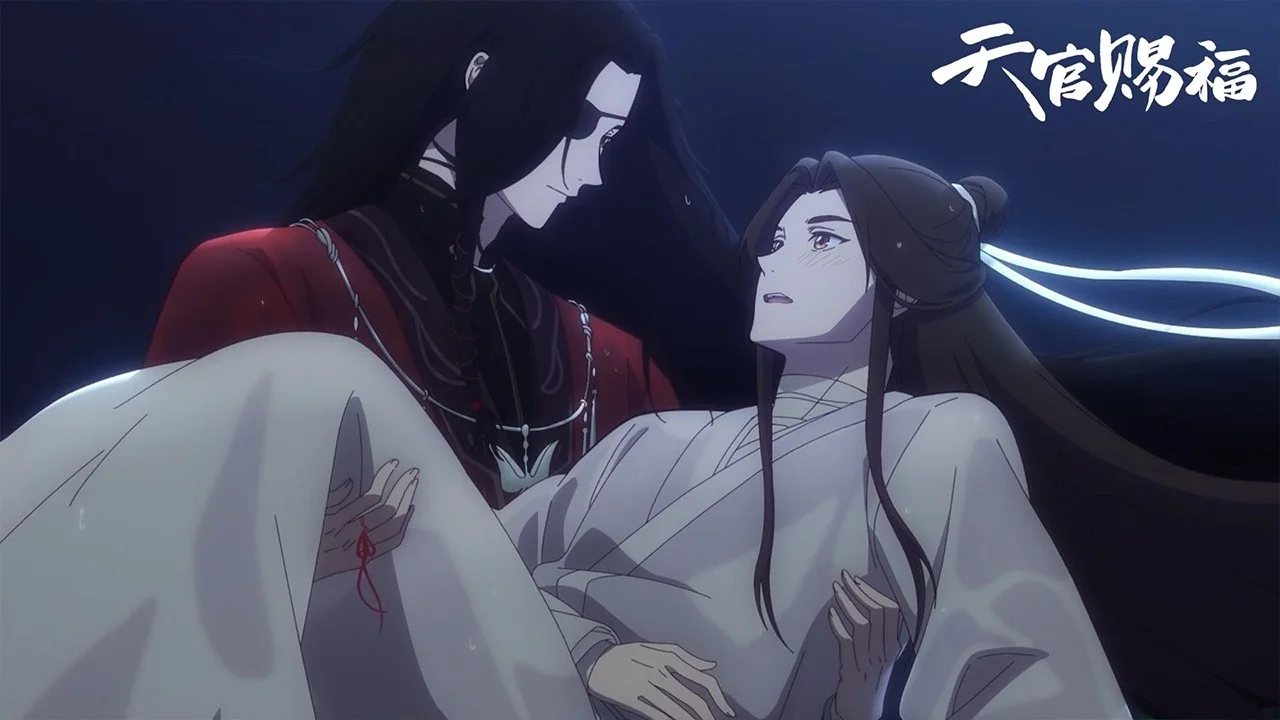
Hua Cheng enters the animation with almost unfair advantages. He knows more, controls more space, commands Ghost City, changes appearance and can turn danger into theater. Around Xie Lian he becomes attentive, playful and startlingly patient. The red umbrella, silver butterflies and red thread make that attention instantly legible.

Their intimacy is built through gaze before explanation: Hua Cheng controls the space, while Xie Lian decides whether to remain inside it. Official animated short via Made By Bilibili.
What makes him more than a perfect fantasy partner is not the length of his waiting. It is the discipline of attention. He remembers Xie Lian's dignity when the world remembers a joke. He recognizes competence under the “scrap-collecting immortal” label. He treats a broken shrine as a home because Xie Lian made a life there.
But admiration should not erase the imbalance. Hua Cheng's knowledge, wealth and power can make every encounter feel prearranged around Xie Lian before Xie Lian understands the arrangement. Devotion can become a room with no visible exit even when it is furnished beautifully.
The animation is strongest when it preserves Xie Lian's choice. On the ox cart, Hua Cheng offers company and partial truth; Xie Lian keeps asking questions. In Ghost City, Hua Cheng performs control; Xie Lian reads the performance and sometimes refuses its emotional script. Their bond works when worship becomes conversation.
This is also why the Cave of Ten Thousand Gods is emotionally complicated. Thousands of images can look like the ultimate proof that one person was never forgotten. They can also look like a beloved person transformed into an object so many times that the maker's need overwhelms the subject's consent. The scene deserves wonder and discomfort at once.

The chapter-four preview sells radiance and closeness, but the real dramatic question is what Xie Lian will feel when he understands what the cave contains. Official PV via Made By Bilibili.
A ruined shrine tells us more than a heavenly palace
Puqi Shrine is one of the smallest important spaces in the series. It leaks status. There is no grand institution separating a god from the person asking for help. Xie Lian has to mend the roof, find food, negotiate with villagers and live beside the objects he has salvaged.
That humility should not be confused with poverty used as decoration. The shrine changes how relationships occur. Hua Cheng cannot approach only as the ruler of Ghost City; he has to sit in a rough domestic space, share food and help with practical work. Xie Lian cannot remain a remote icon; his habits become visible.
The ox cart does similar work. It is slow, public and ordinary. Their first extended conversation does not happen in a palace designed to impress. Two travelers sit close because the road requires it. Hua Cheng's bare feet, impossible knowledge and casual posture introduce mystery without breaking the human scale.
I return to these spaces more than the grand battles. They show what the story understands about intimacy: somebody may worship an image from far away, but loving a person requires sitting inside the life they actually have.
Heaven is a bureaucracy of belief, not a map of Chinese religion
International viewers often search for explanations of ascension, temples, merit, believers, ghost kings and heavenly officials. The animation makes those concepts feel internally coherent, but its system is a fantasy institution, not a documentary guide to Chinese religious practice.
The heavenly court resembles a bureaucracy because Chinese literature has long imagined cosmic order through offices, ranks, petitions, jurisdictions and reputations. Gods in popular traditions may be connected to local temples, communities, historical figures and changing networks of worship. Heaven Official's Blessing borrows that broad imaginative vocabulary and rebuilds it for romance, political memory and adventure.
That distinction matters. “Merit” in the series works like spiritual resource, public confidence and institutional power at once. Real Buddhist, Daoist and folk religious uses of merit are not interchangeable with a fantasy scoreboard. The same caution applies to ghosts, festivals and divine titles.
For a wider cultural frame, use our Chinese mythology guide as a map of recurring traditions, not as a codebook that reduces every fictional element to one ancient source.
The fantasy system is most useful as social criticism. Heaven can see disaster as paperwork. Reputation travels faster than truth. Officials protect networks, institutions defend their versions of history and neglected people become invisible until they threaten the system. Xie Lian's third ascension matters because he returns to this machinery without letting it define every life beneath him.
Season one whispers; season two builds a stage
Season one earns intimacy through restraint. The bridal procession turns horror into a question of who is performing for whom. The ox cart withholds identity. Puqi Shrine creates domestic comedy. Banyue Pass lets Xie Lian's old decisions reappear through people rather than exposition alone.
Its weakness is also restraint. New viewers can leave with a haze of names, ranks and past events because the animation expects emotional curiosity to carry incomplete context. That works if Xie Lian's quietness interests you. It feels evasive if you want the political history immediately.
Season two moves into Ghost City, where Hua Cheng can control color, crowd, risk and spectacle. The environment finally matches his legend. It also gives the relationship more confidence: fewer encounters can be dismissed as coincidence, and Xie Lian's trust becomes an active position rather than passive politeness.

Season two lets Hua Cheng's confidence occupy the frame. The challenge is keeping Xie Lian from becoming only the audience for that charisma. Official PV via Made By Bilibili.
The cost is compression. Ghost City's politics, supporting characters and historical pressure have to compete with the adaptation's desire to preserve every charged glance. A beautiful pause can be worth keeping; too many pauses can make the wider world feel like scenery for the central pair.
My preference remains season one, not because it is less romantic, but because it makes romance work harder. An umbrella and a seat on a cart carry more uncertainty than a city already prepared to display Hua Cheng's devotion.
The new animated shorts are a gift, not season three
As of August 2026, Bilibili has released or previewed a sequence of official animated short chapters: the God-Pleasing Festival encounter, Lantern Festival time in Ghost City, a water reunion and the Cave of Ten Thousand Gods material. They are substantial new animation, not random reposts.
They also create a dangerous expectation. A polished short can feel like continuation because it animates scenes viewers have waited years to see. It does not automatically establish a full production order, episode count, release calendar or formally named third season.
The shorts reveal what viewers are still hungry for. Not only plot completion. They want embodied moments the seasons left at a distance: Hua Cheng nearly losing composure, Xie Lian hiding the marks of punishment, an old rescue seen with adult knowledge and a relationship allowed to occupy the frame without rushing to the next case.
That hunger is understandable. It should not be converted into a false “season 3 release date.” Check Bilibili's official channel and the Crunchyroll series page for announcements and legal availability. Bilibili's own video descriptions note regional restrictions, so even official YouTube material may not play in every country.
The East Moment verdict: choose the person over the monument
Watch Heaven Official's Blessing if you want a romance built from recognition, a fantasy bureaucracy shaped by belief and a fallen god whose kindness is a repeated decision rather than a reward for suffering. Watch season one before deciding that the series is only beautiful men, red thread and eight hundred years of longing.
Its most powerful question is not “Who would wait that long for me?” It is harder: if every public version of me collapsed, who would still recognize the person underneath, and would their recognition leave me free?

“One flower, one sword” compresses Xie Lian's contradiction into an image: tenderness beside force, blessing beside the capacity to wound. Official insert-song art via Made By Bilibili.
For another Chinese animation where intimacy creates an ethical problem, read Link Click. For a hero rebuilding identity through ordinary community rather than worship, continue with Scissor Seven. The Chinese anime and donghua collection will keep these comparisons organized as the cluster grows.
Use XianLore's Heaven Official's Blessing visual archive when you need the character, place, object and relationship map beside this interpretation. The archive helps locate the shrine or cave; East Moment asks what that space does to the person inside it.
Then bring one scene to East Moment's community: the hand that catches, the sleeve that covers, the shrine that becomes home or the cave that turns love into an uncomfortable monument. Use spoiler labels beyond season two. I am less interested in declaring the “best couple” than in hearing the moment when devotion felt like attention, and the moment when it felt too large to breathe inside.