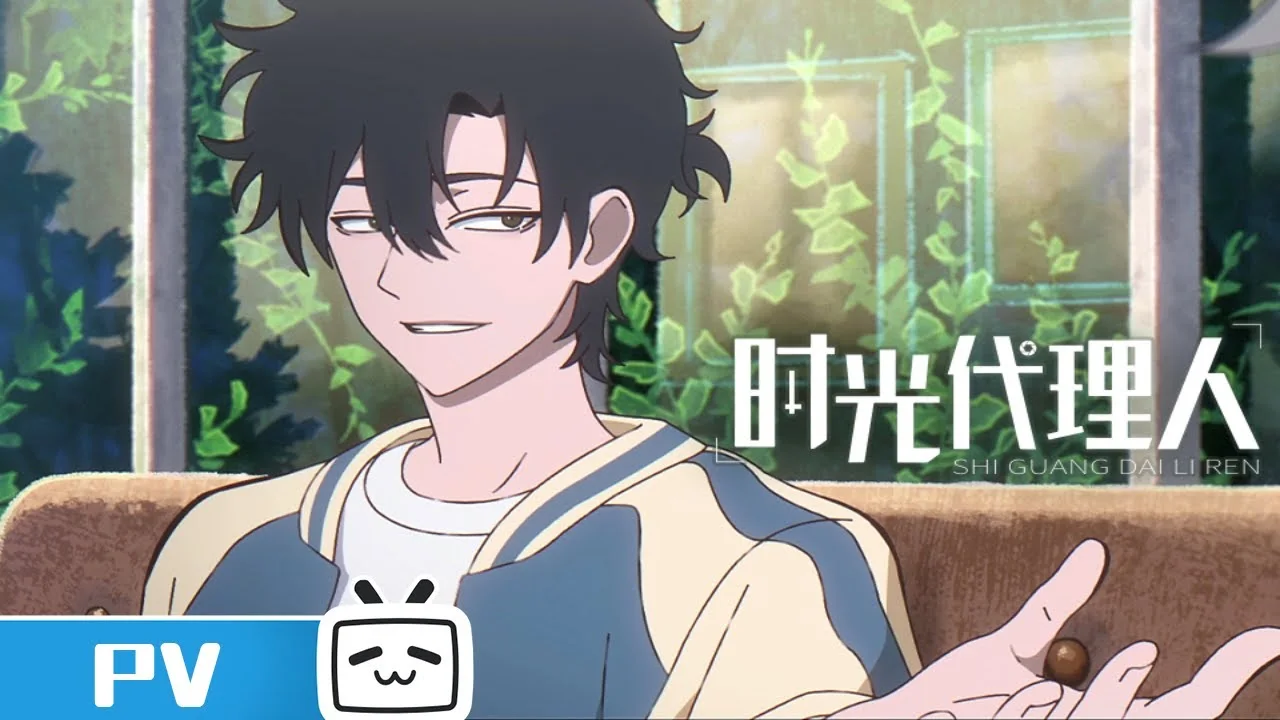
Link Click is not powerful because two young men can enter photographs. It is powerful because entering a photograph makes another person's life feel close enough to save, while the rules demand that it remain untouched. Cheng Xiaoshi experiences the past as a body; Lu Guang reads it as a timeline. Their partnership survives only while those two definitions of responsibility can occupy the same room.
Link Click turns empathy into a dangerous power
The English title sounds like an instruction: follow a link, click, move. The Chinese title, Shiguang Dailiren (时光代理人), is closer to “time agents.” Neither fully prepares you for a show about borrowing someone else's body and discovering that professional distance is almost impossible.
At Time Photo Studio, Cheng Xiaoshi and Lu Guang accept requests connected to photographs. Cheng enters the photographer's position inside the image. Lu Guang remains outside, reads the recorded sequence and guides him. Qiao Ling brings the present-day client, money, trust and consequences to their door.

The complete poster makes the mechanism visible before the rules are explained: two bodies face different directions inside film strips and a clock. Official series art via Bilibili International.
The premise immediately creates a moral split. Lu Guang treats the past as a structure: observe it, complete the request and protect the larger line. Cheng feels hunger, humiliation, affection and panic through a living body. To him, refusing to help can begin to feel like choosing the tragedy.
This is the series' central judgment: empathy is not automatically moral. Feeling another person's pain may produce courage, but it can also make you seize their choices, ignore consequences and confuse your need to repair the past with their right to have lived it.
I side with Cheng emotionally and with Lu Guang operationally, which is exactly why the series traps me. I want the person inside the photograph to be saved; I also know that wanting rescue does not grant ownership of another life. Any explanation that turns their conflict into “heart versus brain” is too cheap. The partnership must answer a harder question: when does care become control, and who pays when the caring person refuses that boundary?
The photo-diving rules in one clear picture
| Question | Direct answer |
|---|---|
| What is Link Click? | An original Chinese animated suspense series directed by Li Haoling and released by Bilibili. |
| Is it anime or donghua? | It is Chinese animation, commonly called donghua; “Link Click anime” is a useful search phrase, not its country of production. |
| What can Cheng Xiaoshi do? | He enters a photograph through the photographer's position and acts inside that person's past. |
| What can Lu Guang do? | He reads the sequence connected to the photograph and directs Cheng from the present. |
| What is the basic rule? | Complete the request without changing the past; their dives work within a limited twelve-hour frame. |
| Who is Qiao Ling? | Their childhood friend, practical partner and the person who connects many clients to the studio. |
| Is it romance? | The central relationships carry deep intimacy, loyalty and dependence, but the animation does not need a fandom label to make those bonds matter. |
| Is it finished? | No. Season-three material is active; use Bilibili's official channels for current scheduling rather than fan countdowns. |
The rules are deliberately easy to explain and emotionally hard to obey. A photograph appears to preserve one stable truth. The moment Cheng enters it, he learns how much the frame excluded: fatigue before the smile, resentment under hospitality, fear after a message and the private cost of an ordinary decision.
A photo agency cannot promise repair just because it can reach the past
The studio's work sounds like a service: a client brings an image, makes a request and hopes for an answer. But the person whose past Cheng enters did not consent to becoming the route toward someone else's closure. That is the ethical pressure inside every case. The agents owe clients honesty about limits, but they also owe the borrowed life more than a clever outcome.
Cheng's impulse to intervene comes from taking that life seriously. Lu Guang's restraint comes from fearing the harm a changed detail may spread beyond the room. Neither instinct is sufficient alone. Pure empathy can turn another person's tragedy into a stage for the helper's need to save. Pure containment can make a person feel like a fixed record whose pain is useful only as data.
The best cases let the team offer recognition without pretending to own the ending: a message is carried, a fact is found, a goodbye becomes audible, but the agent does not get to rewrite a stranger into a happier version for the viewer. That boundary is why the show's grief lands. Its power looks miraculous; its care has to remain humble.
Cheng Xiaoshi lives the moment Lu Guang is trying to contain
The most important Link Click characters are not “the black-haired one” and “the white-haired one.” They are two incompatible methods of care.
Cheng Xiaoshi is immediate. He trusts the emotion arriving through the borrowed body because ignoring it feels dishonest. This makes him impulsive, but “impulsive” is too shallow on its own. His deeper problem is that presence creates obligation. Once he has heard the parent, teammate, friend or frightened stranger as if they were speaking to him, he cannot return easily to the language of acceptable loss.
Lu Guang seems colder because he receives the past as information. He can see the line Cheng cannot. His restraint protects people, yet it also depends on concealment. Every calm instruction asks Cheng to trust knowledge that Lu Guang may not fully share.
Their famous handclap is therefore more than a stylish activation gesture. Each dive begins with consent between partners, but only one of them enters the risk. Lu Guang must guide without possessing Cheng's body. Cheng must obey without seeing Lu Guang's full map. The supernatural mechanism turns trust into choreography.
The series becomes less interesting whenever it asks only, “What power does Lu Guang really have?” The better question is, “How much truth can a partnership hide before guidance becomes control?”
The first season hurts because the clients are ordinary
Spoiler boundary: this section discusses the emotional shape of early cases but does not reveal the season-one ending or solve the central mystery.
The first client stories do not need royal courts, ancient clans or a world-ending villain. They use an office employee trying to satisfy family expectations, two women whose small food business contains years of shared labor, a basketball game remembered across time, a missing child and messages that arrive too late.
Emma's story establishes the cruelty of the format. Her photograph can be entered, her gestures can be borrowed and one part of her evening can be altered. None of that gives Cheng ownership of the social pressure surrounding her: work, loneliness, class, family concern and the vulnerability of traveling home alone.
The noodle-shop story works differently. Food is not a decorative symbol of Chinese warmth. A recipe holds friendship, unequal sacrifice, pride and the fear that one person's future may erase another person's contribution. Cheng cannot solve that conflict by finding a villain because affection and resentment have grown from the same labor.
Then the earthquake-linked story changes the meaning of “do not alter the past.” A sporting regret first appears small enough to repair. The wider disaster reveals that personal memory and historical catastrophe occupy the same hours. Cheng can carry words into the scene, but proximity does not grant rescue.
This is the emotional wound that stays with me: Link Click repeatedly lets a final message do something real without pretending it undoes death. Comfort matters. So does the fact that comfort is not salvation.
A photograph is evidence, invitation and trap
Most time-travel stories need a machine, portal or scientific explanation. Link Click chooses a medium people already misunderstand.
A photograph proves that light reached a surface. It does not prove that the smile was sincere, that the person behind the camera understood the room or that the next minute followed safely. Clients bring photographs because they look complete. The agents discover that every frame is an entrance into missing context.

The OverThink ending turns profile, shadow and backward-looking rhythm into part of the mystery rather than an after-episode decoration. Official distributor upload via Wakanim.
The direction keeps returning to screens, shutters, phone calls, windows, reflections and divided frames. These are not random technology props. Each one separates the person who sees from the person being seen.
Even the opening and ending sequences participate in the argument. Reversed movement invites viewers to search for recoverable order; hand choreography makes coordination look precise; abrupt color changes turn a familiar face into unstable evidence. The songs do not merely advertise mood. “Dive Back in Time” promises return, while “OverThink” names the mental prison created by too much partial knowledge.
This is also where the series looks specifically contemporary and Chinese without stopping for a cultural lesson. Small restaurants, family messages, crowded work, basketball courts, rented rooms and neighborhood relationships create its social scale. The city is not a neon cyberpunk export package. It is where people earn, eat, wait and fail to answer the phone.
Qiao Ling keeps the present from becoming a waiting room
Qiao Ling is often pushed to the edge of discussion because she does not perform the same dive. That mistake reproduces the power system's own blind spot.
She knows the clients before they become cases. She asks whether the studio should accept the work, keeps ordinary obligations visible and has to live with consequences created by information she may not receive. Cheng and Lu Guang can become absorbed by the timeline; Qiao Ling protects the reality that people will still knock on the door tomorrow.
Her position also exposes an imbalance. The two men share a supernatural protocol and private knowledge that can determine her safety. Calling their secrecy protective does not remove her right to understand the danger entering her life.
The series is strongest when Qiao Ling is allowed to choose, confront and interpret rather than serve as emotional proof that the male partnership matters. A triangle does not require romance. It requires three people whose decisions change one another.
Season two raises the threat and loses some ordinary air
Season two expands the consequences of the first season into police pressure, possession, family violence and a more continuous confrontation. The red visual language becomes more aggressive. Bodies can no longer be trusted simply because a familiar face is speaking.
The escalation is effective, but it costs the series something. Early Link Click could spend most of an episode inside a stranger's apparently small regret. The larger conspiracy gives the leads more danger and mythology, while leaving less room for an unfamiliar life to become important on its own.

The Bridon Arc keeps the phone as a line between past and present while moving the relationship history outward. Official image via Made By Bilibili.
The Bridon Arc, released after season two, is valuable because it reopens relationship history rather than simply adding a stronger opponent. Although much of its chronology sits earlier, release order matters: its information is designed for viewers who already carry later questions about Lu Guang, Cheng Xiaoshi and the cost of return.
My verdict is not that anthology episodes are automatically deeper than plot episodes. It is that the central mystery earns its scale only when the series remembers why one unknown person's missed message once felt large enough to break the rules.
Link Click watch order and the current 2026 status
Use release order on a first viewing:
| Order | Watch | Why here |
|---|---|---|
| 1 | Link Click Season 1 | Establishes the power rules, ordinary clients and the emotional cost of intervention. |
| 2 | Season 1 special / bonus material | Optional; useful for character rhythm, not a replacement for the main episodes. |
| 3 | Link Click Season 2 | Continues the cliffhanger and expands the possession mystery. |
| 4 | Link Click: Bridon Arc / Yingdu Chapter | Chronologically earlier material whose revelations work better after season two. |
| 5 | Season 3 material | Follow the official Bilibili sequence and episode labels as released. |
Do not start with the Bridon Arc simply because part of it occurs earlier. A prequel can reveal information at the wrong emotional time.
As of this August 2026 review, Bilibili has published season-three PVs, an episode-one teaser and an English-subtitled Anime Expo 2026 interview with director Li Haoling. Those are reliable evidence that the project is active. A promotional video is not a promise about every territory's release date, subtitle schedule or episode count.

The season-three PV changes the visible character pressure without resolving it in marketing copy. Official image via Made By Bilibili.

Li Haoling's official English-subtitled interview keeps the current production conversation attached to a named creator, not rumor accounts. Image via the Link Click official channel.

Bilibili's free teaser is embedded here instead of a paid episode. It shows current visual direction without asking the preview to prove the complete season.
Check the official Bilibili listing and Crunchyroll series page for legal availability in your region. Catalogs and subscription requirements change; an old “watch free” list becomes misinformation quickly.
Watch the Mandarin performance before changing languages
The original Mandarin track is worth trying even if you normally watch dubbed animation. Cheng Xiaoshi's emotional speed, Lu Guang's controlled instructions and Qiao Ling's practical force create a three-part rhythm. The contrast is audible before a plot explanation arrives.
Subtitles also preserve an important identity: Link Click is donghua made from contemporary Chinese speech and spaces, not an anime-shaped object that becomes culturally neutral when exported. Read our Chinese-language guide when a form of address, kinship term or tone relationship matters more than the dictionary meaning.
That does not make the English or Japanese dubs illegitimate. A strong dub can create access and its own performance. The useful test is not loyalty. It is whether the version preserves who interrupts, who softens a command and who sounds as if they are hiding fear inside certainty.
The East Moment verdict
Watch Link Click if you want a suspense series where the emotional case and the supernatural rule damage each other. Begin with season one and do not search character names between episodes; image results and autocomplete can destroy carefully timed revelations.
Its best achievement is not the cliffhanger. It is making a photograph feel heavier after the episode ends. The image remains still, but you now imagine the labor before it, the unseen person beside it and the message that may arrive one minute too late.
That makes Link Click a strong opening for the Chinese anime and donghua collection. It also belongs beside Black Myth: Wukong: one uses an old myth to question inheritance, while the other uses contemporary photographs to question intervention. Both refuse the idea that Chinese stories must remove their local texture to travel.
If chronology, identities and recurring objects begin to blur, open our sister site XianLore's Link Click visual archive beside this essay. XianLore is the reference map; East Moment remains the argument about why intervention hurts. I insist on that separation because a database can recover the order of events, but it cannot decide whether a rescue was morally earned.
Continue into the wider Chinese culture collection, then bring one ordinary client scene to East Moment's community. Use a spoiler label and name the small action that made the loss real. A timeline theory is useful; an accurately remembered human moment is harder to replace.