Fog Hill of Five Elements is often sold with one convenient phrase: “a Chinese ink-painting anime.” That description captures the surface and misses the achievement. The brushwork does not decorate action after it happens. Pressure, speed, hesitation and impact are already inside the line. Wenren Yixuan's fire works the same way: it is spectacular because it reveals a young man moving faster than his judgment, then discovering that power always leaves somebody else holding the debt.
Fog Hill of Five Elements: what to watch, who made it and why it hits
The opening fights do not ask me to admire a beautiful still image. They teach my eye how this world moves. A dry edge scratches across the frame. A body pauses inside empty paper. Color gathers, then a stroke lands with enough force to make the white around it feel displaced.
When the guzheng enters and the Five Elements step into the frame, I do not experience the music as background. It tightens the body before the first strike. The combat feels heavy because every brush line appears to arrive with pressure, not because the screen is filled with particles.
That distinction matters. Plenty of animation can place ink washes behind conventional digital action. Fog Hill lets the material behavior of ink decide the action grammar. A thin line can be nervous. A pooled black can become weight. A torn edge can register speed more sharply than a clean outline. Empty space is not an unfinished background; it gives a blow somewhere to travel.

A pale hand disturbs a fluid surface until touch, smoke and paint become one action. Official original trailer via Samsara Animation Studio.
This is why calling the series “pretty” feels strangely weak. Its finest images are not polite. They smear, snap and bruise.
Seven episodes, two chapters and the clean watch order
| Question | Direct answer |
|---|---|
| What is the Chinese title? | Wu Shan Wu Xing (雾山五行), literally “Fog Mountain, Five Elements.” |
| Is it anime or donghua? | It is Chinese animation, commonly called donghua. “Fog Hill of Five Elements anime” remains a useful English search phrase. |
| Who made it? | Director Lin Hun and Samsara Animation Studio (六道无鱼动画工作室), with Bilibili as the official release platform. |
| How many main episodes are released? | Seven: the original three-episode chapter followed by the four-episode Xichuan Huanzi Lin chapter. Platform labels sometimes make these look like seasons, but 3 + 4 is the clearest released order. |
| What should I watch first? | Watch the original three episodes, then Xichuan Huanzi Lin (often treated as season two). Do not begin with fight compilations; they remove the moral cost from the spectacle. |
| Is romance the main plot? | No. Family obligation, elemental power, human-beast conflict and survival organize the story. Shipping labels do not explain its dramatic engine. |
| Where can I watch it? | Start with the official Bilibili series page. Access, subtitles and regional availability can vary. |
| Is another chapter dated? | The official sources reviewed on October 16, 2026 do not establish a release date for a new main chapter. Treat fan countdowns and reposted clips as unconfirmed. |
The compact length is both invitation and warning. Seven episodes are easy to begin, but this is not a conventional twenty-four-minute weekly season with leisurely exposition. Names, ranks, seals, family history and creature politics can arrive during motion. The show expects attention and does not always earn clarity.
The first battle is a grammar lesson, not a trailer stretched into a show
The series understands that extraordinary action needs rules the eye can feel before the mind can recite them. Its early elemental confrontation gives each combatant a different relationship to space. Fire rushes and consumes. Water redirects and contains. Metal produces hard, decisive paths. Earth answers with mass. Wood extends life and entanglement beyond one body.
These are dramatic impressions, not a textbook transcription of Chinese philosophy. Historical wuxing is better translated as “five phases” or “five processes”: an account of changing relationships, generation and overcoming. Fog Hill borrows the familiar names of wood, fire, earth, metal and water, then invents clans, envoys, seals and combat mechanics for its fantasy world. Our guide to the Chinese five elements explains the cultural system; do not use the animation as literal cosmology.

The first release campaign compresses the proposition into one silhouette: a human body almost disappearing inside its element. Official studio PV.
The invention works because the elements are not merely colors assigned to five superheroes. Movement expresses temperament. Their entrances carry confidence, rivalry and institutional history before dialogue catches up. The thrill of “the Five Elements have arrived” comes from simultaneous order and danger: these people can restore a boundary precisely because they are powerful enough to tear one open.
Wenren Yixuan's fire is a debt, not a power-up
Wenren Yixuan is easy to misread in clips. Red-black ink consumes his face, white eyes cut through the frame, and the animation offers all the visual pleasure of a hero releasing restraint. In the story, release is not clean liberation.
He acts from a recognizable wound: family illness turns rules into obstacles. Waiting can feel like cowardice when somebody you love is running out of time. That makes his disobedience emotionally legible without making it harmless. He reaches for the Qilin's power because care has narrowed his vision. The choice then weakens a boundary that other people, animals and fellow envoys must survive.

Power distorts Wenren Yixuan's face instead of completing it. The official second-chapter preview refuses the clean beauty of a standard upgrade.
This is the character's real tension. He is neither a rebellious genius who should simply ignore old institutions nor a foolish child who should have obeyed without question. The guardians' rules carry reasons, but rules can become emotionally unbearable when they demand that one person accept a private loss for a public balance.
Fire makes that conflict visible. Wenren moves before the argument is finished. He can save a body in front of him and endanger bodies outside his sight. Every magnificent attack therefore asks a less glamorous question: who inherits the consequence of his urgency?
The second chapter is strongest when it keeps that debt attached to him. A larger enemy is not enough. Wenren must become responsible for a world altered by his earlier love, impatience and confidence.
Su Xiao'an changes the scale from elemental myth to a village life
Su Xiao'an matters because she is not another envoy standing at the same altitude as Wenren. Through her, grand elemental conflict enters ordinary relationships: a village, kinship, mistrust, a vulnerable creature and adults who believe survival permits cruelty.
Her presence keeps the story from becoming a tournament between beautifully designed powers. A sealed beast is an abstract threat until someone feeds, fears or protects a living creature. A broken barrier is a plot device until its consequences reach a home.
The village material also exposes one of the show's weaknesses. Motives and mechanics are sometimes compressed so aggressively that an emotional turn arrives before its connective tissue. Viewers are not wrong to question why a seal behaves one way in one confrontation and another way later, or why a character appears to ignore an obvious danger. The images can create conviction faster than the script creates explanation.
I can accept mystery; I do not want confusion romanticized as depth. A short handmade production still owes the audience causal clarity. The visual force earns patience, not exemption.
The beasts deserve more than villain status
The human-beast divide initially looks simple: dangerous creatures are contained, guardians preserve order, and a Qilin holds extraordinary power. Look longer and the clean moral border starts to fail.
Humans fear what beasts can do, yet human need also turns nonhuman bodies into resources. Healing, power and security become arguments for confinement or extraction. The beasts can be violent without existing only as evil. Their bodies carry injury, hierarchy and survival claims that the human institutions would prefer to classify as threats.

The official studio concept short gives the creature a face before the fight reduces it to a threat.
This is where the creature designs do narrative work. The avian face above is not a generic enemy assembled from horns and teeth. Its teal feathers hold wet, uneven edges; the eye asks to be read before the body attacks. The show gives animal anatomy enough specificity to create presence, then lets ink loosen the boundary between body and environment.
For readers interested in how Chinese art and story repeatedly turn animals into moral, political and cosmic actors, compare our guide to Chinese mythological creatures. Fog Hill is not adapting one canonical bestiary, but it understands the older imaginative possibility: a nonhuman being can reveal the limits of human order rather than merely threaten it.
Water Crown proves authority does not need a solemn face
One of the loveliest design decisions is the Water Crown: an apparently comic, duck-like body that can still carry rank, composure and visual authority. The affection this character creates is not a break from the serious world. It is evidence that the world is alive beyond a single prestige register.
Fantasy animation often makes status painfully obvious. Important characters become taller, sharper and more ornamented. Fog Hill allows a small body and humorous silhouette to disturb that hierarchy. The result also generates a reasonable question: how do Crowns, Envoys and elemental affiliations relate, and does a title translate directly into combat superiority?
The honest answer is that title, role and demonstrated strength should not be collapsed into one fan-made ranking. The released material gives clues through encounters and deference, but it does not turn every relationship into a numbered chart. Water Crown is interesting precisely because visual comedy, institutional status and possible power coexist without becoming a statistic.
That tonal elasticity resembles Scissor Seven, where a ridiculous body can carry grief or lethal skill. The difference is texture: Scissor Seven uses deformation to protect neighborhood humanity; Fog Hill uses it to keep a monumental elemental world from hardening into self-importance.
Xichuan Huanzi Lin makes the conflict stranger and less tidy
The four-episode second chapter, Xichuan Huanzi Lin, expands the released story rather than beginning an unrelated season. Its purple-red visual field, intensified creature presence and harder confrontations move beyond the original chapter's proof of concept.

The campaign image keeps the body central: Wenren's stance is readable before elemental effects explain the threat. Official Made By Bilibili PV.
What improves is not simply scale. The chapter gives consequences more room to develop and makes survival claims collide. Wenren can no longer be understood only through the exciting audacity of the first battle. The world has remembered what he disturbed.
What remains imperfect is narrative density. New names and powers can enter with the confidence of material already explained. Action sometimes carries relationships the dialogue has not fully built. I found myself replaying transitions not because the choreography was too fast, but because the story had skipped a small bridge.
This is the distinction I want praise for the animation to preserve. A sequence can be extraordinarily fluid and still leave a character's emotional turn underprepared. Technical ambition deserves attention; it does not erase the need to know why a promise breaks, why an ally changes sides, or why one danger suddenly matters more than another. When a viewer needs to slow the image down, that can be pleasure. When they need to replay a scene to locate the missing cause, the story has asked its visual force to carry too much.
That does not make the chapter empty spectacle. It means the series' production ambition is currently better at concentrating sensation than distributing information. A future continuation needs more than another magnificent opponent. It needs time for Su Xiao'an, the beasts, elemental offices and Wenren's family obligation to change one another between fights.
Pure hand-drawn beauty has a real cost
The series' irregular rhythm is inseparable from the labor visible on screen. Lin Hun and a small production team developed a style in which key drawings, brush texture, compositing and choreography must feel authored rather than fed through a standard television pipeline. The official Bilibili program with director Lin Hun is part of the production record; I keep the page focused on what the released animation proves rather than turning the article into a source list.
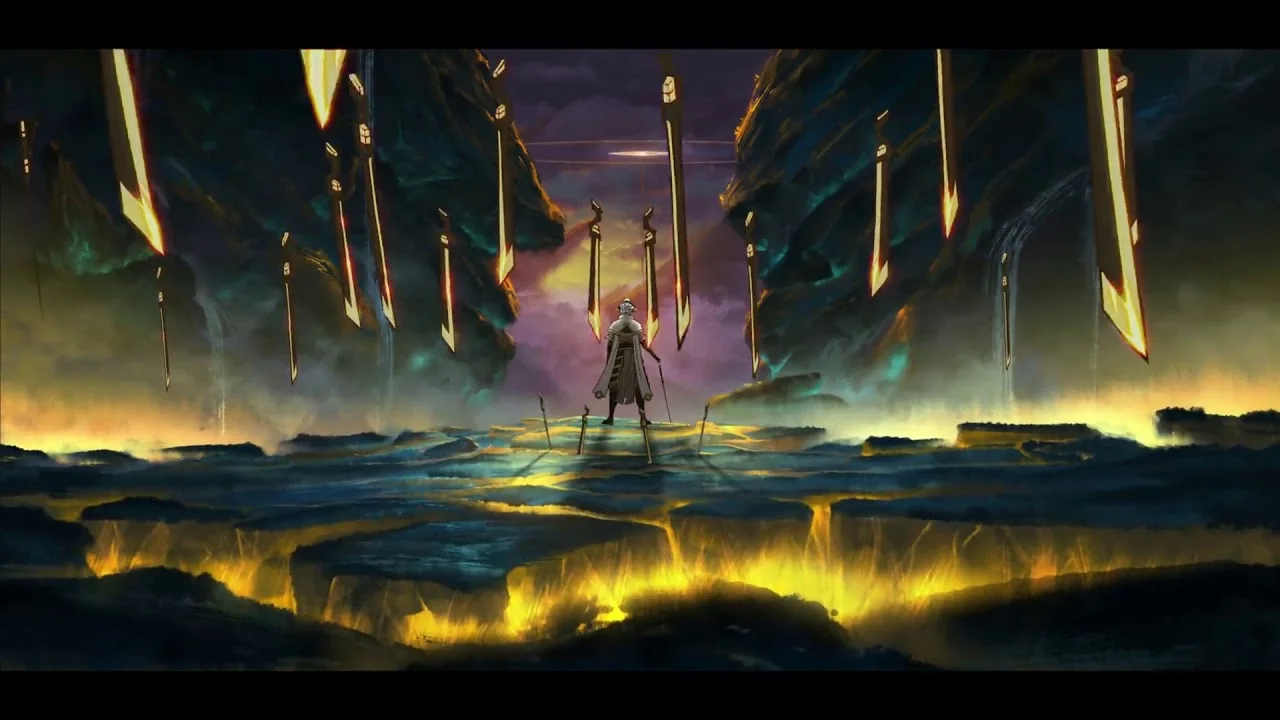
Scale comes from composition rather than visual noise: one small body against a dark horizon, with empty space making the next movement legible. That choice is visible in the official return campaign, but it matters here because it keeps the human cost inside the spectacle.
The result can be worth waiting for and still make waiting costly. Long gaps break emotional continuity. A viewer can remember one fight perfectly and forget why two people were angry. New audiences encounter uncertain labels, abandoned countdowns and uploads that imply progress the studio never announced.
I do not want to turn production pain into a purity myth. “Hand-drawn” is not automatically better, and exhausted artists are not proof of artistic sincerity. The achievement is that this particular process gives the line expressive behavior the story needs. The problem is that a serial narrative also needs a sustainable path back to its audience.
Both truths belong in the verdict: these frames are unusually alive, and the release pattern weakens the bond between them.
Watch the free official concept short as moving evidence
The free official The Flame Ignites concept short is worth watching for motion, not plot summary. The avian beast pictured above changes shape at speed; sound arrives before impact, and empty space makes each change legible.
That short is a free moving reference, not a substitute for the series. Full episodes may require a subscription or differ by territory; use the official series page to check legal availability.
The East Moment verdict: extraordinary movement, unfinished responsibility
Watch Fog Hill of Five Elements if you want animation where form and character are doing the same work. Wenren's fire is beautiful because it is impatient. The beasts are memorable because their painted bodies resist becoming resources. Empty paper becomes dangerous because one stroke can alter its balance.
Do not watch it expecting a relaxed lore encyclopedia, a romance-led fantasy or seven episodes of perfectly explained rules. The plot can be abrupt. The terminology can outrun the translation. The long production gaps are a real structural weakness, not a charming sign of artisanal virtue.
My strongest memory is still physical: the guzheng begins, bodies enter, and the line seems to tighten before it hits. That sensation survives after names and seal mechanics blur. Few animated series make technique feel so inseparable from moral temperament.
Continue through our Chinese anime and donghua guide, then compare the use of consequence here with Link Click: one turns empathy into a dangerous intervention, while the other turns family love into power released before the world is ready.
For a separate character, creature and visual-reference route, use XianLore's Fog Hill of Five Elements archive. East Moment keeps the argument here focused on why the movement hits; XianLore helps you identify what moved.
Then bring one frame to East Moment's community. Not a ranking and not a copied synopsis: show us the strike, creature, silence or sound cue that stayed in your body, and explain what the image made you feel before you knew how to name it. Use spoiler labels for both chapters.