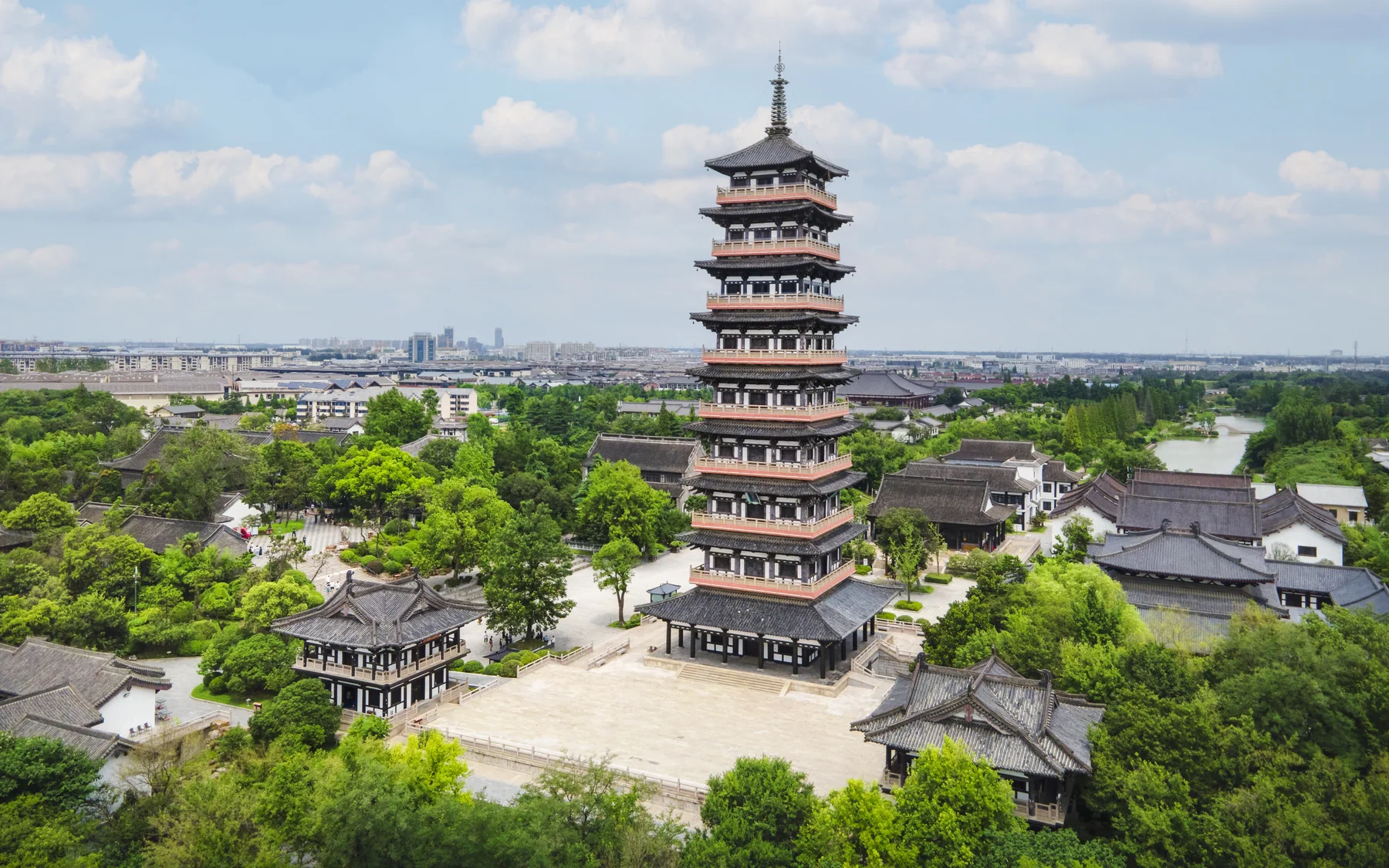
Chinese pagoda is often translated as a Buddhist tower, but that phrase makes a living building sound like a label in a museum case. A pagoda can hold relic memory, mark a route, dominate a city skyline, survive a change of dynasty, or become the place where a family takes the same photograph every year. I understand these towers best when I stop asking which one is the “most beautiful” and ask what each one is doing to the people and landscape around it.
Chinese pagoda begins with a tower carrying more than weight
The first thing to notice is vertical pressure. A Chinese pagoda pulls the eye upward through stacked roofs, projecting eaves, openings, brick courses or timber frames. But its meaning does not rise in a straight line. It moves between the ground where visitors stand, the relic or image the building once protected, and the horizon it reorganizes. Read it beside our broader Chinese architecture guide, which keeps roofs, courtyards and building systems in view rather than treating the tower as an isolated icon.
The Big Wild Goose Pagoda is a useful starting point because its silhouette is so familiar that it can become invisible. In Xi'an, the tower is not only an ancient-looking object. It is a meeting point between the city's Tang-era Buddhist translation history, a modern public square, tour groups, local evening walks and the camera phone held up by almost everyone nearby. The same vertical form is read as heritage, pilgrimage, landmark and backdrop depending on who is standing there.
The UNESCO Silk Roads listing places the Chang'an-Tianshan corridor within a network of exchange rather than a sealed national story. That is the scale I want readers to keep: pagodas belong to routes, translations, patrons, craftspeople and urban change, not to an isolated category called “old Chinese architecture.”
Chinese pagoda types are regional answers, not one fixed template
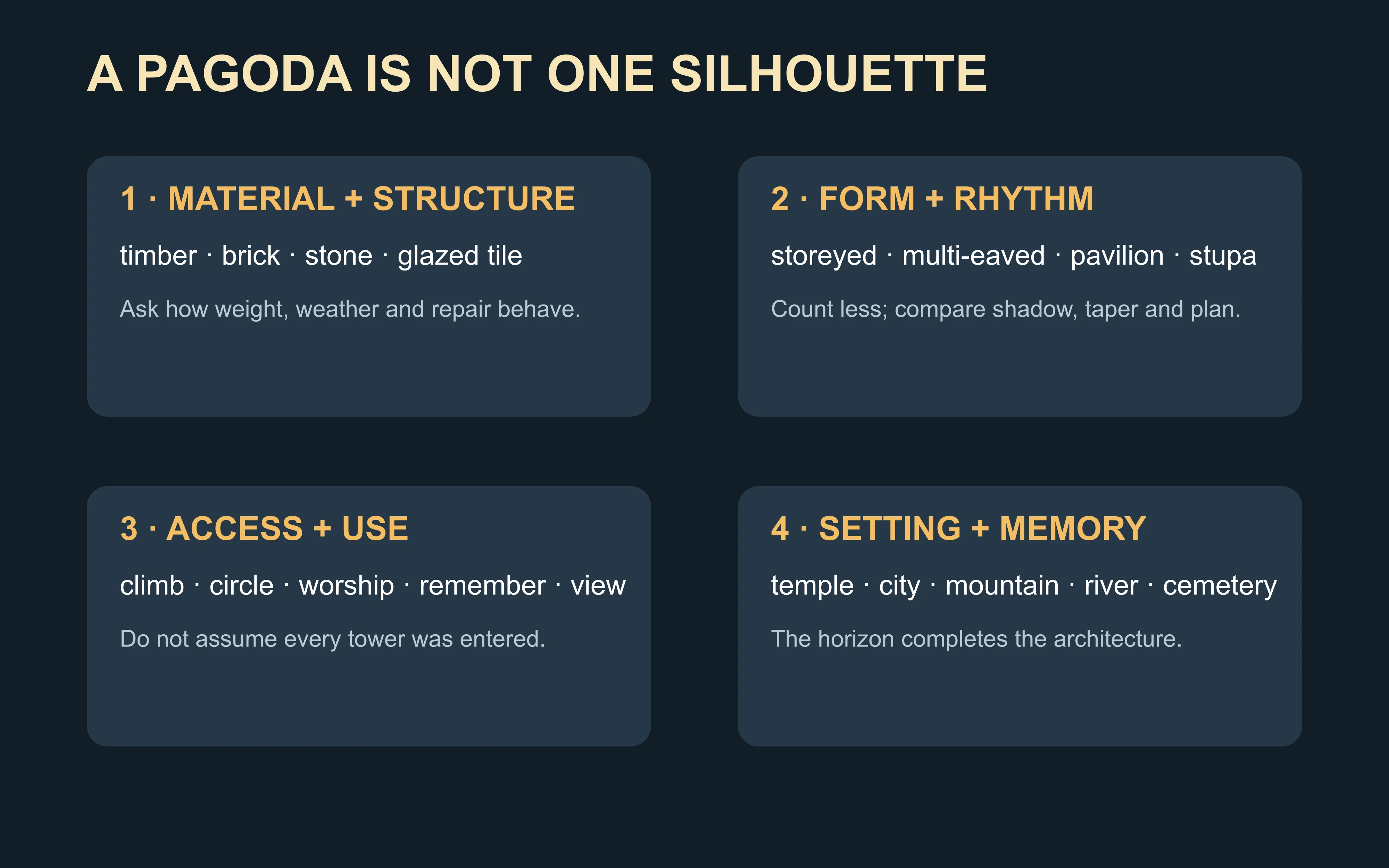
Search results often offer a neat list of “types of Chinese pagoda.” The list is useful only if it explains what changes between the examples. A timber pagoda, a brick or stone pagoda, a multi-eaved tower and a monastery stupa may share a translated name while solving different structural, ritual and climatic problems.
| What to compare | Why it matters | What not to assume |
|---|---|---|
| Material | Timber, brick, stone and glazed surfaces age, flex and repair differently | Material alone does not date a tower |
| Plan and movement | Some towers invite circumambulation; others are primarily visual or commemorative | Every pagoda was designed for public climbing |
| Roof rhythm | Repeated eaves make height legible and create shadow | More roofs do not automatically mean greater status |
| Setting | Monastery court, city wall, river edge and mountain route change the building's role | A pagoda's meaning is not contained in its silhouette |
| Later repairs | Rebuilding can preserve a landmark while changing its appearance | “Rebuilt” does not mean “fake” |
The word “pagoda” itself is a translation history. Chinese towers developed through encounters with Buddhist forms and local building traditions, then continued to change as patrons, technologies and religious settings changed. The Metropolitan Museum's overview of Buddhism and Buddhist art in China is a better companion than a universal origin myth because it keeps images, institutions and transmission in the same frame.
The Shaolin Pagoda Forest makes memory look crowded
The Shaolin Pagoda Forest in Henan is not one heroic tower waiting to be photographed alone. It is a field of stupas and pagodas built across generations for eminent monks. Their different heights, shapes and weathered surfaces make succession visible. That crowded memory belongs to a wider Chinese mythology and religious imagination, where stories, buildings and local ritual keep changing one another.
When I look at the forest, the emotion is different from looking at the Big Wild Goose Pagoda. Xi'an gives me a single vertical sentence. Shaolin gives me a crowded archive. Some towers feel compressed, some elaborate, some almost absorbed by grass and stone. The site resists the fantasy that heritage is preserved by keeping one perfect form unchanged. It is preserved here through accumulation, repair, erosion and the continued act of walking among names.
UNESCO's Historic Monuments of Dengfeng places the Shaolin ensemble within a broader sacred and architectural landscape. The listing is evidence for the site's heritage status and components; it is not a promise that every story told by a guide, social post or souvenir is historically exact.
Kaifeng Iron Pagoda turns engineering into a dark red glow
Kaifeng's Iron Pagoda is a good antidote to the idea that Chinese pagodas are delicate, pale and ornamental. Its glazed brick surface and dense, almost metallic colour make the tower feel less like a painted decoration and more like a structure that has absorbed weather.

At night the tower does not disappear into darkness. It becomes a vertical mass with a low, warm glow around it. I find that more moving than a spotless daylight postcard because the building appears to carry its own weight. The repeated details are not there only to be counted; they slow the eye and make the tower's endurance physical.
Kaifeng also teaches a practical lesson about cities. A pagoda is never just an object in a historical vacuum. Floods, warfare, urban rebuilding, tourism and changing river routes all affect how a tower is seen and reached. “Ancient” describes accumulated time; it does not mean the surrounding city stopped moving.
Quanzhou pagodas face the sea, trade and many communities
The Kaiyuan Temple towers in Quanzhou bring a different atmosphere. Their stone bodies stand inside a port city whose history includes maritime trade, religious exchange and communities moving through the same streets.
The paired towers create balance, but they do not feel interchangeable. Light, carving, distance and the activity of the temple court make each approach different. A visitor who only photographs the pair from the central axis misses the small negotiations around them: incense smoke, shade, vendors, repair work, school groups and residents passing through without performing “heritage” for the camera.
This is why I resist writing pagoda pages as architecture-only descriptions. A building gains meaning through use. The body of the tower is evidence; the people moving around it are part of the interpretation.
Leifeng Pagoda shows that reconstruction can carry memory
Leifeng Pagoda beside West Lake is famous partly because its story includes destruction and rebuilding. The tower seen today is not a simple untouched survival from a remote past. It sits inside a layered public memory shaped by the old tower, its collapse, the legends attached to it and the later decision to build again.

That makes it useful for overseas readers who assume “authentic” means original stones in an unchanged setting. Sometimes reconstruction is precisely how a city admits that its relationship with the past has changed. The honest question is not whether a rebuilt tower is identical to its predecessor. It is what evidence, design choices and public expectations the reconstruction makes visible.
The Three Pagodas of Dali change the scale again
The Three Pagodas of Dali are read against mountains, weather and a wide valley rather than a dense metropolitan square. Their spacing makes the landscape part of the composition. The towers do not merely puncture the skyline; they measure the distance between human construction and the Cangshan range.

This is one reason photographs of pagodas can become misleading. A tight crop turns a regional landscape into an isolated icon. A wider frame shows why the tower was placed there, how weather changes its colour and why the same building can feel protective in one season and exposed in another.
How to visit a Chinese pagoda without flattening it into a checklist
If you are planning a visit, I suggest four slow questions rather than a race through “top ten” landmarks:
- What is the ground asking you to do? Walk around, enter a court, climb, look outward or stand at a respectful distance?
- What is original, repaired or rebuilt? Read the site's own explanation and keep those categories separate.
- Who uses the space today? Monks, residents, tourists, school groups, vendors and maintenance workers create different rhythms.
- What does the tower frame? A river, a mountain, a city wall, a market, a temple court or only the sky?
These questions turn a photograph into a relationship. They also prevent a common mistake: treating a sacred building as a decorative background while repeating a meaning it no longer carries in exactly the same way.
The most important view may be from the ground
Travel pages often advertise a pagoda by the view from its top. That promise can be historically wrong, physically impossible or simply beside the point. Some towers were never designed as public observation decks. Others contain narrow stairs, altered interiors or protected fabric that cannot safely absorb constant climbing. Access can also change during restoration.
I do not treat a closed stair as a failed visit. Stay on the ground and circle once. Watch how the eaves shorten as you approach, where the entrance actually sits, which side receives the hard afternoon light and whether the tower organizes a monastery court or merely survives beside a modern road. Step farther away until the skyline returns. The building changes each time your body changes distance.
That movement answers a question a drone photograph cannot: when does the tower begin to govern the place around it? At Dali, the mountain and spacing matter. At Kaifeng, dense glazed surfaces make the tower hold visual weight. In the Shaolin forest, no single monument wins; repetition creates the field. The useful souvenir is therefore not always the closest portrait. It may be the frame that shows what the pagoda makes smaller, gathers around itself or leaves open.
Which Chinese pagoda should a first-time visitor choose?
Choose by the experience you want, not by a single fame ranking:
- Xi'an: the clearest city-scale introduction, where a single tower connects translation history, public space and a modern landmark route.
- Shaolin: the strongest choice for a dense memorial landscape and a monastery context; UNESCO's Dengfeng heritage listing is the best planning reference.
- Quanzhou: choose the Kaiyuan Temple towers if you want a pagoda inside a port-city history. The UNESCO Quanzhou listing gives the wider maritime context.
- Hangzhou: choose Leifeng if reconstruction, legend and a lake landscape are the point; the West Lake cultural landscape listing helps separate the tower from the tourist postcard.
Check each site's official visitor information for opening times, access rules and restoration closures before travelling. This page helps you decide what kind of encounter you want; it is not a substitute for current ticket or transport information.
Compare a pagoda with four questions
When two towers look similar in a photograph, compare them in this order:
- Material: brick, stone, timber, concrete restoration or a mixed structure?
- Vertical rhythm: one body, many eaves, a solid profile or an open stair tower?
- Relationship to movement: can people enter, circle, climb, worship nearby or only view it from outside?
- Relationship to place: does it face a city street, a monastery, a river route, a mountain or a remembered burial landscape?
This is more useful than ranking “the most beautiful Chinese pagoda.” The same tiered roof can carry relic memory in one site, skyline identity in another and tourism pressure in a third. A tower's meaning is made by structure, ritual, geography and the people who continue to name it.
The East Moment verdict: a pagoda is a relationship between height and memory
My short answer to “what is a Chinese pagoda?” is this: it is a family of Buddhist and Buddhist-influenced tower forms that became local through materials, patrons, construction traditions, routes and repeated acts of remembrance. There is no single visual template and no one timeless function.
The Big Wild Goose Pagoda teaches the power of translation and city-scale memory. Shaolin's forest teaches that remembrance can accumulate instead of becoming one perfect monument. Kaifeng makes endurance feel structural. Quanzhou keeps trade and multiple communities in the frame. Leifeng makes reconstruction part of the story. Dali lets mountains complete the architecture.
That is why I would rather see six different pagodas than memorize one “most famous” answer. The differences are the knowledge. Share the tower that changed for you in Moments, and include the view, weather, people and surrounding street—not only the name on the sign.