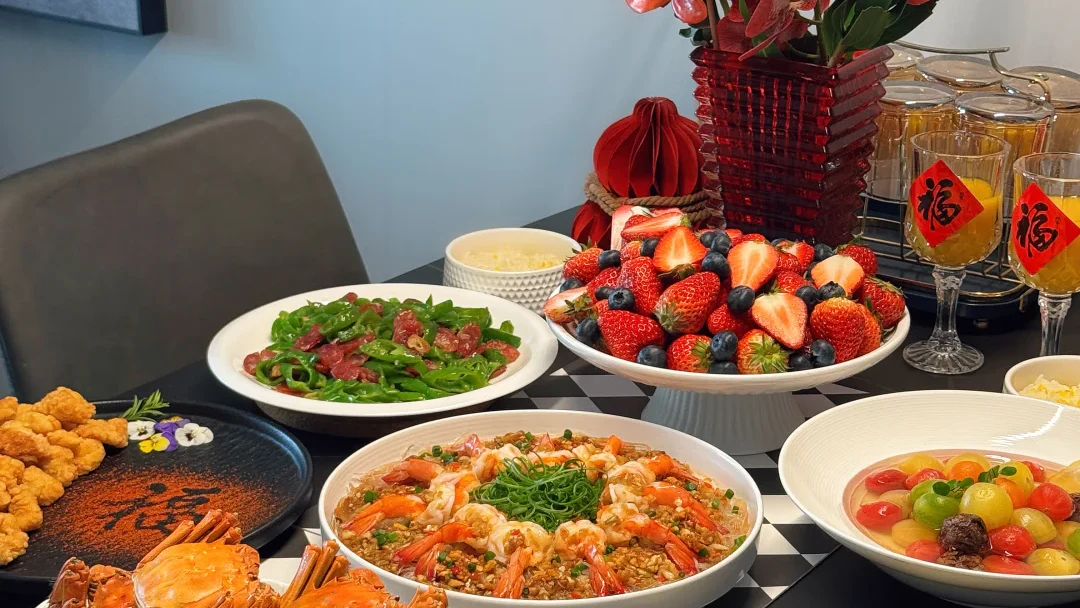
Laba Festival is not a miniature Chinese New Year. It is the quiet day when waiting for New Year turns into work. Grains are soaked, garlic is peeled, jars are found, and the kitchen begins preparing for a table that does not exist yet. I value Laba because it makes anticipation visible.
Laba Festival is the quiet beginning of Chinese New Year
Laba Festival—Laba Jie (腊八节, Làbā Jié)—falls on the eighth day of the twelfth lunar month. Its best-known foods are a mixed-grain porridge called labazhou (腊八粥) and, especially in northern China, garlic pickled in vinegar until the cloves turn green.
Those facts are easy. The feeling is harder to translate.
Laba usually does not stop traffic, fill the night with fireworks or bring every relative home. It can pass like an ordinary work or school day. Yet one pot on the stove changes the direction of winter. Before Laba, New Year is still an idea. After Laba, there are ingredients to buy, jars to check, tickets to discuss and rooms to make ready.
That is what the familiar saying guo le Laba jiu shi nian—“after Laba, it is New Year”—gets right. The festival does not claim that New Year has arrived. It says preparation has become real.
| Quick question | Useful answer |
|---|---|
| When is Laba Festival 2027? | Friday, January 15, 2027. |
| What is the Chinese date? | The eighth day of the twelfth lunar month. |
| What is eaten? | Mixed-grain Laba porridge is most familiar; Laba garlic, Laba noodles and Laba tofu belong to particular regions and households. |
| Must the porridge contain eight ingredients? | No. There is no single national ingredient list or mandatory count. |
| Does every Chinese family celebrate? | No. Practice varies sharply by region, religion, generation and household. |
| Is it a public holiday? | Laba is a traditional observance, not a nationwide statutory day off in mainland China. |
When is Laba Festival 2027?
The next Laba Festival is January 15, 2027. The date changes in the Gregorian calendar because Laba follows the Chinese lunisolar calendar.
The Hong Kong Observatory's official 2027 conversion table places the first day of the twelfth lunar month on January 8; its eighth day is January 15. This is the useful way to verify the date. Do not calculate it from the zodiac animal, a fixed January rule or last year's social post.
Laba sits late in the wider New Year sequence. Dongzhi has already marked the winter turning point. Laba begins the tightening circle of preparation. The reunion dinner, red envelopes and first day of the new year still lie ahead in our Chinese New Year guide.
“After Laba comes New Year” is a schedule disguised as a rhyme
Festival explanations often translate sayings and stop. I hear a household calendar inside this one.
Laba porridge asks for advance attention because different beans and grains soften at different speeds. Laba garlic asks for even more patience: peel the cloves now, cover them with vinegar, seal the jar, then leave the result for a future meal. Shopping, preserving and cooking begin to lean toward the end of the year.
The emotional force lies in this change of tense. A bowl of porridge belongs to today. A jar of garlic belongs to the table weeks ahead. Laba holds both at once.
That is also why the festival can survive in a reduced form. A family may not perform a ceremony or cook an enormous meal. One pot made before work can still announce, quietly, that the year has entered its final passage.
Laba porridge is not an eight-ingredient checklist

The number eight is in the festival's name, so commercial recipes love to promise the correct eight ingredients. Real bowls are less obedient.
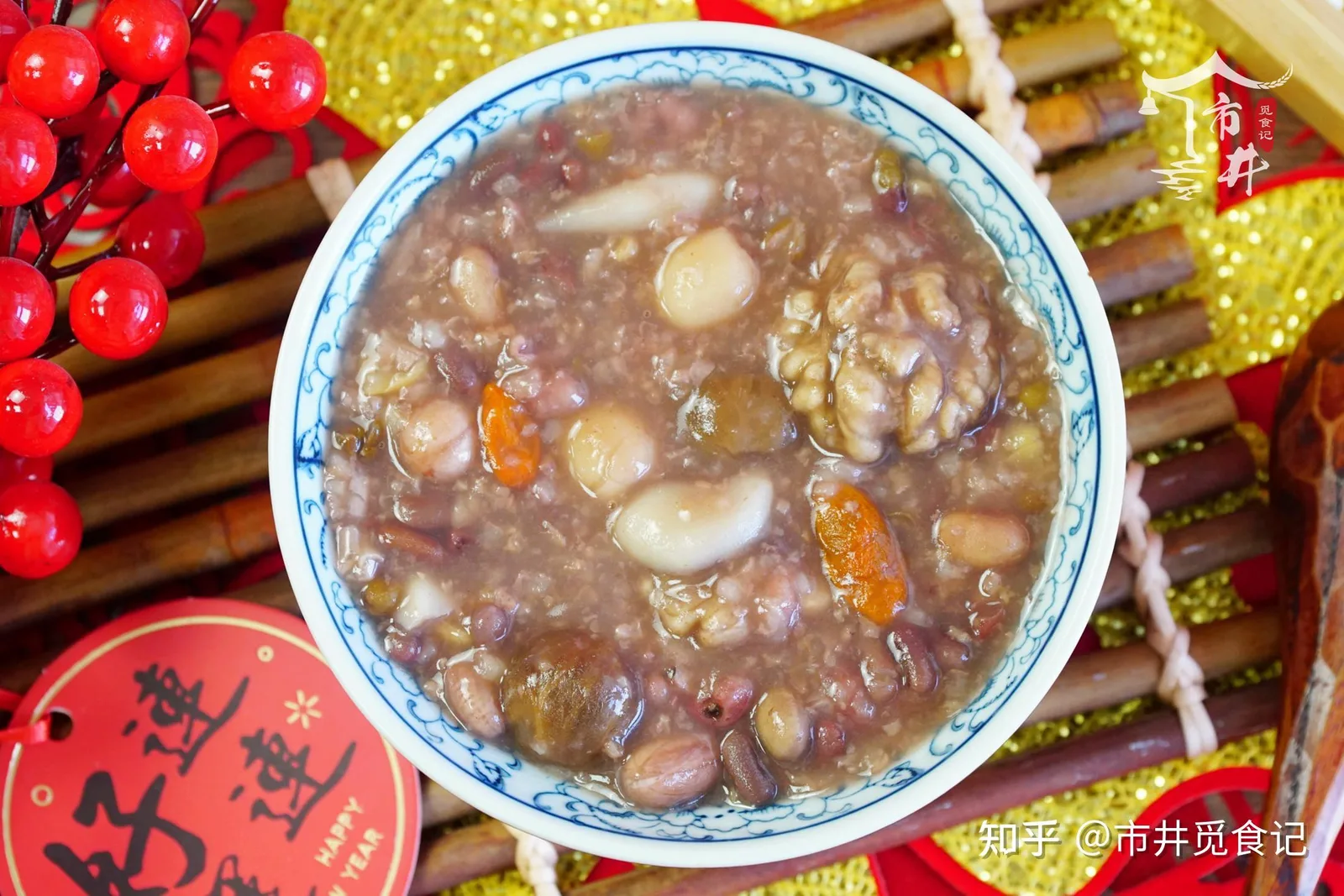
A Laba porridge may combine rice or glutinous rice with millet, sorghum, barley, corn, red beans, mung beans, black beans, peanuts, walnuts, chestnuts, lotus seeds, dates, dried longan or other ingredients available to that household. Some versions are sweet. Some are plain. Savory regional versions can include vegetables or meat. The mixture reflects climate, pantry, taste and budget more honestly than an internet formula does.
The tray above contains more than eight visible ingredients. That is not a mistake. It demonstrates the point: Laba porridge is a method of gathering, not a counting game.
I find its meaning in what cooking does to difference. Before heat, each grain sits in its own strip or bowl, easy to name. After a long simmer, colors bleed, beans split and starch thickens the water. Nothing disappears completely, but no ingredient keeps a perfect border. A cold-season pantry becomes one warm meal.
The honest work happens before the photogenic bowl

The most useful photograph is not the styled bowl. It is this strainer lifted from cloudy water.
Mixed porridge is inconvenient in a revealing way. Large beans may need soaking. Lotus seeds may need checking. Hard grains and quick-cooking rice should not always enter the pot at the same moment. Then someone has to watch the water, prevent scorching and decide when distinct ingredients have become one texture without turning everything to paste.
This is where Laba stops being a list of symbols and becomes domestic skill. The person cooking is coordinating several clocks inside one pot.
My test for a good bowl is not whether every expensive ingredient appears on top. I want a base thick enough to hold the grains, beans soft enough to yield, nuts that still offer contrast, and sweetness restrained enough that the porridge remains breakfast rather than dessert. A beautiful ingredient list cannot rescue undercooked beans or a burnt bottom.
The finished bowl proves something the raw tray cannot: long cooking has softened the boundaries but not erased all texture. You can still find a walnut, lotus seed or bean. The pleasure comes from meeting them inside a shared body.
Laba garlic is the festival's most revealing food

If porridge explains mixture, Laba garlic explains time.
In a familiar northern practice, peeled garlic cloves are submerged in vinegar and kept in a clean sealed container. Over time the cloves can turn jade green while becoming crisp, sour and less aggressively raw. They are often eaten with dumplings around Chinese New Year.
The green color attracts every camera. The waiting interests me more. Laba garlic is prepared for a meal weeks away. It makes confidence tangible: we act today as if the family table will gather later.
The process is also fallible. Cloves may color unevenly. A forgotten jar may never reach the table. Peeling enough garlic can make the fingertips sore, and younger people with long workdays may simply buy a small packet. Those imperfect outcomes do not weaken the tradition. They rescue it from lifestyle fantasy.
I would rather see one modest jar that a household remembers to open than twelve decorative jars made for a photograph. Laba is not a contest in performing old-fashioned competence.
A Buddhist observance, an older year-end season and a household food met here
Laba does not have one clean origin story.
China had year-end sacrificial observances associated with the word la before the modern festival took its present form. Buddhist tradition marks the eighth day of the twelfth lunar month as the Buddha's Enlightenment Day, and temples prepared porridge as an offering and for distribution. Written records from later imperial periods make the connection between the date, temples and mixed porridge increasingly visible. Household practice then developed through local ingredients, stories and New Year schedules.
These strands overlap, but overlap is not the same as a single straight line. It is safer to say that older year-end rites, Buddhist observance and regional foodways all helped shape what people now recognize as Laba.
The Hubei Intangible Cultural Heritage Network's cultural account describes the threshold into New Year and the movement from temple porridge toward public and household sharing. That supports the relationship; it does not prove that every family recipe began inside a temple.
Temple porridge turns one household logic outward

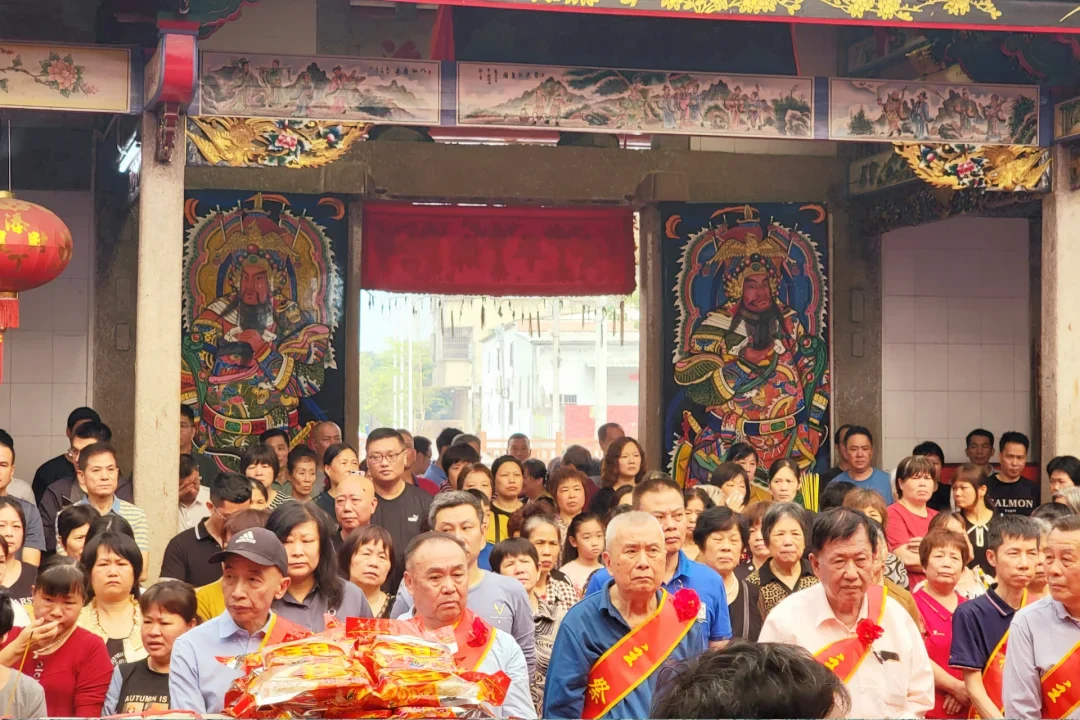
A table crowded with separate bowls makes the public scale of Laba visible. One household contributes or cooks what it can. A temple or community kitchen must sort, soak, combine, cook and distribute enough for strangers.
Contemporary temple sharing remains a living practice in some cities. In 2025, for example, Quanzhou's municipal record documented local temples preparing and giving out Laba porridge. That is evidence of a specific place and year, not permission to write “all Chinese temples serve porridge.”
Still, the public action clarifies why this food fits the day. Porridge expands without demanding identical portions of every ingredient. Water, grain, heat and labor can turn a limited pantry into many warm bowls. Its generosity is practical before it becomes poetic.
Some families barely notice Laba—and that belongs in the story
The most truthful Laba map has blank spaces.
Northern food writing often makes porridge and vinegar-green garlic sound universal. They are not. In parts of southern China, Laba may have little household presence. In one home the day arrives through sweet porridge before breakfast; in another it is an ordinary morning whose name appears only on a phone. Migration can also break a sensory chain: the festival that once arrived through a grandparent's pot becomes difficult to recognize in a new city.
Regional foods widen the picture rather than completing a national menu. Some places make Laba noodles, using noodles and diced vegetables or legumes. Anhui's Yixian area is associated with Laba tofu, a salted dried bean-curd preparation. Local savory porridges can look nothing like the sweet red-brown bowl promoted in gift boxes.
A festival does not become false because some households barely notice it. The variation is the fact. “Chinese people eat this” is usually less accurate than “this practice gives certain families a way to mark the day.”
A low-pressure way to observe Laba outside China
You do not need a perfect ingredient set, a temple nearby or an inherited jar.
- Choose one grain, two beans and two contrasting additions. Use ingredients you can cook safely and actually enjoy. The point is mixture, not numerical obedience.
- Soak according to the ingredient, not the festival story. Dried beans vary. Follow package guidance and cook them fully.
- Make a small pot. Laba should not create a week of unwanted leftovers just to look abundant.
- Prepare one future task. Pickle a small jar of garlic if it belongs to your food habits, or choose another practical New Year preparation: confirm a call, write a shopping list, clean the guest bedding.
- Name the regional limit. If you share the food with friends, say whose recipe it is and how your version changed. Do not sell one bowl as the national standard.
This is where Chinese festival foods become more than edible symbols. Food organizes time. A soaked bean belongs to tomorrow morning. A green clove belongs to New Year dumplings. A family task completed now creates room for reunion later.
My verdict: Laba makes anticipation visible
The loudest festivals are easy to photograph. Laba asks us to look closer: at beans swelling under water, vinegar covering white cloves, and a pot slowly losing the borders between its grains.
That is why I would not reduce it to “Chinese porridge day.” The porridge matters, but the deeper subject is readiness. Laba gives waiting a smell, a texture and a list of jobs. It lets New Year enter the home before the red decorations do.
Continue through the Chinese Festivals calendar or explore more winter cooking in the Chinese Food guide. The next useful question is not how many customs a household can perform. It is which small act makes an ordinary winter day feel like preparation.