Osmanthus wine is a Chinese alcoholic drink scented or made with sweet osmanthus flowers, but the name does not guarantee one base, method, sweetness or alcohol level. It may be a clear spirit infusion, a prepared liqueur-like drink, a fermented rice-based wine or a local sweet brew. Read the label before you believe the romance.
My standard is severe because osmanthus deserves it: the best osmanthus wine smells like autumn arriving through an open window; the worst tastes like perfume poured into sugar. Flowers are not an excuse for a vague drink. A good bottle lets you sense the base wine, the season and a clean floral lift. A bad one shouts “桂花” from the packaging because the liquid has nothing specific to say.
What is osmanthus wine?
Osmanthus wine—guihua jiu (桂花酒)—is a family name for alcoholic drinks in which osmanthus contributes aroma, flavor, material or cultural identity. Sweet osmanthus (Osmanthus fragrans) produces tiny yellow, orange or pale flowers with an aroma often compared with ripe apricot, peach skin, honey and soft floral wax. The exact perception changes by cultivar, freshness and processing.
There is no single universal recipe hidden behind the English phrase. The drink in a Beijing restaurant, a Jiangnan household jar, a Chongqing local custom, a supermarket bottle and Xi'an's cloudy huanggui choujiu can be radically different.
That diversity is not a defect. The defect is pretending the words “osmanthus wine” tell you enough.
| What the bottle may actually be | What to expect | What to inspect |
|---|---|---|
| Spirit infused or macerated with flowers and sweetener | Clear to amber, aromatic, sometimes strong | Base spirit, alcohol by volume, ingredients, whether aroma feels integrated |
| Prepared or blended alcoholic drink | Often clear, sweet and easy to serve chilled | Product category, flavorings, sugar, base alcohol and producer |
| Fermented rice- or grain-based wine with osmanthus | Grain aroma, acidity and texture beneath the flower | Fermentation category, filtration, sweetness and regional method |
| Thick sweet rice drink associated with osmanthus | Cloudy, low-strength or dessert-like in some versions | Do not confuse it with a clear liqueur merely because both use 桂花 |
| Homemade jar | Method varies completely | Safety, sanitation, reliable process and whether it is infusion or active fermentation |
The State Administration for Market Regulation's terminology around prepared alcoholic beverages is useful because it reminds buyers that products can be created by combining a base alcohol with edible materials or food additives. That does not make them inferior. It means method belongs on the label, not inside a fantasy of timeless village brewing.
Osmanthus wine begins as an argument between nose and mouth

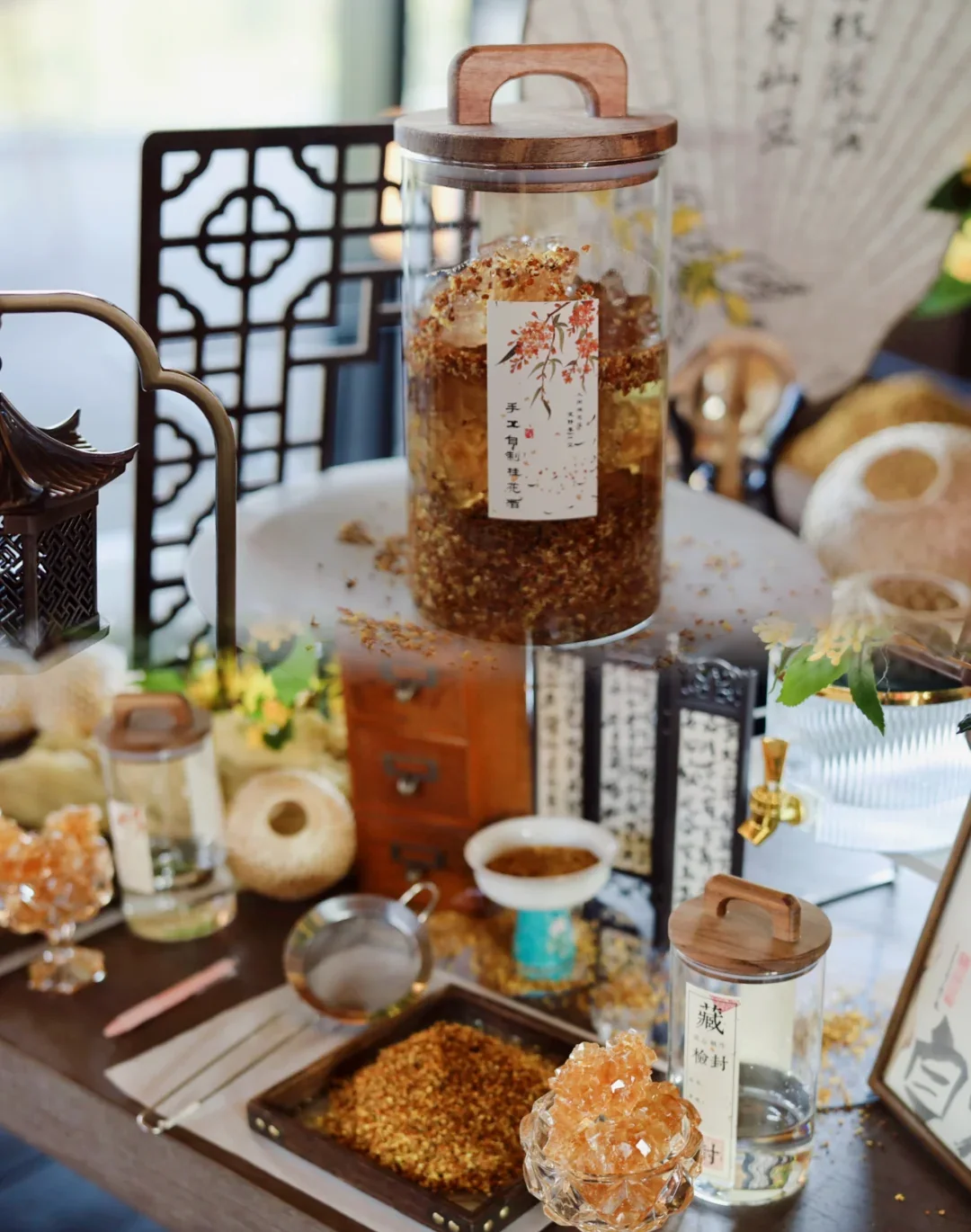
This authorized photograph proves the visible relationship between flower material and amber liquid in one jar. It cannot establish the alcohol, sugar, recipe, fermentation stage or safety of the contents.
Osmanthus is a dangerous ingredient for a lazy maker because its name already supplies the consumer with emotion. We imagine a courtyard, a moon, yellow petals caught in hair. Sugar can make that image immediately pleasant. A strong floral aroma can make it unmistakable. But unmistakable is not the same as good.
Taste in this order:
- Smell before swirling. Is the first impression flower, syrup, ethanol or artificial candy?
- Find the fruit inside the flower. Good osmanthus often suggests apricot or ripe yellow fruit rather than generic perfume.
- Locate the base. Can you still taste rice, grain, spirit or wine acidity beneath the aroma?
- Measure sweetness by the finish. Sweetness is not the enemy; a sticky finish that erases everything else is.
- Wait thirty seconds. Does the flower return cleanly, or does only heat and sugar remain?
Shanghai Jiao Tong University has reported research into the fragrance components and biological mechanisms behind osmanthus aroma. A drinker's language will never map neatly onto a laboratory's compounds, but the research supports a basic point: “floral” is not one chemical or one sensory block. The aroma has structure. We should taste with equal attention.
What does osmanthus wine taste like?
The honest answer depends on style, but a balanced version can combine:
- apricot-like or peach-skin fruitiness;
- honeyed, pollen-like warmth;
- a soft floral top note;
- rice, grain or neutral-spirit character from the base;
- moderate acidity that prevents syrupiness;
- a faint bitterness or drying edge from flowers or maturation.
It should not taste like drinking a room fragrance. Nor should it become anonymous sugar water with petals floating for decoration.
Temperature changes the verdict. Chilling can make a sweet commercial bottle feel cleaner, but it can also mute the flower and hide a weak base. Serve a small first pour cool rather than ice-cold, then let it warm. If the drink collapses as soon as the chill leaves, the refrigerator was doing the winemaker's work.
Glassware need not be ceremonial. A small tulip-shaped wine glass gathers aroma better than a wide bowl; a tiny Chinese cup suits a strong or sweet drink because it controls the serving. The point is not to cosplay antiquity. It is to get the nose close enough to judge.
A real jar is evidence, not a recipe

The scene makes raw material visible: dried flower particles, a glass vessel and a workshop table. It does not prove the creator's formula or validate a home-fermentation method.
Online osmanthus-wine posts often create a dangerous illusion of completeness. A beautiful jar, a handful of flowers and three ingredient names look like a recipe. They are not.
An infusion places materials into an alcoholic base. A fermentation asks microorganisms to transform sugars and creates different risks, controls and timelines. Adding fresh, wet or contaminated plant material can change stability. Sealing an actively fermenting liquid can create pressure. Smell and appearance cannot reliably certify microbiological safety.
The State Administration for Market Regulation's food-safety guidance on home fermentation emphasizes clean materials, controlled processes and caution. East Moment therefore does not convert an attractive social post into an untested alcohol recipe. If you want to make a drink, use a method from a reliable food-science, licensed production or professionally tested source and understand whether you are infusing or fermenting.
This boundary improves the culture writing. The interesting question is not “How many grams should I copy from a stranger?” It is how Chinese drinkers turn a flower whose season can vanish in days into aroma that remains after the branch is bare.
Why osmanthus belongs to Chinese autumn

The image documents contemporary styling around osmanthus. It shows how the flower is made visually seasonal; it does not prove an ancient universal drinking ritual.
Osmanthus blooms around the part of the year when heat loosens and Mid-Autumn imagery becomes unavoidable. The flower is small enough to be missed by the eye before it catches the nose. That reversal gives it cultural power. Peony announces itself. Osmanthus ambushes you.
Local-government cultural records from Changshu and Chongqing document osmanthus wine in named regional custom and brewing contexts. Those records matter more than the floating claim “Chinese people have drunk this for thousands of years.” China is not one courtyard, and a local tradition should not be inflated into a mandatory national ritual.
The relationship with the Mid-Autumn Festival is natural but not compulsory. Osmanthus, moon viewing, Chang'e stories and autumn foods can share one seasonal imagination. A family may serve tea, beer, baijiu, fruit or nothing alcoholic. The festival's center is reunion, not a beverage checklist.
Still, osmanthus wine fits the night beautifully because it asks for a small pour and slow attention. Mooncakes are dense. The drink can lift their aroma, but only if sweetness does not pile on sweetness.
How to pair osmanthus wine without drowning the table
With mooncakes, match intensity rather than symbolism.
- A lightly sweet, fragrant bottle can work with lotus-seed or nut mooncakes.
- A syrupy style beside a very sweet filling becomes exhausting.
- Salted egg yolk needs enough acidity or alcohol structure to cut richness.
- Delicate snow-skin products can disappear under a strong spirit infusion.
Outside the festival, try it with plain nuts, lightly salted poultry, soft rice cakes, poached pear or restrained desserts. Avoid placing five perfume-like flavors on one plate. Osmanthus needs contrast: salt, grain, clean fat, fresh fruit or plain starch.
Tea can be a better companion than another sweet food. A brisk green tea or lightly oxidized oolong resets the mouth. Our Chinese tea guide helps choose by structure rather than by packaging poetry.
How to choose an osmanthus wine bottle

Visible flowers make the ingredient legible, but they do not tell you the drink's alcohol, sweetness, stability or quality. The label must do that work.
Turn the bottle around. The back label is often more truthful than the front.
Check:
- the legal product category;
- alcohol by volume;
- ingredients and allergens where declared;
- producer and place of production;
- bottle size and recommended storage;
- whether “osmanthus” means flowers, extract, flavoring or simply the product identity;
- whether the base is rice wine, another fermented wine, spirit or prepared alcohol.
Then decide what you actually want. A sweet, low-pressure restaurant drink can be enjoyable even if it is not a profound craft object. A powerful infusion may be exciting in ten millilitres and unpleasant in a full glass. A traditional local brew can carry cultural meaning and still fail your palate.
Do not pay a mythology tax. A moon, palace, ancient woman and gold calligraphy on the box do not improve the liquid. I will always choose an honestly labeled modest bottle with a clean finish over a “millennium secret” wrapped in velvet.
Osmanthus wine is not Xi'an thick wine
English search results often collapse different Chinese drinks because both names contain “wine.” Xi'an's huanggui choujiu is commonly a cloudy, sweet, thick rice-based drink associated with the city. It is visually and texturally far from many clear osmanthus infusions or prepared drinks.
Our Xi'an food guide shows a real serving of the cloudy local drink. Treating it as interchangeable with every bottle labeled guihua jiu erases the very regional difference that makes Chinese drink culture worth learning.
The same caution applies to huangjiu, rice wine, baijiu and liqueur. English categories are imperfect bridges. Read the Chinese product type, inspect the liquid and ask how it was made.
If the flower shouts, the osmanthus wine has already lost
The flower's charm comes from scale. It is tiny, briefly abundant and often perceived before it is seen. A good osmanthus wine respects that scale. The flower rises, then allows grain, acidity, alcohol and finish to continue the sentence.
The modern temptation is to make osmanthus louder: more sugar, more gold, more petals, more “Oriental” packaging. That is exactly how the season disappears. Autumn in China is not a scented candle. It is the first cooler night, flowers underfoot, a jar catching low sunlight and someone noticing the air has changed.
Explore the wider Chinese food collection if you want to compare how dishes, tea, fermented grain and seasonal ingredients carry place differently. But begin this bottle with one question: after the flower introduces itself, is there still a drink worth meeting?