JJ Lin writes melodies that seem inevitable only after they have trapped you. His durability comes from what happens before the famous chorus—delayed arrivals, breath with nowhere to hide, bands that withhold the floor—and from his willingness to rebuild those choices on stage. Start with River South and A Thousand Years Later, then compare studio and live versions. Familiarity is not the end of these songs; it is their raw material.
JJ Lin makes familiar Mandopop feel unfinished
Imagine A Thousand Years Later (《一千年以后》) opened on a workbench. The melody is familiar enough that millions of listeners can complete the next phrase before JJ Lin (林俊杰, Lin Junjie) sings it. That is not an uncomplicated advantage. Memory can carry a weak performance across the finish line.
A serious live version therefore cannot merely become louder. It has to remove the protective layer of nostalgia, expose the song's joints, and reassemble them so the final chorus feels discovered rather than scheduled. JJ Lin's best stage work does exactly that. A piano enters alone; percussion waits; a backing voice disappears; the crowd receives a line the singer once owned. The old song changes its emotional subject.
This is why I do not describe him simply as a Singaporean Mandopop singer with a powerful voice and many hits. Those facts identify him, but they do not explain him. JJ's real craft is emotional engineering: melody, breath placement, harmonic delay, arrangement and live revision cooperate so that listeners know where they are going and still feel ambushed when they arrive.
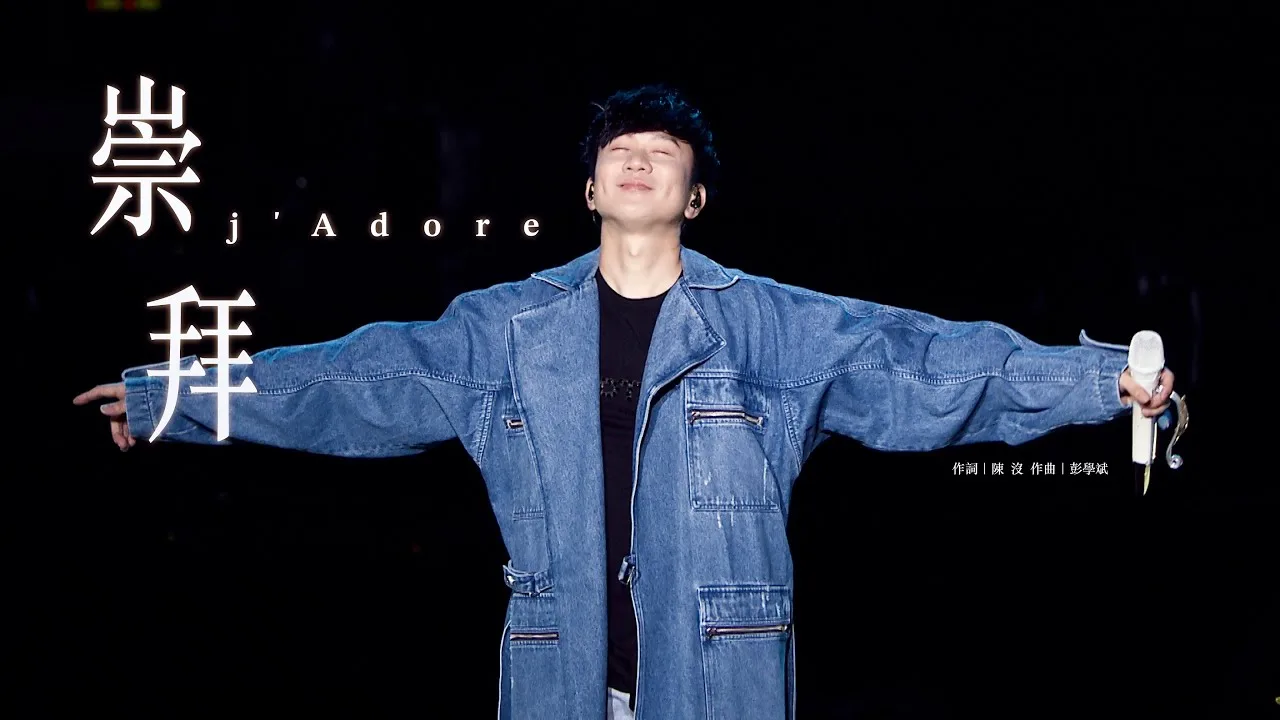
Watch an official JJ20 performance of Worship, then notice how much meaning lives in the distance between his open-armed image and the pressure held inside the line. The stage is large. The emotional mechanism remains intimate.
Workbench one: his melodies climb before the heart is ready
JJ Lin's choruses do not endure because they are merely “catchy.” They possess strong internal direction. A phrase begins with a destination already implied, then delays the expected landing through repetition, a bent contour or one extra breath of harmonic uncertainty.
That design produces a recognizable bodily effect. You know the release is coming, but the song makes you live inside the approach. His best choruses do not simply go higher. They make the previous emotional position impossible to remain inside.
A Thousand Years Later is the clearest demonstration. Its premise is distance: a future in which the speaker and listener cannot occupy the same time. The melody cannot rush without betraying the idea. It lengthens the road, letting each rise feel like an attempt to cross what the lyric has declared uncrossable.

In a live reconstruction, the arrangement can thin the opening and delay the rhythmic floor. The vocal begins as one person inside the story. By the final chorus, the audience has become the future imagined by the lyric: thousands of present-tense voices singing words about absence.
That is not generic “concert atmosphere.” The crowd has been assigned a dramatic role. The arranger and band have converted memory into part of the composition.
Workbench two: River South builds a place that never existed
River South (《江南》) is often filed as a smooth early hit, then left there. I hear something stranger: contemporary R&B building an imaginary Jiangnan from melodic signs.

Ornamented turns and pentatonic colour suggest inherited Chinese sound without pretending to be a field recording. The beat and pop structure keep the song firmly contemporary. The result is not historical Jiangnan. It is what a generation of Mandarin listeners learned to feel when the word Jiangnan appeared: rain, softness, distance, a romance already becoming memory.
I prefer calling this emotional geography rather than cultural fusion. “Fusion” often means ingredients have been listed without explaining what they do. Here the imagined place changes the lyric's temperature. A direct confession would be too exposed; landscape gives it shelter.
The official duet with Li Jian is especially revealing. JJ's brighter pressure and Li Jian's floating restraint do not merely produce two pretty timbres. They expose the composition's flexibility. One voice leans toward arrival; the other preserves distance. The same melody can carry both relationships to longing.
This is also where the Chinese music collection matters. A listener unfamiliar with Jiangnan imagery should not mistake pop memory for ethnographic truth. JJ's achievement is not documentary authenticity. He makes an imagined Chinese place navigable to the modern ear, then lets the listener supply personal weather.
Workbench three: breath is the hidden wall of the room
Online vocal discussion becomes pseudo-medical with alarming speed. A rough edge turns into a diagnosis; a changed vowel becomes a theory about anatomy. I will not do that. We can hear artistic decisions without pretending to inspect a living person's body.
JJ writes lines that make breath dramatically visible. A long phrase removes easy exits. If the singer breathes too early, the emotional thought fractures. If he holds everything in polished control, the result can sound sealed. The live decision is not simply whether he can finish the line, but how much effort he lets the listener hear.

Later performances often reveal a more expressive negotiation with pressure. He may begin with less force, allow texture to remain, then decide exactly when a sustained note becomes clean and public. Earlier studio recordings sometimes sound as if the melody is carrying the singer forward. Mature live work more often sounds as if the singer is choosing how much of the architecture to expose.
That distinction makes songs such as Practice Love (《修炼爱情》) and A Song for No One (《不为谁而作的歌》) more than vocal showcases. Control is arguing with grief. The technically secure finish matters because we have heard how close the phrase came to breaking its composure.
My criticism begins at the same point as my admiration. JJ's command can become too complete. When every entrance is elegant, every swell has a purpose and every climax arrives perfectly lit, feeling risks becoming a premium product behind glass. Emotional engineering is art only when the listener can still enter the machine.
Workbench four: collaboration opens the sealed room
Another voice is one of the best ways to test a perfect structure. A duet introduces a body the original arrangement did not fully control.

With Zhou Shen, timbral clarity moves vulnerability to a different height. JJ's warmer pressure makes the ground more audible; Zhou's line can seem almost detached from it. The useful result is not “two amazing singers together.” It is a new map of where weight sits inside the same song.
With Li Jian, understatement exposes every place JJ might otherwise fill. With G.E.M., force meets force and the arrangement must choose between dialogue and competition. A collaboration succeeds when each singer reveals an assumption inside the other. It fails when two fan bases are placed in the same frame and instructed to admire scale.
This is why I resist ranking these voices as if singing were a clean tournament. Chinese online discussion repeatedly asks who has the best technique, then quietly changes the criteria when a preferred singer loses. Music is not improved by pretending interpretation can be reduced to a scoreboard.
The sharper question is: what becomes audible only because this other person entered? If the answer is nothing, the duet is marketing. If the entire emotional centre shifts, the song has been reopened.
Workbench five: the live show edits the archive
JJ20 and Final Lap are often described through scale, milestones and nostalgia. Those are the least interesting parts. An anniversary show earns its existence only when changed technique, changed listeners and changed rooms force the old material to become different.

Authorized current audience material keeps returning to arrangement decisions: how an entrance was rebuilt, where the band dropped out, why a familiar chorus suddenly hurt again. That curiosity is more valuable than applause counts. People are not only proving that the hit remains popular. They are trying to understand the reconstruction.
Memory Foam provides a useful current contrast because it does not carry the same decades of public memory as the earliest hits. In Hong Kong, the performance cannot rely entirely on collective autobiography. It has to establish its own pressure while sharing a set with songs that arrive preloaded with school years, first phones and old relationships.
That unequal memory is part of concert design. The set list alternates between recognition and risk. Too many classics and the show becomes karaoke with premium lighting. Too much new material and the shared history has no chance to change. JJ's strongest live sequencing lets one category interrogate the other.
His official site documents the continuing music, video and live world around the catalog. It cannot tell us whether a given rearrangement succeeds. The proof remains audible: if nothing changes except volume and screen size, nostalgia did the work. If the emotional subject changes, the arrangement earned the return.
Workbench six: Singapore is a route, not a footnote
JJ Lin's Singapore background is frequently reduced to a nationality in the opening sentence. It should instead change how we understand the circulation of Mandarin pop.
His career belongs to a regional network: Singapore, Taiwan, mainland China, Hong Kong, Malaysia and overseas Chinese communities do not consume Mandarin music as isolated national markets. Songs move through television, karaoke, radio, phones, streaming platforms and concerts. A melody released in one industry becomes somebody else's adolescence thousands of kilometres away.
The Singapore city guide gives the geographic context, but music supplies the lived connection. JJ's Mandarin catalog never needed a single political border to explain its audience. His accent, songwriting influences and production world belong to a Chinese-language modernity built across cities.
This regional position also complicates the word “Chinese.” It can name language, cultural reference, ancestry, market and genre without those categories lining up neatly. JJ Lin does not need to be forced into one definition. The songs already show how culture travels: an imagined Jiangnan written through contemporary pop by a Singaporean artist becomes a memory shared across Asia.
The best JJ Lin songs depend on what you want to hear
A flat “top ten” list pretends every listener has the same task. Use four routes instead:
| Your route | Begin here | The real test |
|---|---|---|
| Melody | River South, A Thousand Years Later | where the phrase delays the landing you already expect |
| Emotional narrative | She Says, Practice Love | whether restraint makes direct language heavier or merely prettier |
| Live reconstruction | one early studio hit followed by its JJ20 or Final Lap version | which layer enters later, disappears or moves to the crowd |
| Collaboration | performances with Li Jian, Zhou Shen or G.E.M. | what the second timbre exposes inside the original structure |
Add A Song for No One when you want control placed under sustained emotional pressure. Add If Possible when you want to hear later live texture. Add Memory Foam when you want to test whether the current catalog can stand beside the inherited monuments.
Do not rush this route. One studio recording and one live version can teach more than twenty tracks played as background. Mark four moments: the first entrance, the first withheld release, the band's largest change and the final note. Then write one sentence describing what changed emotionally. “More powerful” is not enough.
Why JJ Lin still matters after nostalgia is removed
The obvious explanation for JJ Lin's endurance is that his songs accompanied a generation. That is true and insufficient. Nostalgia can preserve almost anything that arrived at the right age.
The harder explanation is structural. His melodies survive repetition because they organize anticipation precisely. His live work survives memory because he treats the catalog as editable. His collaborations survive spectacle when another voice is allowed to alter the song rather than merely decorate it. And his regional career shows how Mandarin pop can create intimacy across cities without collapsing them into one generic market.
The limitation remains real: precision can seal the room. Sometimes the immaculate rise, beautiful light and perfectly timed release leave too little mess for me to inhabit. I do not want JJ Lin to become less skilled. I want the skill to risk being touched by the world it has organized.
My conclusion is firm: JJ Lin's greatest achievement is not writing songs everybody remembers. It is building songs strong enough to be reopened after everybody remembers them. The old chorus is not a museum object. On the right night, with one layer withheld and one breath made newly dangerous, it becomes unfinished again.
Continue with Jay Chou to compare two different architectures of early-2000s Mandopop, or return to the Chinese musicians collection for another voice. Then put one song on the East Moment workbench: studio version on one side, official live version on the other. Tell us what moved—the entrance, the breath, the band, the crowd or the final release. We will return with a reader-built map of the arrangements that truly changed the emotional subject.