Zhou Shen is not compelling because a male singer can produce an unexpectedly high sound. He is compelling because he can turn one unmistakable instrument into water, steel, mischief, grief and several characters arguing in the same song. Start with Big Fish, but do not stop there. Rubia, Dalabengba and Shenself reveal the person that “ethereal voice” edits out.
Zhou Shen becomes interesting after the surprise is over
The first encounter with Zhou Shen (周深) often produces a question before it produces listening: is that really his voice? The surprise is understandable. Building an entire profile around it is lazy.
Calling the sound “female” turns a trained human instrument into a gender quiz. Calling it “ethereal” is gentler, but nearly as limiting. Ethereal tells us the tone seems pure, light or above ordinary gravity. It tells us nothing about diction, comic timing, dramatic judgment, rhythmic bite or what he does when a song needs weight instead of air.
I want to remove the novelty in the first minute. Once we accept that this is Zhou Shen's voice, the serious questions can begin. Why does one quiet entrance feel vulnerable while another feels resolved? How can the same clarity suggest a child, an ancient witness or a person standing inside catastrophe? When does beauty become a habit that the arrangement exploits?
His career is best understood as five acts, not a list of awards: surprise, restraint, resistance, play and authorship. Each act corrects a common listening mistake. The fifth matters most, because a singer who has voiced countless screen worlds eventually has to ask what his own world sounds like.
Act one: Big Fish made transparency feel enormous
Big Fish (《大鱼》) remains the obvious entrance, and I will not pretend obscurity is sophistication. The song is popular because voice, melody and imagined world recognize one another immediately.

The upper line seems to float, but floating is not the absence of labor. The effect depends on steady airflow, softened consonants and a disciplined refusal to overfill the phrase. The opening carries more of the song's identity than the eventual height. Zhou Shen lets the sound appear from a distance, almost without edges, so the listener leans toward it.
Then the melody expands. What changes is not simply volume. The private voice becomes landscape. The best soundtrack singing performs exactly this conversion: one body creates enough emotional weather for an animated world to feel inhabited.
The song also created a commercial trap. Once an artist becomes associated with water, purity and ache, every new soundtrack can request the same beautiful miracle. Demand proves recognition; it does not prove growth. Some commissions give him a dramatic problem to solve. Others clear a polished space for the recognizable tone and call the job complete.
My judgment is unambiguous: Big Fish deserves its status, but using it as the final definition of Zhou Shen is like describing an actor through one close-up. It is the door, not the house. The Chinese animation collection shows why these songs travel so far: donghua has become an international route into Chinese voices. The singer still deserves to exist beyond the screen that introduced him.
Act two: Rubia proves lightness is not weakness
People often confuse sonic weight with emotional strength. A rougher or louder voice appears more “serious”; a clean high line is treated as fragile. Rubia, written for the game world of Honkai Impact 3rd, breaks that equation.

The song asks tenderness to stand beside catastrophe. Zhou Shen does not manufacture strength by darkening every vowel or forcing a heroic belt. He holds the line steady. That steadiness becomes the point: grief is present, but the voice does not collapse under it.
Restraint is physical work. A quiet note placed exactly where it belongs can carry more dramatic responsibility than a climax inflated for applause. In Rubia, the English lyric also changes the surface. Consonants interrupt the long Chinese-style legato differently, and the voice has to preserve intimacy without dissolving the words.
This is a better way to discuss “Zhou Shen vocal range.” Range is not merely the distance between lowest and highest notes. Artistic range is the number of emotional jobs an instrument can perform without pretending to be a different singer. Big Fish creates distance; Rubia creates endurance. The pitches may share a recognizable world, but the moral temperature is different.
Readers who arrived through games can continue into Chinese games. The important connection is not an exhaustive soundtrack list. It is how games now commission songs that must carry story, character memory and global fandom before a player even presses start.
Act three: the voice resisted every gendered shortcut
Chinese discussion around Zhou Shen has often spent more energy naming the voice than hearing it. That says as much about listeners as it does about the singer. We are comfortable when bodies, voices and social categories line up predictably. An unfamiliar sound makes people reach for explanation before emotion.
There is nothing brave about repeatedly asking whether he “sounds like a woman.” The question centres the listener's category anxiety. It also erases technique by treating the result as a biological curiosity.
The respectful move is not to pretend gender never shapes reception. It clearly does. The respectful move is to stop using gender as the conclusion. Hear how Zhou Shen places a consonant, how quickly a bright tone can become cutting, how a breathy entrance can later reveal a metallic core. These are choices available to criticism. His private identity is not.
This distinction protects the human being from two opposite reductions. Mockery makes the sound abnormal; reverence makes it angelic and disembodied. Both remove ordinary personality. Zhou Shen's public humor is therefore more than variety-show decoration. It gives the voice a body again.
Act four: Dalabengba lets the angel grow elbows
Dalabengba is not where I send someone looking only for beauty. It is where I send someone who thinks Zhou Shen has one colour.
The performance moves through a miniature cast. Register, diction, timing and posture shift rapidly enough that the listener follows characters rather than notes. The feat is technically impressive, but technique is not the punchline. The pleasure comes from watching a singer understand the audience's expectations and kick holes in them.
Humor requires precision of a different kind. A beautiful sustained phrase can survive a slightly delayed intention. A joke cannot. Character switching also exposes rhythm: each identity needs its own attack and social attitude, or the exercise becomes a collection of effects.
This is the performance that makes the old gender question collapse. One body can create several dramatic identities because voice is behavior, not a fixed costume. The floating sound from Big Fish was never the whole person. It was one deliberately chosen behavior.
The same public quickness appears between songs. Zhou Shen can puncture grandeur, tease the scale of the event and return to a demanding line without asking the audience to worship him. That ability matters in arenas. Technical singers are often turned into marble statues; humor keeps the relationship alive.
I value that irreverence more than another flawless high note. Perfection can make a listener stand at a respectful distance. A badly timed joke, a sudden character voice and the willingness to look ridiculous pull the person back into the room. I insist on keeping that unruly Zhou Shen in the portrait because the solemn “heavenly voice” image is only half true.
The 2026 stage is not decoration—it enlarges the argument
Authorized first-hand material from the 2026 tour emphasizes an unusually integrated stage world: orbit structures, moving scenic elements, light fields and a design language built around a personal universe. A stage of that scale can become expensive wallpaper. The useful question is whether it changes how a song is heard.
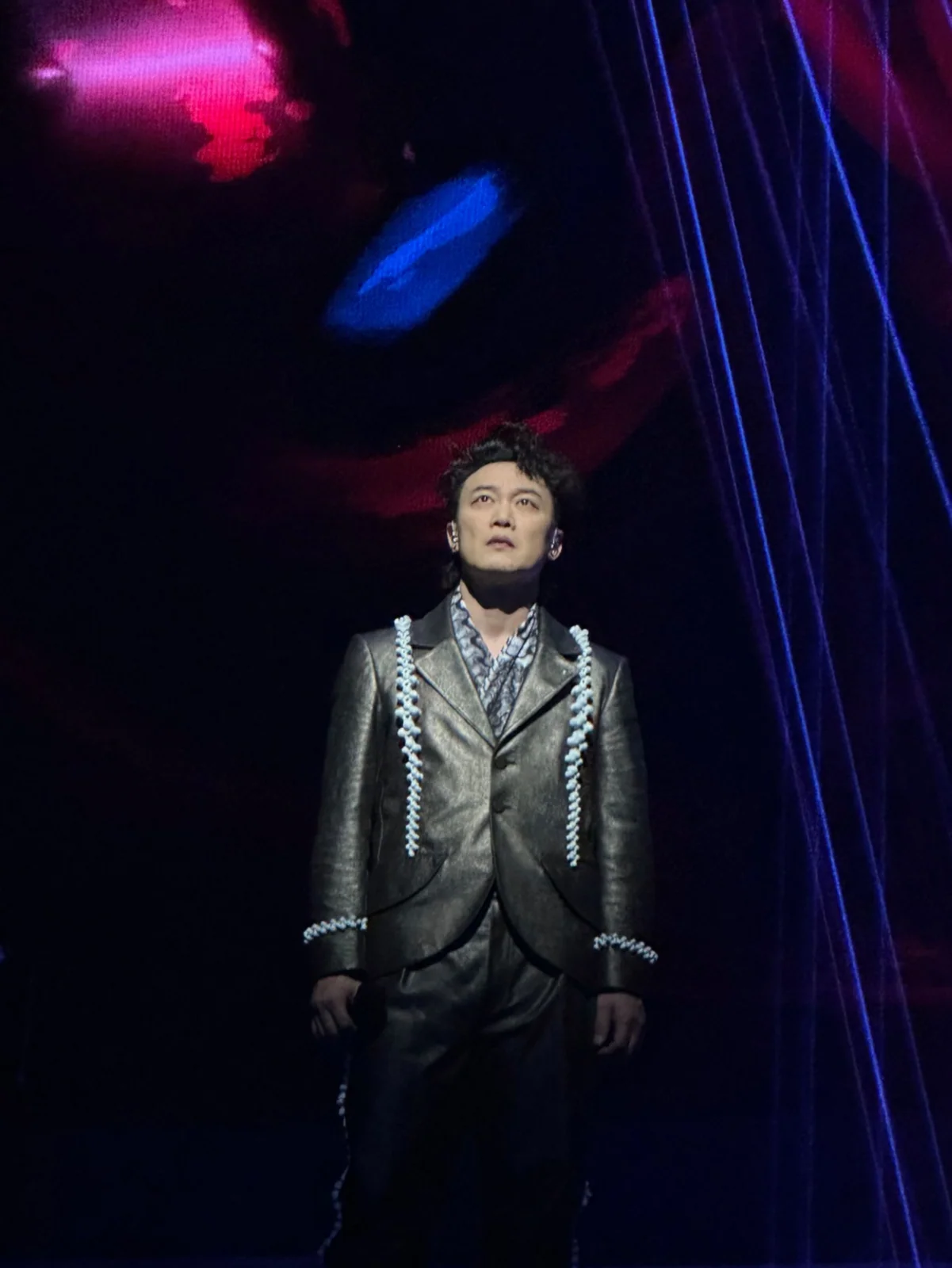
For Zhou Shen, spatial design can externalize what the voice already does. A single clear line appears small against a vast structure, then fills it without becoming coarse. The contrast between body and architecture makes vulnerability visible. When the stage moves from cosmic distance to playful machinery, it also gives humor a physical home.

The open-access photograph documents Zhou Shen inside a large concert architecture. It cannot prove vocal quality or audience consensus, but it makes the scale relationship in this paragraph visible.
I did not place the downloaded infographic into this page. It contains heavy explanatory text and a platform mark; cropping it would weaken both evidence and image. The research still changes the argument. First-hand material can inform criticism without being forced into the layout. Visual abundance is not the same as visual intelligence.
The existing hero portrait performs a different job. It returns scale to the person: hand, microphone, face, breath. The page then lets artwork and language open the surrounding worlds. Four distinct visual roles are stronger than six decorative pictures.
Act five: Shenself asks who speaks when no character is waiting
The 2024 album Shenself (《反深代词》) is the crucial turn in this profile. A singer recognized through other people's films, games and dramas needs a project where sequencing, repertoire and visual language describe him rather than a fictional character.

The official album catalog establishes the record and its track list. It cannot tell us whether the project wins the struggle for authorship. My reading is that the title itself recognizes the problem: too many pronouns, projections and ready-made descriptions have been attached to Zhou Shen. The album tries to turn the instrument inward.
That does not mean every experiment lands equally. When production is fascinated by the pristine tone, it can rebuild the same glass display case with more fashionable materials. The strongest moments give the voice friction—rhythmic pressure, an unexpected texture, a lyric that does not arrive already wrapped in nobility.
This is the real limitation in Zhou Shen's career. He is so useful to the Chinese soundtrack machine that usefulness can become confinement. A production needs instant emotional altitude; his voice supplies it. The commission succeeds, the scene gains feeling, and the artist's own questions wait outside. Shenself matters because it refuses to let usefulness be the final identity.
I want his next chapter to risk a little ugliness. Not careless singing, but texture that resists being placed behind a tragic montage. If every surface remains immaculate, the industry wins: it receives an endlessly reusable emotion machine. Zhou Shen is better than that function, and listeners should demand the person even when the familiar miracle would be easier.
His current Apple Music catalog also keeps this page in the present tense. New releases are not automatically progress. They are new evidence for the same test: is the familiar miracle being repeated, or has the emotional vocabulary expanded?
A Zhou Shen listening route in five acts
Do not shuffle a “top songs” playlist and hope the person emerges. Follow the argument:
| Act | Hear or watch | Listen for |
|---|---|---|
| Surprise | Big Fish | the quiet entrance and the point where one body becomes landscape |
| Restraint | Rubia | strength created by steadiness rather than force |
| Resistance | a stripped live ballad | how the voice escapes “ethereal” when no cinematic arrangement protects it |
| Play | Dalabengba | character, attack, timing and the exact moment beauty stops being the subject |
| Authorship | Shenself | whether production gives him friction or merely a more elaborate display case |
Then compare his collaboration with JJ Lin. JJ's melodic engineering and Zhou's timbral clarity reveal different kinds of control. A duet is useful when each voice exposes assumptions inside the other, not when two fan bases are simply placed in the same frame.
My conclusion is simple and not neutral: Zhou Shen's voice is extraordinary, but the extraordinary sound is the least complete fact about him. His artistry begins when surprise gives way to decision—when purity becomes resolve, a floating line grows comic elbows, and a soundtrack instrument claims the right to narrate itself.
Return to the Chinese musicians collection or widen the listening field through Chinese music. In the comments, do not write only “beautiful” or “powerful.” Bring one performance and name its decisive act: restraint, character, humor, rupture or release. We will place it on a community-built five-act map and return to see which performances remain convincing after the impossible voice is no longer a surprise.