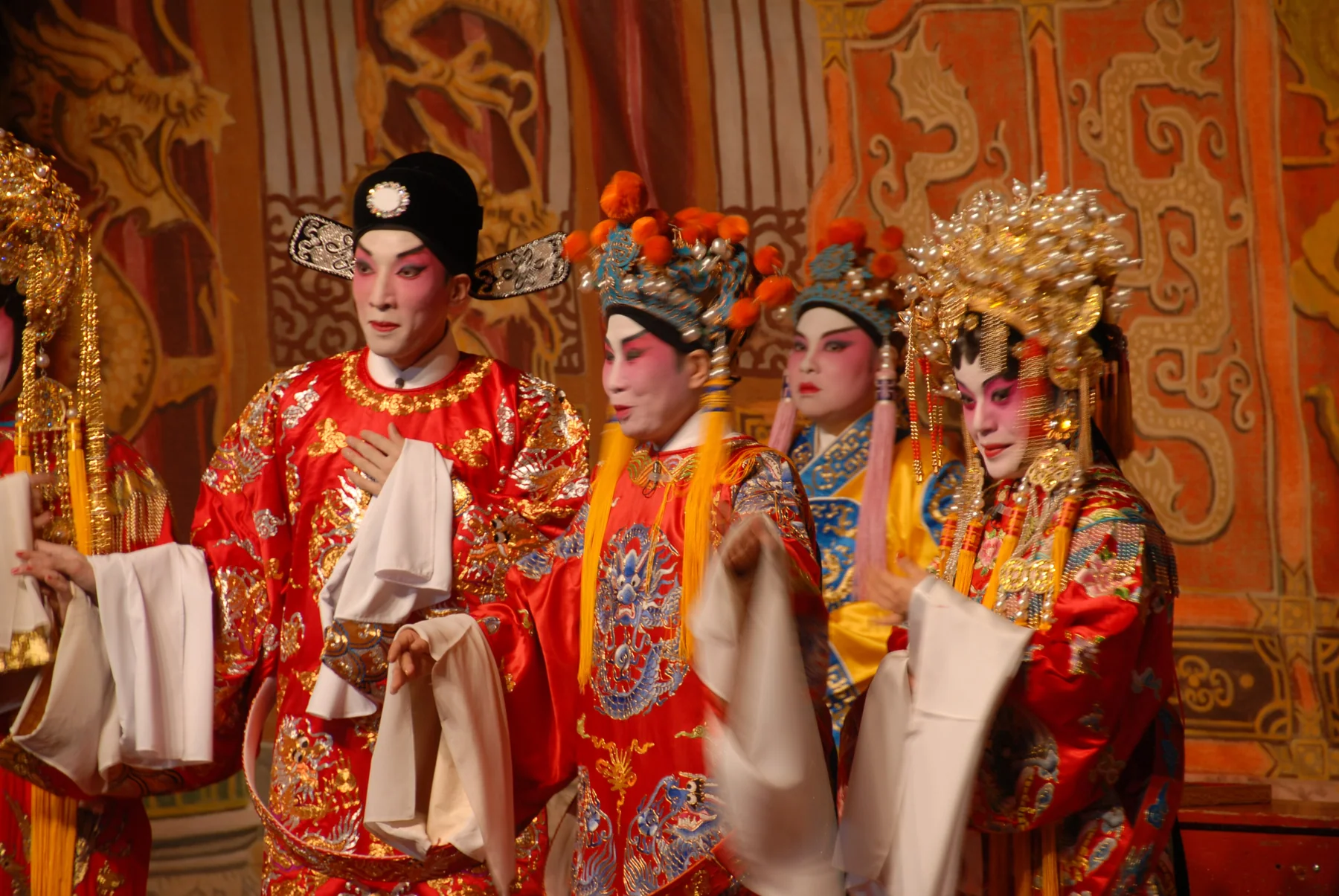
Peking Opera becomes much easier the moment you stop treating it as a code-breaking exam. Do not begin by memorising face colours. Watch one performer wait, look, step and turn. The body tells you who controls the room before the surtitles explain why.
My blunt view is that most beginner guides start at the wrong end. They hand you four role names and a colour chart, then wonder why the theatre still feels sealed. Jingju is a performed language. A dictionary helps only after you have heard a sentence.
Peking Opera begins with a body changing an empty stage
Peking Opera, also called Beijing Opera or jingju (京剧), combines singing, stylised speech, movement, combat, percussion, costume and role specialisation. Scenery is usually restrained. The actor carries the missing architecture.
A hand reaches forward, touches nothing and opens a door. A whip establishes a horse. Several turns compress a journey. Four performers can create a battle whose geography exists entirely through rhythm and direction. None of this is a cheap substitute for realism. It is a different bargain with the audience: give me your attention, and I will give an empty floor distance, weather, rank and danger.
| If you notice this | Read it first as | Then ask |
|---|---|---|
| A measured entrance | Status and control of space | Who is allowed to move quickly? |
| A sleeve released and recovered | Emotion extended beyond the hand | Does it hide, reject, invite or grieve? |
| A percussion burst | A change in dramatic pressure | What did the actor do exactly on the beat? |
| A whip, paddle or weapon | Both object and movement score | What place has the prop created? |
| Sudden stillness | A held decision | Who is watching whom? |
This is the fastest route into the form. It also explains why a poor clip can mislead. Cut away from the full body, mute the percussion or crop the empty space and much of the sentence disappears.
I insist that the first clip must keep the performer's feet and the percussion audible. Without them, a beginner receives face paint and costume while the grammar that makes both live has already been edited away.
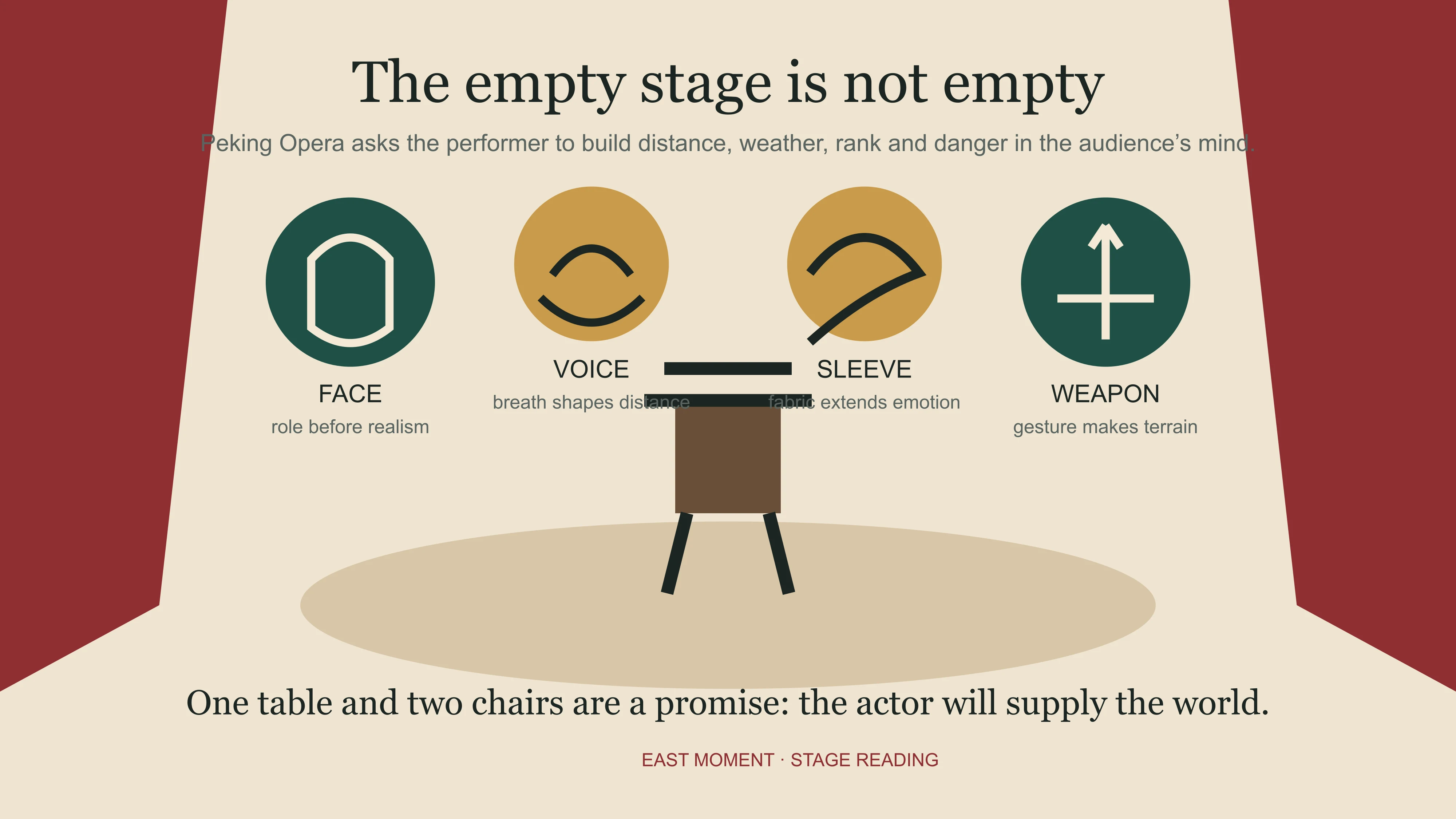
The empty floor is active. It gives every step a measurable cost and lets a small prop redraw the entire scene.
Sheng, dan, jing and chou are working systems, not personality labels
The familiar four role families help a beginner organise what they see. They do not tell the complete story.
| Role family | Broad field | Listen and look for |
|---|---|---|
| Sheng (生) | Male roles, including young scholars, older officials and martial figures | Vocal register, beard work, gait, age and rank |
| Dan (旦) | Female roles with distinct age, status and martial specialisations | Gaze, sleeve line, footwork, vocal placement and restraint |
| Jing (净) | Painted-face roles with enlarged physical and vocal presence | Pattern, stance, projection and how force occupies space |
| Chou (丑) | Comic roles, often marked by a white patch around the nose | Timing, speech, social intelligence and licence to puncture dignity |
The mistake is turning these into four horoscope signs: sheng equals noble, dan equals graceful, jing equals fierce, chou equals funny. Each family contains subdivisions, techniques and contradictory characters. Role type establishes the instrument; the actor still has to play a person.
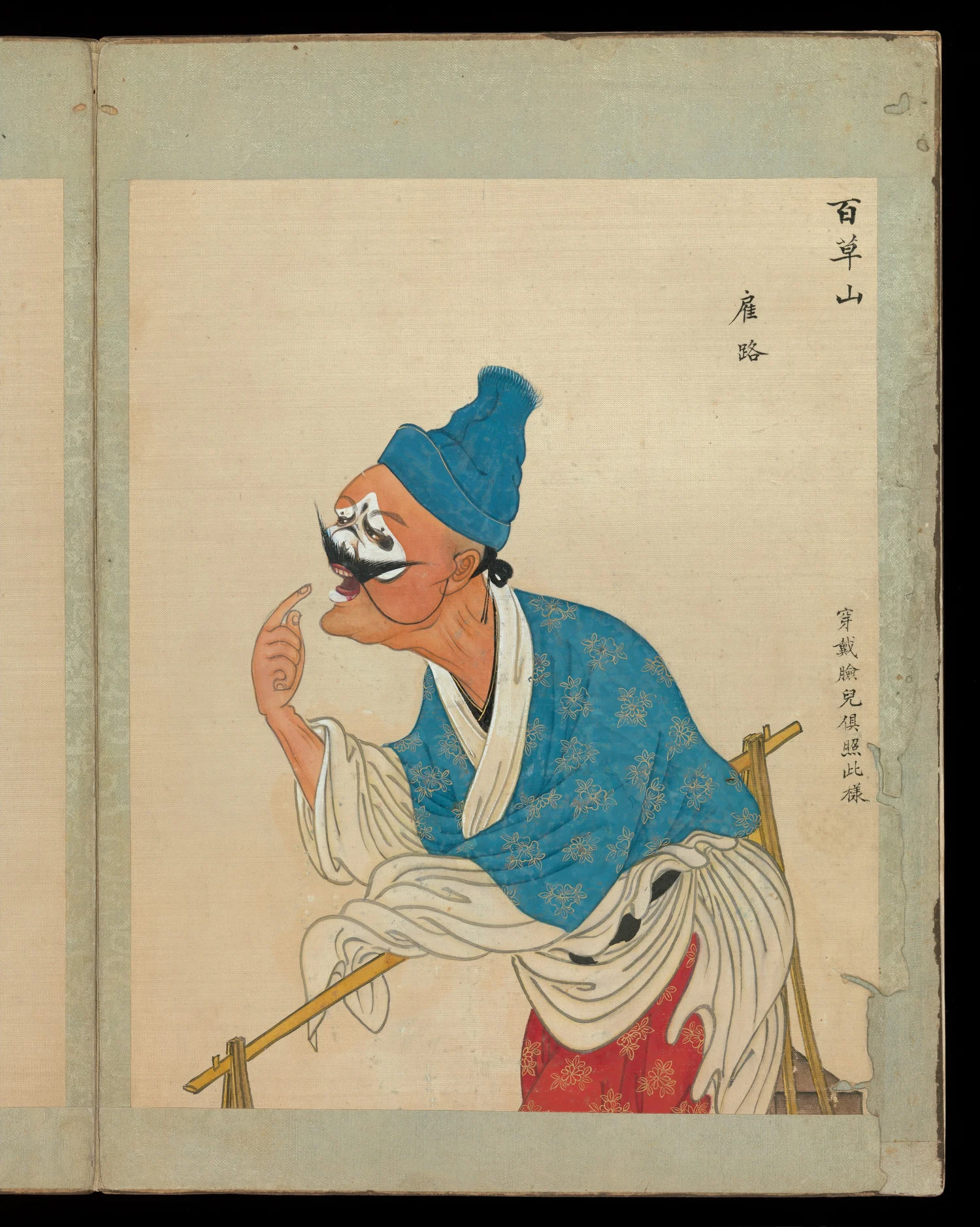
This late nineteenth- or early twentieth-century album did not preserve one generic “opera look.” It recorded one hundred named characters from nine plays, evidence that role vocabulary always became specific through character and story.
The Metropolitan Museum of Art describes its album of one hundred Peking Opera characters as a record of the variety of late Qing stage culture. Look at the bent torso, lifted finger and painted eyes here. Costume identifies a field of possibility. The pose supplies the immediate thought.
Peking Opera masks are usually makeup, and colour is never enough
“Peking Opera masks” is a useful search phrase and a dangerous reading habit. Many of the famous faces are lianpu (脸谱), designs painted directly onto the performer rather than removable masks. Colour, line, asymmetry and exaggeration can suggest temperament, loyalty, cunning, violence or supernatural status. Context decides how those signals work.
Red is often associated with loyalty and upright force; black can suggest firmness or an uncompromising character; white frequently appears in crafty or treacherous roles. Stop there and the actor becomes a traffic sign. A face design cannot tell you the whole moral position, and online colour charts routinely pretend the tradition is more fixed than performance allows.
Watch what the painted face does. Does the head snap toward an opponent while the torso stays still? Do the eyes travel before the feet? Does the actor make a broad pattern feel comic, frightening or wounded? Makeup enlarges expression so it can cross the auditorium. It succeeds through motion.
The orchestra does not accompany the action; it tightens the action
The first collision for many listeners is sonic. Jingju singing does not imitate casual conversation, and the percussion can feel brutally exposed. That exposure is useful. The jinghu, a high-pitched bowed instrument, follows and pressures the vocal line. Gongs, drums and clappers mark entrances, turns, combat, surprise and shifts in dramatic temperature.
Try a simple experiment. During a short scene, ignore the subtitles for thirty seconds and follow the drum. Notice how a glance lands, how a foot stops and how the room seems to contract after a strike. The orchestra has made time visible.
This is where “slow” becomes a lazy complaint. Some scenes do move slowly, and a beginner can absolutely feel impatient. Yet slowness is often where control becomes legible: breath held across a phrase, a sleeve gathered without losing the line, one step delayed until the emotional decision catches up. Fast plot is not the only form of dramatic pressure.
A Peking Opera costume is wearable architecture
The stage gives you little furniture, so clothing must carry rank, occupation, movement and silhouette. Embroidery can remain readable from a distance. Sleeves extend the arm. Headwear changes height. A beard changes the rhythm of a turn. Armour makes the body wider and converts every entrance into a public claim.
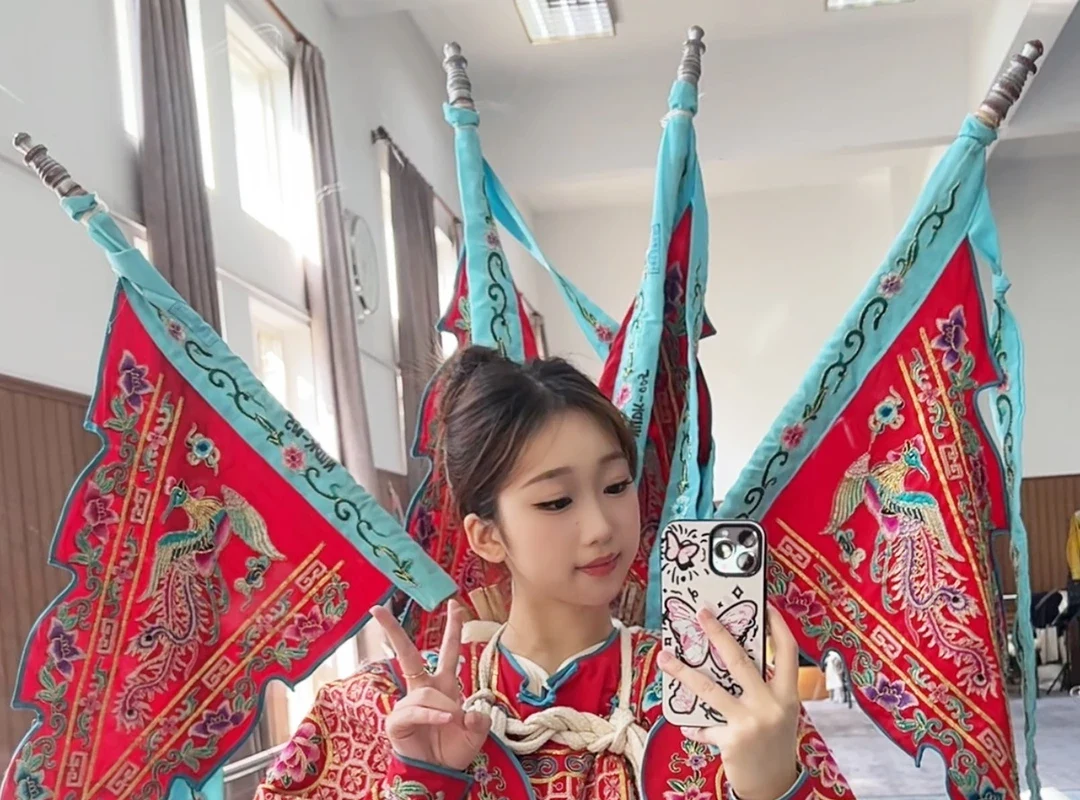
The backstage view kills the fantasy that a martial silhouette simply appears. The kao is tied, balanced and learned on an ordinary rehearsal-room floor before it commands a stage.
The four triangular flags rising behind this martial costume are called kaoqi (靠旗). They do not prove that the character literally carried flags into battle. They enlarge the military body and make speed, command and formation visible. A performer has to turn, lower the centre of gravity and handle weapons without letting the structure collapse into clutter. That is training, not ornament.
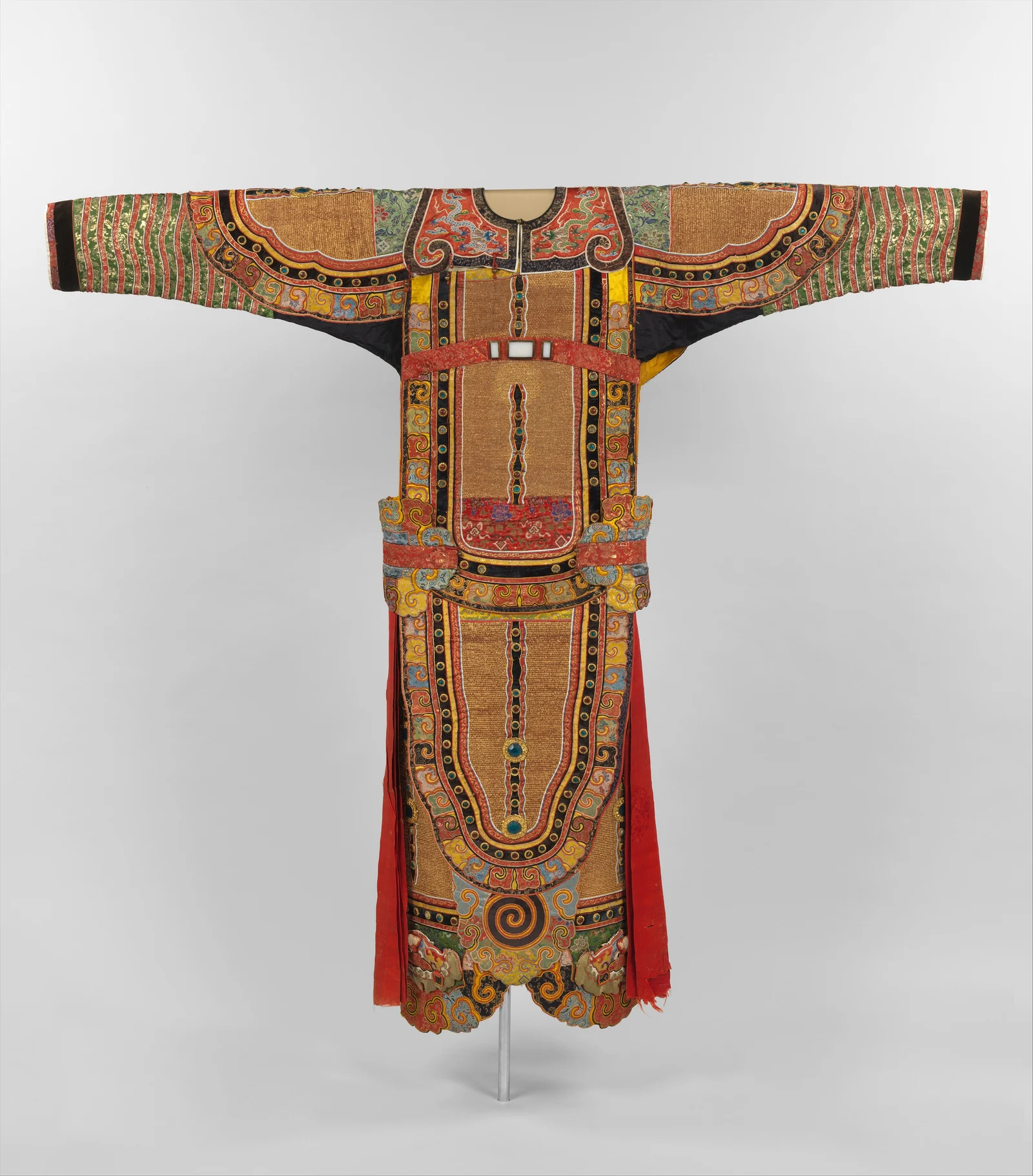
Displayed without an actor, the costume reveals its engineering. Broad horizontal sleeves and long vertical panels wait for movement to convert textile into rank.
The Met dates this warrior theatrical costume to the eighteenth century. It predates the mature form usually called Peking Opera, so it should not be sold as a frozen modern uniform. Its value here is more precise: court and theatrical costume traditions supplied material vocabularies that later stage practice could inherit, revise and animate.
Water sleeves, weapons and walking are verbs
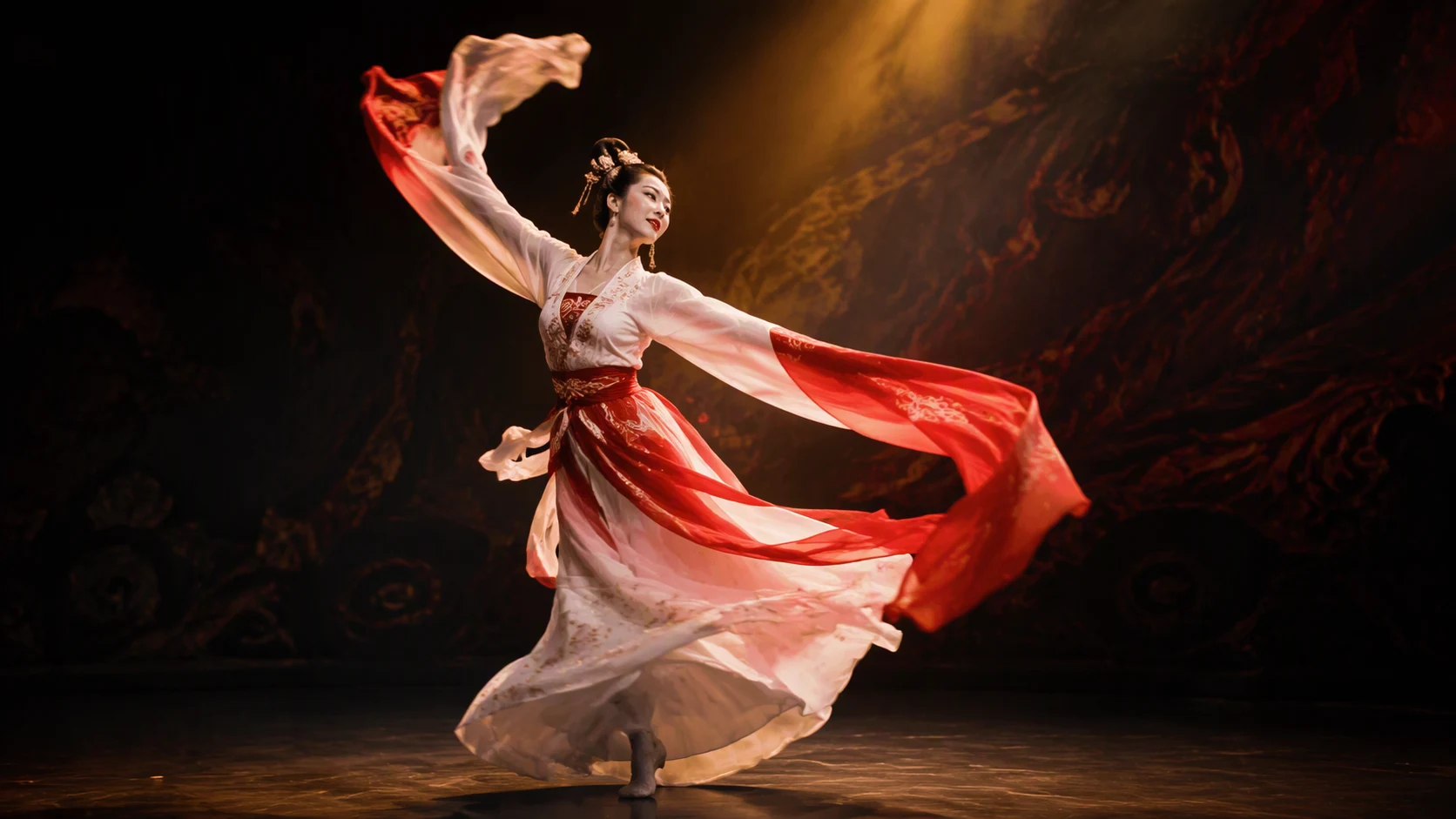
A water sleeve is a length of white silk attached to the cuff. In weak tourist imagery it floats prettily. Onstage it can conceal, dismiss, accuse, gather emotion or make grief take longer to arrive. The cloth matters because the performer controls when it leaves the hand and how it returns.
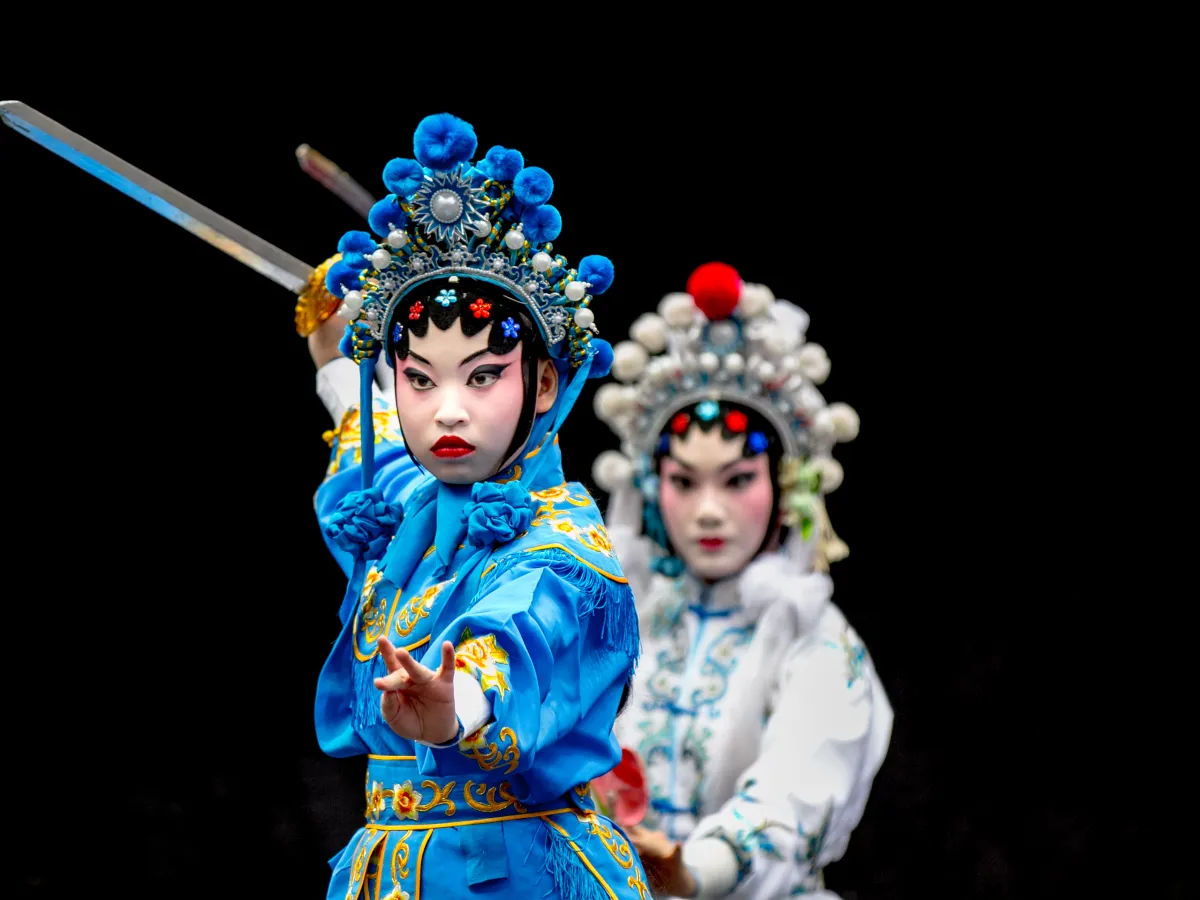
Weapons work the same way. A spear is an object, a line through the composition and a partner in rhythm. Combat depends on distance, eye line and repeated patterns, not only athletic difficulty. When a weapon spins perfectly but the relationship between characters disappears, the technique has become a circus excerpt. Impressive, yes. Dramatically empty, also yes.
Walking may be the most underrated skill. Gender, age, class, fatigue and intention can all alter the step. The pleasure begins when you stop asking whether anyone walks that way in daily life and start asking what this walk makes unmistakable.
Beijing gave the form a capital, not a monopoly on Chinese opera
Peking Opera developed through multiple regional performance traditions and became established in Beijing during the Qing period. Its capital-city institutions, patronage, performers and later touring history helped make it internationally visible. That history explains the English name. It does not entitle jingju to stand in for every Chinese opera tradition.
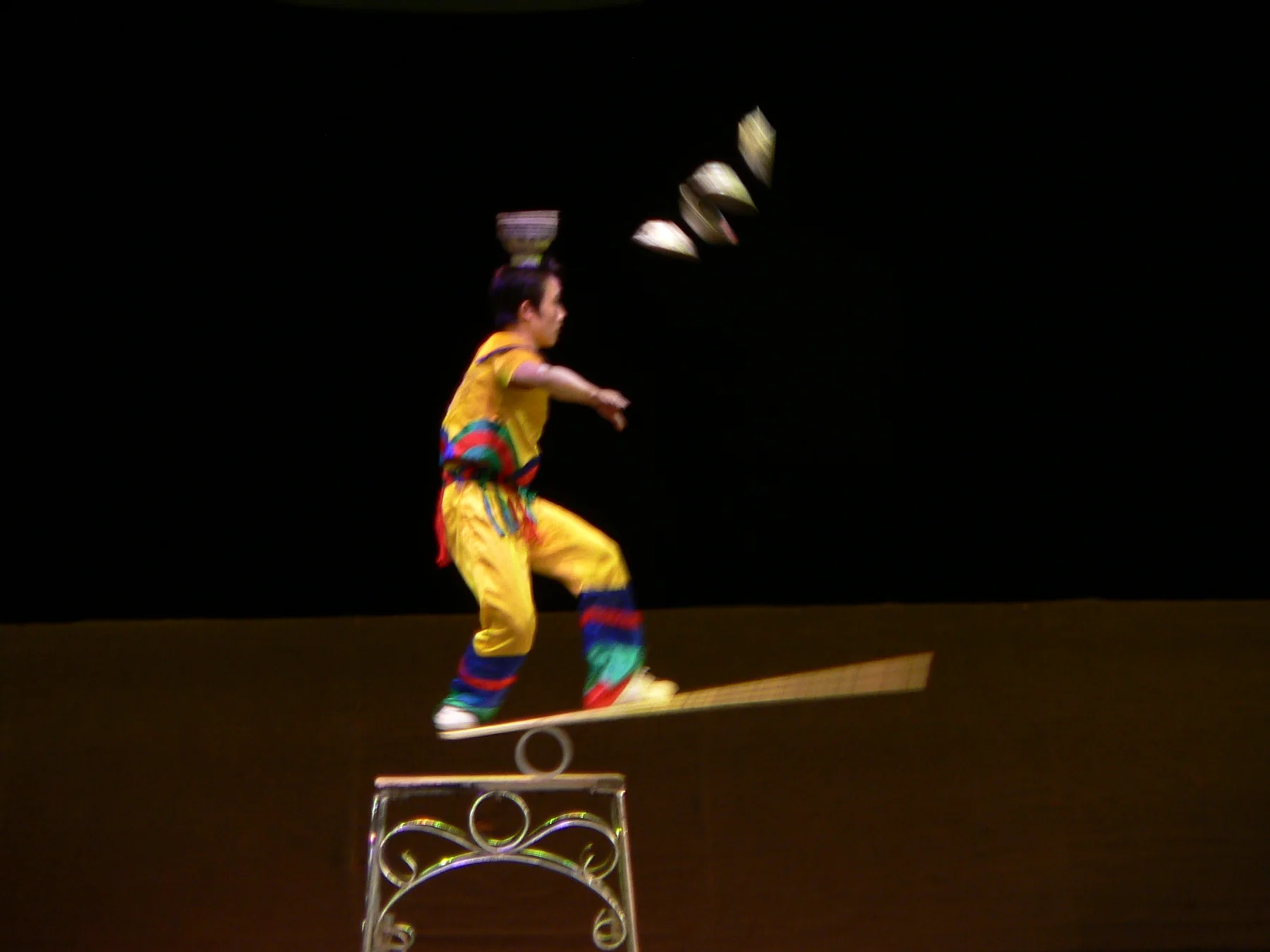
China contains many regional theatre forms with different languages, instruments, repertoires and performance priorities. Kunqu, Cantonese Opera and Sichuan Opera face-changing deserve their own ears and their own evidence. Beyond opera, Chinese shadow puppetry transfers intention into jointed figures, while Chinese acrobatics makes apparatus, receiving and recovery the drama. Calling all of these forms “Peking Opera” is as careless as calling every European stage tradition Shakespeare.
UNESCO's Peking Opera heritage record documents the form as intangible cultural heritage. The phrase matters most when “heritage” remains a living practice rather than a glass case. Training rooms, touring companies, online clips, young learners and arguments over performance quality are part of the form's present tense.
The Beijing culture guide places that practice beside the capital's other scales: imperial axis, hutong threshold and contemporary metropolis. The Forbidden City guide explains how architecture choreographs approach and rank. Jingju achieves a related effect with almost no architecture at all. One uses gates and courtyards; the other uses entrance, spacing and pause.
Choose your first Peking Opera by appetite, not duty
Do not begin with whichever full recording someone calls “the most important.” Choose the part of performance that already has a chance of holding you.
- You want story first: pick a plot you already recognise, perhaps a Three Kingdoms episode or a Journey to the West scene. Familiar relationships free your eyes to watch technique.
- You want voice first: begin with a famous aria and compare two performers. Differences in breath, ornament and emotional temperature become audible quickly.
- You want movement first: choose a compact martial excerpt where the full body and orchestra remain visible.
- You want character first: watch a chou scene. Comedy exposes timing and social observation without demanding reverence.
- You arrived through film: read Farewell My Concubine after learning the basic stage grammar, then keep the film's fictional training world separate from every real troupe and period.
Chinese discussions among new and experienced viewers return to one practical truth: interest usually starts with one hook, not a complete theory course. Some enter through a familiar story, some through a dan role, some through martial movement, and some through the shock of seeing facial emotion projected with almost ruthless clarity. That is not a lesser form of appreciation. It is the door.
Use subtitles. Read a short synopsis before a full play. Keep the camera wide enough to see feet. If a clip cuts every two seconds, find another recording. After one scene catches you, return to it with one question: what changed in the voice, body or percussion at the exact moment the relationship changed?
The souvenir face is the least interesting ending
Peking Opera is easy to package into a red mask, a costume photograph and the word “ancient.” That package photographs well and teaches almost nothing. The form survives in the transfer between bodies: a teacher adjusts a student's shoulder, a drummer meets a footfall, an actor makes an empty doorway appear and an audience learns when silence has become action.
My verdict is simple. You do not need to understand everything before you are allowed to enjoy jingju. You do need to give the performer more attention than the face paint. Start with one body in one scene. Watch until the empty floor becomes a place. Then continue through Chinese performing arts or bring that exact transformation to East Moment Moments, because the most useful beginner note is not “I finally understood Peking Opera.” It is the second when understanding began.