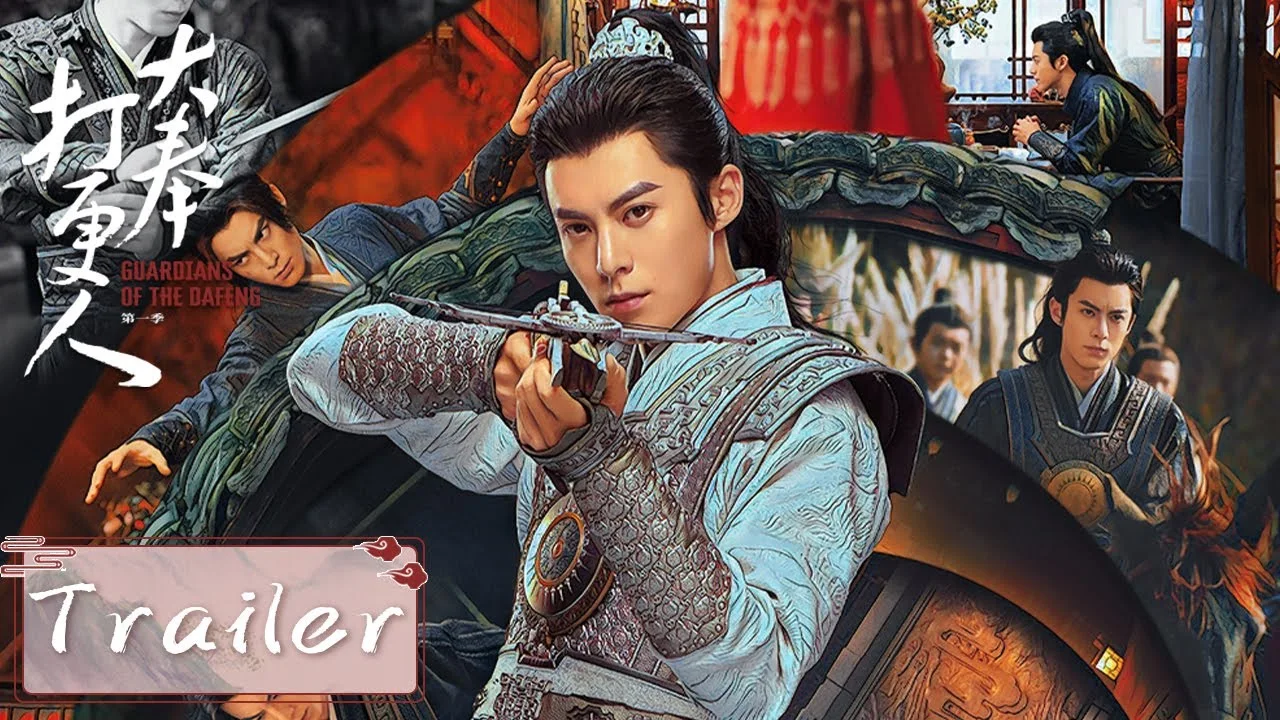
The best version of Guardians of the Dafeng is a detective comedy where Xu Qi'an's modern street intelligence lets the viewer laugh and solve the problem at the same time. The weak version is three shows fighting for the same hour: a gag reel, a cultivation manual and a heroic destiny epic. Watch it if the first mode wins you over. Do not expect all 40 episodes to keep that balance.
Is Guardians of the Dafeng worth watching for 40 episodes?
| Dossier item | Direct answer |
|---|---|
| What is it? | A 40-episode 2024-2025 costume fantasy adapted from the web novel by Mai Bao Xiao Lang Jun. |
| Main cast | Dylan Wang plays Xu Qi'an; Tian Xiwei plays Princess Lin'an. Liu Yijun's Wei Yuan is central to the night-watch institution and Xu's moral formation. |
| What is the setup? | A modern man enters the fictional Dafeng dynasty, survives a criminal accusation through deduction and joins a world of night watchmen, court power, cases and cultivation. |
| What does "Dafeng" mean? | It is the fictional dynasty, not a claim about one real historical regime. |
| What are the "guardians"? | The title refers to the dagengren, night-watch officials who investigate, police and serve power inside the fantasy world. |
| Is it mostly comedy? | Comedy dominates the entrance, but investigation, court politics, romance, cultivation and national crisis increasingly compete with it. |
| Is the ending complete? | Season 1 resolves a major northern-border injustice and makes Xu's opposition to imperial abuse explicit, while leaving identity, power and future conflicts open. |
| East Moment verdict | Try the opening tax-silver case and the truth/lie puzzle. Continue only if Dylan Wang's loose comic rhythm helps rather than irritates you. |
This is not a review that asks whether the drama is faithful in the abstract. A 40-episode adaptation cannot be identical to a long serial novel. The useful question is more demanding: after a change, does cause still lead to effect?
WeTV's official series listing confirms the 40-episode run and names Dylan Wang, Tian Xiwei and Liu Yijun in the central cast. It also describes Xu Qi'an as a police-academy graduate who wakes in prison before entering the guardians' institution. That official setup matters because the adaptation changes the kind of modern knowledge the hero brings into Dafeng; the page therefore judges whether the new background still pays for his later methods.
Every exhibit below returns to that test.
Yes, but I recommend a two-case trial before a forty-episode commitment. Watch the opening tax-silver case and the truth-and-lie box puzzle. If you enjoy the moment when a joke releases a deduction, continue. If Dylan Wang's elastic comic rhythm already feels like noise, later political seriousness will not transform the show into a sober detective drama.
That is my honest review in one sentence: Guardians of the Dafeng is worth watching when the case remains in charge. I like its modern street intelligence, its willingness to let a hero look foolish and the way Wei Yuan gives the institution memory. I dislike the scenes that treat a reaction shot as a substitute for evidence, or a cultivation reveal as a substitute for consequence. The series does not fail because it mixes genres; it fails when it forgets which genre should be carrying the scene.

This authorized promotional image is useful because it shows the newer search promise surrounding the title: blood, scale, fate and a possible continuation. It does not prove a release schedule or replace the Season 1 ending evidence below. I include it to explain why a viewer may arrive expecting a darker second phase, then feel a tonal whiplash when the early detective comedy is still the show's most distinctive pleasure.
Exhibit A: the tax-silver case gives the hero a reason to exist

Xu Qi'an begins under pressure. Deduction is not a decorative superpower; it is how he keeps himself and his family alive. That makes the opening case structurally clean. The viewer understands the evidence, the deadline and why this modern mind has value in Dafeng.
The sodium-related reasoning is theatrical rather than a classroom demonstration. What matters dramatically is the method: observe residue, challenge the official story, translate unfamiliar knowledge into a conclusion people in the room can use.
The ancient-world sodium reaction is a small but revealing pleasure. The modern reference does not stop the story; it solves something.
This is the show's ideal rhythm:
- a concrete problem creates danger;
- Xu notices the overlooked relation;
- contemporary language releases tension;
- the solution changes his position inside the institution.
When all four steps remain connected, comedy feels intelligent.
Exhibit B: the box puzzle turns comments into a second viewing room
Tencent Video later framed a truth-and-lie box puzzle with the line: "Some people have not understood the question; others have already answered in the top grade."
The comments are better evidence of engagement than a star rating. One viewer admitted the question still made no sense. Another explained that asking either truth-teller or liar to imitate the other's answer produces a false answer in both cases. Others corrected the wording and debated whether the question itself was rigorous.
That is community behavior the series earns: people do not only praise Xu for being clever. They reconstruct the reasoning together.

This is also why a case can survive imperfect logic. If the steps are visible enough for viewers to test, the scene remains alive after the episode. A magical answer that arrives only because cultivation rank demands it cannot create the same participation.
Suspect one: Dylan Wang's looseness
Dylan Wang does not play Xu Qi'an like a solemn genius. The body bends, the face reacts quickly and swagger is frequently allowed to become foolish. That is a meaningful contrast with Dongfang Qingcang in Love Between Fairy and Devil, where controlled stillness is the instrument.
Here, looseness is the instrument.
It is also the most polarizing part of the show. I can see detailed performance choices and still think the novel already had enough humor before the adaptation added forced clowning.
Votes cannot decide acting quality. The split identifies the performance's wager: Xu's modernity will be communicated through rhythm before it is explained through biography.
My judgment is that Dylan works when the joke is tactical. A quick grin can disarm an official, expose rank anxiety or buy time. He becomes tiring when reaction itself is treated as content and the world pauses to admire how funny the hero is.
For the fuller person beyond this role, use our Dylan Wang guide. It connects this comic body to basketball, music, Meteor Garden and fantasy authority rather than reducing him to one rating dispute.
Suspect two: too many genres claiming leadership

Investigation asks the audience to remember evidence. Comedy asks it to enjoy the interruption. Cultivation asks it to learn rules and ranks. Court drama asks it to track power. Romance asks it to stay inside a look. Any two can strengthen each other. All five require hierarchy.
The series often supplies sequence instead: joke, clue, magical explanation, romantic beat, official speech. Energy remains high while consequence becomes difficult to feel.
Comedy should be an element inside tension and heat, not the complete governing style. That is not a rule for every story. It is the correct diagnosis here because the series keeps asking cases to carry moral and political weight after training us to expect release.
Wei Yuan helps restore hierarchy. The character gives the night-watch institution history, discipline and a reason to matter beyond Xu's career advancement. When loyalty to colleagues collides with obedience to court, the fantasy office becomes a moral space rather than a costume workplace.
The night watch must feel like a workplace before it can feel heroic
This is the part generic plot summaries miss. The guardians are not interesting because uniforms look sharp or because ranks give the wiki more entries. They matter when Xu has to depend on people whose habits, loyalties and limits he did not design.
An institution becomes visible through friction: who signs off on a conclusion, who can enter a room, whose mistake stains the whole team, and whether an order remains legitimate after the evidence changes. Xu's modern nerve is valuable only if it meets those constraints. If every superior recognizes his brilliance immediately, the night watch is a fan club in official clothing. If colleagues can correct him, refuse him or carry consequences he cannot joke away, the office acquires weight.
Wei Yuan is decisive because he makes power quiet. He does not need Xu's speed. His pauses remind the viewer that an organization stores memory longer than one brilliant recruit. Liu Yijun's performance gives the fantasy a vertical axis: the hero can move fast, but he still operates beneath someone who knows what earlier compromises cost.
That is also where Wang Hedi's looseness becomes more than personality. Xu bends the room because he is willing to speak in a register that rank does not expect. The joke is a tactic of mobility. Yet mobility without discipline soon becomes privilege. I enjoy him most when a grin buys ten seconds and those ten seconds produce evidence. I lose patience when the grin itself is treated as proof that the scene remains alive.
The women reveal the same structural problem from another angle. Being funny beside the hero is not the same as owning a decision. A useful ensemble member changes what the case can become: she sees evidence he cannot, withholds cooperation for a reason, or forces his moral certainty to survive disagreement. When a character exists only to confirm his charm, the adaptation has preserved a name and discarded a function.
So my demand is blunt: the night watch must be a place where Xu can be wrong. Without that possibility, deduction becomes applause and loyalty becomes decoration.
Missing link: why novel readers are not only complaining about cuts
The adaptation does not produce passive agreement; it opens a real dispute.
The reordered Yunzhou case, cultivation progression, removed characters and northern-border material expose the adaptation's real tradeoff. A complete literal adaptation would require too many seasons, and some material could not be staged economically. Even so, my concise criticism is that the script is careful about small lines but careless about the large structure.
That is the strongest objection.
Fidelity is not the number of original lines retained. It is whether a character still possesses the cause that makes a later ability, loyalty or sacrifice intelligible. If Xu's modern occupation changes, his investigative skill needs a new root. If a case moves, cultivation and relationships formed through that case must still arrive by another route.
The argument should therefore be mapped as a chain:
background -> method -> case -> institutional trust -> power -> consequence
A cut is successful when the chain remains. A "faithful" quotation can still fail if it hangs from nothing.
This is why I take the adaptation dispute seriously without treating novel readers as owners of the only valid version. Television must compress. It may reorder a case, combine a person or replace an internal explanation with visible action. What it cannot do is keep the reward after removing the labor that made the reward intelligible.
The practical community test is simple: choose one altered case and reconstruct the chain without using “the novel explains it” as a repair. If the televised background still produces the method, trust and later power, the change works. If viewers must import a missing cause from the book, the series has not adapted the relation; it has retained the destination.
Write the chain as six short lines—initial danger, first clue, wrong assumption, comic interruption, corrected inference and institutional consequence. If one line can be removed without changing the result, that is where the episode used speed to hide a missing cause. Bring that reconstruction to East Moment; another viewer can challenge the weak link without turning the discussion into a popularity vote.
Princess Lin'an is warmth, but warmth is not narrative ownership

Tian Xiwei gives Lin'an comic brightness and direct feeling, but the series does not consistently let her alter the investigative engine. That distinction matters. A heroine can be beloved, visible and still remain structurally downstream from the hero's discoveries.
Late political pressure gives Lin'an more than romantic reaction because family loyalty and imperial injustice pull in opposite directions. These are the scenes where warmth acquires cost.
The dedicated Tian Xiwei profile places this limitation beside roles with stronger ownership. It is a better next step than pretending a cast list can explain what the adaptation gives her to do.
Guardians of the Dafeng ending: the verdict is not the end of the case
Major spoilers begin here.
The final movement brings the northern-border massacre and abuse of imperial power into open conflict. Xu Qi'an's position hardens from clever institutional survivor into a man willing to oppose authority when law is used to bury the people it should protect. The night watchmen's solidarity matters because their uniforms stop being proof of obedience and become a choice about whom the institution serves.

Season 1 resolves a major injustice enough to create moral arrival. It does not complete the whole novel architecture. Questions of identity, cultivation power, state conflict and future relationships remain open.
So the answer is neither "cliffhanger with no payoff" nor "complete ending." It is a season verdict inside a much larger case file.
Do not interpret promotional discussion as a confirmed Season 2 schedule. Official platform announcements, not social speculation, should establish future production and release.
Final ruling: test two cases before committing to forty episodes
You should watch Guardians of the Dafeng if:
- you like heroes who solve problems with social nerve as well as knowledge;
- you enjoy contemporary humor inside costume fantasy;
- a busy mix of investigation, cultivation and court politics energizes you;
- Dylan Wang looking briefly foolish is a feature, not a failure.
You should stop if the opening comedy already feels forced. The series becomes more politically serious, but it never abandons the elastic performance language that creates that first reaction.
The tax-silver case tests whether you accept Xu's modern method. The box puzzle tests whether you enjoy thinking with the show. If both work, continue. If neither does, forty episodes will not reverse the governing rhythm.
Browse the Chinese television collection for dramas organized by what they do, not only what they resemble. In the comments, bring one case where comedy clarifies the solution - or one where a joke snaps the causal chain. Then open a shared case file in the East Moment community with exact scenes, novel references and corrections other viewers can verify.