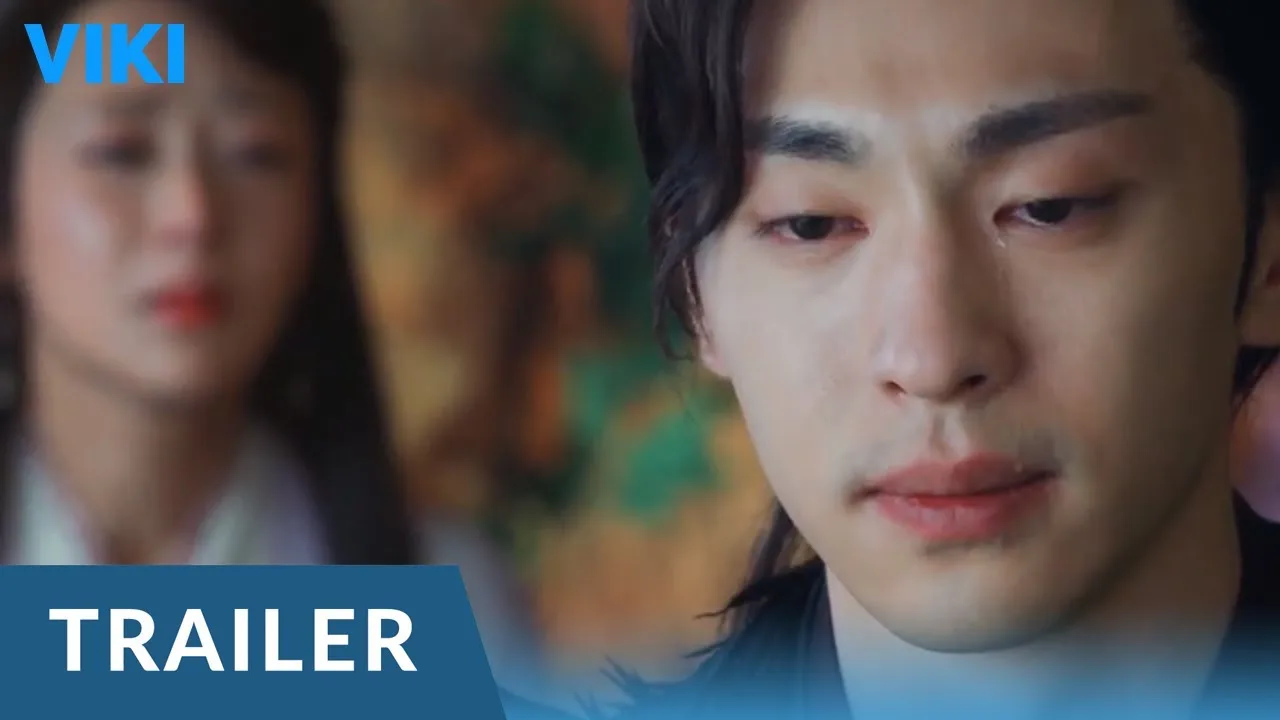
The Prisoner of Beauty is worth watching when you stop staring at the couple and notice everyone standing outside their door. Its forced marriage is not private enough to be a romance at first. Family, military duty, inherited hatred and the household's reproductive expectations are already in the room.
The Prisoner of Beauty begins outside the bedroom door
WeTV's official English trailer establishes the political marriage and central pair. My reading deliberately moves attention outward, toward the relatives, soldiers and household expectations already occupying the relationship.
The Prisoner of Beauty (折腰) is a Chinese costume drama led by Song Zuer and Liu Yuning. The premise joins people from opposing sides through marriage. That sounds like familiar enemies-to-lovers machinery, but the most revealing audience response did not focus on a kiss or confession. It focused on the crowd.
Wei Shao waits until dark while Xiao Qiao is made to read an instructional book. The arrangement frightens me because a whole group of people seems to be watching the couple's sex life. The joke is that leaving work twenty minutes early might have been enough to complete the expected wedding-night duty, but the pressure underneath it is real.
The joke is funny because the pressure is not. Viewers recognised a marriage in which even the timing of intimacy belongs partly to the household.
The outer courtyard: two families have already written the script

The official WeTV trailer confirms the enmity-marriage premise and its leads. It cannot tell us whether the relationship becomes equal, but it shows why the word "forced" matters: the couple arrives carrying obligations that existed before they knew one another.
I do not read this as a lesson about what all historical Chinese marriages were like. The series is contemporary fiction using a historical-looking world. Its useful cultural question is narrower: what happens to intimacy when family survival makes a marriage publicly accountable?
Outside the private room, every gesture can be interpreted as political information. Courtesy may reassure one side and alarm the other. Protecting a spouse may look like betraying a clan. A delayed visit can become household news. Under those conditions, romance cannot begin with attraction alone. It begins when two people decide what information will no longer be available to everyone else.
The family hall: a bride is also being evaluated

This public-alliance image is evidence of staging, not equality. Look at how often the drama makes the couple appear before other people. A marriage ceremony may join them, but it also installs them inside a hierarchy of elders, retainers and political expectations.
This is where styling criticism becomes more than superficial. Some viewers disliked early visual choices, including hairline and costume presentation. That disagreement matters because costume drama uses appearance to tell us who has settled into authority and who still looks arranged by someone else. I would not treat every disliked wig as failed characterization, but I would ask whether the visual discomfort belongs to Xiao Qiao, to the household's attempt to position her, or simply to production design that distracts from the scene.
The audience should be allowed to say, "This looks wrong," without being told that every awkward image is secretly profound.
The corridor: information travels faster than trust
Enemies-to-lovers summaries usually track emotional temperature: hostile, curious, attracted, loyal. I find information more revealing. Who learns about a threat first? Who is expected to report to family? Who can withhold knowledge without being called disloyal? Who is allowed to close a door?
Song Zuer's performance matters when Xiao Qiao uses politeness as active management rather than passive sweetness. Liu Yuning's matters when Wei Shao's authority stops being a pose and acquires a cost. If he can command everyone except his own suspicion, the role remains static. If he changes who receives protection or truth, authority has been forced to negotiate.
The corridor between public and private space is therefore the drama's real romantic territory. Each secret carried past one door and not another redraws the marriage.
Inside the room: privacy has to be invented

This is the most important visual in the article because it changes the scale. The couple is no longer only an emblem of two sides. They occupy a domestic space that could become private, but privacy is not guaranteed merely because the door is closed.
What unsettles me is that everyone seems to be watching. A room is private only when the people inside can decide what the outside world is entitled to know. If the household controls the timetable, the purpose and the expected outcome of intimacy, the architecture is private but the relationship is not.
My measure of the romance is therefore not the first soft look. It is the first moment when either person protects the other's right not to perform the marriage for an audience.
What the ending needs to earn
Readers searching for The Prisoner of Beauty ending usually want to know whether the couple stays together and what happens politically. Detailed ending claims remain outside this draft until complete episode review. But the thematic requirement is clear.
A satisfying ending must show that the marriage has acquired a boundary. The couple does not need to escape family or duty completely. They do need the power to decide which demands enter their room and which remain outside. Without that change, affection merely decorates the alliance.
My verdict: the most romantic act is closing the door
Watch The Prisoner of Beauty if you want a costume romance in which space, witnesses and information matter as much as chemistry. Skip it if you want politics to disappear once attraction begins.
For a wider route through the performers, use the Chinese actors collection. For other costume and relationship dramas, continue through the Chinese television guide rather than treating this series as evidence for an entire historical period.
The wedding-night scene becomes a communal joke, but the laughter identifies the drama's deepest anxiety: how can two people become a couple when everyone else believes the marriage belongs to them? For me, the romance succeeds whenever Xiao Qiao and Wei Shao create one decision that the household cannot make on their behalf.
In the comments, identify the first scene where the marriage becomes private rather than merely affectionate. Then join the East Moment community to compare which doors, witnesses and family demands shaped your reading. Continue with Love's Ambition for a modern relationship built under a different kind of public gaze.
The Prisoner of Beauty begins with a marriage that is not private
The central marriage joins hostile political interests. That means attraction cannot be evaluated outside information, family obligation and the threat of violence. A beautiful domestic frame may contain a negotiation in which neither person can safely reveal everything.
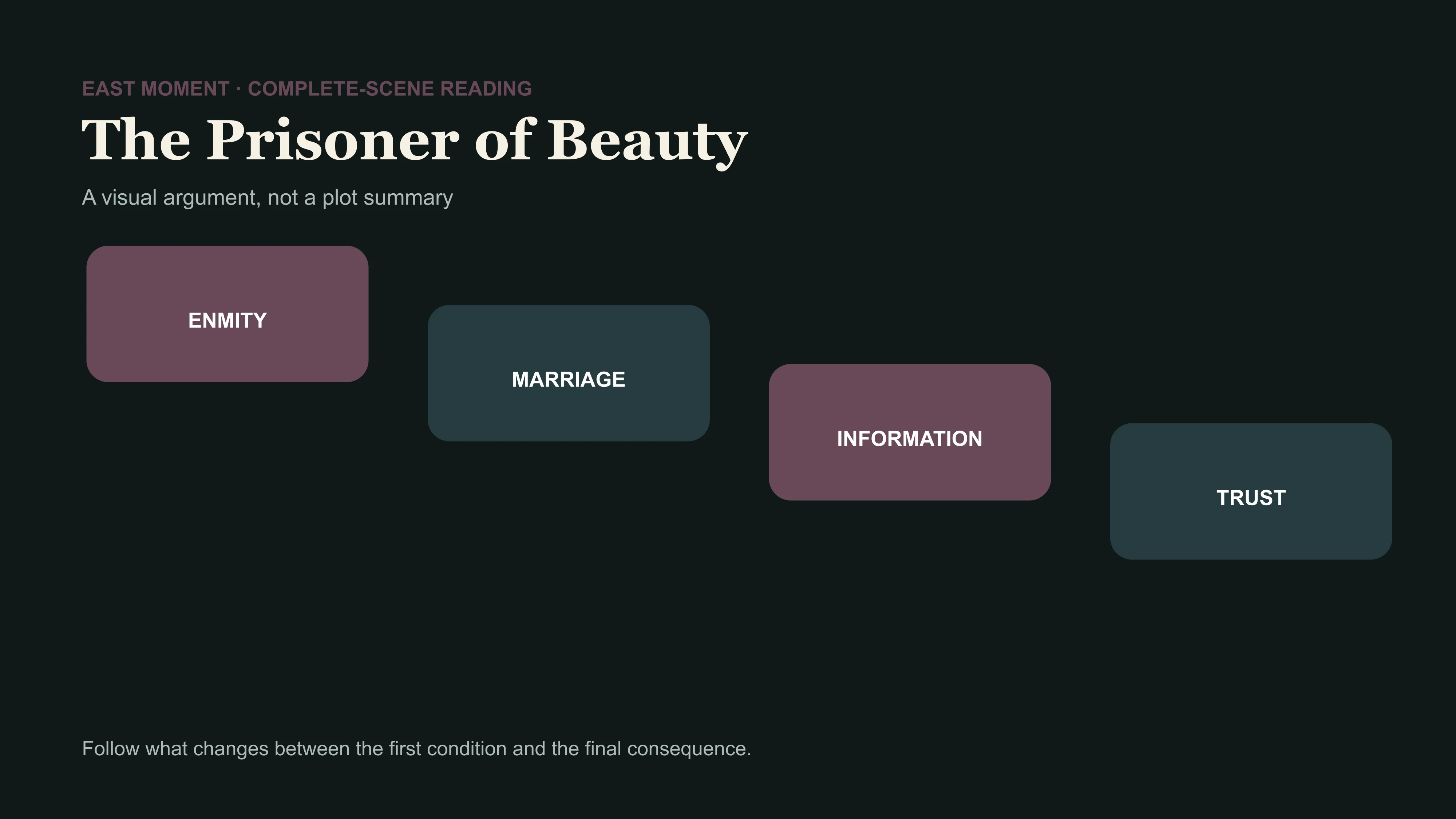
Xiao Qiao's intelligence must be measured by what she preserves and changes under those conditions. Courtesy can be strategy. Domestic competence can be political work. Silence may protect another person or simply reflect lack of power; the next action decides.
Wei Shao's pain does not excuse domination
A wounded history can explain suspicion without making coercion romantic. The drama earns a change in Wei Shao only when new evidence alters behaviour: he consults rather than commands, protects without imprisoning, and accepts that alliance does not equal possession.
This distinction matters because enemies-to-lovers stories often use intensity as moral repair. Desire is not restitution. A relationship becomes credible when the person with greater force gives up some unilateral power.
Domestic scenes are political scenes
Meals, visits, servants, doors and sleeping arrangements reveal who belongs and who can be watched. The household is not a retreat from war; it is another territory where reputation and information move.
The series is most persuasive when Xiao Qiao changes this space through observation and relationship-building rather than secret modern superpowers. Her agency should grow from available tools.
What to watch instead of chemistry edits
Choose one conflict and follow four beats: who holds the information, who misreads it, what punishment appears possible, and who changes the rule afterward. A gaze compilation can prove visual attraction. It cannot prove that trust has been earned.
The official Tencent Video/WeTV material establishes the licensed drama and lead pairing. It cannot by itself validate historical institutions or healthy relationship claims.
My limitation: strategic heroines can become infallible
If Xiao Qiao always reads the room correctly, intelligence becomes another fantasy of perfection. A real strategic arc needs error, cost and repair. The same applies to Wei Shao: one protective act cannot cancel a pattern of control.
My verdict is that The Prisoner of Beauty works when marriage becomes a slowly renegotiated political contract. It fails whenever costume, trauma and attraction are used to skip the negotiation. Compare Love Like the Galaxy for another romance shaped by family and state pressure, then return with the exact scene where one lead voluntarily gives up leverage.
Consent changes as the available choices change
In a political marriage, a spoken yes may occur inside family pressure and military threat. The drama should not erase that condition. It can show consent becoming more meaningful as Xiao Qiao gains information, allies and the practical ability to refuse.
That produces a better romance arc than instant devotion. Trust becomes measurable when the range of possible choices expands and the relationship survives the expansion.
Strategy is not the absence of feeling
Xiao Qiao does not become less sincere because she thinks before speaking. Under surveillance, emotional directness can be dangerous. The performance must let calculation and feeling occupy the same pause.
Wei Shao faces the opposite risk: intense feeling can be used to justify immediate action. Growth appears when he can tolerate uncertainty long enough to receive her account.
Family loyalty can preserve harm
Both leads inherit narratives about the other side. Loyalty makes those narratives emotionally durable even when facts change. A marriage cannot solve the feud simply by producing attraction; each person must decide which inherited claim no longer deserves obedience.
This is the cultural and political depth the page should preserve. The household becomes a place where collective memory is revised one interaction at a time.
What a satisfying ending must show
Peace is not just the absence of battle. It requires a credible new rule for information, family intervention and the heroine's independent agency. If the couple reconciles while the original power structure remains untouched, romance has decorated the prison rather than opened it.
That is my final standard: the beauty in the title must stop functioning as a possession. Xiao Qiao has to become a participant whose reading of the world changes what everyone else may do.
When that happens, the title changes meaning. The “prisoner” is no longer defined only by walls or marriage, but by the story other people insist her beauty must serve. Agency begins when she can redirect the story as well as survive it.