
Bai Jingting is most interesting when a character has to revise his behavior in public. His best roles turn restraint into an active social skill. His weaker material mistakes a quiet face for depth and expects the audience to complete the missing work.
Bai Jingting dramas: where should you start?
If you search Bai Jingting actor, Bai Jingting dramas, or Bai Jingting movies and TV shows, do not begin with a flat filmography. Begin with a route that increases the size of the responsibility placed on him:
- Reset (开端) for repetition, panic and visible recalculation.
- New Life Begins (卿卿日常) for social negotiation inside a crowded ensemble.
- Destined (长风渡) for the point where cleverness creates consequences for a household and a public world.
- The First Frost (难哄) for guarded intimacy, adult boundaries and the difficult difference between familiarity and permission.
That order is not a ranking. It is a pressure test. Reset asks whether he can make thought visible without turning every moment into a speech. New Life Begins asks whether quietness can make room for other people. Destined asks whether charm survives responsibility. The First Frost asks whether restraint eventually becomes reciprocity.
| Start with | What it tests | What I watch for |
|---|---|---|
| Reset | Repetition and incomplete information | Whether each new fact changes the next move |
| New Life Begins | Ensemble hierarchy and courtesy | Whether he listens without turning silence into superiority |
| Destined | Family and public consequence | Whether intelligence becomes accountable rather than merely attractive |
| The First Frost | Memory, desire and boundaries | Whether a refusal changes his conduct, not only his expression |
This route gives a better answer than “his best drama is whichever one has the most chemistry.” Chemistry is a result. I want to know what each character does when the room stops cooperating.
The official Reset title page and New Life Begins page verify the productions and cast context. They cannot prove acting quality. The useful evidence is in the complete scenes between the poster moments.
Bai Jingting actor: restraint is not the absence of feeling
“Cold but caring” is convenient search language because it compresses a character into a mood. It is also a weak critical description. It does not tell us what the actor changes when the scene changes.
My test is simpler and more severe: what changes when another person enters the room?
Does Bai Jingting's character stop performing certainty? Does he offer information? Does he abandon the first plan? Does his body become more open, more defensive or more precise? Does he let somebody else preserve face even when he could win the exchange?
Those adjustments create the impression of restraint. Restraint is not emptiness; it is a public strategy for controlling what other people are allowed to know. The Chinese phrase 清冷感, often used for a clean, distant screen aura, describes a surface. It does not explain whether the character is observing, hiding, calculating or simply underwritten.
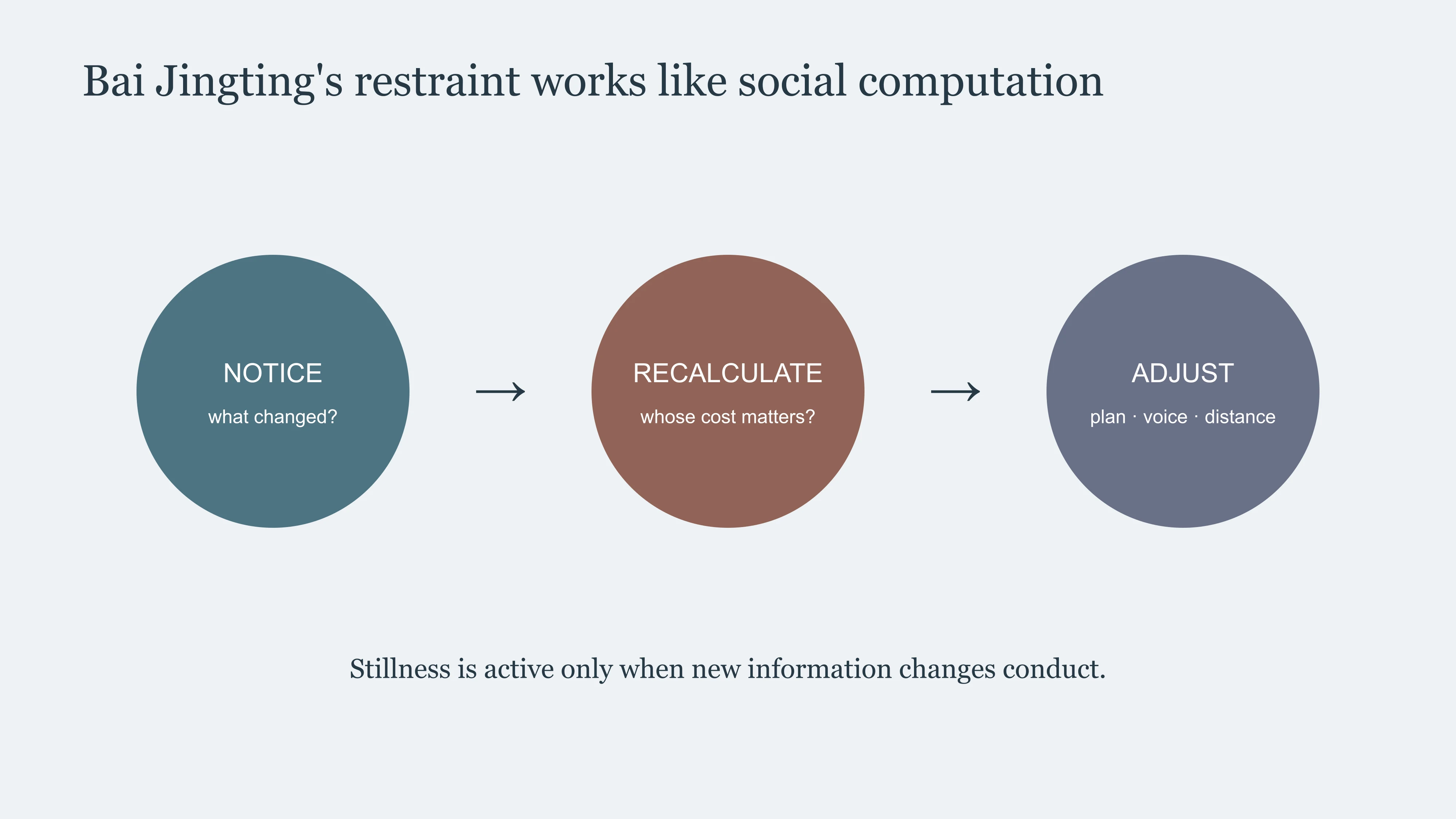
This distinction matters for overseas viewers because subtitles preserve words more easily than social temperature. A short answer can be respect, evasion, embarrassment or an attempt to protect someone else. Timing, posture and the decision not to speak carry part of the meaning.
I am also careful with the phrase Bai Jingting movies and TV shows. This page is a person-level viewing guide, not an excuse to list every credit or pretend that a promotional photograph proves range. The page owns the actor's screen method and a practical route; individual drama pages own plot, ending and title-specific viewing questions.
Reset proves that repetition can still move

The clock composition in Reset makes the acting problem visible before I describe it: the situation repeats, information is incomplete and the characters have to act again without simply replaying the previous attempt. That is an unusually fair test for an actor whose appeal depends on controlled attention.
Bai Jingting's useful work is not shouting urgency into every loop. It is recalibration. The character notices a detail, changes the order of questions, trusts somebody earlier or abandons an assumption that felt safe one minute before. The performance gives the audience a record of thinking under pressure.
This is why Reset is the best first stop. It lets you test the thesis scene by scene. If a character remains “quiet” but every loop changes nothing in his body, voice or relationship to the other investigators, the performance would be decorative. When the adjustments accumulate, restraint becomes action.
The drama should not be used as evidence of real emergency procedure. It is a constructed thriller. What it can show is how an actor makes changed information legible without repeating the same emotional speech. For a useful co-star comparison, read the Zhao Jinmai actor guide: Bai Jingting often makes recalculation look public and controlled, while Zhao Jinmai's strongest scenes make recognition grow into a decision.
The limitation is visible too. A character who is always the most composed person in the frame can become an answer machine. I need mistakes, impatience and moments when the best plan belongs to someone else. Otherwise “competence” becomes another form of idol protection.
New Life Begins moves the problem into a room full of people
An ensemble drama creates a different difficulty. A performer cannot rely on one private gaze or one romantic pairing to carry the scene. Yin Zheng has to negotiate status, etiquette, misunderstanding and group rhythm.
The official iQIYI International New Life Begins page identifies Bai Jingting as Yin Zheng inside the ensemble. His screen value here comes from listening. He does not need to turn every exchange into a declaration of intelligence. The character can let another person finish, absorb the social cost and then choose a response that shifts the room by a few degrees.
That is a useful entry into Chinese costume-drama social worlds. Power is often carried through who may speak first, who must wait, which courtesy hides a refusal and who is allowed to change the subject. The production is fictional; this is an editorial lens, not a claim that every historical household operated the same way.
The role also limits the easy “quiet man” label. A quiet character in an ensemble must still create connections. If silence only makes him look superior, the performance shrinks. If silence lets him notice the people with less room to speak, it becomes attention.
There is a difference between being hard to read and being responsive. Bai Jingting is most persuasive when Yin Zheng is not merely withholding; he is processing the room and making a choice about what the room can safely bear.
Destined makes cleverness pay a public cost
Destined widens the scale. Gu Jiusi cannot remain a private puzzle because marriage, family survival, money and public responsibility keep increasing the number of people affected by his choices.
That widening matters because Bai Jingting can be reduced to styling, body line, chemistry or a convincing “boyfriend” atmosphere. Those qualities explain attention; they do not explain a career. Destined asks whether quick social intelligence can survive consequences larger than the self.
I watch for the moment cleverness stops being charming and becomes accountable. Can the character admit that a fast solution created a slower problem for somebody with less power? Can he listen after status begins to reward him? A role becomes adult when being correct no longer settles the moral question.
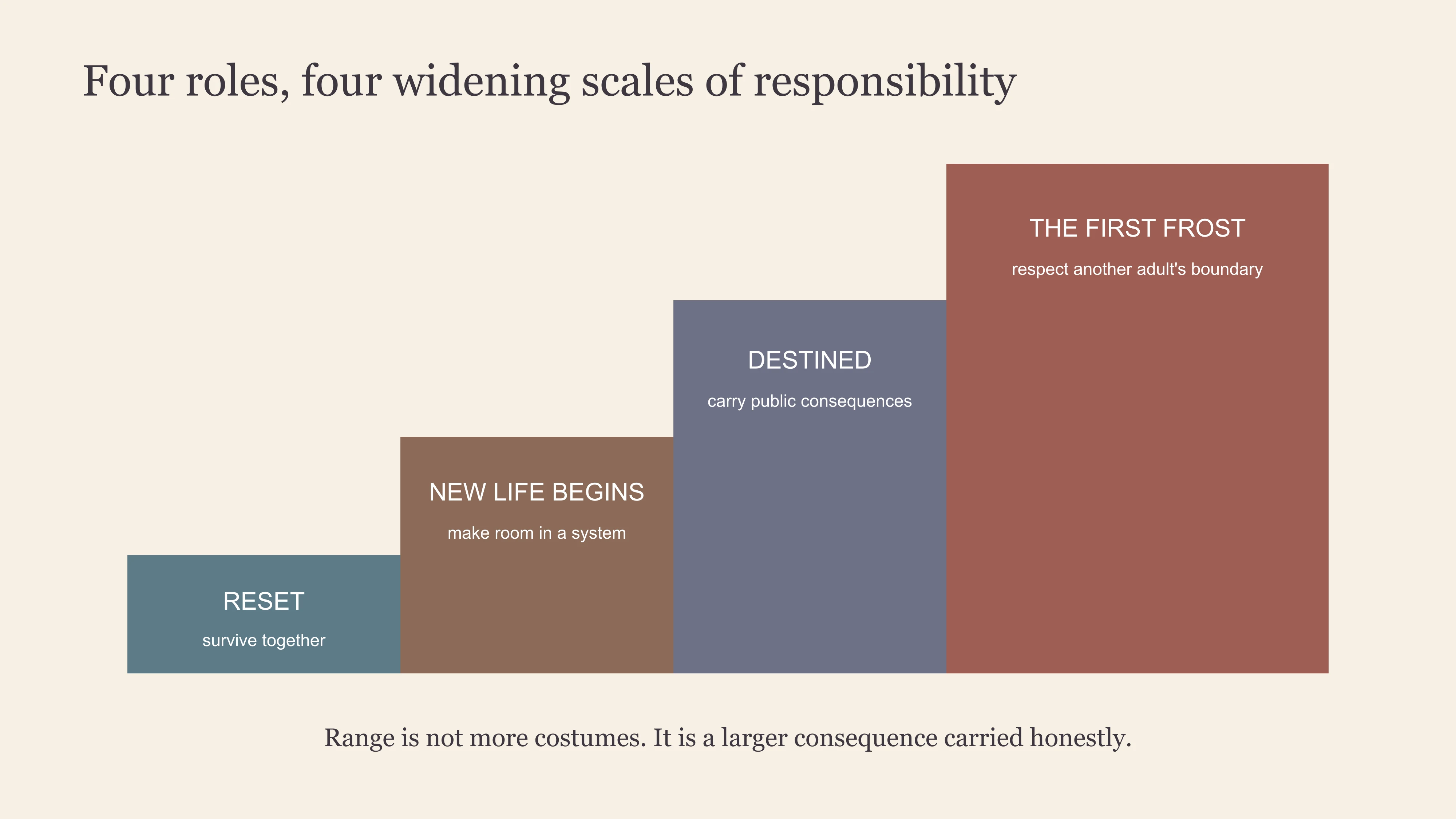
The four-role route now has a clear shape. Reset tests changed information. New Life Begins tests shared social space. Destined tests public consequence. The First Frost tests whether love respects another adult's boundary. These are not interchangeable versions of a quiet handsome man. They are four different sizes of responsibility.
I like Bai Jingting more when the character has to repair a consequence than when he is merely praised for being clever. The repair may be incomplete. It still has to cost him something.
The First Frost is the hardest current test
In The First Frost, the guarded male lead is surrounded by emotional history. That makes stillness tempting and dangerous. The audience already knows that the past matters, so a production can mistake recognition for development.
The test is whether Bai Jingting's character changes his behavior after the female lead sets a boundary. Listening is not enough. He has to give up control, accept a refusal or stop using old familiarity as permission to enter her present life.
This page owns the narrower actor question. The The First Frost guide owns the series premise, cast, ending and viewing decision. The Zhang Ruonan profile owns her wider career and her own screen method. Keeping those owners separate makes the shared drama easier to judge honestly.
If the character remains silent but continues to arrange every condition around the other person, the aura is doing more work than the writing. If silence leads to changed conduct, it earns its place.
The most interesting version of this role is not “the man who has always loved her.” It is the man who has to learn that memory does not grant access. That is a cultural and dramatic distinction overseas viewers can miss when a reunion romance is reduced to chemistry clips.
The star image is useful, but it cannot finish the acting argument
An actor with a strong variety-show presence and intense fandom discussion attracts a secondary biography: jokes, clothing debates, relationship speculation and edited clips presented as personality proof. None of that helps me judge the scene in front of me.
The boundary is deliberate. Public charisma can show speed and comfort in an unscripted format; it cannot prove what happened privately, and it cannot substitute for performance analysis. I keep the useful part—the ability to notice a room and change timing—and discard the rumor economy around it.

This stage image is a warning against confusing presence with performance. The red architecture, black silhouette and microphone make confidence visible in one frame. It proves that Bai Jingting can be presented as a live-event center; it cannot prove a character arc, vocal ability across a full set or private temperament.
I keep the image because it exposes the same tension as the acting page. A star can enter a room already framed as important. The performance starts when another person changes the terms.
Where the restraint breaks
My strongest criticism of Bai Jingting is not that he is too quiet. It is that a production can protect him inside quietness. Editing may cut before awkwardness. Costuming may turn hesitation into elegance. A script may call a character thoughtful when he has not actually made a difficult choice.
So I use four questions:
- What new fact did the character notice?
- What first plan became impossible?
- Which person bears the cost of the revised plan?
- What does the next scene prove about the choice?
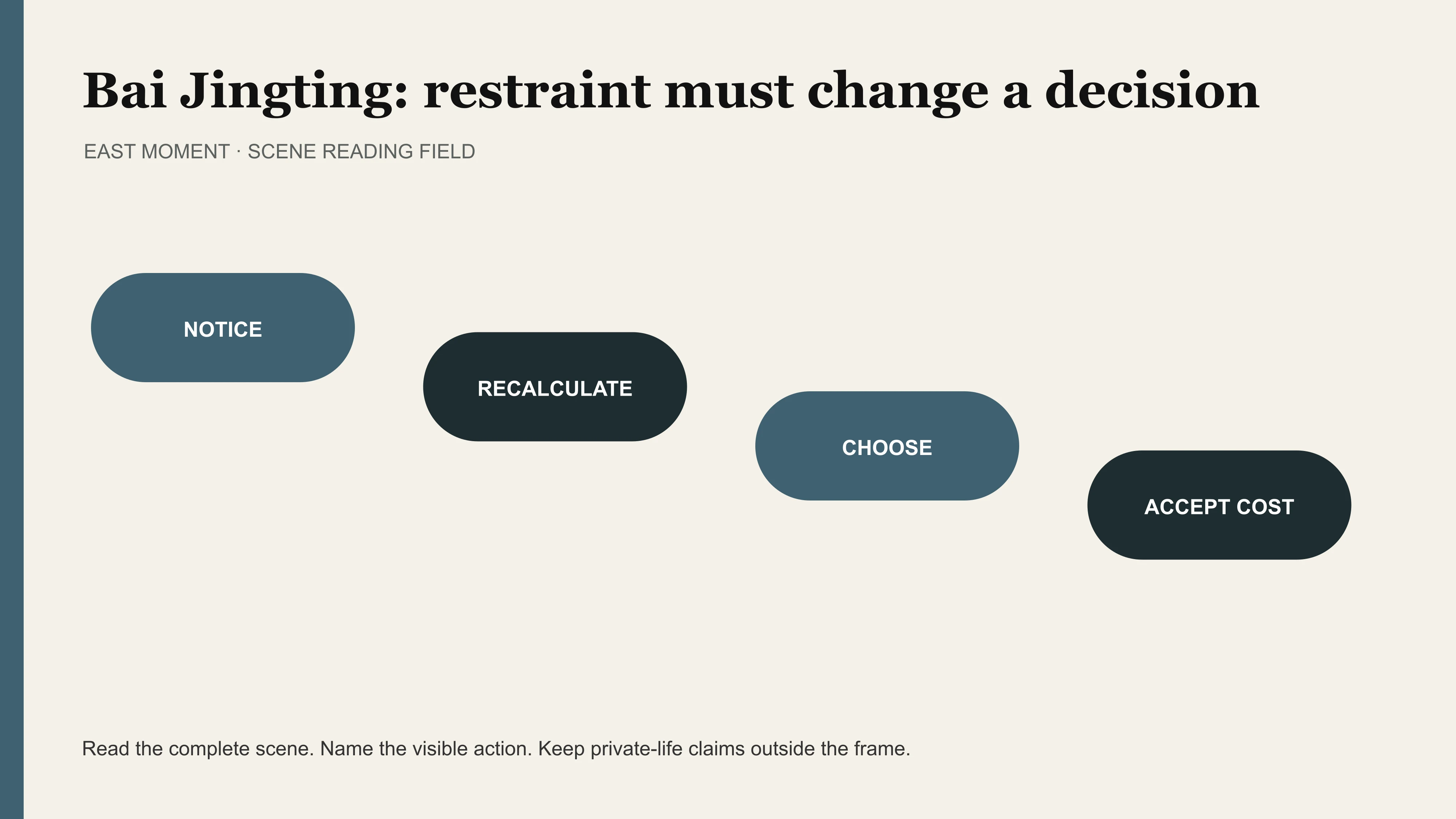
Use the sequence on Reset: repetition matters because responsibility accumulates. Use it on New Life Begins: a private reaction must survive a crowded household and changing alliance. Use it on The First Frost: a feeling must survive another adult's refusal without becoming entitlement.
If the face remains controlled but the decision never changes, the stillness has become style rather than drama. That standard protects Bai Jingting from praise as much as criticism. A quiet scene is not automatically profound; it earns depth when the next action proves that thought occurred.
Final judgment on Bai Jingting
Bai Jingting is not most interesting as a handsome mystery. He is most interesting when composure becomes labor: noticing the room, revising the plan, choosing what to reveal and accepting the cost of that choice.
Start with Reset for the cleanest proof. Move to New Life Begins for ensemble negotiation and costume-drama social texture. Use Destined to test public responsibility, then The First Frost to see whether guardedness can become reciprocity rather than control.
Continue through the Chinese actors collection or the Chinese television guide. In the comments, name one moment when another person enters the room and Bai Jingting's character changes behavior. Then bring the exact timestamp to Moments so the discussion stays attached to a scene rather than a popularity slogan.
I will return when his next role forces competence to fail in public. That is the next honest question: can Bai Jingting remain compelling when restraint no longer protects the character from embarrassment?