Yue Minjun's laughing man is famous because the mouth says joy while every other part of the face refuses contact. The eyes are sealed, the teeth form a hard white fence, and the same body keeps returning until a person becomes a mask. His achievement was to make laughter feel defensive. His problem is that the defence became one of contemporary Chinese art's most recognizable brands.
Yue Minjun made laughter feel like a face with nowhere to go
Yue Minjun (岳敏君) is a Beijing-based Chinese contemporary artist, born in 1962, best known for pink-skinned figures who wear his own exaggerated, closed-eye grin. He is commonly associated with Cynical Realism, a term attached to artists who responded to the rapid social and economic changes of 1990s China with irony, boredom, absurdity and emotional distance. The M+ Museum collection record confirms the biographical outline and shows that his practice extends across painting, installation, sculpture and print.
That definition answers who he is, but not why the face stays in memory. I do not read the figure as a happy man. I read him as someone who has made his expression impossible to question. You cannot meet his eyes. You cannot tell whether the laugh began before the scene or was pasted onto it afterward. The bigger the mouth opens, the less access we receive.
If you have only ten minutes, do not begin with auction prices. Look at one early group painting, one image that rewrites a familiar public or art-historical scene, and the bronze figures of A-maze-ing Laughter in Vancouver. Those three encounters reveal the full argument: refusal, repetition and what happens when a disturbing private mask enters public life.
The closed eyes matter more than the open mouth
The mouth attracts attention because it is huge. The eyes explain the painting because they are unavailable.
Ordinary laughter changes a face through contact: eyes crease toward another person, breath interrupts speech, and the body loses a little control. Yue reverses that social movement. His figure performs maximum expression while withholding recognition. The eyelids lock. The neat rows of teeth repeat. Pink skin can feel overheated, artificial or exposed, yet it reveals almost nothing about the person beneath it.
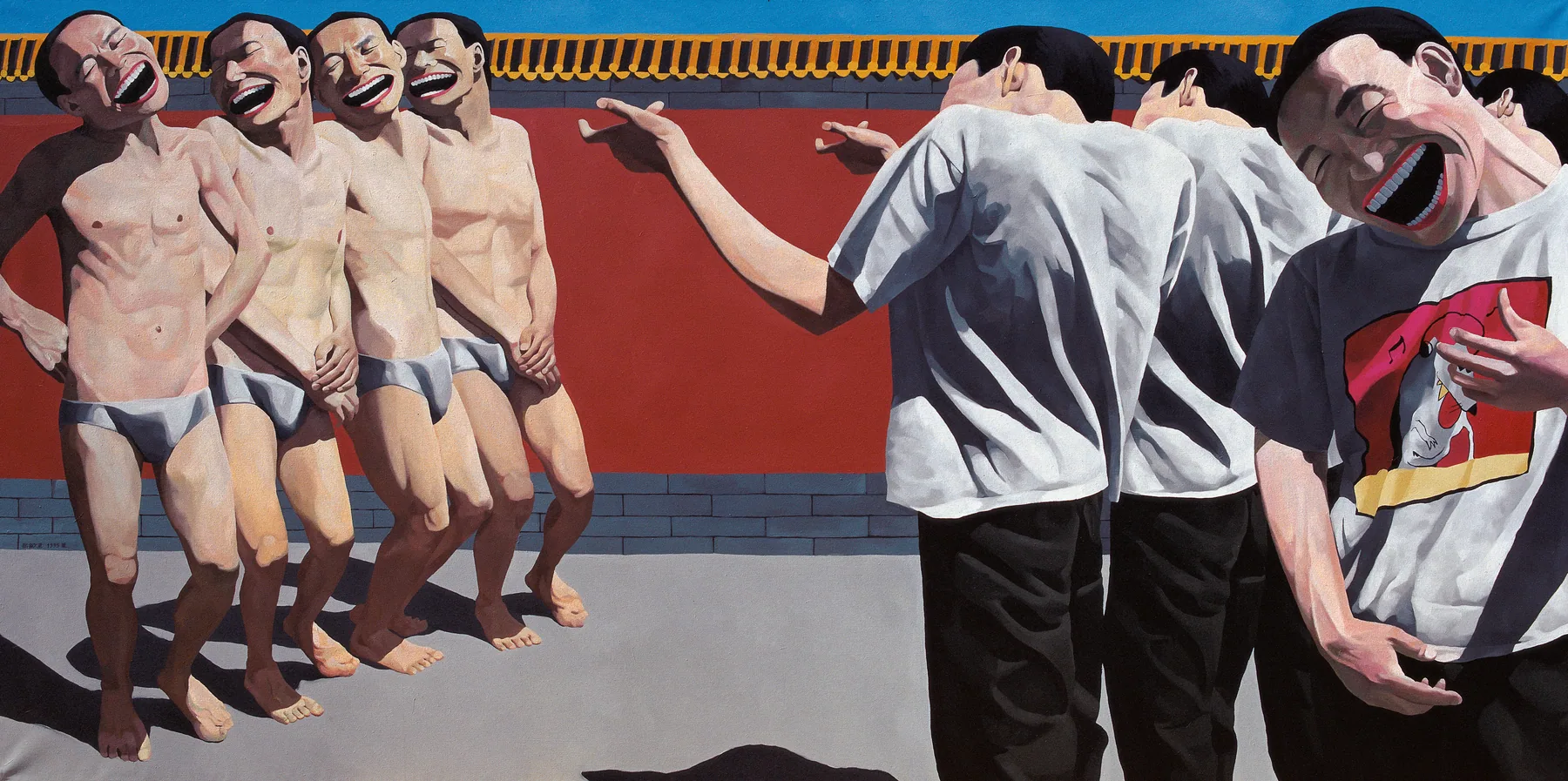
This is why the image can move between comedy and threat so quickly. A single laughing figure may look foolish. A group begins to feel disciplined. When every body carries the same face, laughter no longer proves individual feeling; it becomes a uniform.

The masked figures on Yue's official site make this mechanism unusually clear. Covering the face should hide identity, but the laugh survives as if it were more permanent than the person. Around them, bright graphic fragments resemble the noisy surfaces of advertising and popular culture. The scene does not ask me to decode one secret symbol. It asks a more uncomfortable question: what if a recognizable emotion can circulate perfectly after the human being has disappeared?
One self-portrait becomes a crowd
Yue began developing the repeated self-image in the early 1990s. Calling every figure a conventional self-portrait is misleading. He uses his face as raw material, then strips away the privacy that a portrait normally promises. The copied grin can stand alone, multiply into a crowd, replace people inside a familiar composition or occupy a landscape that does not explain why anyone is laughing.
That multiplication is the real invention. A single caricature can be read as personality. Twenty near-identical bodies turn personality into a social condition. Difference survives in posture—bending, floating, saluting, running, pointing—but the face has already decided the emotional result.
The laughter also protects the picture from one fixed explanation. It may be submission, ridicule, boredom, embarrassment or a way of refusing to say what cannot be said plainly. I resist the tidy claim that every grin translates into one political sentence. The work is stronger when the expression remains overdetermined: too loud to be neutral, too closed to be a confession.
Rewriting a famous image removes the hero first

When Yue places the same face inside a monumental, historical or heroic-looking composition, the result is not merely parody. Familiar images usually distribute roles: leader and follower, victor and witness, person acting and person acted upon. Yue's copy-and-paste humanity damages that structure. Everyone appears to know the same joke, yet no one can explain it.
This is where his paintings differ from an internet meme. A meme gains speed by making the reference easy to recognize. Yue's strongest revisions slow recognition down. First the scene feels familiar; then the wrong face repeats; finally the viewer notices that history has lost distinct human reactions. The laugh does not add commentary from outside. It hollows out the people who were supposed to carry the event.
For readers exploring Chinese art beyond dynastic masterpieces, this is a useful threshold. Contemporary art does not have to reject older images or public memory. It can reuse their visual authority while exposing how easily an image teaches us whom to admire, mourn or obey.
The signature became a trap as well as a language
Here is the difficulty I do not want a polite profile to avoid: Yue Minjun found an image with extraordinary force, then repeated it so successfully that the image could begin to protect itself from criticism.
The early laugh makes emotional conformity visible. Later, once viewers can identify “a Yue Minjun” across a room, recognition arrives before uncertainty. The face becomes collectible, reproducible and instantly legible. The very system the paintings once exposed—one expression repeated until it feels normal—can reappear as an art-market system: one signature repeated until it feels valuable.
That does not mean repetition automatically empties the work. Repetition is the subject. A new setting can change who controls the laugh, whether bodies become more vulnerable, and whether the familiar mask fails. But each return has to do more than confirm authorship. My test is simple: does this particular painting make the grin newly dangerous, or does it merely give the logo another background?
This disagreement is part of the reason the work remains worth seeing. I understand the frustration that the language entered a dead end; in some pictures, I feel it too. Yet dismissing the entire practice because the market loved the face would be equally mechanical. Commercial success cannot prove artistic value, but it cannot erase the formal intelligence of the closed eyes, cloned identity and badly timed joy.
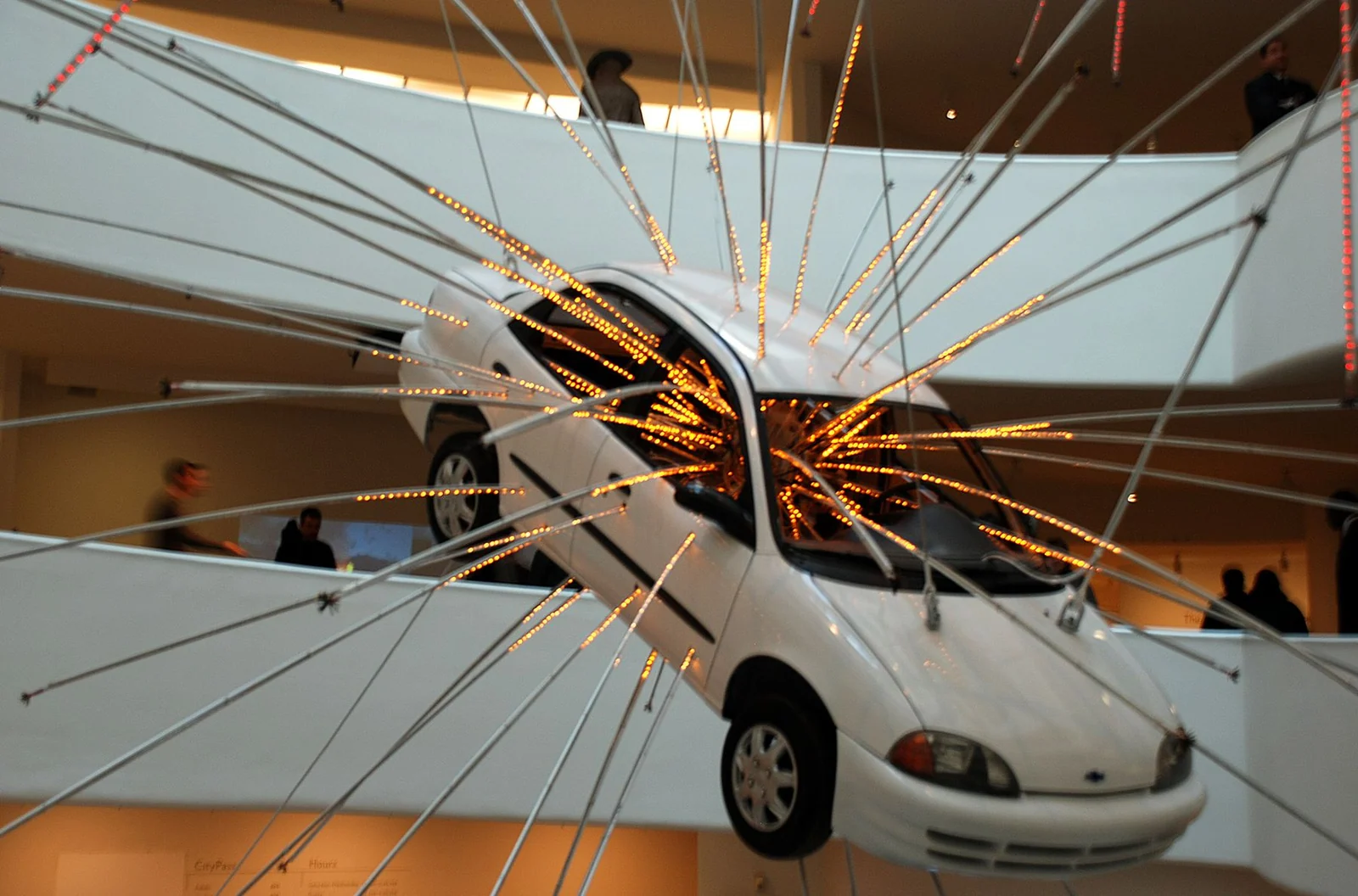
The comparison with Ai Weiwei is useful precisely because their repetitions behave differently. Ai often repeats objects until quantity becomes a system of labor and counting. Yue repeats a face until individuality becomes performance. With Cai Guo-Qiang, risk enters through an event that cannot be fully corrected; with Yue, risk enters when a perfectly controlled symbol threatens to control its maker.
Zao Wou-Ki offers the opposite route into recognition. Yue compresses uncertainty into one face that returns; Zao removes the recognizable figure until pressure, interval and empty space become the subject.
Zhang Xiaogang makes a more uncomfortable comparison. His repeated frontal faces also risk instant recognition, but their pressure comes from family-photo alignment, red relation lines and small color exceptions rather than a copied expression. Put the two artists together and “same face” stops being an explanation: repetition can behave as mask, kinship, market signature or a structure that makes difference harder to admit.
Vancouver gave the laugh another life

In a museum, the laugh can remain an object of suspicion. At Morton Park beside Vancouver's English Bay, fourteen cast-bronze figures stand at about 259 centimetres tall and weigh roughly 250 kilograms each. The Vancouver Biennale record for A-maze-ing Laughter documents the work's 2009–2011 exhibition history, permanent public placement and continued local popularity.
The bronze changes the argument. A frozen sculpture cannot actually laugh, so the open mouth becomes more absurd. At the same time, visitors stand beside the figures, copy their poses, touch them and make photographs. The crowd supplies the movement and eye contact that the statues refuse.

I find this public afterlife more interesting than using popularity as proof that the sculpture is good. The work is no longer controlled by the art market's recognition game or a critic's preferred interpretation. People use it. A threatening uniform becomes a playground; a sad mask becomes a holiday photograph; the artist's self-image becomes temporary choreography for strangers.
That warmth does not cancel the earlier unease. It demonstrates that an artwork can be socially rewritten without being physically altered. The same closed eyes mean something different when a child, tourist or local runner opens theirs beside the statue.
Recent Yue Minjun works still have to escape recognition
Yue has continued working beyond the paintings that established the laughing man. His gallery archive records recent painting and exhibitions, including the 2025 Hong Kong solo presentation Crab, while his official site places newer, densely staged images beside the familiar grin. This matters because an artist profile should not freeze a living person at the moment the market first recognized him.
Still, “recent” is not the same as renewed. New colors, costumes, flowers, animals or settings can extend the world around the figure without changing its internal pressure. I look for moments when the face becomes less secure: when it is masked, obstructed, displaced, made lonely, or forced into contact with an environment that refuses to behave like a backdrop.
The most generous way to judge the later work is also the hardest. Do not demand that Yue abandon the face simply to demonstrate novelty. Demand that each return discover something the face could not say before.
Where to start with Yue Minjun paintings and sculpture
Choose a route based on the question that brought you here:
- Why is he famous? Begin with a 1990s group of pink laughing figures and inspect the eyes before the mouth.
- What does Cynical Realism mean? Compare the emotional distance in Yue's repeated face with the social setting around it; treat the label as context, not a complete explanation.
- Are all the paintings the same? Put an early crowd, a historical-image revision and a recent work side by side. Track what changes in pose, scale, setting and vulnerability.
- Where can I encounter the work outside a gallery? Start with A-maze-ing Laughter in Vancouver and watch how other bodies complete the installation.
- Is he overrated? Ignore prices first. Ask whether the repetition creates a new contradiction in the exact work before you.
My verdict: the saddest smile works only when it can still fail
Yue Minjun gave contemporary Chinese art a face that travels almost too well. Its visual grammar is immediate: closed eyes, exposed teeth, flushed skin, copied body. Its emotional grammar remains unstable. That gap is his lasting contribution.
I value the laugh most when it makes certainty impossible—when comedy feels defensive, crowds feel lonely and recognition becomes suspicious. I value it least when the setting merely confirms a brand I already know. The tension between those outcomes is not a footnote to Yue Minjun's career. It is the career.
Return to the Chinese artists collection and choose one exact Yue Minjun image below. At what point does its laugh stop exposing a mask and begin behaving like a logo? Bring the face, pose or setting that changed your answer to the East Moment community.