Zao Wou-Ki did not make Chinese mountains disappear into Western abstraction. He made empty space behave like pressure. Colour gathers, breaks and releases like weather moving through a landscape that never becomes a literal mountain. That is why his paintings can feel Chinese before they show us a single recognizably Chinese object.
Zao Wou Ki made empty space carry the weight of a landscape
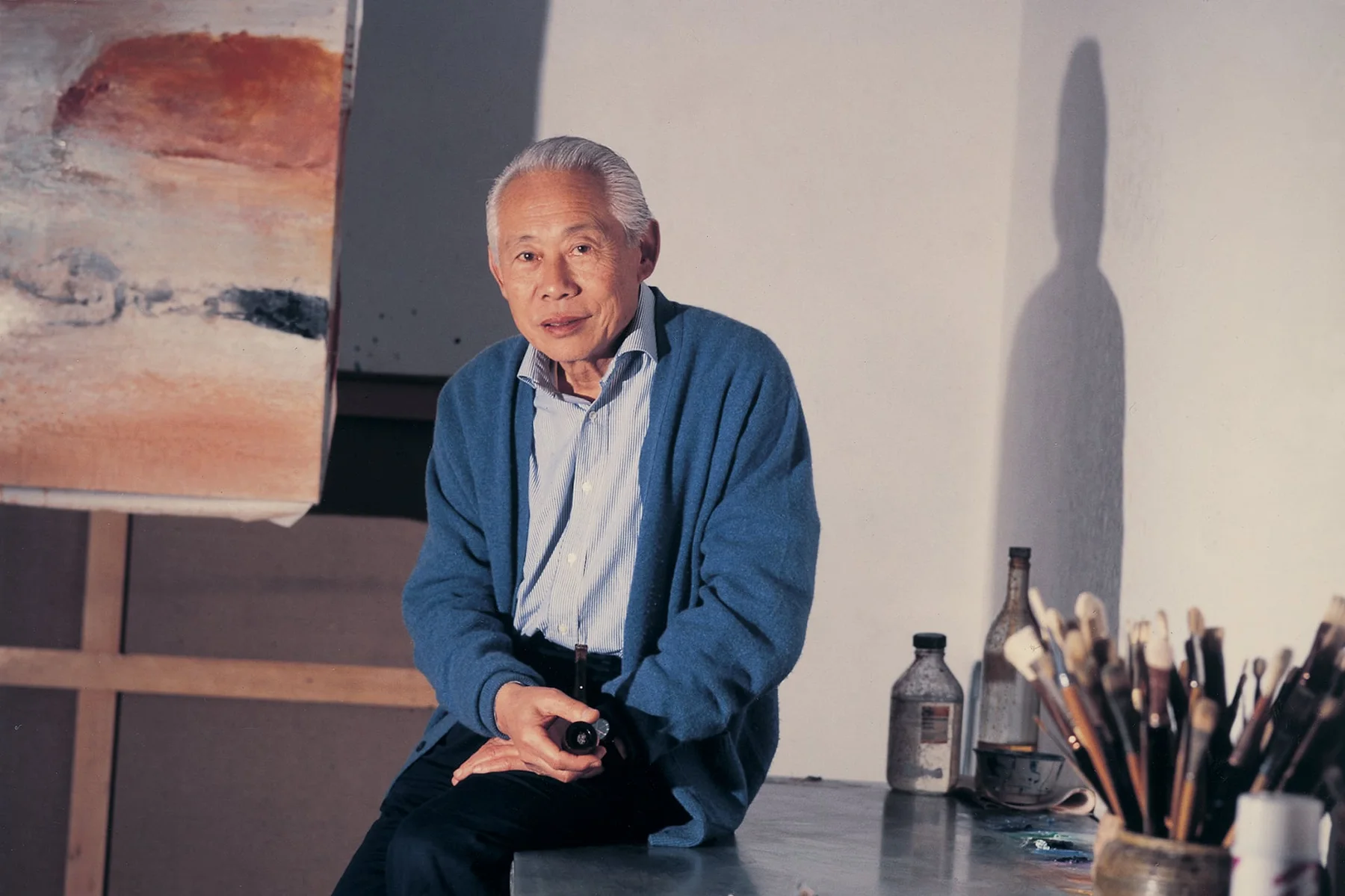
Zao Wou-Ki (赵无极, 1920–2013) was a Chinese-born, French-naturalized painter and printmaker who moved to Paris in 1948. He worked across oil, ink, watercolor and printmaking, becoming known for paintings in which signs, light and turbulent colour create immense spaces without settling into conventional scenery. The Fondation Zao Wou-Ki biography documents his training at the Hangzhou art academy, his move to Paris, French citizenship in 1964 and his return to teach in Hangzhou in 1985.
Those facts identify the person. They do not explain the sensation of standing before the work.
I used to approach abstraction with the impatient question many viewers carry quietly: what is it supposed to be? In Zao's strongest paintings, that question closes the door too early. I see more when I ask where the picture tightens, where it thins, where my eye accelerates and where it is allowed to rest. The canvas may contain no mountain, cloud or river, yet it can still organize my breathing like a landscape.
Here is the shortest useful orientation:
| Reader question | East Moment answer |
|---|---|
| Who was he? | A Chinese-French painter and printmaker, born in Beijing in 1920 and active mainly in Paris from 1948 until his death in 2013. |
| Why is he important? | He turned line, colour and emptiness into spatial forces rather than decorating abstraction with Chinese symbols. |
| Was he an Abstract Expressionist? | He shared scale, gesture and transatlantic dialogue with postwar abstraction, but the label alone misses his Paris formation and Chinese spatial memory. |
| Best first work | Vent (Wind, 1954), where a sign begins to act as atmosphere instead of readable writing. |
| Essential media | Oil, ink and printmaking; none is merely a side practice. |
| Where to look | The Zao Wou-Ki Foundation's work archive, M+ in Hong Kong and the Musée d’Art Moderne de Paris. |
The 1949 portrait proves that abstraction was a decision

Portrait de ma femme (1949) stops us from inventing a convenient myth of an artist born speaking abstraction. A seated woman occupies a shallow interior. Her face, clothing and hands remain recognizable; the room is simplified but not dissolved. The painting belongs to a young artist who could build a figure and then chose to move away from it.
That choice matters. Zao did not abandon representation because he was unable to draw a body. According to his foundation, by 1953 he no longer wanted to paint still lifes and flowers; he was looking for an “imaginary and indecipherable new writing.” I read the phrase less as a rejection of meaning than a rejection of naming. A flower arrives already carrying the word flower. A broken sign can remain active before language pins it down.
The portrait also keeps the biography human. Paris did not instantly erase Hangzhou, and modernity did not begin with a clean cut. An artist carried training, relationships and remembered spaces into a different visual argument. The interesting story is not East becoming West. It is a painter discovering which parts of both traditions had become too easy.
In Wind, writing stops explaining and starts moving air

The title Vent—Wind—invites us to look for weather. The painting refuses to illustrate it. Small dark marks drift, cluster and separate inside a pale vertical field. They resemble an ancient script from a distance, but they do not reward translation. Their work is positional: one mark tugs another upward, a denser knot slows the eye, open ground makes the next sign feel exposed.
This is the 1954 turning point because the mark has stopped carrying a message across space and has started producing the space itself. It is close to Chinese calligraphy in its sensitivity to pressure, interval and the life of a stroke. It is not calligraphy enlarged and stripped of words. A calligraphic line still bears the discipline of writing; Zao lets the suggestion of writing become unstable enough to act like wind.
I understand why the first response can be, “These are only scratches.” The ingredients are simple. Simplicity of ingredient is not simplicity of relation. A few notes can make a melody; a few marks can make distance. The test is not whether I could imitate one sign. It is whether I could make every interval hold tension without turning the field into decoration.
Why Zao Wou-Ki paintings feel like Chinese landscape without depicting mountains
“Fusion of East and West” is the phrase most likely to appear in a polite summary and least likely to help me see. It names the result while hiding the mechanism.
The Chinese quality I feel in Zao's mature work is not a collection of motifs. It lies in how emptiness remains structurally alive. In a weak abstract painting, an unpainted or pale area can feel like leftover ground. In Zao's best paintings, it behaves like weather, distance or held breath. Dense passages do not simply sit on top; they lean into the open field and make it answer.
This connects him to the longer history of Chinese art without reducing that history to ink, mountains and philosophy. Traditional landscape painting often gives a viewer several distances and paths through one surface. Zao's paintings also resist the single fixed window of ordinary perspective. The eye enters, swerves, loses scale and reappears somewhere else.
The resemblance is spatial, not illustrative. I do not need to rename every black mass a mountain or every pale wash a cloud. Doing so domesticates the painting. The more exact question is: does the picture make emptiness feel charged enough that I sense a world extending beyond the canvas?
Abstract Expressionism is a useful neighbor, not his address
Zao travelled in the artistic worlds of Paris and New York, and his large gestures naturally invite comparison with Abstract Expressionism. Scale matters. So do bodily movement, improvisation and the refusal of a centered object. But calling him a Chinese Abstract Expressionist can quietly turn one American category into the main house and place Zao in a side room.
Paris mattered as more than a stop on the way to New York. So did his friendships with poets and artists, his encounter with European modernism and his earlier training in China. The mature paintings emerge from circulation rather than obedience to one school.
The distinction becomes visible in the way energy is handled. A gesture can announce the painter's body—I moved here. Zao's marks often do something less heroic. They disperse the body into atmosphere. I am less aware of a performer standing before the canvas than of pressure passing through a field.
This makes a useful contrast with Cai Guo-Qiang. Cai gives material a public event and accepts the burn after ignition. Zao keeps revising a painted atmosphere until accident and control become difficult to separate. Both use uncertainty, but one detonates it in time while the other suspends it in space.
Grief enters En mémoire de May without becoming a code

Zao's second wife, May, died in 1972. En mémoire de May – 10.03.72 stretches horizontally in black, ochre, white and bruised grey. Knowing the title changes the encounter: the dense central-dark movement can feel like grief forcing itself across a surface too wide to contain it.
Yet biography should not become a dictionary. Black does not equal death in every passage. Gold does not equal memory. The painting matters because grief alters its rhythm, not because every mark can be assigned to an episode in a life.
I feel the work through its unequal pressure. The darkness does not cover everything; pale space remains, but it does not provide easy peace. The picture knows that loss can make ordinary air feel different. That is more truthful than a symbol that announces mourning and asks to be understood immediately.
Zao's peers are often flattened by another kind of shortcut: Yue Minjun becomes the laughing face, Ai Weiwei becomes the political gesture, and Zao becomes “East meets West.” Each label helps recognition and then threatens to replace attention. A real artist profile has to reopen what the label closed.
Returning to ink was not a return to innocence

In 1971, encouraged by his friend Henri Michaux, Zao began working seriously with ink again. It is tempting to narrate this as a return to Chinese roots. I think that story is too neat. He returned with decades of oil painting already inside his hand.
Oil permits delay, layering, scraping and correction. Ink enters absorbent paper and makes time visible. A wet edge spreads. A dark concentration cannot simply be taken back. White is not painted illumination; it is the paper protected from the mark.
The change of material therefore changes the artist's ethics of decision. Speed becomes consequential. Empty space must be reserved rather than recovered. Zao did not become “more Chinese” by picking up ink. He confronted a material whose memory and risk had changed because he had changed.
This is why viewers should not treat the inks as minor, monochrome versions of the oils. Put one beside En mémoire de May. The oil builds atmosphere through accumulated colour; the ink makes one dark movement answer for every place it cannot revisit. The family resemblance is pressure. The time inside the pressure is different.
A triptych makes the viewer travel

Hommage à mon ami Henri Michaux (April 1999–August 2000) is not a small abstract painting stretched into a luxurious panorama. Its width demands movement. The seams between three panels interrupt continuity, turning looking into a sequence: arrive, cross, revise.
From far away, the picture offers weather. Closer, the marks lose their atmospheric unity and become separate decisions. Moving sideways joins them again. The work changes not because paint moves, but because the viewer does.
That bodily scale protects the painting from becoming elegant wallpaper. A reproduction can show the colour arrangement, but not the delay between one end and the other. The ideal first encounter includes at least three distances: far enough to feel the total pressure, close enough to see an edge or dragged mark, and sideways enough to let the panel breaks measure your own movement.
Printmaking was Zao's laboratory, not his souvenir shop
Prints are often treated as affordable echoes of famous paintings. Zao's career makes that hierarchy especially misleading. M+ traces his print practice from 1949 to 2000 and holds a substantial collection of his works and archives. Its exhibition Zao Wou-Ki: Master Printmaker ran from December 13, 2025 to May 3, 2026 and brought together nearly 180 works.
The dates matter because the exhibition has ended; it should not be presented as a current visit recommendation. Its scholarship remains useful. Printmaking required Zao to think through reversal, pressure, repeatability, collaboration and the translation of a mark from one surface to another. It also connected his images with poets and circulated them internationally.
This is not secondary work produced after an oil painting proved successful. A print can test how a sign survives transfer, how colour separates into stages and how repetition changes an image's authority. If the oils ask how space can expand, the prints ask what remains when an image must pass through a system.
How to look at Zao Wou-Ki for the first time
Do not attempt to “understand abstract art” in one visit. Give one painting three kinds of attention.
- Thirty seconds: locate the pressure. Before reading the title, find the densest area and the largest opening. Notice which one your eye reaches first.
- Three minutes: follow one route. Choose a line, colour edge or gap and let it carry you. Record where the route breaks. That break is often more revealing than the object you hoped to identify.
- Change distance. Move close enough for atmosphere to become paint, then far enough for paint to become weather again.
- Cross media. Compare one oil, one ink and one print. Ask not which looks most Chinese, but what each material permits the artist to change or forbids him from correcting.
- Read biography last. Then return to En mémoire de May or a late homage and judge whether the life enlarges the painting instead of replacing it.
For a stable digital route, begin with the Fondation Zao Wou-Ki works archive, then use the M+ collection to move across prints, objects and archival material. In person, the Musée d’Art Moderne de Paris holds works from historical acquisitions and the Françoise Marquet-Zao donations. Always confirm display status with the museum before making a special trip.
My verdict: the subject is not the storm but the pressure around it
Zao Wou-Ki is famous for abstract paintings that can look like cosmic storms, shattered landscapes or light breaking through weather. I think those comparisons are useful only for the first few seconds. His deeper achievement lies in the area we are tempted to call empty.
He made a pale field resist. He made a broken sign change distance. He made the seam in a triptych measure time and made ink's inability to reverse a decision feel like thought rather than virtuosity. None of that requires a dragon, mountain or readable character to certify its cultural origin.
Continue through the Chinese artists collection, but bring one exact painting with you. Which Zao Wou-Ki work first made empty space feel active rather than unfinished? Tell us where its pressure gathers—and where your eye finally breathes—in the East Moment community.