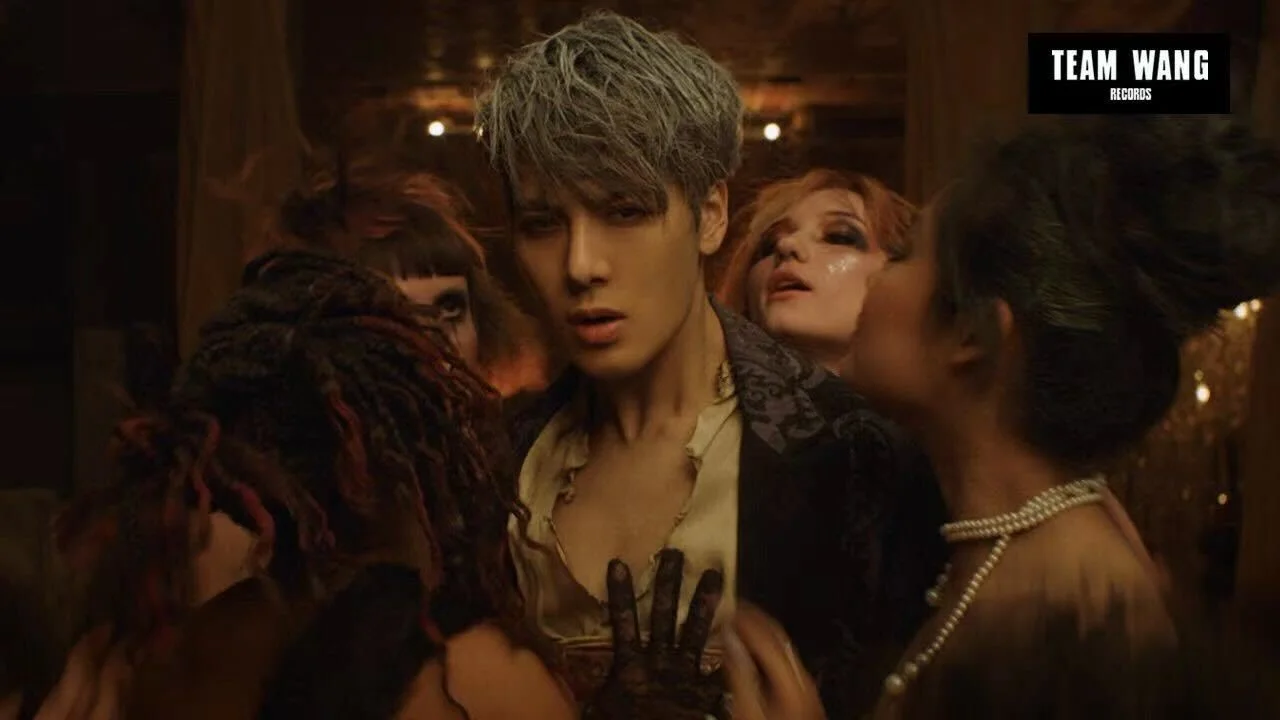
Jackson Wang is not best understood as a singer who happens to make elaborate videos. He builds songs as complete performances: voice, body, camera, costume and set all carry the same dramatic idea. That control is his real solo signature. The honest test is whether the song still holds after the spectacle ends.
Jackson Wang in 60 seconds
| What you want to know | The short answer |
|---|---|
| Chinese name | Wang Ka-yee / Wang Jia'er (王嘉尔) |
| Born | March 28, 1994, in Hong Kong |
| First major music identity | Member of GOT7 |
| Solo system | TEAM WANG and TEAM WANG records |
| What hits first | A grainy low register, sharp movement and cinematic visual control |
| Start with | 100 Ways, Blow, Cruel, LMLY and Cheetah |
| Albums to know | MIRRORS, MAGIC MAN and MAGIC MAN 2 |
| Best first test | Watch Blow, then replay it without the image |
The answer to “why is Jackson Wang famous?” includes fencing, variety television, GOT7 and fashion. The answer to “why does his solo work matter?” is narrower: he learned to direct attention across an entire frame.
Who Jackson Wang is, without mixing the careers together
Jackson Wang is a Hong Kong-born performer who first built a large international audience as a member of the Korean group GOT7, then developed an English-heavy solo catalog and the TEAM WANG creative system. Search results often compress those chapters into one label, which creates three avoidable mistakes.
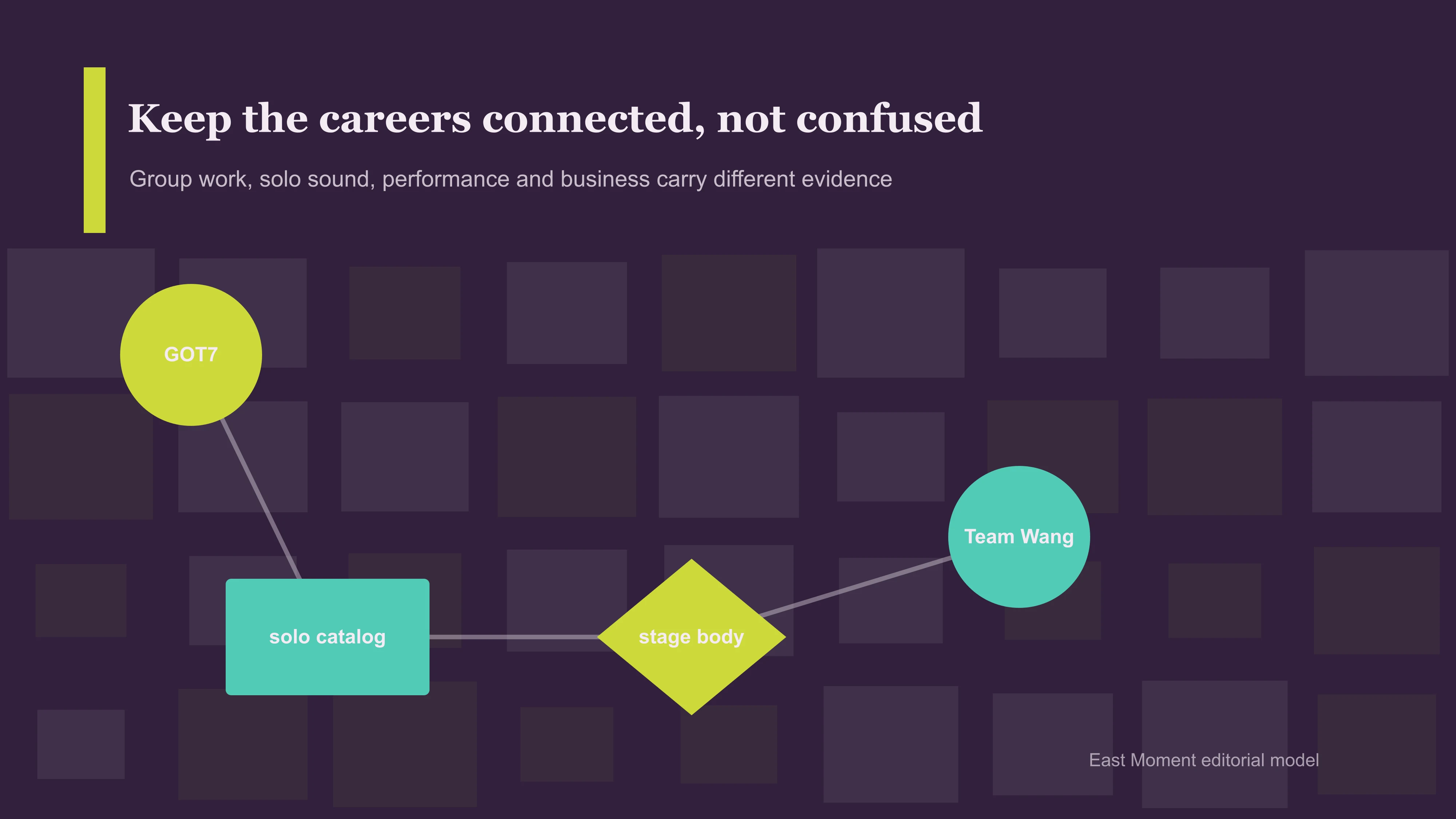
First, GOT7 is a group, not Jackson's former stage name. Group songs should not be counted as solo releases. Second, TEAM WANG is broader than an album title: it is the public creative and business frame attached to music, visuals, fashion and collaborations. Third, language does not provide a simple nationality test. English dominates important solo records, while Hong Kong, Chinese and Korean entertainment contexts remain part of the career.
If you arrived through K-pop, begin by asking what becomes more personal when seven-member choreography disappears. If you arrived through Blow or a fashion clip, go backward to GOT7 to understand where the camera discipline and group-performance precision were trained.
Best Jackson Wang songs by what you want
| Your goal | Start here | What it proves | Do not mistake it for |
|---|---|---|---|
| One complete solo statement | Blow | Voice, movement, set and edit serving one feverish idea | Proof that every solo song is equally strong without visuals |
| A melody that travels quickly | 100 Ways | Economy, repetition and choreography that clarifies a hook | A documentary version of historical China |
| Accessible romantic pop | LMLY | An open chorus and lighter emotional temperature | The full darkness of MAGIC MAN |
| Album-world continuity | Cruel | Visual and physical language continuing across releases | A standalone action short unrelated to the record |
| Funkier charisma | Cheetah | Looser rhythm and playful control | His deepest lyrical writing |
| Early solo ambition | Bullet to the Heart | The transitional MIRRORS identity | A finished version of the later theater |
This table resolves the most common search mismatch: “best” depends on whether you want the strongest standalone song, the most complete performance or the easiest first listen.
The voice is rough on purpose
Jackson's solo voice often sits low and textured. It can sound smoked, compressed or close to breaking. That roughness separates him from a cleaner idol-pop vocal ideal and works especially well against polished production.
It is not a limitless instrument. Long melodic lines can expose a narrower range, and heavy processing sometimes turns character into a uniform surface. His best songs therefore give the voice a dramatic job: seduction in LMLY, command in 100 Ways, feverish decadence in Blow or exhaustion and appetite across MAGIC MAN.
This distinction matters because charisma can make every sound feel convincing for three minutes. Replaying without the video reveals which hooks have shape of their own.
Three performances explain the solo method
100 Ways: choreography makes the hook visible
100 Ways uses a clean, repeated melodic line and turns it into a piece of physical storytelling. The official video draws on a stylized historical-fantasy frame, but the value is not “Chinese imagery” pasted onto an international pop record. Gesture, formation and camera direction clarify the pulse.

Watch 100 Ways on Jackson Wang's official channel. Notice how the repeated hand and group movements make the chorus readable even with the sound low.
Blow: a pop song staged as one dangerous room
Blow is the clearest statement of the method. The distorted rock-pop arrangement, breathy vocal and crowded cabaret setting all suggest the same loss of control. Choreography does not pause the story; it is the story.
The official Blow video, shown in the page's opening image, is the best first watch. Then play the audio alone: the clipped phrasing and descending hook still need to create pressure without the room.
Cruel: continuity becomes authorship
Cruel continues the scorched theatrical world of MAGIC MAN. Fire, combat-like partnering and aggressive silhouette turn desire into physical conflict. Seen beside Blow, it proves that Jackson was not commissioning isolated luxury visuals. He was building a repeatable visual grammar around the album.

Watch Cruel on the official channel. The frame above comes from that official upload; movement and flame extend the album's volatile stage language.
What performance authorship changes inside a song
Calling Jackson a “complete performer” can become empty praise unless it changes the way we listen. In his strongest work, the body edits the music. A held breath creates suspense before a beat lands; a shoulder turn redirects attention before the camera cuts; a group formation makes repetition feel intentional instead of cheap. The visual does not merely decorate a finished track. It teaches the audience where the track places pressure.
That creates a demanding standard. If the costume announces danger but the vocal phrase stays emotionally neutral, the system splits. If dancers create violence while the lyric offers only a generic seduction, scale conceals a weak idea. Blow works because sound, room and movement all feel overheated. 100 Ways works differently: its cleaner geometry makes the hook feel inevitable. Jackson's authorship is visible in those different contracts, not in spending the most money or occupying every frame.
GOT7 is the foundation, not the whole explanation
Jackson's group history matters because GOT7 trained the skills his solo work later concentrates: camera awareness, multilingual communication, synchronized movement and the ability to create a recognizable character inside a group arrangement.
But treating every solo song as a GOT7 side project misses the structural change. TEAM WANG gives him a public framework for records, visual direction, fashion and collaboration. The solo work is more physically theatrical, often darker and more willing to leave vocal grain exposed.
The distinction should not become a false break. Group identity and solo authorship can coexist. One explains the scale of the audience; the other explains why MAGIC MAN looks and sounds internally consistent.
Fashion belongs to the system, but it cannot grade the music

Jackson's fashion visibility is not a decorative footnote. Clothes, silhouette and brand direction are part of how TEAM WANG turns a public appearance into a recognizable world. The photograph above shows that control clearly: black tailoring, warm display light and still posture make restraint carry the frame without concert-scale movement.
But a beautiful brand appearance cannot prove a strong song. This boundary matters because Jackson's visual fluency is so persuasive that fashion authority, personal charisma and musical authorship can blur into one impression. I separate them deliberately. The event image proves that he can organize attention while standing still; Blow and 100 Ways must separately prove that a voice, hook and arrangement can survive replay.
MIRRORS and MAGIC MAN solve different problems
MIRRORS is the broader introduction. It moves through pop, hip-hop and R&B while Jackson tests how much of his public persona can be carried by a solo album. Bullet to the Heart and DWAY! make ambition visible, but the record still feels like several possible futures placed beside one another.
MAGIC MAN is more decisive. Rock texture, dark pop, stage fantasy and bodily performance become one world. That unity is why Blow and Cruel are stronger evidence than a list of streaming numbers: they show an artist choosing constraints.
Later work can be judged against that achievement. More scale is not automatically more authorship. The question is whether a new visual, genre or fashion frame changes what the music can express.
The albums in order, and what changes
MIRRORS: separating a solo voice from a group identity
The debut album behaves like a set of mirrors because it tries several versions of the same public figure: rapper, R&B singer, wounded romantic and ambitious global pop performer. Its unevenness is useful evidence. Jackson had reach before he had one coherent solo world.
MAGIC MAN: choosing the world instead of displaying options
The second major album cycle is the better full-project starting point. Rock and dark-pop texture narrow the palette, while the body becomes part of the composition. Blow is not simply the single with the best video; it establishes the rules other performances can extend or fail to extend.
MAGIC MAN 2: the sequel problem
A sequel title creates a hard standard. Returning to a successful world is justified only if the character changes, the production finds a new pressure or the songs expose something the first chapter could not. More costumes and darker lighting are continuity, not development by themselves. That is the question East Moment carries into every update of this page.
A five-date career map
- 2014: GOT7 debuts, establishing Jackson inside a multilingual, choreography-intensive group system.
- 2017: Early solo releases and TEAM WANG make individual authorship a visible public project.
- 2019: MIRRORS gives the solo catalog its first album-scale test.
- 2022: MAGIC MAN aligns voice, stage movement and cinematic design more decisively.
- Current chapter: newer releases must be judged by whether they extend that authorship rather than merely repeat its most recognizable surfaces.
This is intentionally a map, not a complete chronology of television appearances, brand work or every single. It keeps the events that change how the music should be heard.
The honest limitation: spectacle can finish the thought too early
Jackson's images are so controlled that they sometimes leave the listener little room to imagine a different emotional world. A weaker song can feel complete because the lighting, body and edit supply intensity it did not earn melodically.
That is why the audio-only test is useful rather than hostile. 100 Ways survives through economy. LMLY survives through an open, memorable chorus. Blow survives through vocal rhythm and pressure. Other tracks may work better as performances than as records, which is a valid outcome but a different achievement.
His strongest identity lies in accepting that tension. He is a performance author, not merely a vocalist competing on range or a celebrity attaching himself to expensive images.
Where to start with Jackson Wang
Use this five-step route:
- 100 Ways for the cleanest bridge between melody and movement.
- LMLY for accessible pop writing without the darkest theater.
- Blow for the complete MAGIC MAN proposition.
- Cruel for continuity and physical storytelling.
- Cheetah for a looser, funkier test of his charisma.
Then hear MIRRORS if you want the search for a solo language, or MAGIC MAN if you want the language after it became coherent. Use official uploads because credits, sequence and visual context disappear quickly in fan compilations.
For a different model of internationally legible Chinese music, compare Lexie Liu's bilingual futurism and Masiwei's Chengdu-rooted crossover. Then use the Cai Xukun guide for the harder comparison between idol visibility and self-authored music: Jackson builds one performance world around the song, while Cai has to make the song audible through an older meme and fandom argument. The broader Chinese musicians guide keeps these routes connected without pretending they represent one sound.
Before leaving, make one comparison of your own: play 100 Ways and Blow without watching, then watch both once. If your ranking reverses, identify whether camera, choreography, costume or facial performance changed it. That specific answer is more valuable to other readers than “he has charisma,” and it is the question carried into the discussion below.
Why Jackson Wang matters
Jackson Wang shows that global reach does not require removing every trace of origin or remaining inside one entertainment-industry role. His Hong Kong cultural background, Korean group training, English-language solo records, Chinese visual references and an independent brand system all coexist in the work.
The achievement is not that every element is equally deep. It is that audiences can see who is organizing them. When Jackson's music is strongest, performance is not packaging around the song. It is the form in which the song thinks.