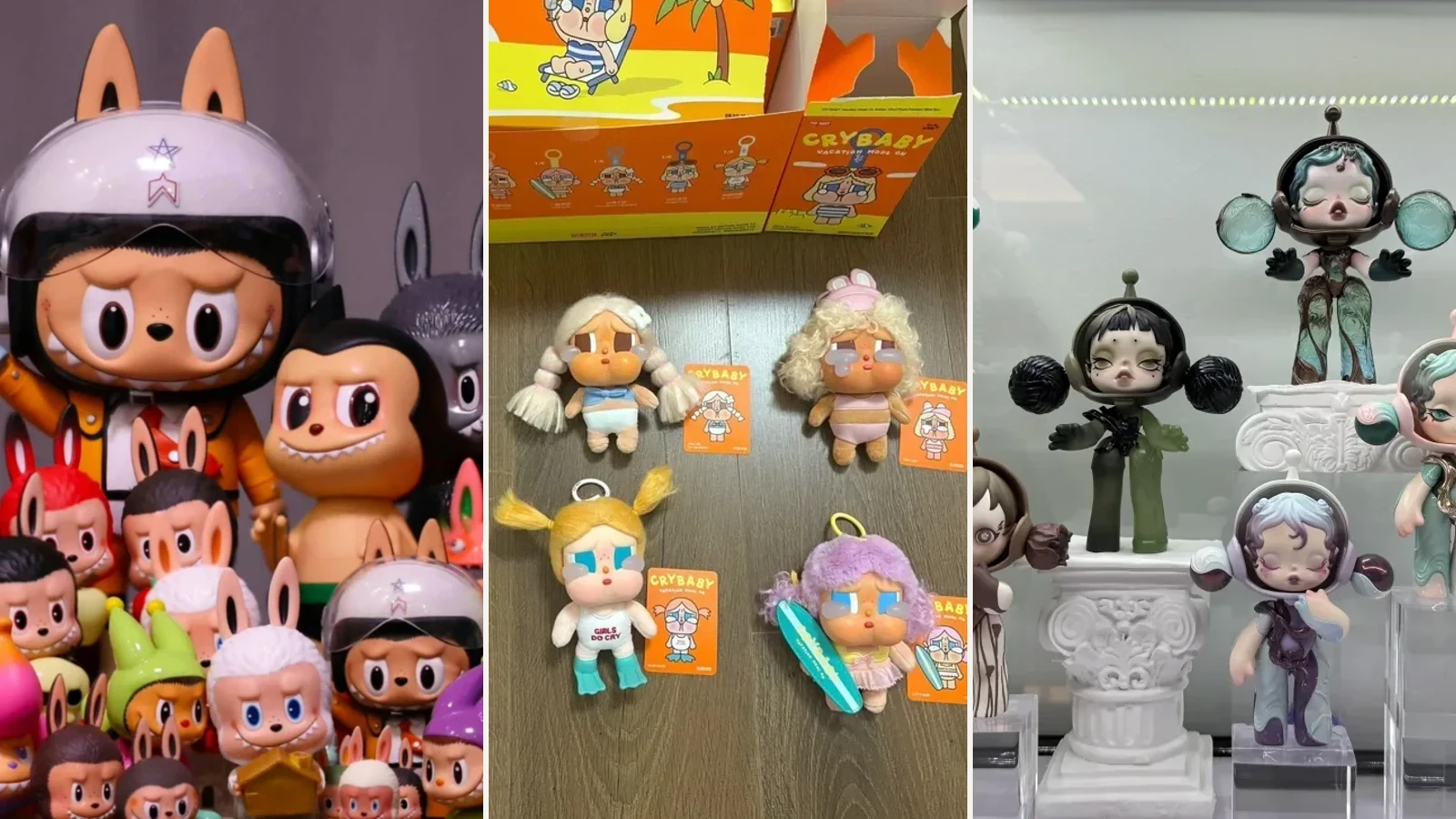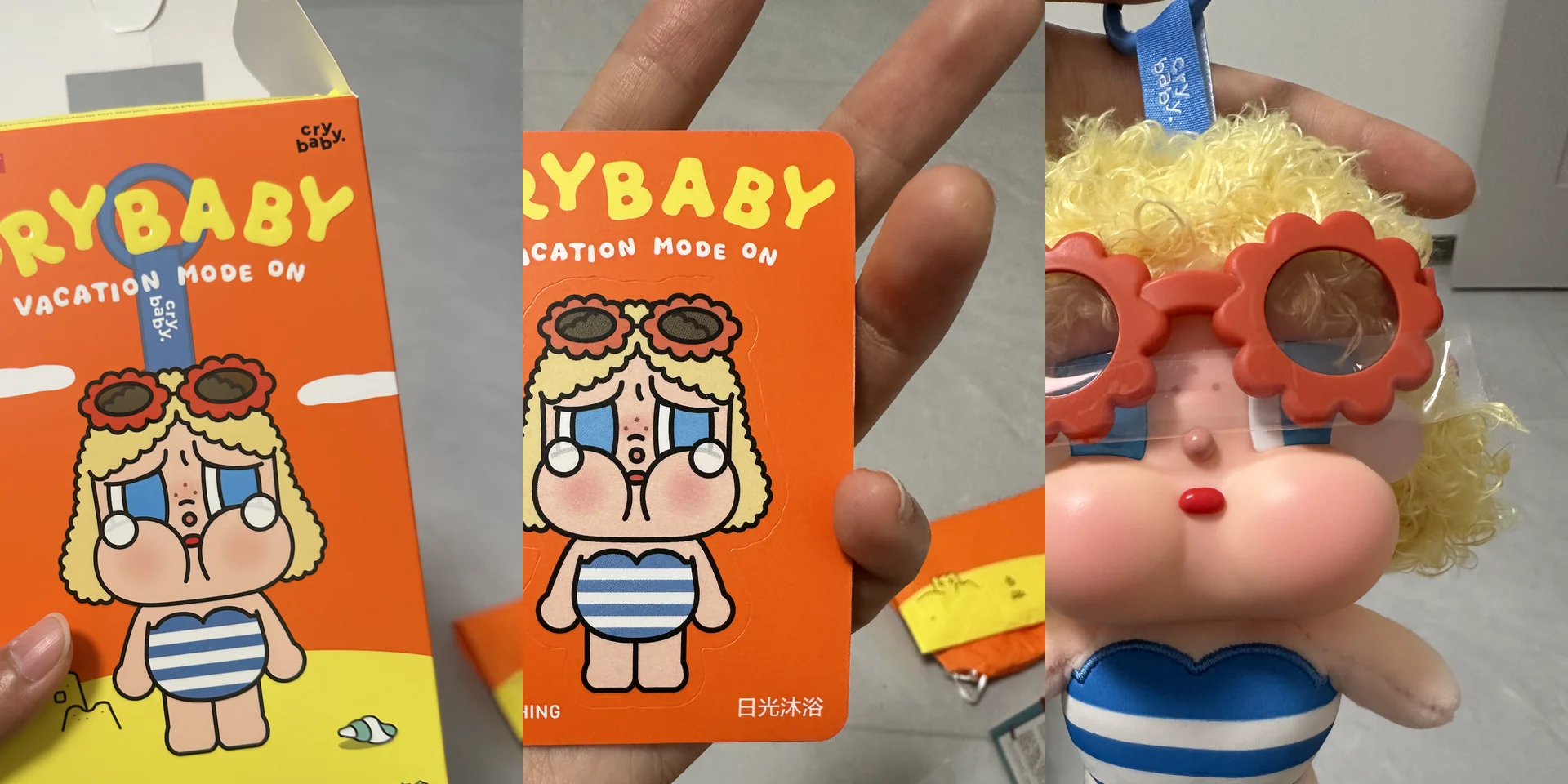
CRYBABY is not simply a sad little girl and not the name of one toy shape. Pop Mart defines the character as neither boy nor girl and not even limited to human form. Its real subject is the emotion of crying. The best first purchase is therefore not the rarest release: choose the emotional expression you want to live with, then choose whether it should sit on a shelf, hang on a bag, occupy a wall or arrive as a random reveal.
The direct answer: CRYBABY Pop Mart turns tears into a character system
The name looks obvious until the official definition complicates it. Pop Mart's US CRYBABY collection says CRYBABY is “neither a boy nor a girl,” is “not even limited to humans,” and represents a deep emotion from within. That rules out the shallowest description: CRYBABY is not one crying child repeated in different costumes.
The 2025 annual report filed with HKEX gives the philosophy behind the face. Pop Mart says CRYBABY communicates that laughter is not the only way to feel better and that crying can also heal. The company frames the character as permission not to perform the role of a strong adult all the time: tears can be followed by the courage to continue.
That is the strongest explanation of why the design works. Most cute characters promise escape from discomfort. CRYBABY keeps discomfort visible. The eyes swell, tears become physical objects and the mouth often remains open at the exact moment composure fails. Costume and scene can be playful, but the face refuses to pretend that play cancels feeling.
This does not mean every owner reads the character in the same psychological way. It means the visual system leaves room for sadness, frustration, embarrassment, anger, relief and tenderness without forcing them into a smiling mascot.
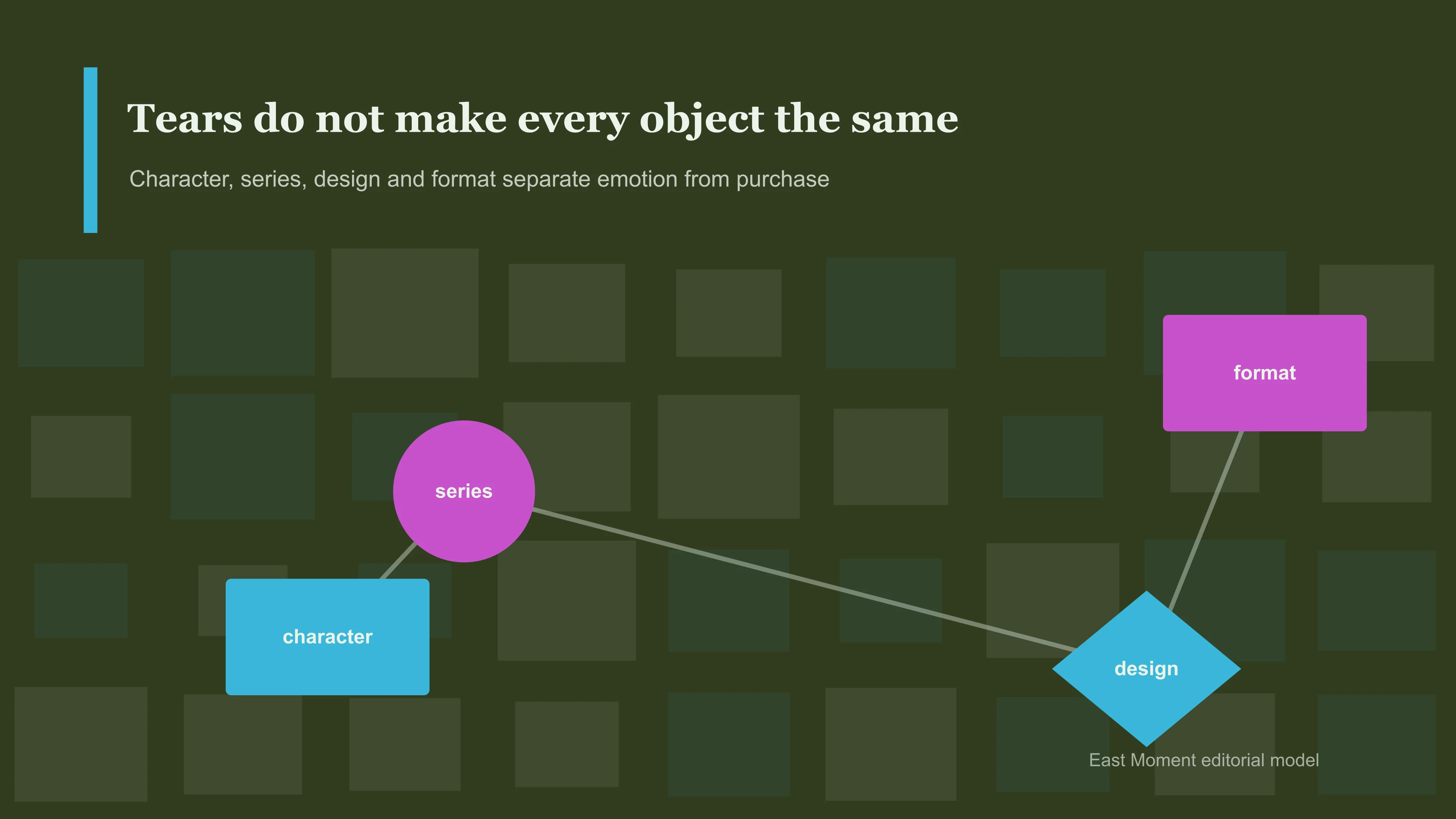
Do not confuse the character, series, design and object
A listing can contain four layers, and a buyer should identify all four:
| Layer | Example | What it tells you | What it does not tell you |
|---|---|---|---|
| IP or character system | CRYBABY | The recognizable emotional and visual identity | Exact object, dimensions or material |
| Series | Vacation Mode On | The shared theme and disclosed lineup | Which design is inside one random box |
| Design | One named beach character | The exact appearance within that lineup | Whether the object is a figure, pendant or accessory |
| Product format | Vinyl-plush pendant | Material relationship and intended use | Series composition, authenticity or condition |
This hierarchy prevents a common mistake. A shopper sees one familiar tearful face and assumes every result is a comparable “CRYBABY doll.” The official catalog currently spans hard figures, vinyl-plush pendants, larger display pieces, bags, phone objects, cups, jewelry and collaborative products. They share an identity, not a use.
The main Pop Mart guide explains how the company turns characters into repeated product systems. CRYBABY is a clear case: the emotional idea remains stable while material, scale and function move around it.
Choose the relationship before the series
Series names create urgency because each one offers a complete visual world. Start somewhere more practical.
| Intended relationship | Best starting format | Decision that matters most | Main source of regret |
|---|---|---|---|
| Quiet desk or shelf companion | Hard figure or stable scene object | Viewing angle, footprint and expression | Buying a famous design that disappears at normal distance |
| Daily bag use | Vinyl-plush pendant | Attachment, size, fabric exposure and acceptable wear | Expecting carried fabric to remain display-perfect |
| Touch and room presence | Larger plush or vinyl-plush object | Exact dimensions, handling and storage | Discovering the scale only after delivery |
| Character-focused wall | Individually hung pendants or small objects | Hardware, clearance and removal path | Treating a dense arrangement as harmless storage |
| Opening experience | One exact disclosed blind-box series | Acceptance of every basic outcome | Repeating purchases until surprise becomes chasing |
The key question is not “Which generation is best?” It is: What role will this object have after the release conversation ends?
If the answer is only “I hope it becomes valuable,” stop. CRYBABY's growth as a business IP does not make one object an investment. Asking prices, sold-out notices and high social engagement do not establish liquidity or future demand.
Real collections show two different ways to live with CRYBABY

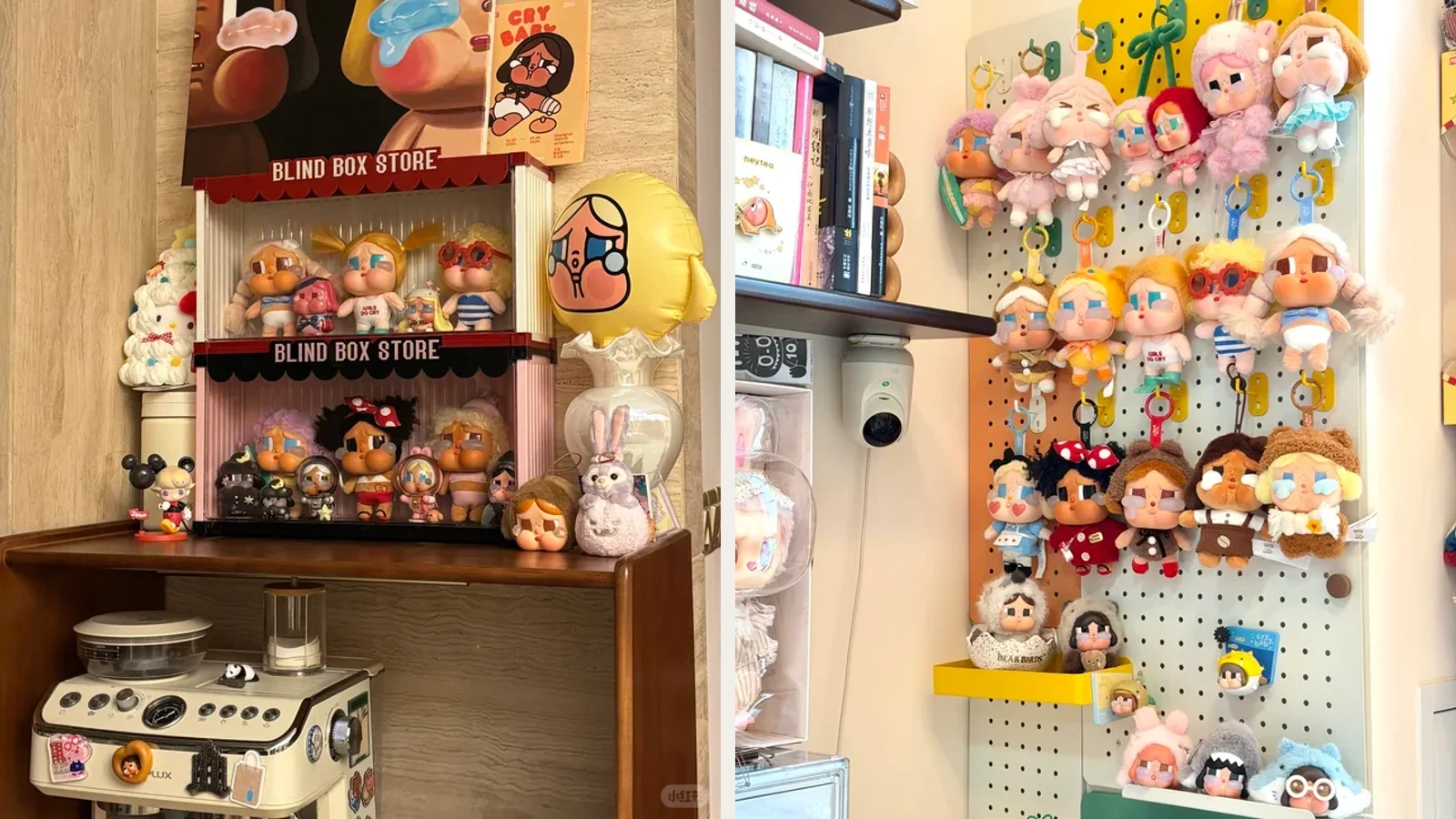
These are separate authorized collection photographs. The cabinet on the left groups formats into a compact character environment: figures, pendants, a larger head-shaped object and wall art reinforce one another. It is visually coherent, but lower shelves are dense enough that removing one object may disturb another.
The pegboard on the right treats each pendant as an individual object. Hooks preserve visible separation, while unused positions reveal that the arrangement can change. The tradeoff is exposure: an open wall does not protect against dust, light or accidental contact as a closed cabinet might.
Neither display is universally better. They solve different problems.
- Use a cabinet when dust reduction and a concentrated scene matter more than frequent rearrangement.
- Use a pegboard when individual access and changing composition matter more than enclosure.
- Leave enough clearance to remove one pendant without pulling an adjacent ring, ear, tag or textile surface.
- Treat hooks and attachment points as load-bearing hardware, not decoration.
- Keep direct sunlight and heat away from mixed textile, painted and plastic materials.
The photographs establish real use, scale and crowding. They do not authenticate every visible object or prove ideal conservation conditions.
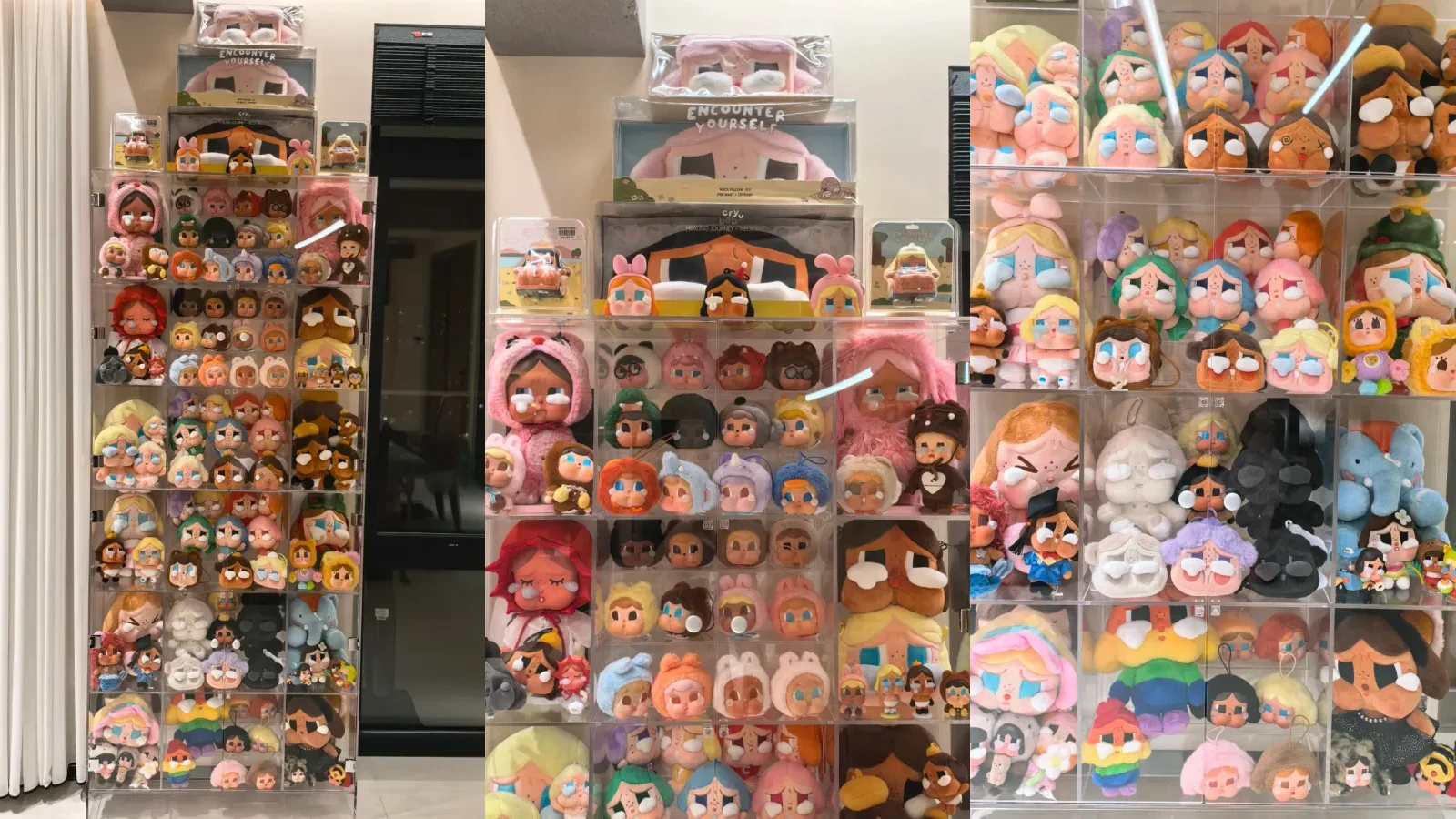
This newer room photograph makes the hidden cost impossible to romanticize. The collection is no longer a handful of toys on a shelf; it has become a 1.9-metre piece of furniture, and even that cabinet is full. Boxed pieces sit above it, small faces compete through acrylic compartments and the owner is already thinking about whether another room should become a doll room. That is not a criticism of devotion. It is the moment devotion acquires a floor plan.
I love CRYBABY most when the tears still feel emotionally precise. I lose interest when quantity makes every expression equally small. Before buying the next release, photograph the whole storage footprint from the doorway. If the new object has no visible position, no safe removal path and no place for its package, the purchase is not expanding the collection's meaning. It is only transferring the problem to the room.
These three views prove density, mixed formats and a real capacity limit. They cannot authenticate the objects, prove that acrylic is an ideal conservation material or tell us how the owner feels about every piece.
What the tears actually do in the design
CRYBABY's tears are not a minor facial detail. They are the organizing device that lets very different products remain recognizable.
First, the tears enlarge an internal feeling until it becomes visible at room distance. A tiny realistic tear would disappear on a small figure. Oversized drops survive scale reduction, photography and shelf display.
Second, they create contrast. Hair, costume and theme may change, but the translucent or light-colored tear shapes interrupt the face in roughly the same emotional zone. The viewer reads feeling before decoding the outfit.
Third, they prevent sweetness from becoming passive. Many designs pair tears with clenched brows, an open mouth, a flushed nose or an awkward posture. The character is not merely asking to be comforted. It can look irritated, overwhelmed, stubborn or exhausted.
That is why “crying means sad” is too narrow. The same visual grammar can carry several emotions. The series changes the situation around the tears; the buyer should decide which situation feels specific rather than merely choosing a color.
A real six-design set reveals what product photos hide

The left photograph prioritizes the emotional lineup: six beach characters appear together, making differences in hair, costume, accessories and tear treatment easy to compare. The handwritten note reflects one collector's reading that crying can release emotion. It is personal interpretation, not a medical claim.
The right photograph adds the missing product evidence. Six objects are paired with six design cards beneath the Vacation Mode On case. Together, the photographs answer questions a catalog tile cannot:
- the vinyl-plush objects occupy meaningful physical space as a group;
- hair and textile parts create more volume than a flat product outline suggests;
- rigid face parts and soft bodies coexist in one object;
- cards help preserve exact design identity;
- a complete set produces packaging and storage obligations beyond the six pendants.
Pop Mart's exact US product record for this Vacation Mode On vinyl-plush pendant lists a height range of 14-18.5 cm and materials of polyester, PVC and ABS with polyester stuffing. Those specifications belong to product 4071. They must not be copied to a different CRYBABY figure, bag or pendant merely because the face looks related.
Figure, vinyl-plush pendant or larger object?
The material decision changes how CRYBABY's emotional design is experienced.
Hard figure
A figure holds pose and silhouette. Sculpted tears, brows and body language can be read from a fixed angle. It suits a stable shelf, but paint, protruding parts and balance deserve attention. Check the exact height and base rather than assuming every boxed figure shares one scale.
Vinyl-plush pendant
The molded face preserves the graphic tears while the textile body introduces touch and movement. This is the format most clearly documented in the Vacation Mode On photographs. It also carries more kinds of wear: fabric can attract dust and oils, hair can compress, pale areas can stain, and the attachment can experience repeated load.
A pendant is not a smaller shelf figure. It is a carried object with a different failure path.
Larger plush, MEGA or room object
At larger scale, CRYBABY becomes less like an accessory and more like a room presence. Measure the intended location, doorway and storage route before purchase. Confirm whether displayed dimensions include an attachment, base, ears or extended accessory. A large face in a product image can conceal how much depth the object needs.
Functional accessory
A cup, bag, phone charm or display container should be judged first by its function. Character recognition cannot compensate for a strap that is the wrong length, a container that does not fit the intended object or care instructions that conflict with daily use.
How to choose a CRYBABY series without chasing hype
Use a three-pass test.
Pass 1: expression
Ignore rarity labels and identify two designs you would choose if every item cost the same. Name the specific reason: brow shape, tear treatment, posture, costume or the emotional situation. “It is popular” is not a design reason.
Pass 2: format
Confirm the exact product type, dimensions, material description and intended location. If it is a pendant, decide whether it will be carried or displayed. If it is a figure, measure the shelf. If it is a blind box, inspect the entire basic lineup.
Pass 3: uncertainty
For a random box, ask whether the least-preferred basic design is still acceptable. If not, the opening experience does not match the goal. Look for an official confirmed option where available or evaluate a documented opened item, understanding that certainty about design introduces seller, condition and authenticity questions.
Do not treat “hand-feel” or box-weight posts as guaranteed selection methods. They can document one person's observation about one production run. They do not override official probability, packaging or case disclosure.
The full transaction, authenticity and duplicate-control workflow belongs in the Pop Mart collecting guide.
Who created CRYBABY?
This question deserves a source, not a repeated caption. The current Pop Mart US CRYBABY collection page defines the character's emotional identity but does not name a creator. The exact Vacation Mode On product record used here also leaves its public designer field blank.
Secondary pages frequently attach an artist name to CRYBABY. East Moment does not expand that into a legal name, biography or origin story until an artist-owned, publisher-owned or Pop Mart creator record is attached to the claim. That is not a minor technicality: Pop Mart also operates a separate classic IP named MOLLY, so an unattributed reference to “Molly” can create a false connection between two different character systems.
The reliable statement today is narrower: Pop Mart operates and develops CRYBABY as a major artist IP, while the current official US pages cited here do not supply the creator attribution needed for a verified biography.
How large is CRYBABY inside Pop Mart?
Pop Mart's 2025 annual report lists CRYBABY revenue of RMB2.929 billion, representing 7.9% of total group revenue. The prior-year comparison in the same table was RMB1.165 billion and 8.9%.
The useful conclusion is not that every CRYBABY object became scarce. It is that the character system became commercially substantial while the company itself grew quickly. Revenue, percentage share and collector value answer different questions.
The report also says Pop Mart expanded themes and formats and added interactive features to plush products. That supports the evidence visible in real collections: CRYBABY is no longer one fixed figure. It moves among carried pendants, shelf objects, room displays and functional products while keeping the emotional face legible.
The first-purchase rule worth keeping
Choose one sentence before opening a store page:
I want this CRYBABY because its expression describes ___, and I will use it as ___.
If the first blank cannot be filled, attention may be doing the choosing. If the second cannot be filled, the format is unresolved. If the purchase requires resale to justify the cost, the budget is unresolved.
CRYBABY's value as a character is that it makes a difficult emotion visible without resolving it into a slogan. A good purchase should preserve that specificity. Choose the tearful expression you actually recognize, in the object form your life can support, through a transaction you can document.
For the wider company and product system, continue to what Pop Mart is. Use the Pop Mart character comparison to decide whether open emotion, quiet narrative, dream worlds or strong silhouette fits you, then compare CRYBABY with the Labubu guide and SKULLPANDA's identity-through-transformation system. For random boxes, confirmed items, condition records and storage decisions, use the collecting guide. Then bring one kept-expression portrait to East Moment's community: the face, its real place and the object you chose not to add. Return when other collectors have shown whether their most emotional piece survived the pressure to keep buying.