SKULLPANDA is not one character with a fixed biography repeated in new costumes. It is a stable face used to travel through identities, eras, emotions and visual worlds. That is why choosing a first SKULLPANDA by rarity or “best generation” is backwards. Choose the series whose world you would still want to see every day if every design were equally common, then choose the physical format your shelf, bag and budget can actually support.
The direct answer: SKULLPANDA is a face that can become many selves
Pop Mart's current SKULLPANDA collection says the character journeys through different worlds, assumes different personas, lives many lives and searches for its truest self. The 2025 annual report filed with HKEX sharpens that idea: the IP crosses time and space, breaks boundaries of style and expression, and creates emotional resonance through changing scenes and forms.
This is not decorative lore pasted onto unrelated products. It explains the basic design mechanism. A recognizable head, face and emotional distance remain present while costume, material, historical reference, color and setting can change radically. One release can feel theatrical and metallic; another can be quiet, botanical, futuristic, domestic or soft. The identity survives because the transformation is the point.
The clearest conclusion is therefore not “SKULLPANDA is dark” or “SKULLPANDA is a panda.” Neither description survives the full range. SKULLPANDA is an identity system built around controlled contradiction: childlike proportions with adult styling, a rounded face with emotional reserve, elaborate worlds with an expression that does not explain itself.
Who created SKULLPANDA?
SKULLPANDA is credited to Chinese artist Xiong Miao, written 熊喵 in Chinese. That creator relationship matters because the IP is better understood as an artist-led visual language than as a mascot assembled from one paragraph of corporate backstory.
The source boundary also matters. Pop Mart's 2025 annual report classifies SKULLPANDA among its major “artist IPs,” but the current US collection page and the exact product record used in this guide do not expose a populated artist field. Current profiles consistently attach Xiong Miao's name to the work; the official pages cited here establish the IP concept, product system and business record rather than a complete personal biography.
For that reason, this guide does not turn repeated retail copy into claims about the artist's legal name, education, gender or career chronology. The reliable relationship is the useful one: Xiong Miao created the character system, and Pop Mart develops and distributes it across products, exhibitions and collaborations.
Character, series, design and object are four different layers
Search results often collapse every layer into “a SKULLPANDA doll.” That makes comparison almost useless.
| Layer | Example | What it tells you | What it does not tell you |
|---|---|---|---|
| Artist IP | SKULLPANDA | The continuing face, mood and transformation logic | Exact material, size or scene |
| Series | The Feast Begins | The shared art direction and disclosed lineup | Which design is inside one random box |
| Design | One named character in the lineup | The exact costume, pose and color relationship | Whether another format uses the same scale or material |
| Product format | Hard figure, plush, pendant or MEGA object | How the object occupies space and is handled | Whether its visual world suits you |
This distinction resolves a common buying mistake. Liking one photograph of one design does not mean the whole series is acceptable. Liking the series art does not mean a plush pendant will behave like a hard figure. And recognizing the face does not make two listings comparable.
The main Pop Mart guide explains the wider company and product system. On this page, the decision starts with what remains specifically SKULLPANDA when the surrounding world changes.
Read the visual language before ranking the series
SKULLPANDA remains recognizable through several recurring relationships rather than one mandatory costume.
The face withholds a final answer
The eyes may be lowered, half-closed, heavily framed or directed past the viewer. The small open mouth and full lips can suggest sleep, surprise, breath, distance or performance without settling on one. The expression is specific enough to be recognizable but open enough to survive a new persona.
That ambiguity is useful. A permanently cheerful face would fight darker or more introspective scenes. A permanently tragic face would flatten playful releases. SKULLPANDA's emotional reserve lets costume and environment carry part of the meaning.
The head creates a stable silhouette
Many designs use rounded side forms, ear-like spheres, hair masses, headpieces or helmet structures to widen the head. The exact object changes, but the broad silhouette keeps a small figure legible among detailed clothing and props. At normal shelf distance, viewers often read head shape and color blocks before facial detail.
Costume is world-building, not a simple outfit swap
Strong SKULLPANDA series do more than recolor the same body. Pose, base, surface, accessories, translucency, metallic effects and implied setting work together. This is why series comparison should begin with art direction rather than a list of character names.
Contradiction creates tension
Rounded proportions can meet severe makeup. Pale faces can sit inside saturated or metallic worlds. A delicate pose can carry armor-like detail. Softness and distance remain visible at the same time. That tension is more durable than the label “dark cute,” which describes only part of the catalog.
Choose the visual world first, then the product
Use this decision map before looking at rarity or sold-out status.
| What you actually want | Best starting point | Evidence to inspect | Main regret to prevent |
|---|---|---|---|
| One complete miniature world | Hard figure from a coherent series | Full basic lineup, pose, base, viewing angle and maximum dimensions | Loving the poster but disliking several physical designs |
| A single sculptural focal point | Larger figure or MEGA-scale object | Width, depth, height, weight, base and delivery route | Discovering that the object dominates the room or cannot be stored |
| A carried character | Plush or vinyl-plush pendant | Attachment, textile exposure, actual scale and care limits | Expecting a carried textile object to remain display-perfect |
| A changing display | Several figures with risers or modular shelves | Clearance, access, dust control and visual hierarchy | Buying more objects before solving how to see them |
| The opening experience | One exact blind-box series | Every basic design, official box rules and hard spending limit | Turning one unwanted result into repeated chasing |
The hard test is simple: remove the secret design, resale listings and like counts. If the remaining visual world still holds your attention, the series has passed the first test.
A real collection shows why “which series?” is a spatial question
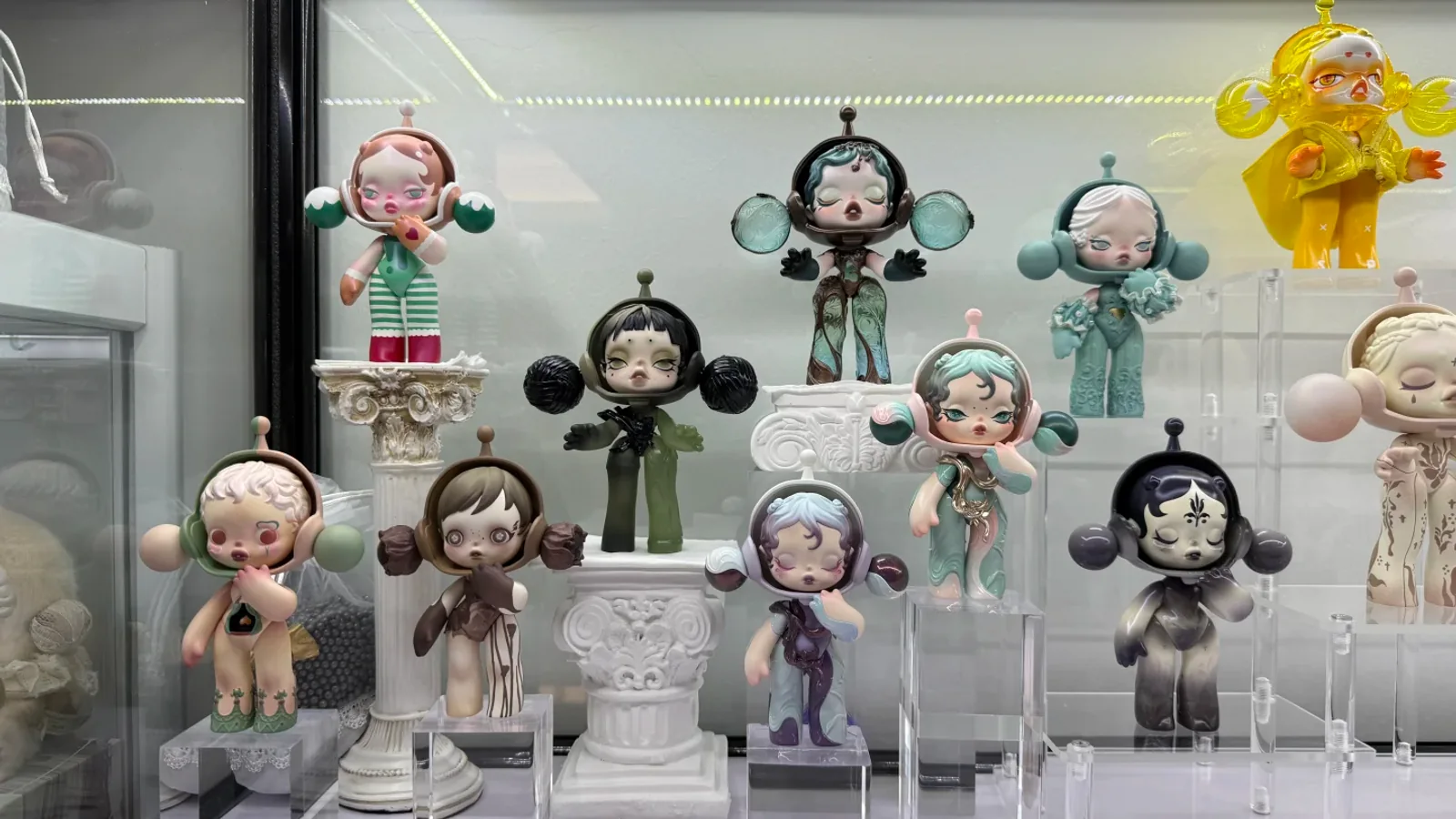
The hero photograph is not a catalog lineup. It is one authorized collector's cabinet, with figures raised on clear blocks and architectural plinths at several heights. Similar head proportions repeat, but differences in color, costume, base and pose remain visible because the display creates separation.
Three decisions are doing more work than the quantity of objects:
- Height: risers stop the back row from becoming a row of heads.
- Spacing: negative space protects silhouettes and makes series differences readable.
- Light: top lighting reveals translucent and metallic surfaces, but reflection on the glass also shows why more light is not automatically better.
This changes how a buyer should evaluate a figure. Product pages isolate the object against a clean background. Real display adds glass, neighboring colors, eye level and viewing distance. A design that looks intricate at phone distance can disappear in a crowded cabinet. A simpler high-contrast design may hold the shelf more effectively.
Before buying, reduce the product image to roughly the size it will occupy from your normal viewing position. If only the color remains legible, decide whether that is enough.
A collector can turn one series into a scene

This authorized dining-series display demonstrates a different relationship. The collector did not merely place a complete lineup shoulder to shoulder. Figures are raised on silver-toned vessels and clear supports, a circular graphic anchors the background, pearl strands connect the lower level and directional light turns reflective surfaces into part of the scene.
The practical lesson is not to copy the decoration. It is that a series can supply the cast while the collector supplies the stage.
A useful scene has four layers:
- Anchor: one central object or backdrop establishes the visual center.
- Levels: foreground, middle and upper positions stop small figures from blocking one another.
- Repeated material: silver, glass and pearl-like surfaces make separate objects feel related.
- Exit path: every figure can still be removed without pulling a chain, toppling a riser or scraping another surface.
The last condition is where photography and long-term display diverge. A dense arrangement may look complete in one frame while being difficult to clean or change. Build the scene, then remove one object from the center. If that cannot be done safely, the display is too interlocked.
The photograph proves one real display solution and the collector's authorship. It does not authenticate every visible object or establish that decorative materials are chemically safe for long contact.
One figure can carry a world—if the world is edited
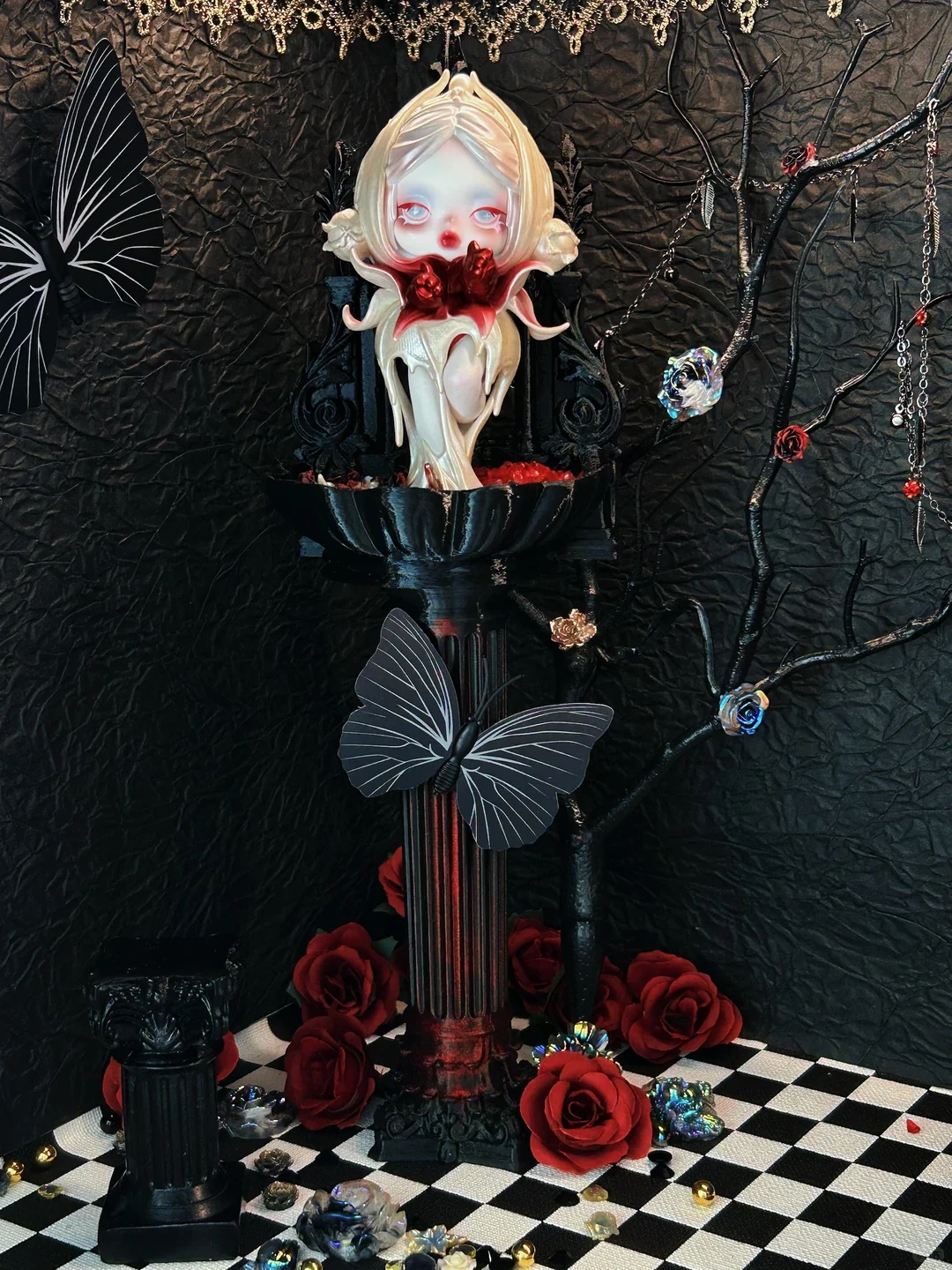
This authorized home-built scene makes the opposite argument from a full cabinet. One pale figure holds the center because almost everything around it has been forced into the same black, ivory and blood-red grammar: the pedestal lifts the face; the roses repeat the collar color; the butterflies echo the wing-like silhouette; the branch extends the scene without competing with it. The collector has not displayed more. They have edited harder.
That distinction is why I reject the idea that a good SKULLPANDA display begins with completing a set. A single figure can feel more finished than twelve figures when the surrounding materials repeat something already present in the design. Start with one visible cue—color, texture, era or shape—and let no more than two supporting cues answer it. Props that introduce a fourth unrelated idea are clutter, however expensive they are.
The photograph proves a real staging method and the scale relationship between figure, pedestal and props. It cannot prove that the decorative materials are archival-safe, that the object is authentic or that this arrangement survives dusting and daylight unchanged.
Figure, plush, pendant or MEGA: the format changes the relationship
Hard figure
A hard figure preserves pose, surface treatment and small sculptural decisions. It is usually the clearest way to read a series as art direction. The tradeoff is physical: extended parts can snag, tall bases need clearance and painted surfaces can make casual handling costly.
Pop Mart's exact US record for SKULLPANDA The Feast Begins Series Figures lists a maximum height of 15 cm / 5.91 inches and PVC/ABS materials. It records an online release on October 30, 2025 and offers both single-box and 12-box whole-set options. Those facts belong to product 4080; they are not a default specification for every SKULLPANDA figure.
Plush or vinyl-plush pendant
A soft body changes the character from a fixed scene to a touchable or carried object. Hair, textile pile and stuffing add volume that a front-facing product image may hide. Bag use also adds friction, compression, dust, skin oils, weather and repeated load at the attachment point.
Treat “display pendant” and “daily bag pendant” as different condition goals. There is no honest way to carry a pale textile object frequently and promise that it will remain visually untouched.
Larger plush or room object
At larger scale, the head and expression become room architecture. Measure width and depth, not only height. Confirm whether the published size includes the base, headpiece or extended limbs. Plan the storage location before the display location; an object is hardest to live with when it has nowhere safe to go during cleaning, travel or a room change.
MEGA and art collaboration
MEGA-scale SKULLPANDA objects can shift the emphasis from lineup collecting to one focal work. The 2025 annual report gives a useful example: MEGA alpha SKULLPANDA 1000% Wu Jian'an - Nine Heavens integrated techniques including velvet flower, Pa Hua, shadow puppetry and carved lacquer. That is evidence of a specific collaboration and material-cultural program, not proof that every large edition is museum-level art.
The same boundary applies to institutional display. The report records SKULLPANDA CAGE-UNCAGE at the National Museum of Singapore. Its English description refers to “certainty and freedom,” while the Chinese text refers to “choice and self.” The discrepancy should remain visible; compressing both into one neat slogan would make the source less accurate.
How to compare two SKULLPANDA series in ten minutes
Do not begin with release date. Use five passes.
1. Reduce both lineups to silhouettes
Look for differences in head width, body height, base and extended accessories. If every design in one series relies on tiny printed detail, it may be weaker at your intended viewing distance.
2. Identify the visual rule
Finish this sentence for each series: “This world is held together by ___.” The answer might be a material effect, era, stage, color system, object family or emotional state. If the answer is only “different costumes,” the concept may not be specific enough for you.
3. Mark the acceptable basic designs
Count the basic designs you would willingly receive. Do not include the secret. A random purchase makes sense only when the acceptable share is high enough for your budget and tolerance. Social “hand-feel” methods do not convert an unwanted lineup into a controlled purchase.
4. Measure the intended position
Use the exact product record. Height alone is insufficient when a design has a wide headpiece, long base or forward projection. Leave access space above and beside the object.
5. Choose certainty or surprise
If you want one specific design, a documented confirmed or opened item is the more honest route, subject to seller, condition and authenticity checks. If you want the reveal, buy one box within a predetermined limit and accept the disclosed basic outcomes. The full workflow belongs in the Pop Mart collecting guide.
Real rooms reveal the cost of scale

The left view shows a collection as a room system: several cabinets, boxes stored above, mixed figure sizes and a large object outside the glass. The right view shows the internal density more clearly: multiple rows of small figures need tiered risers, while a circular wall shelf holds only a few head-shaped objects with more breathing room.
The comparison produces a practical capacity formula:
usable collection capacity is not shelf width divided by figure width. It is the number of objects that remain visible, removable and cleanable.
That number is always lower than the maximum physical fit.
Plan four resources, not one:
- display footprint;
- protected storage for boxes, cards and rotated objects;
- maintenance access;
- visual attention.
When every shelf is equally dense, the collection loses hierarchy. A deliberate empty zone can make the objects already owned more visible than another purchase would.
How large is SKULLPANDA inside Pop Mart?
Pop Mart's 2025 annual report lists SKULLPANDA revenue of RMB3.540 billion, equal to 9.5% of group revenue. The 2024 comparison was RMB1.308 billion and 10.0%. Revenue rose sharply while its share of a rapidly growing company shifted slightly downward.
The defensible conclusion is narrow but important: SKULLPANDA is a major commercial artist IP with enough range to support figures, plush, accessories, exhibitions and collaborations. It does not follow that a sold-out object is scarce in a durable market, that an asking price is achievable or that one purchase is an investment.
Business scale answers “How important is this IP to the company?” It does not answer “What will my object be worth?” East Moment does not recommend collectibles as investments.
The first-buyer plan
Use this sequence before checkout:
- Choose one visual world. Compare at least two complete basic lineups and name the specific art-direction rule you prefer.
- Choose the relationship. Decide whether the object will be viewed, carried, handled, opened for surprise or used as the anchor of a larger scene.
- Read the exact record. Confirm product name, format, dimensions, materials, included components and single-box or whole-set status.
- Test the least-favorite outcome. For a blind box, decide whether the least-preferred disclosed basic design is acceptable before paying.
- Measure display and storage. Include width, depth, headpiece, base, removal clearance and the package you intend to keep.
- Set total spend. Include tax and shipping. Do not use a disappointing pull as permission to change the limit.
- Keep evidence. Save the receipt, order record, exact product URL and arrival photographs. Packaging and cards help identify an item but do not replace transaction provenance.
One sentence should survive the process:
I chose this SKULLPANDA because this visual world expresses ___, and this object will live ___.
If the first blank contains only “popular,” the series decision is unresolved. If the second is blank, the format decision is unresolved. If resale is required to justify the cost, the budget decision is unresolved.
SKULLPANDA works because the face can change worlds without becoming empty. A good first purchase respects that strength. Choose a world with a point of view, an object with a real place in your life and a transaction you can document.
I would not buy a SKULLPANDA merely because a resale chart, secret ratio or crowded feed tells me to hurry. I want the figure to survive the moment after the box opens, when hype is gone and the object has to hold a shelf on its own. A first purchase must earn attention through its visual world; scarcity is not a substitute for taste.
For the company and its wider character system, continue to what Pop Mart is. Use the Pop Mart character comparison to test SKULLPANDA's transformation logic against HIRONO, DIMOO, MOLLY and other IPs, compare it directly with Labubu and CRYBABY, then use the collecting guide for buying channels, condition records, duplicates and storage. Bring one scene-and-removal test to East Moment's community and return when other collectors have shown which arrangements survived real cleaning, distance and time.