
Watch You Are My Glory if you want an adult romance where attraction grows through competence. Its fantasy is not that work disappears when love arrives; it is that two successful people learn to respect the cost of each other's work.
Qiao Jingjing enters as a celebrity who is publicly excellent and privately bad at a game she is paid to represent. Yu Tu enters as an aerospace engineer who is technically gifted and privately unsure whether idealism can survive ordinary financial pressure.
Neither needs the other to become impressive. They need someone who understands why being impressive has become exhausting.
Watch Qiao Jingjing and Yu Tu in the official You Are My Glory trailer
You Are My Glory makes work part of the love story
You Are My Glory (《你是我的荣耀》) is a 2021 contemporary romance starring Dilraba Dilmurat as actress Qiao Jingjing and Yang Yang as aerospace engineer Yu Tu. They reconnect through mobile gaming after knowing each other at school. The ending is happy: the relationship survives career demands and moves toward marriage without requiring either person to abandon professional identity.
The series is based on Gu Man's novel and released by Tencent Video. It is warm, low-conflict and highly polished. Watch it for adult ease, career pressure and two people learning each other's attention. Skip it if you need messy social realism or fast plot turns; the drama's comfort is deliberate and sometimes too frictionless.
| Search question | Direct answer |
|---|---|
| Is it worth watching? | Yes, if you want a low-conflict adult romance built around work and mutual admiration |
| Who are the leads? | Dilraba Dilmurat plays Qiao Jingjing; Yang Yang plays Yu Tu |
| Is there a love triangle? | Not as the central engine; vocation and self-worth create the real obstruction |
| Is the ending happy? | Yes; love and work are coordinated rather than forced into a final either/or choice |
| What is the weakness? | The world often protects the couple from consequences that would make the fantasy messier |
Track one: gaming creates equality before romance

The gaming plot works because it gives attraction an external task. Jingjing is famous, but inside practice she must fail visibly, accept instruction and make decisions under pressure. Yu Tu is not useful because he is handsome. He is useful because he can observe a mistake without humiliating the learner.
Their early intimacy is attention with rules. He notices her habits. She notices the difference between his patience and his self-doubt. The game becomes less important later, but it earns the romance a shared grammar before desire takes over.
This is also where Yang Yang's profile becomes useful: his polished control turns into acting when Jingjing's response forces a delay, a recalculation or an awkward silence.
Track two: celebrity is labour, not a glittering obstacle

Qiao Jingjing is one of Dilraba Dilmurat's best fits because the drama does not pretend beauty and public visibility are accidents. Her job requires rehearsal, brand discipline, emotional containment and the ability to remain readable to strangers.
The role's lightness is deceptive. Jingjing can tease because she understands the room. More importantly, she can stop pursuing. When Yu Tu's uncertainty turns her into a possibility he can repeatedly postpone, she protects her own dignity without turning the scene into punishment.
That boundary is why the romance feels adult. Love is not proof that one person must wait forever while the other solves himself.
Track three: Yu Tu's real rival is not another man - it is the price of meaning

Yu Tu's aerospace career gives the drama seriousness, but it should not be mistaken for documentary proof about China's aerospace industry. Its dramatic function is sharper: he has to decide whether meaningful work remains meaningful when it pays less, exhausts him and makes him compare his life with richer classmates.
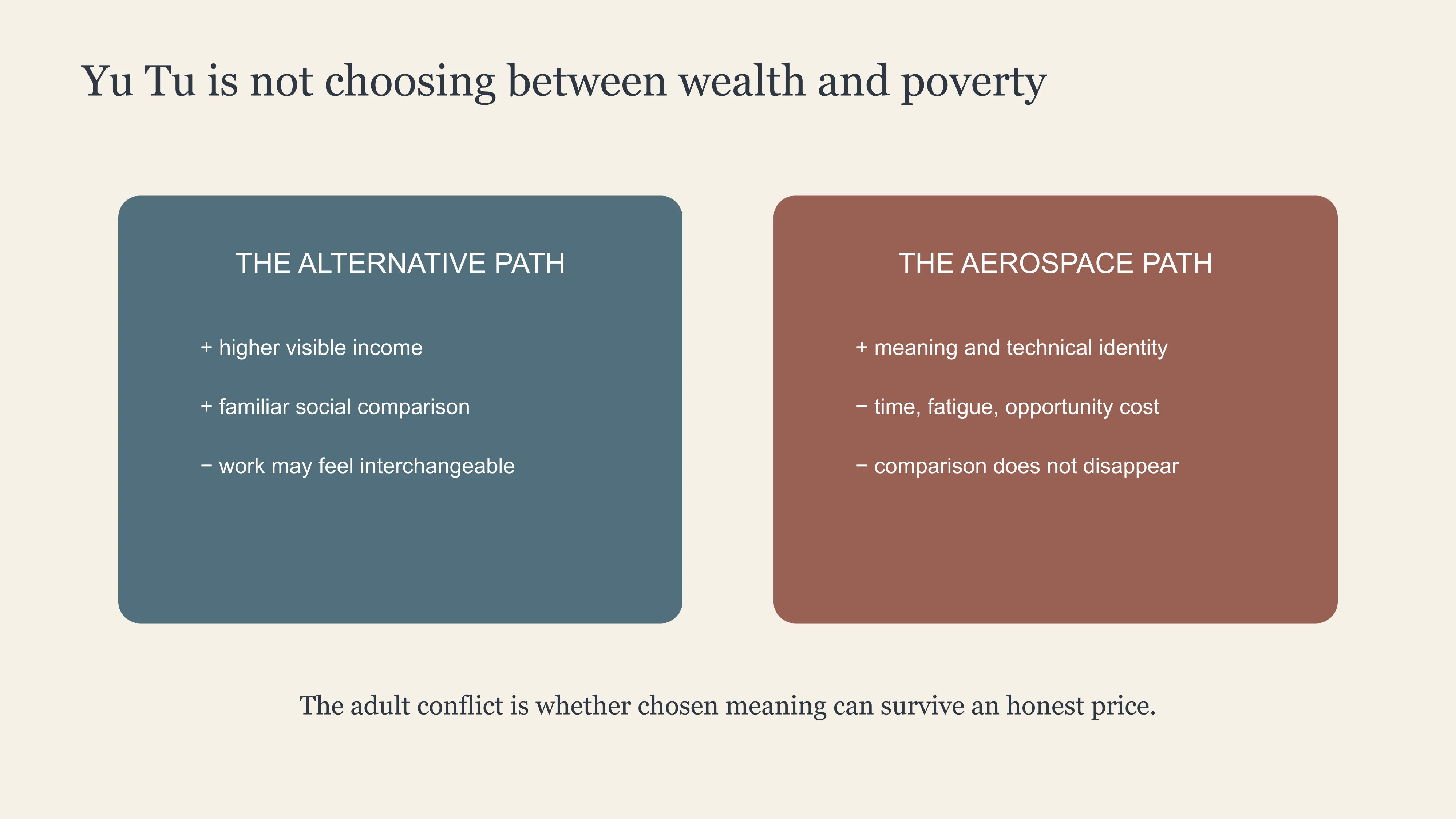
Calling this a simple choice between money and ideals makes Yu Tu flatter than he is. He is not standing between wealth and literal poverty. He is comparing two professional paths, two versions of adult competence and two ways of explaining his life to people whose judgments matter. The pain comes from knowing that a meaningful choice can still be materially expensive.
That distinction was the piece that made Yu Tu feel human to me. I do not admire him because the drama puts aerospace behind a handsome face. I recognize the humiliation inside comparison: the moment when somebody else's salary, certainty or visible progress makes your own chosen path feel childish. A vocation does not become fake because it has a cost. It becomes real when the cost is finally admitted.
Yu Tu survives outside the original broadcast window because his difficulty feels recognizable: a respected ideal cannot answer every practical question.
The drama's answer is hopeful and selective. Jingjing's success softens some material pressure, but she does not buy his purpose for him. Yu Tu has to choose the work again with open eyes.
The aerospace detail is credible texture, not proof of an ordinary workday
The series did enough homework to make Yu Tu's profession feel organized rather than magical. Meetings have technical purpose. Development is distributed across teams. The work depends on systems, testing and institutional coordination, not a lone genius staring nobly at a screen. The China Manned Space Agency's own description of the program shows how many specialized systems and participating units sit behind one national space effort. That scale is the reality the romance can only compress.
People familiar with the field have recognized the care in the vocabulary and working relationships while also pointing out the polish. That distinction matters. Accurate terms do not make Yu Tu's days statistically representative. The drama cleans the office, concentrates responsibility into attractive characters and gives private emotion room that real project schedules may not grant.
I still consider the professional writing a major strength because it refuses the laziest fantasy: that “important work” is automatically fulfilling. Yu Tu worries about compensation, comparison, family obligation and the humiliating possibility that commitment has become stubbornness. These are not aerospace-exclusive problems. They are the adult questions hiding under every admired vocation.
The series becomes less convincing whenever Jingjing's wealth silently absorbs those pressures. A rich partner can change the household equation, but that is not the same as repairing compensation, workload or institutional incentives. Romance solves loneliness. It does not solve labor policy. The show knows this in its best scenes and forgets it in its smoothest ones.
That is the honest boundary: watch the drama to understand why a capable person might remain loyal to difficult work, not to learn how China's space program operates day to day. Its achievement is emotional specificity backed by credible texture. Its limitation is a world arranged so that sacrifice can remain beautiful.
The two tracks meet when admiration becomes specific

“Each shining in their own field” can become motivational wallpaper. The drama earns it only when competence changes how the couple listens, waits and gives ground.
Jingjing does not admire a generic scientist; she watches what Yu Tu sacrifices, how he concentrates and why the work changes his availability. Yu Tu does not admire a generic star; he learns how much planning and emotional labour sit under public ease.
Competence becomes intimacy when it is observed accurately. Otherwise it is résumé romance.
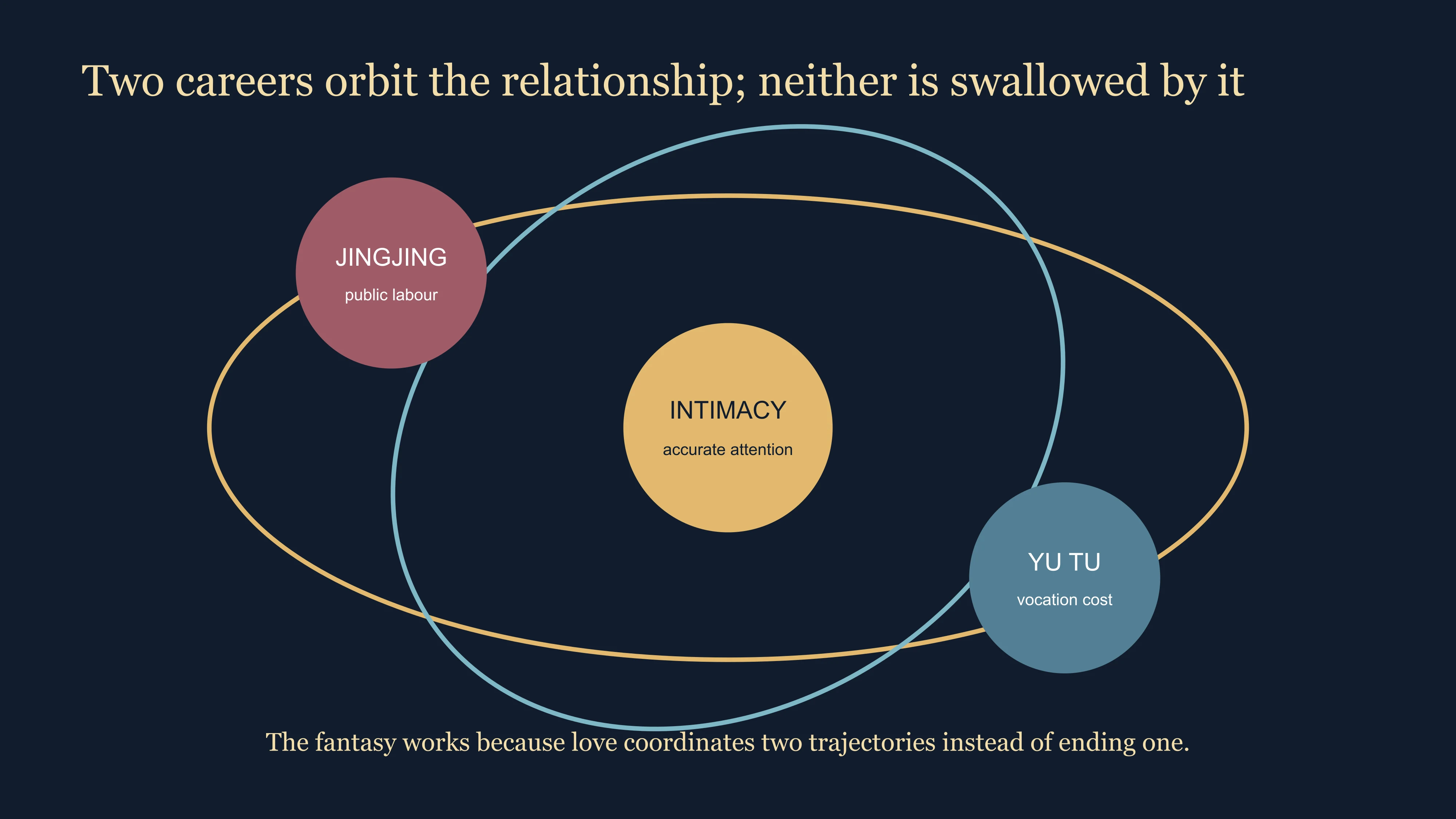
The orbit is the series' central fantasy. Jingjing does not shrink into a supportive celebrity girlfriend; Yu Tu does not become a decorative scientist husband. Their careers continue to pull time, attention and identity away from the center. The relationship survives because neither demands permanent centrality.
This is more convincing than the slogan that they “shine in their own fields.” Shining is a poster. Coordination is a calendar, an unanswered message, an exhausted return home and the decision not to turn absence into indifference. The drama is at its most adult when it shows that interpretation itself is part of love: knowing whether silence means concentration, avoidance, protection or neglect.
Yang Yang and Dilraba are playing two different kinds of polish
The casting works because the leads arrive with visual authority that the story does not need to invent. But their polish functions differently. Qiao Jingjing's is public labor. She must remain readable, likable and controlled for an audience that feels entitled to react to her. Yu Tu's is technical and private. He wants the answer to be correct even when his emotional timing is not.
Dilraba's best choice is making Jingjing's brightness strategic rather than naive. She knows how to warm a room, and therefore the moments when she withdraws that warmth carry force. Yang Yang's harder task is to let Yu Tu's competence fail without making him suddenly inarticulate for plot convenience. A delayed answer works only if we can see what he is protecting.
Their chemistry is not proof by itself. The test is whether each actor changes the other's timing. When Jingjing stops pursuing, does Yu Tu lose the comfortable pace of self-analysis? When Yu Tu names the professional cost honestly, does Jingjing listen without turning support into rescue? Those exchanges make the romance reciprocal.
What the series gets right about adult restraint
I read the performances as restrained when a withheld feeling changes the next decision, and as stiff when the calm face carries no consequence. Adult restraint is not automatically mature, and stillness is not automatically subtle. The scene has to show what the silence costs.
In a workplace and celebrity context, immediate emotional release can create costs for people beyond the couple. A postponed conversation may be considerate. It may also be avoidance wearing professional clothes. You Are My Glory is worth discussing because it repeatedly puts those two possibilities close together.
My rule is simple: restraint earns respect when it protects shared work or gives the other person room; it becomes cowardice when it protects only the speaker's image. Yu Tu crosses that line more than once. Jingjing's refusal matters because it forces the drama to stop treating his introspection as an unlimited excuse.
Why the low conflict works - and where it becomes too easy

The drama's popularity has a reason, and I understand the urge to rewatch it repeatedly. Rewatchability here comes from comfort: conversations resolve, adults are capable, the couple likes each other and professional worlds look beautiful.
The limitation is the same. Supporting structures often cooperate with the central fantasy. Celebrity risk, income difference and aerospace schedules generate tension, but the series rarely lets these systems deform the relationship for long. If You Are My Glory feels emotionally healthy, it is partly because the world has been edited to give health room.
That is not a reason to dismiss it. It is a reason to name the pleasure honestly.
I return to it for that pleasure. I simply would not use the series as a blueprint for how celebrity, money or research institutions behave. It is an emotionally intelligent fantasy with unusually good professional texture, not social documentation. Its truth is in the longing to be understood accurately by the person who loves you.
Does You Are My Glory have a happy ending?
Yes. The ending confirms a stable relationship and honours Yu Tu's aerospace work rather than forcing a choice between marriage and vocation. The emotional resolution is not the wedding itself. It is the shift from “Will your work leave space for me?” to “I understand the shape of the space we are building.”
For a first watch:
| Watch for | Best section | What it proves |
|---|---|---|
| competence as flirtation | gaming practice | attraction has an external task |
| Jingjing's dignity | the rejection and pause | confidence includes boundaries |
| Yu Tu's conflict | career decision scenes | idealism has a material price |
| adult partnership | later work-and-home scenes | love coordinates rather than erases careers |
Compare its adult ease with Love Like the Galaxy, where family and state power make intimacy far more dangerous, or with The First Frost, where shared space tests safety before professional coordination becomes possible. In the comments, identify one scene where competence genuinely changes the relationship. Then bring one “work creates closeness” scene and one “work creates distance” scene into the East Moment community. Continue through the Chinese TV shows collection for a less frictionless next watch.