A kung fu uniform is not one timeless Chinese outfit. The right choice is the least theatrical garment that correctly answers three questions: Which room are you entering, what movement will you practise, and what does the teacher or event require? Ask the school first, buy for the movement second, and let aesthetics decide last.
Kung fu uniform: choose the room before the costume
Online stores make the decision look easy. Search for a kung fu uniform and you meet the same visual promise: a shiny jacket, frog-button closure, loose trousers and soft black shoes. The photograph says “traditional” before the product description has proved anything.
I do not accept that shortcut. There is no single outfit that can authenticate Chinese martial arts. A taolu athlete on a judged floor, a sanda competitor, a student repeating basics in a neighbourhood school, a person practising taijiquan in a park and a monk demonstrating at Shaolin may all be doing something connected to Chinese martial arts. Their clothes do not have the same job.
The distinction is practical, not pedantic. A beginner who buys the most cinematic set may arrive at a school that trains in a T-shirt and ordinary athletic trousers. Someone entering a taolu event may need to follow written attire rules. A visitor may copy a monastic robe without belonging to the institution that gives the robe meaning. A performer may legitimately choose colour, shine and silhouette because the audience must read the movement from a distance.
My rule is deliberately strict: clothing can show context, but it cannot prove lineage, skill or authenticity by itself. The wider Chinese martial arts guide maps schools, sport and screen culture. This page owns the narrower buying decision: what should you actually wear?
| Setting | What normally decides the outfit | Best first action | Common mistake |
|---|---|---|---|
| First class | School custom, instructor request and type of training | Ask for the exact dress expectation before buying | Arriving in a formal satin set because it looked “authentic” online |
| Regular forms practice | Range of motion, heat, repeated floor contact and school identity | Use the school's normal shirt, trousers and shoes | Treating decorative trim as evidence of better training |
| Taolu competition | Current event and federation rules | Read the entry rules and confirm with the coach | Assuming every attractive wushu uniform is legal for every event |
| Sanda | Competition kit and equipment specified by the event | Follow coach and organizer requirements | Shopping for a generic “kung fu suit” instead of the actual competition category |
| Demonstration or stage | Visual readability, choreography and organizer brief | Separate performance design from class clothing | Calling a costume historical because it looks old |
| Religious or institutional setting | The institution and role of the wearer | Do not imitate status clothing casually | Calling every robe a “Shaolin uniform” |
The room–movement–rule test
Before material, colour or price, run three checks.
Room: Is this an ordinary class, a public park, a competition floor, a stage, a ceremony or a temple-linked institution? The room tells you who has authority over the dress decision. In class, that is usually the school. At a competition, it is the event rulebook and coach. In a religious setting, it is the institution—not an e-commerce category.
Movement: Are you repeating stances and kicks, performing a weapons routine, practising partner sensitivity, grappling, or doing conditioning? Clothing that looks spacious while standing may pull across the hips in a low stance. Long cuffs may be visually elegant and practically distracting around partner work or equipment. This is not a medical or protective claim; it is a simple question of whether the garment stays out of the task.
Rule: Has the teacher, school or organizer specified a colour, logo, cut, shoe or complete kit? That answer overrules every generic buying guide, including this one. The current International Wushu Federation taolu rules contain competition-attire provisions. A product titled “professional wushu uniform” is not proof that it satisfies the event you will enter.
Only after those three checks should you compare fabric, closure, fit and appearance.
Competition uniforms are rules made visible
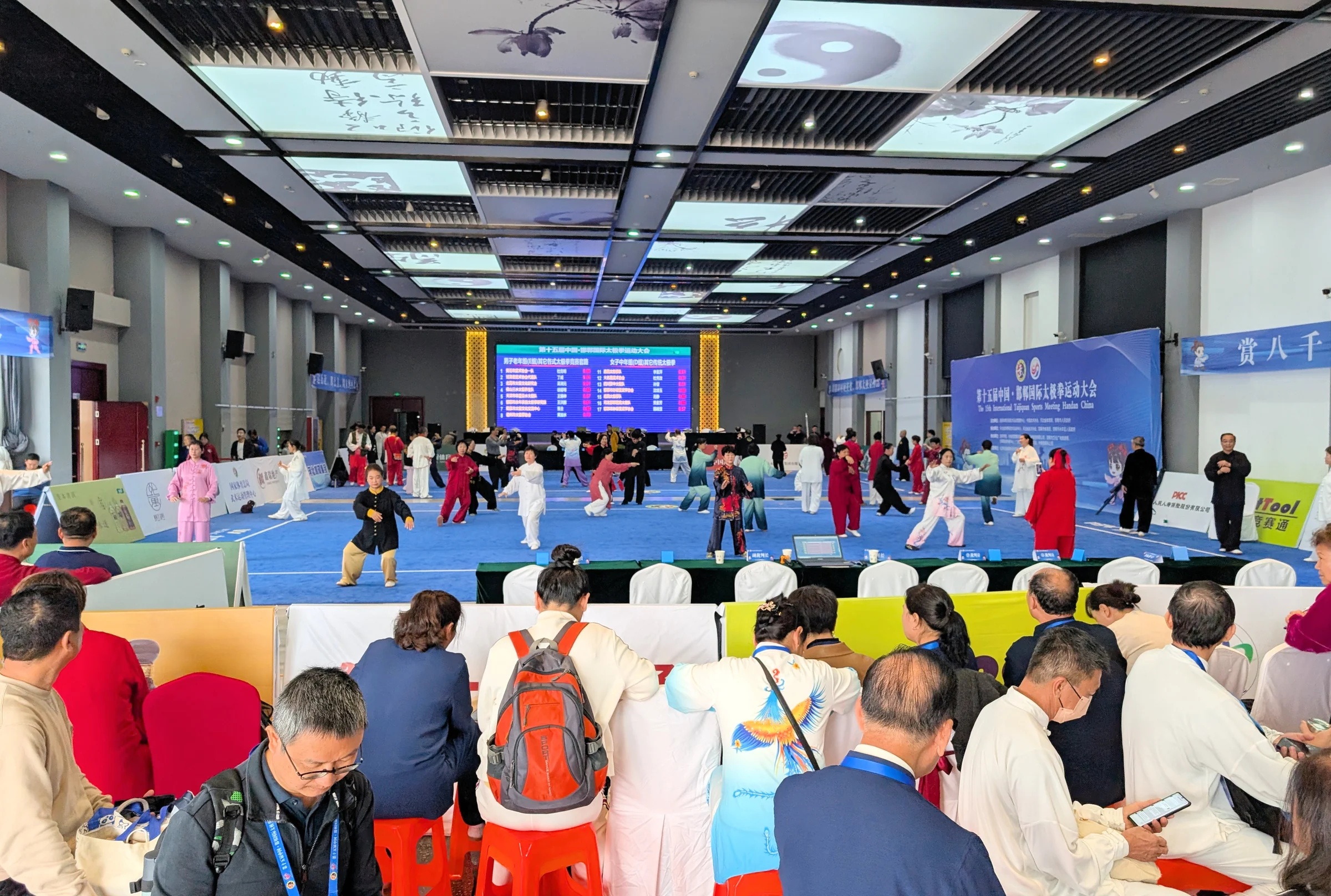
This 2024 Handan photograph is the best correction to the idea that one colour or one silhouette owns Chinese martial arts. On the same floor, practitioners wear white, red, pink, black, green and patterned sets. Some tops have frog closures; some read more like simple jackets. The visible variety is not disorder. It is evidence that a competitive setting can contain multiple permitted designs while still operating inside rules.
The official IWUF taolu overview distinguishes bare-hand, short-weapon and long-weapon events. Clothing does not create those disciplines. The routine, implement and rules do. A uniform helps officials and viewers see the body, but it cannot turn an untrained pose into taolu.
If you are buying for competition, ask for the event name, current rule edition, team requirement and coach approval. Do not start with “What is the most traditional colour?” Start with “What will be accepted in this event?”
That also explains why a medal photo or promotional portrait is weak shopping evidence. It may show team clothing after the event, not the garment worn during the routine. The image above proves real clothing diversity in a named competition environment; it does not prove that every visible outfit is legal in every division or federation.
Ordinary practice often looks ordinary
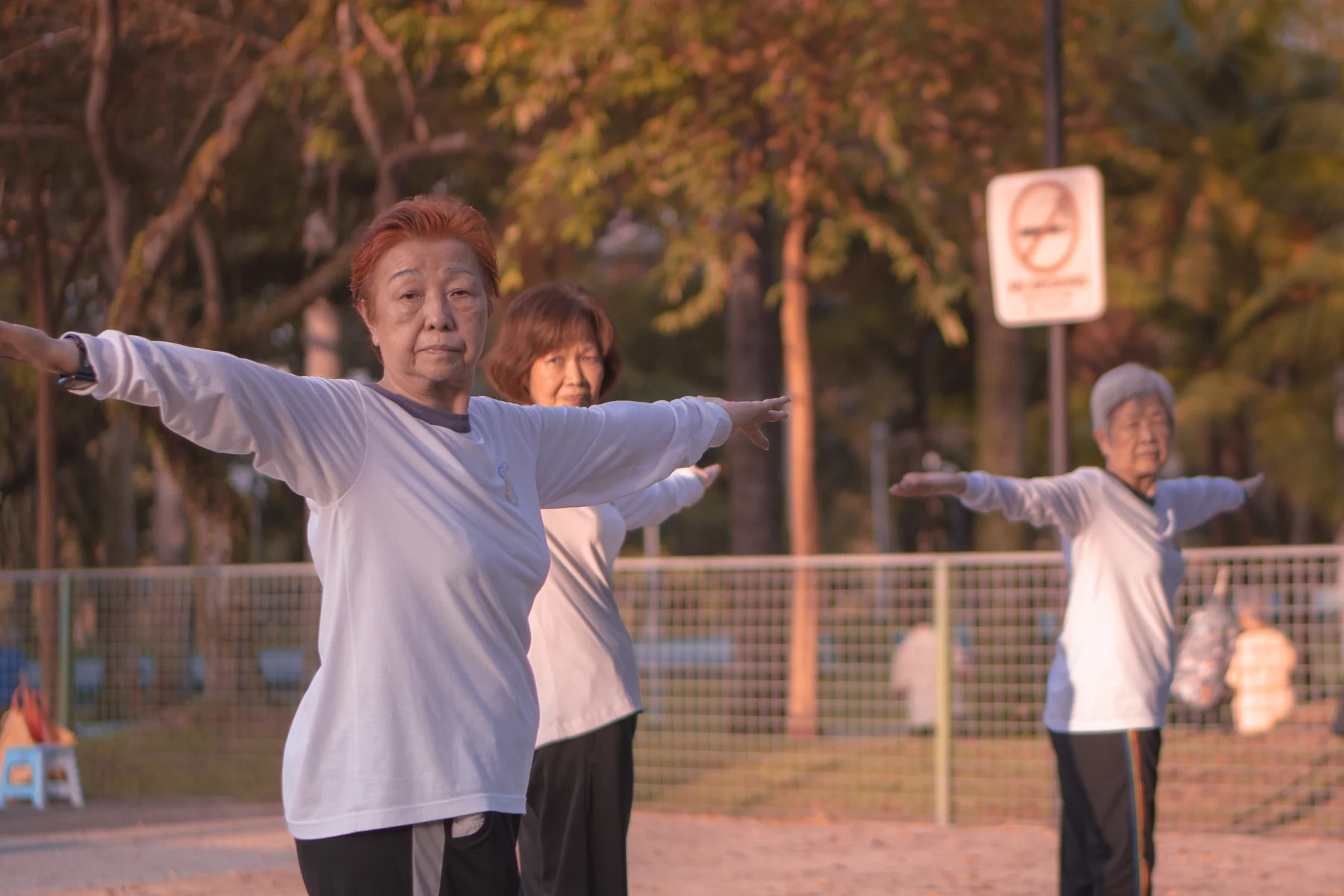
These people are practising tai chi in a park in Singapore. Their pale long-sleeve tops and dark trousers coordinate loosely, but they are not dressed as historical characters. The photograph matters because it shows what product pages often remove: Chinese martial practice can be visually modest.
For a first class, modest is a strength. If the school has not specified a uniform, clean exercise clothes that permit the class movement are usually a better starting point than a ceremonial-looking purchase. The teacher can then tell you whether the school uses a team shirt, a particular trouser cut or indoor footwear.
This is not an argument against uniforms. Shared clothing can make a group legible, reduce distraction and express school identity. It is an argument against buying identity before entering the practice. The tai chi guide explains the art and its modern contexts; it does not require a silk suit to make the movement real.
Partner work changes what clothing must not interrupt
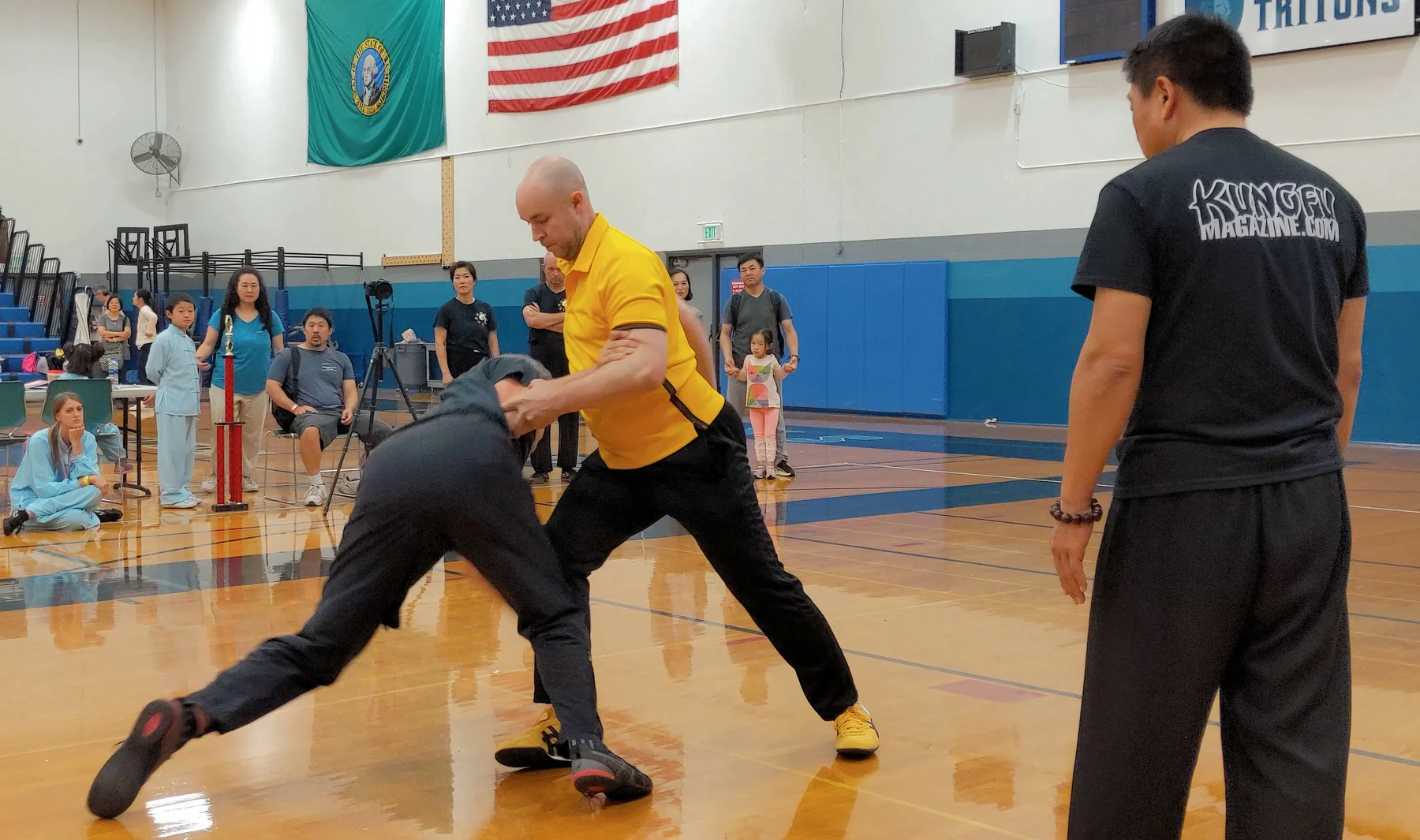
At this 2019 Seattle push-hands competition, the people at the centre wear simple dark trousers and short-sleeve tops. Other participants in pale blue traditional-style sets sit nearby. One photograph therefore contains two legitimate clothing languages: event identity and active partner work.
The useful observation is not “black is better.” It is that partner contact makes loose decorative elements, long jewellery and unsecured accessories a different question from visual presentation. Ask the organizer what is permitted. Ask the coach what the drills involve. Do not infer protection from thicker-looking fabric or buy a garment as safety equipment unless the activity's rules define it that way.
Sanda makes this boundary even clearer. The IWUF sanda overview describes a competitive fighting discipline with its own arena and equipment context. A frog-button jacket sold as a “kung fu outfit” is not the default answer. If your class or event is sanda, follow its coach and organizer rather than this page's visual examples.
Shaolin clothing is not a costume category
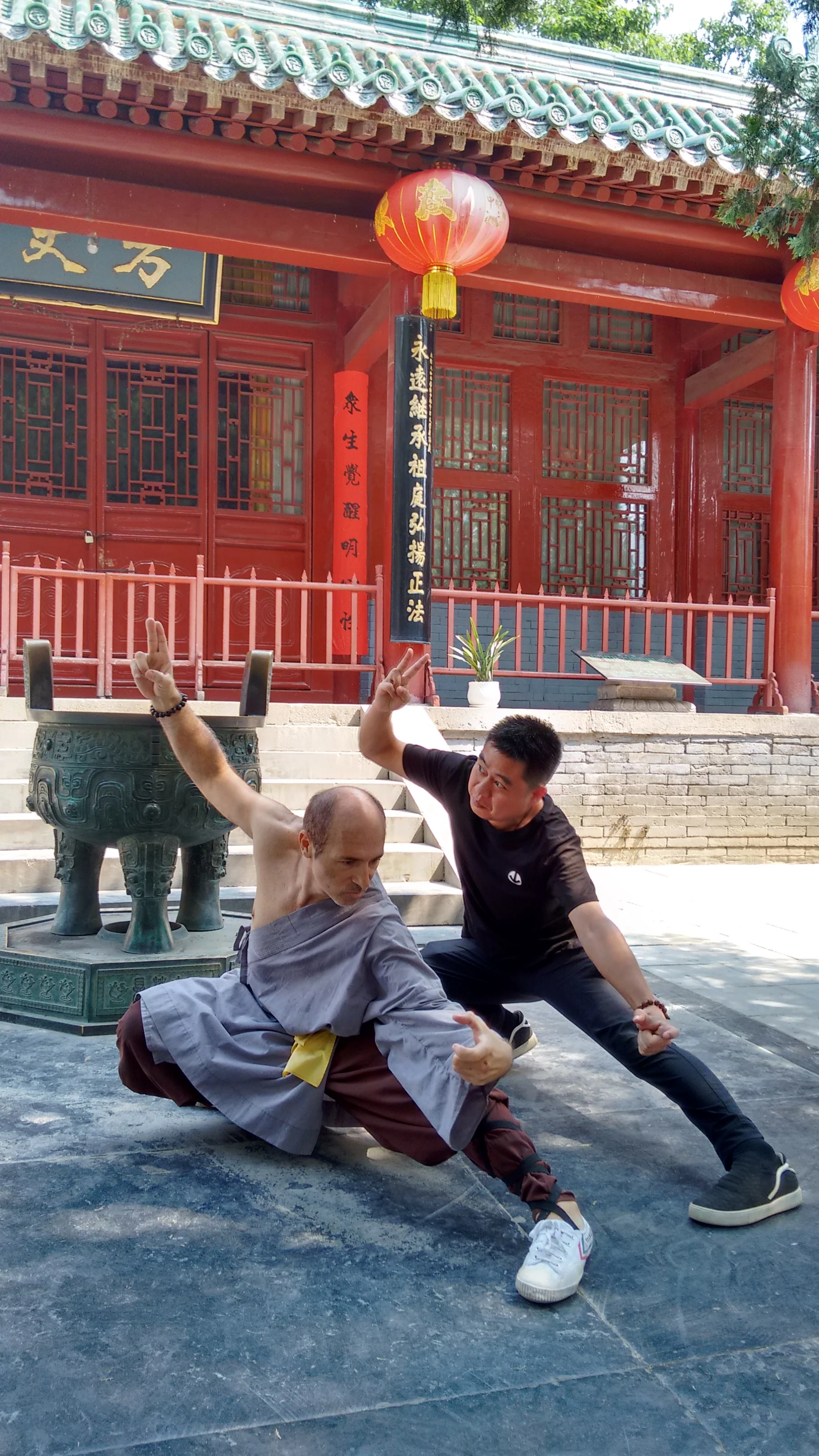
The contrast in this Shaolin training photograph is more useful than a catalogue. One practitioner wears layered grey robes. The other wears a black T-shirt, black trousers and ordinary training shoes. They share a movement moment without sharing a costume.
That is why “Shaolin uniform” is a risky shopping phrase. It can collapse monastic clothing, school-branded training clothes, performance costumes and tourist imagery into one product. A robe may communicate religious or institutional belonging. A school outfit may communicate enrollment. A stage costume may quote both because the audience recognizes the silhouette.
Our Shaolin kung fu guide keeps the temple, nearby schools, Buddhist institution and global symbol separate. The same discipline belongs here. Do not buy a robe to manufacture authority. If a Shaolin-linked school specifies clothing, use its exact instruction. If you are attending an ordinary class elsewhere, a generic “monk suit” may be less appropriate than a school T-shirt.
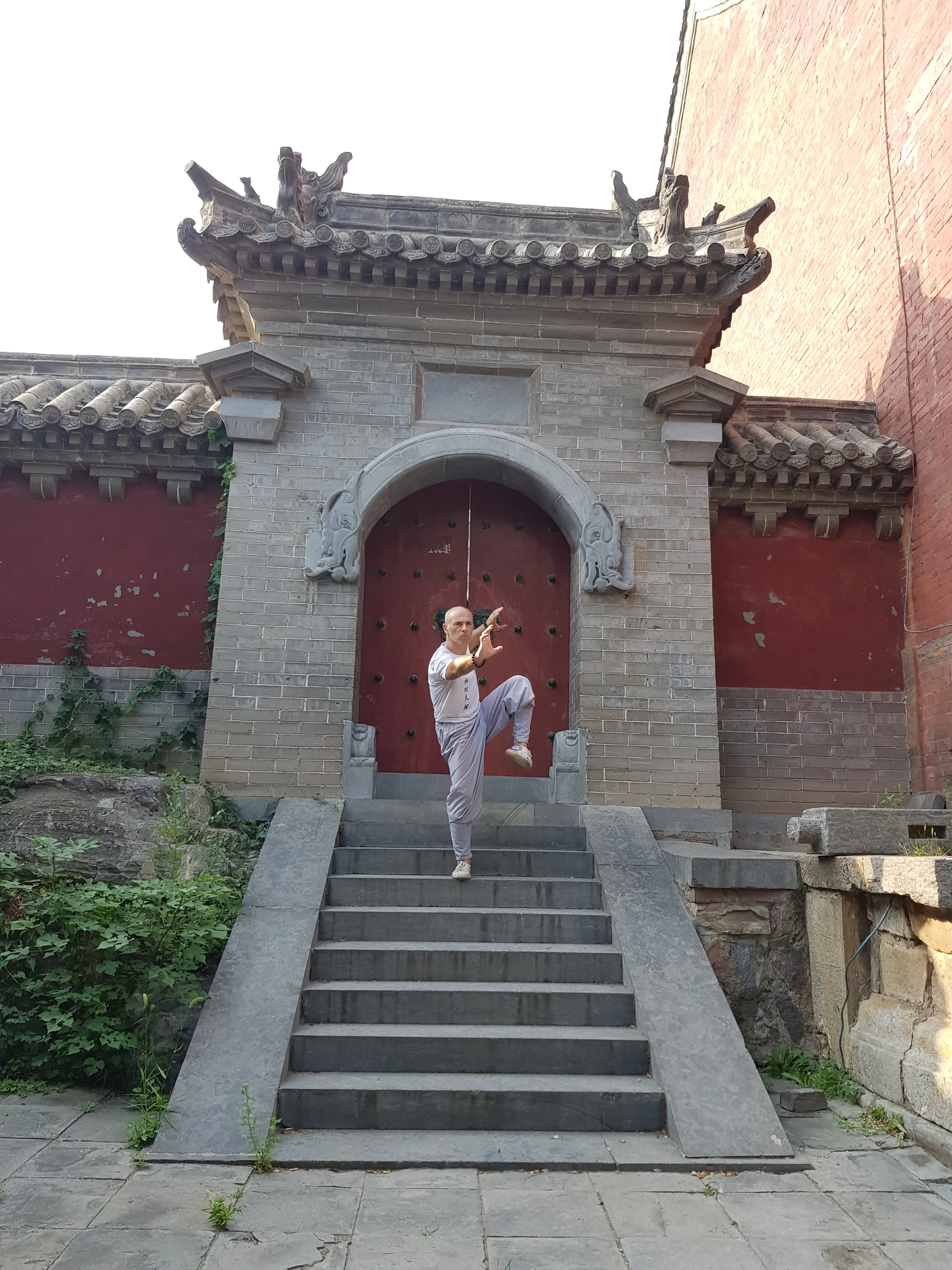
This second temple photograph reinforces the point. The person is not wearing a glossy jacket. The outfit is visually plain: a white top, loose grey trousers and light shoes. The image can prove that this documented training moment used simple clothes. It cannot prove that the outfit represents a universal Shaolin rule, a formal rank or a historical uniform.
A robe can carry institutional meaning that a uniform shop cannot sell
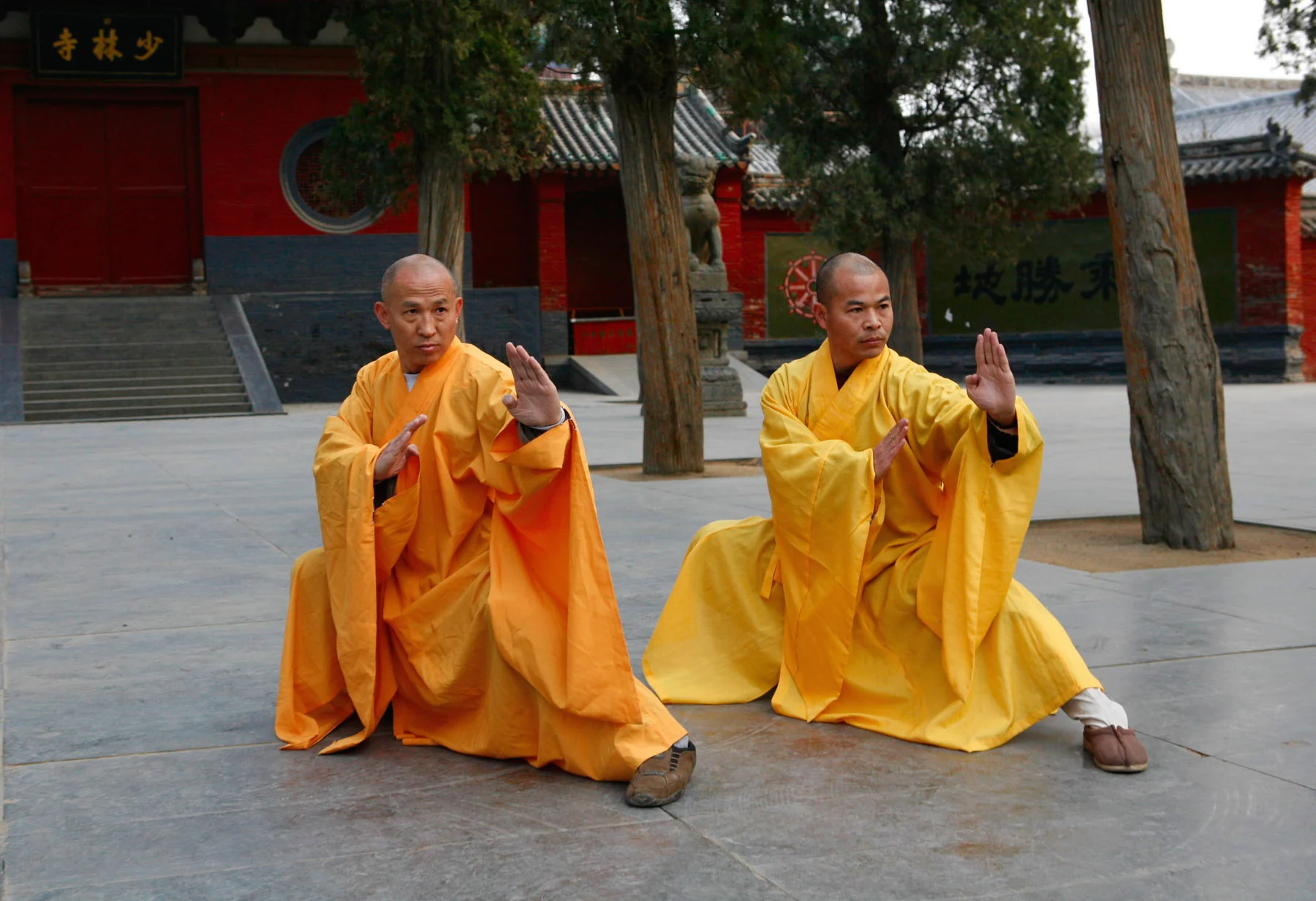
The yellow and orange robes worn here by Shi DeRu and Shi DeYang are visually powerful because the people, place and institutional context give them meaning. Copying the colour and cut does not copy that context.
This is the line I want overseas readers to keep: appearance can reference a tradition; it cannot confer membership in it. The same is true of an embroidered school badge, a competition bib or a national-team jacket. Clothing can honestly identify a relationship when that relationship exists. It becomes empty theatre when the buyer expects the garment to create the relationship.
There is nothing wrong with theatre when it is named as theatre. A stage performance needs readable colour and motion. A film costume may exaggerate sleeve length or silhouette. A festival demonstration may choose robes because the cultural setting matters. The problem begins only when “looks traditional” is used as a substitute for provenance.
Fabric and closure: judge the garment you can inspect
Product descriptions frequently use “silk” as a prestige word. Many inexpensive shiny sets are synthetic satin or blends. That is not automatically bad; it simply means the fibre and weave should be named honestly. Check the sewn label, fibre content, care instructions and close photographs of seams rather than trusting “traditional silk” in the title.
For regular practice, ask practical questions:
- Does the fabric become transparent under strong light or when stretched?
- Do seams lie flat enough for the movements you will repeat?
- Can you raise the knee, sit into the required stance and extend the arms without the garment pulling out of place?
- Are frog closures decorative, functional or both—and does the school want them?
- Will long cuffs, wide hems or hanging ties enter partner work or contact equipment?
- Can the garment be washed at the frequency your training demands?
None of these questions can tell you whether a school is authentic. They tell you whether the object is honestly made and compatible with its stated use.
Fit should be tested in the largest positions your class actually uses, not only in a mirror. “Loose” is not a measurement. Excess fabric can create as many distractions as a restrictive cut. If online sizing is the only option, compare garment measurements—not only body-size labels—and keep the return policy visible before ordering.
Kung fu shoes are a floor decision, not a magic accessory
Search results often pair every uniform with thin black slip-on shoes. Those shoes have become a visual shorthand for Chinese martial arts, but the floor and school matter more than the stereotype.
A smooth indoor training surface, a sprung competition carpet, outdoor paving and a school mat do not create the same footwear question. Some classes train barefoot; some require clean indoor shoes; some use flat flexible shoes; some schools specify a team model. A photograph of a sole cannot certify traction on your floor, and a product title cannot certify that an instructor will allow it.
Ask four things before buying kung fu shoes: What surface do we use? Are outdoor soles permitted? Does the school require a particular colour or model? Will I practise weapons, partner work or another activity with a separate rule? Then try the shoe under the school's guidance.
The Chinese swordsmanship guide and martial arts weapons guide show why implements change the space around a body. They do not make a shoe “weapon-ready.” That judgment remains with the teacher and training environment.
My buying order for a first kung fu class
- Message the school. Ask exactly what students wear for the first month and whether shoes are required.
- Name the practice. “Kung fu” is too broad. Confirm taolu, sanda, taijiquan, a named traditional system, performance training or another format.
- Use what is already acceptable. If the teacher allows a T-shirt and flexible athletic trousers, start there.
- Observe one real class. Notice what instructors and long-term students repeatedly wear, not only what appears in promotional portraits.
- Buy the required identity item. A school shirt, sash or competition set should come after the requirement is clear.
- Test movement before removing tags. Use the stances and arm positions the garment must accommodate, within the seller's return rules.
- Keep claims narrow. Buy a garment for fit, rule and context—not because it promises lineage, rank or protection.
This order sounds less exciting than choosing the most beautiful set. It is also the fastest route to clothing you will actually use.
What a kung fu uniform can—and cannot—tell you
A uniform can tell you that a group chose shared visual identity. A competition set can show that an athlete entered a regulated context. A robe can participate in religious and institutional life. A stage costume can make movement legible. A simple T-shirt can show that practice does not need to advertise itself.
It cannot tell you who would win a fight. It cannot prove a teacher's lineage. It cannot certify historical continuity. It cannot turn a performance into a religious act. It cannot protect the wearer merely because the fabric looks heavy. And it cannot make the buyer Chinese.
That firm boundary is not cynical. It lets clothing do its real work. The best kung fu uniform is not the one that wins the image search. It is the one your room recognizes, your movement can use and your rule allows.
If your school made a surprising choice—plain clothes, a specific shoe, a team shirt or a formal competition set—bring the reason to East Moment's community. The useful story is not “this is the authentic uniform.” It is “this is what our practice required, and here is why.”