Chinese diaspora food by migration system
Begin with people, period, city and institution. A continent is only a navigation layer.
| Route | Question to ask | Boundary |
|---|---|---|
| North America | How did exclusion, bachelor societies, rail and mining labor, laundries and restaurants shape Chinese American and Chinese Canadian menus? | Chop suey, chow mein or orange chicken represents every migration wave. |
| Southeast Asia | How did Hokkien, Teochew, Cantonese, Hakka, Hainanese and Peranakan communities become local within port and colonial societies? | Every shared noodle or spice has one national or ethnic owner. |
| South Asia | How did Kolkata's Hakka and Cantonese communities, tannery and restaurant work, and Indian urban tastes form Indo-Chinese food? | Chilli chicken is simply Chinese food made spicier. |
| Caribbean and Latin America | How did indenture, canal and railway labor, commerce and urban restaurants produce Guyanese, Trinidadian, Cuban, Peruvian and other Chinese-local tables? | One chifa or Caribbean fried-rice story explains a hemisphere. |
Chinese diaspora food begins when a community begins
A recipe does not become diaspora food merely because soy sauce crossed a border. The category requires people building households, businesses, associations, temples, churches, schools and memories in another society. Sometimes a dish remains strongly tied to a dialect group; sometimes it becomes a national comfort food shared far beyond Chinese descendants. Both outcomes are real. The analytical unit is the community and its institutions. Ingredient resemblance is secondary evidence, useful only after we know who cooked, for whom, under what economic and political conditions.
The first arrivals and the newest menu rarely tell the same story
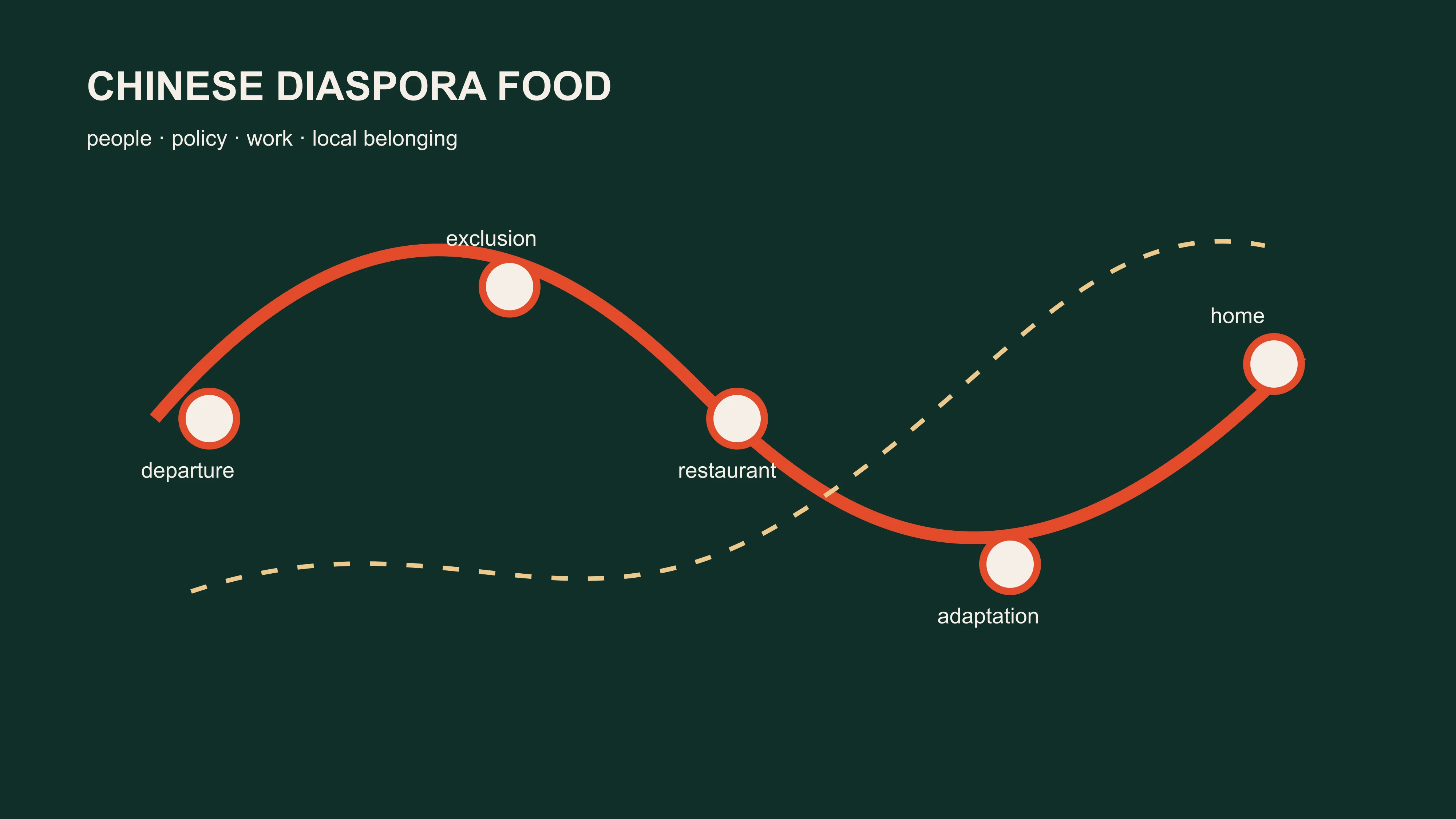
Nineteenth-century migrants from Guangdong or Fujian often entered colonial labor systems, mining zones, plantations, railways or maritime commerce. Later family reunification and postwar migration expanded regional repertoires. Recent students, professionals and entrepreneurs brought Sichuan, Hunan, Dongbei, northwestern, Taiwanese and other food into cities whose older 'Chinese food' had long local histories. A map must keep those layers visible. New regional restaurants do not correct an earlier cuisine out of existence; they change the options and the argument over who gets to define Chinese food.
A menu can be a record of who was allowed to stay
Exclusion laws, head taxes, racial zoning, licensing restrictions and limits on family migration shaped where Chinese migrants could live and which businesses were open to them. Restaurants and laundries often became survival routes because other occupations were blocked. Menus then negotiated hostile customers, limited suppliers and long hours. This does not mean every sweet sauce was caused by racism. It means restaurant economics must be read beside the law. A dish's public popularity can coexist with contempt for the people who cooked it.
The takeaway counter is home, workplace and translation desk
Family restaurants compress multiple worlds into a narrow space. Children may do homework behind the counter and translate for suppliers; elders prep ingredients before opening; the dining room performs hospitality to customers who know little about the family. The menu is therefore an operational design: dishes share sauces, equipment and ingredients so a small team can deliver speed and consistency. Understanding that system makes familiar combination plates more interesting. They are not just simplified cuisine. They are products of rent, labor, customer expectation and the intimate overlap of home and work.
Adaptation is a negotiation with ingredients and neighbors
Local produce, religious practice, colonial trade and nearby cuisines can all change a dish. Coconut, cassava, Scotch bonnet, curry leaves, tomatoes, local seafood or different starches enter through specific places. So do French, British, Dutch, Portuguese, Indian, Malay, African, Indigenous and Creole techniques. The strongest writing identifies the partnership rather than congratulating a vague fusion. Adaptation also works in reverse: Chinese businesses introduce ingredients and service formats that become ordinary local life. The result belongs to the society that sustained it, even when a migration route remains visible.
A dish can be locally national and diasporically Chinese at once
Peruvian lomo saltado can belong fully to Peruvian cuisine while carrying chifa history. Singaporean Hokkien mee can be locally Singaporean while its name and technique remember migration. Guyanese chow mein can evoke Chinese presence and a wider national family table. These identities do not cancel one another. Food holds layered belonging better than purity tests do. The question 'Is it really Chinese?' often asks the wrong person to surrender part of their history. Ask instead which community names the dish, what local institution serves it and how the meaning changed across generations.
Popularity can hide the cook
Diaspora food is frequently loved while Chinese workers remain stereotyped, underpaid or invisible. A national cuisine may celebrate a dish without teaching who introduced it. Chinatowns can be marketed as entertainment districts while residents lose housing and family businesses lose leases. This tension belongs in food writing. Celebration is not enough. Name the labor, policy and community organization that kept the food present. Then notice who receives authority today: a descendant, a celebrity chef, a developer or a non-Chinese brand. Ownership is not simple, but erasure is often easy to see.
Follow one dish through documents, kitchens and language
A responsible food history combines official migration and legal records with menus, oral histories, business archives, community publications and culinary observation. No source does every job. A government record can establish exclusion; it cannot tell us how a sauce tasted. A family story can explain meaning; it cannot prove a national origin on its own. Dish names change spelling across dialects and colonial languages, so search variants matter. East Moment states what each source supports and refuses the false precision of a single inventor when evidence only shows gradual community formation.
Choose a city and a migration phase before choosing a dish
Do not browse this hub as eight continental menus. Pick a city—San Francisco, Vancouver, Liverpool, Kolkata, Singapore, Lima, Port of Spain, Sydney, Johannesburg—and ask which Chinese communities arrived, when, under which law and through which businesses. Then taste or study one dish from that phase. Next, compare a newer migration layer in the same city. The contrast between an old takeaway and a new regional restaurant reveals continuity, class and changing identity more clearly than a list of globally famous Chinese foods.
Return as readers restore businesses and family names to the map
Menus disappear, restaurants close and redevelopment can erase the address where a community fed a city. East Moment will use reader-submitted menu scans, storefront photographs and family-approved histories to create a map of institutions, not a leaderboard. Contributors must own the material or have permission, and private family details stay private. Return because the archive gains value over time: one dated menu can connect an ingredient, price, migration phase and neighborhood before that evidence vanishes. Preservation here is a public act of gratitude.