Chinese food in Africa through specific migration economies
The routes are deliberately uneven because the documentary record and communities differ; no row stands for a continent.
| Country route | Evidence | Boundary |
|---|---|---|
| South Africa | Old Cantonese and Hakka communities, mining labor, apartheid, Taiwanese industrial migration and newer arrivals form distinct groups and businesses. | Johannesburg's old Chinatown, Cyrildene or every Chinese-run restaurant shares one history. |
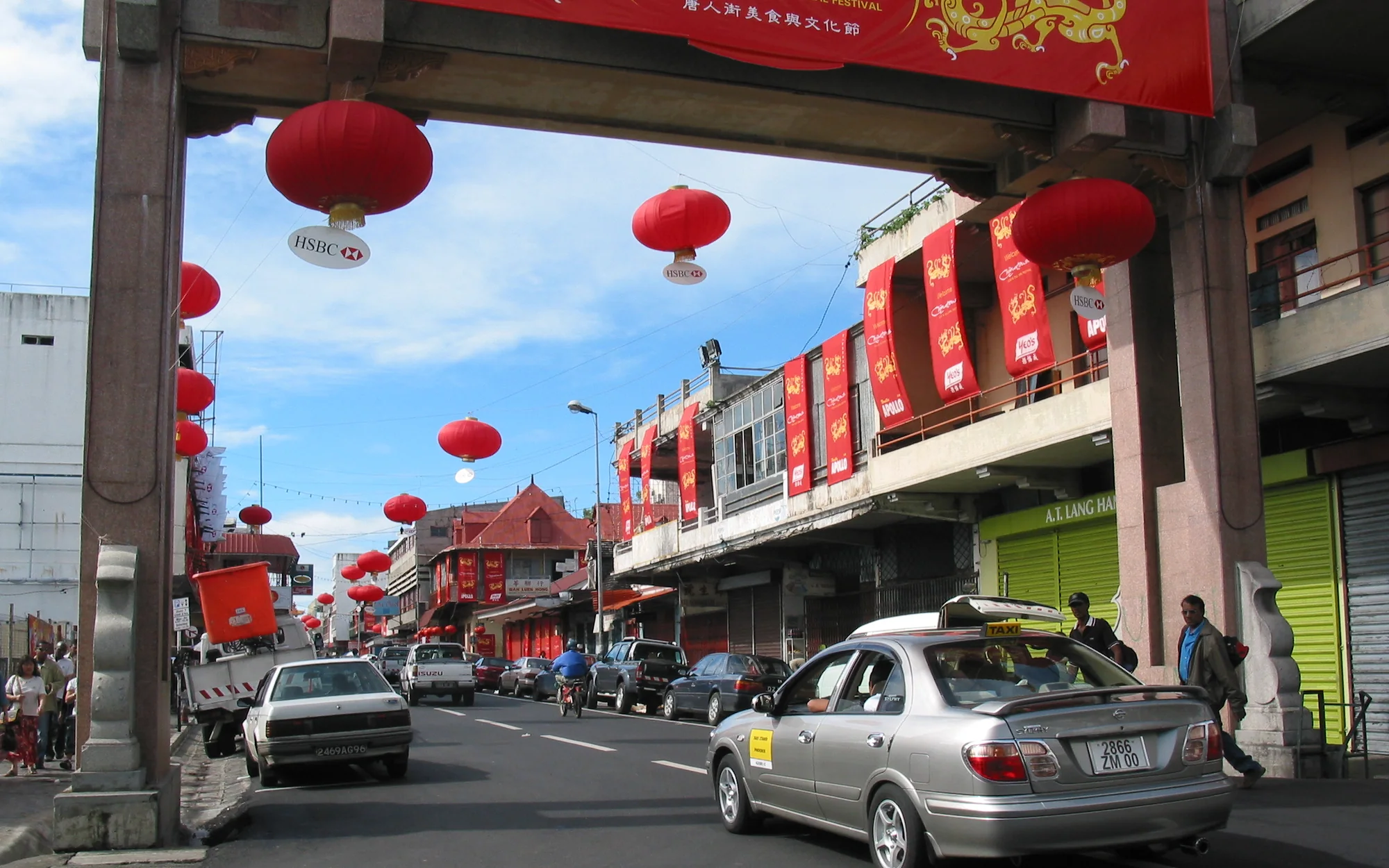
| Mauritius | Sino-Mauritian settlement participates in a multilingual island cuisine shaped by African, Indian, European and Chinese histories. | Mauritian noodles or dumplings can be assigned to one community without local evidence. |
| East African cities | Older merchant routes and newer infrastructure, trade and professional migration affect Nairobi, Mombasa, Addis Ababa and other cities differently. | Recent China-Africa economic ties explain every Chinese community. |
| West African cities | Lagos, Accra and other commercial centers develop restaurants for Chinese migrants, local elites and wider customers through distinct markets. | One restaurant's chile level or ingredient substitution defines West African Chinese food. |
Country before continent; city before menu
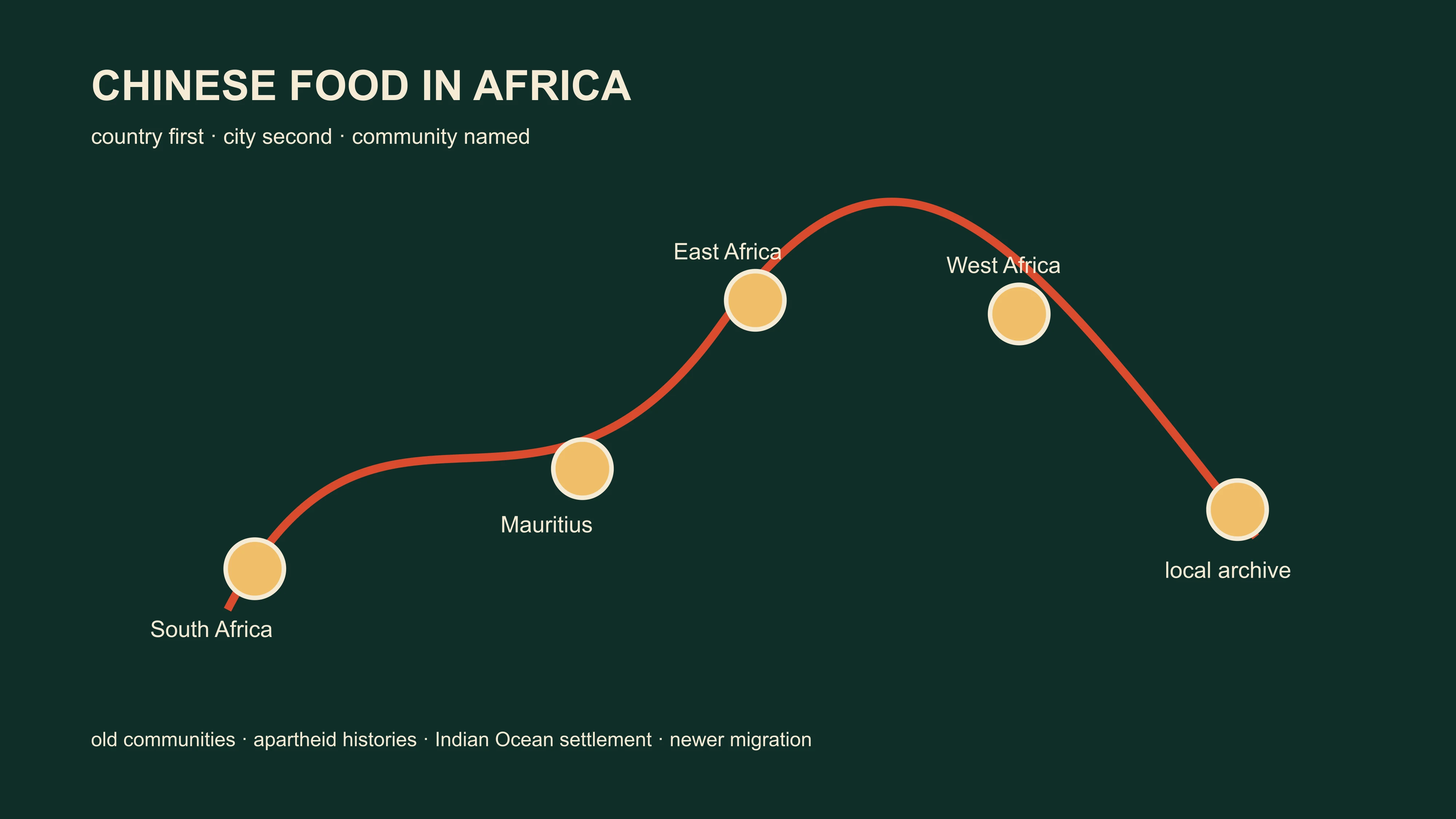
Africa's size, languages, colonial histories, religions and food ecologies make continent-wide culinary claims nearly meaningless. A Chinese restaurant in Johannesburg operates within South African migration and race history; one in Port Louis belongs to a Mauritian national cuisine with long Indian Ocean connections; a new business in Nairobi may serve infrastructure workers, local professionals and tourists. We begin with country, then city, migration phase, operator's stated community and customer. When those facts are missing, we do not manufacture a story from the dishes visible in a photograph.
Old Chinese, Taiwanese and newer mainland routes must stay distinct
South Africa's Chinese history includes small free-migrant Cantonese and Hakka communities, imported Chinese mine labor under coercive conditions, and later Taiwanese industrial migration encouraged during apartheid, followed by newer mainland migration. University of Cape Town research emphasizes differences among groups, livelihoods and identities. These layers created different associations, neighborhoods and food businesses. The older Chinatown around Commissioner Street and newer Cyrildene Chinatown in Johannesburg do not represent a simple relocation. They reflect changing language, class, migration source and customer.
Race classification shaped who could trade and belong
Chinese South Africans lived under discriminatory law and unstable racial classification during segregation and apartheid. Taiwanese migrants later entered under different political and economic arrangements. Food businesses existed within these unequal systems, and their public visibility should not be mistaken for social acceptance. A restaurant could offer livelihood and community while owners navigated licensing, residence and racial prejudice. This history belongs beside the menu because it explains why two Chinese-looking businesses in the same city may have entirely different institutional and family backgrounds.
Sino-Mauritian food belongs inside an island Creole system
Chinese migration to Mauritius developed through commerce, shops, associations and intermarriage inside a society shaped by slavery, indenture, French and British colonial rule, African and Malagasy presence and Indian migration. Noodles, dumplings and stir-fried foods became part of Mauritian daily and festive life alongside Creole, Indian and European forms. A dish can be Sino-Mauritian and nationally Mauritian without splitting the difference. UNESCO's Mauritius reporting emphasizes safeguarding food and other intangible practices across the island's multiple communities, a useful institutional boundary against single-origin claims.
Madagascar and Réunion need their own creole histories
Chinese communities in Madagascar and Réunion participated in trade and local food economies within French colonial and Indian Ocean networks. Rice, noodles, broths, fried snacks and shopkeeping histories may overlap with Mauritius, but language, citizenship and island food systems differ. The term Indian Ocean Chinese can help trace movement among ports; it cannot assign recipes. Community sources and local archives are required before naming a dish Chinese Malagasy or Sino-Réunionnais. Restraint is productive: it leaves room for residents to define the food rather than letting a global guide speak first.
Infrastructure and trade created restaurants with different publics
Recent Chinese migration to African countries includes traders, construction and infrastructure workers, managers, professionals, students and long-term entrepreneurs. Some restaurants primarily serve Chinese-speaking customers seeking regional familiarity; others court local business diners; many do both. Ingredient import networks and local agriculture shape the menu. A Sichuan dish cooked in Addis Ababa is not automatically an Ethiopian-Chinese fusion, and a locally sourced vegetable is not proof of deep adaptation. Customer, ownership, time and repeated local use must support that claim.
Adaptation becomes meaningful when it enters local life
Chinese cooking techniques may meet cassava, plantain, local greens, seafood, goat, chiles, spice blends or staple porridges in different countries. Yet ingredient substitution alone is ordinary restaurant logistics. A distinct local cuisine emerges when cooks and diners repeat, name and claim the result across time. Look for bilingual menus, mixed family histories, locally specific service and dishes requested by returning customers. The strongest evidence may come from a Mauritian household or a South African Chinese family business, not from a short-term expatriate dining room.
Chinese African lives are not a new geopolitical headline
Media coverage often frames Chinese presence in Africa through twenty-first-century state relations, making older communities disappear and newer migrants look temporary by definition. South African Chinese families and Sino-Mauritian communities have multigenerational national identities. New arrivals can also become long-term residents whose children define belonging differently. Food writing should not turn them into evidence for or against a government's foreign policy. Ask how a restaurant participates in neighborhood life, which languages it uses and how the family describes itself. Identity belongs to people, not to our menu taxonomy.
Ask the restaurant which city it is speaking from
In Johannesburg or Cape Town, determine whether the menu reflects an older Cantonese, Hakka, Taiwanese or newer mainland route. In Port Louis, ask for the Mauritian context and locally understood dish name. Elsewhere, distinguish a short-term expatriate restaurant from a long-established local business without ranking them. Order one staple, one vegetable and one technique that reveals the claimed region. Then record language, customer and neighborhood. This method produces a more honest map than asking staff to perform a continent-wide African-Chinese identity.
Return as local contributors fill the deliberate gaps
This page will remain incomplete until residents and scholars contribute country-level evidence. That is an editorial choice, not a failure to fill space. Submit permitted menus, storefronts, oral histories or institutional sources with exact country, city, date and community context. East Moment will not infer identity or invent a national cuisine from one restaurant. Return as Johannesburg, Gqeberha, Cape Town, Port Louis, Antananarivo, Saint-Denis, Nairobi, Lagos, Accra and other cities gain separate entries written at the scale their histories deserve.