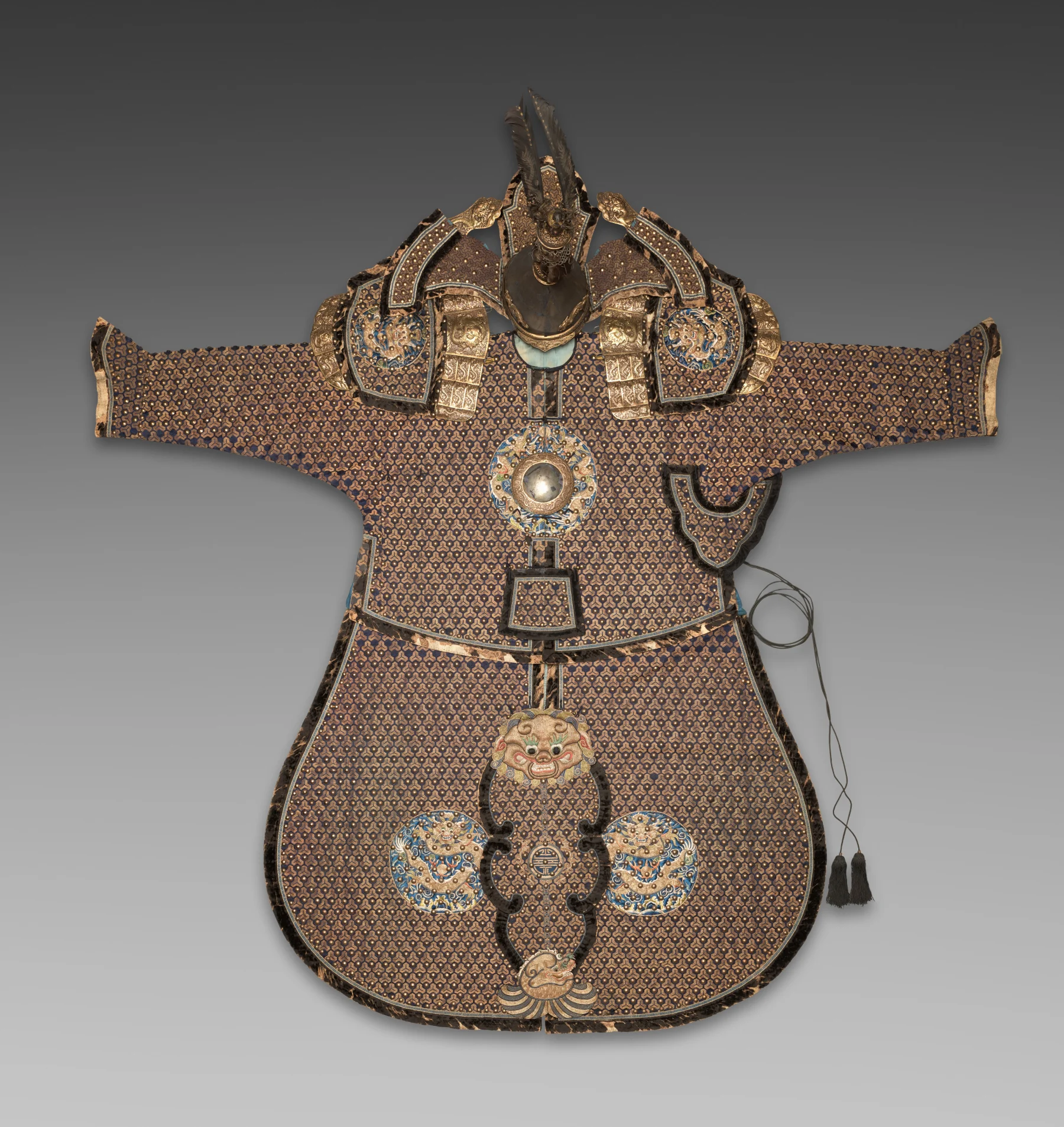
Chinese armor is not one timeless suit with a single correct silhouette. It is a long history of protective objects, uniforms and images made from different materials for different bodies, roles and moments. The useful way to recognize it is to ask five questions in order: What is the source? What is it made from? How are its parts joined? Which parts of the body does it cover? Was it made to protect, display status, perform ceremony—or combine those jobs?
Chinese armor is a material system, not a fantasy costume
Search images make Chinese armor look strangely consistent. A broad helmet, layered shoulder guards, a skirt of plates and a heroic chest seem to travel intact from the Tang dynasty to a modern game. That continuity is visually satisfying. It is also unreliable.
My first judgment is simple: the silhouette is the last thing I trust, not the first. A silhouette can be copied by a tomb sculptor, court workshop, opera wardrobe, film costume department or game artist. Material and construction narrow the claim. Provenance narrows it further.
That does not drain the romance from armor. It gives the romance somewhere solid to stand. A row of laced plates is interesting because each plate has to share impact and movement with its neighbours. A textile coat studded with metal is interesting because protection can be hidden inside an object that reads like clothing. A ceremonial uniform is interesting because authority may be the main thing it protects.
The wider Chinese martial arts collection maps schools, sport, weapons and screen culture. This page stays with the armored object and the images built around it.
The phrase ancient Chinese armor therefore names a field, not a type. China was not one workshop. An object from the Dali Kingdom in the twelfth or thirteenth century, a Tang tomb figure and an eighteenth-century Qing court uniform do not belong in one evolutionary before-and-after chart. They answer different questions.
| Evidence source | What it can establish | What it cannot establish by itself |
|---|---|---|
| Excavated or catalogued armor component | Material, dimensions, construction clues, date range and provenance recorded by the institution | How every soldier dressed, exact battlefield performance or an unchanged martial tradition |
| Tomb figure or guardian | How armor was represented in a funerary setting; visible plate, collar and skirt conventions | The figure's clay “plates” as surviving wearable metal; universal military issue |
| Court or ceremonial uniform | Rank, display, materials and the relationship between armor and state ceremony | That every visible stud hides a plate, or that the ensemble was optimized for combat |
| Historical painting | A period image of armor, status and visual convention | A technical blueprint or neutral eyewitness photograph |
| Film or game design | What modern creators want armor to communicate about a character and world | Historical construction, date or protective performance |
The distinction is not academic housekeeping. It is the difference between reading evidence and borrowing authority from an attractive image.
A Tang warrior shows an idea of armor, not a surviving suit
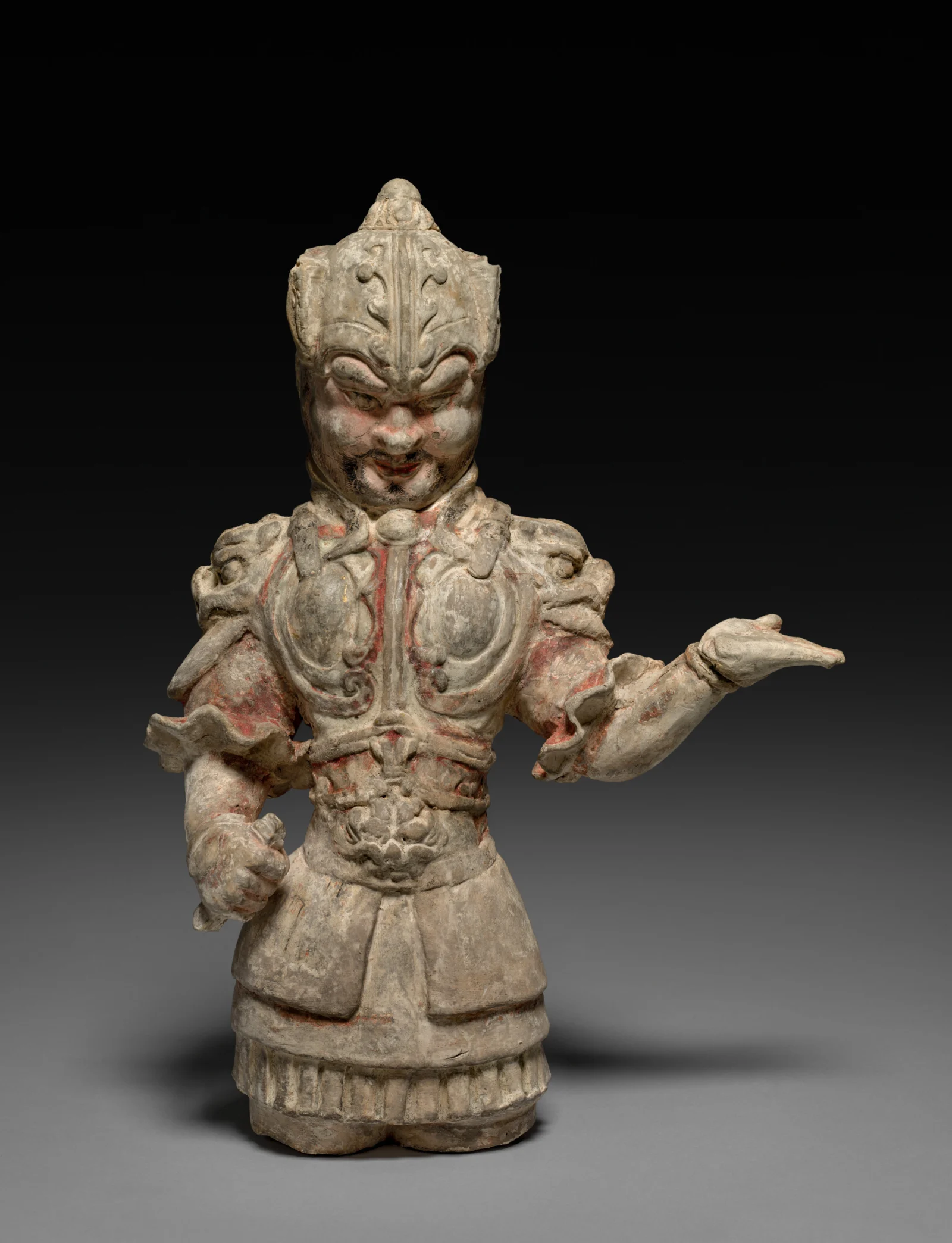
The Cleveland Museum of Art calls this object Warrior in Sheet-Metal Armor and dates it to the Tang dynasty, 618–907. It is 43.5 centimetres high. The material is not iron: it is earthenware.
That last sentence changes the entire reading. The figure preserves a sculpted statement about an armored body. We can see a high collar, large shoulder forms, a protected torso and a lower garment divided into broad sections. Faint pigment survives on the face and body. The museum record gives the object an institutional identity, period and medium.
The figure does not let us remove a plate, examine a fastening or test whether the sculpted divisions correspond exactly to a wearable construction. It cannot tell us that “Tang armor looked like this” in every region, unit or decade. It does something more precise: it shows that this armored silhouette was worth modelling for a tomb context in Tang China.
I like tomb figures because they expose a common mistake. Viewers often trust the oldest-looking image most. Age does not turn representation into engineering evidence. A sculpture can preserve a valuable historical image while still compressing, stylizing or idealizing the object it depicts.
This is the right place to separate Chinese armor from the wider martial arts weapons guide. A weapon changes reach and distance. Armor changes how a body is divided, weighted, displayed and imagined. Both shape movement, but a tomb figure is not a movement demonstration.
Lamellar, scale and brigandine describe construction—not dynasties
Three words dominate English descriptions of Chinese armor: lamellar, scale and brigandine. They are useful only when treated as construction terms.
Lamellar armor is assembled from many small plates laced or tied to one another. The plates help form the structure. A British Museum record for a Tang-period leather armor scale from Central Asia identifies leather, lacquer and silk cord. That single scale is modest evidence, but excellent evidence: holes, surface and material are more informative than a hundred generic “Tang general” illustrations.
Scale armor also uses many small elements, but the scales are normally attached to a backing and overlap in a scale-like direction. In photographs, the visible surface may look similar to lamellar. The fastening system matters more than the pattern your eye expects.
Brigandine hides or partly hides plates inside a textile or leather garment, holding them with rivets. The Metropolitan Museum of Art catalogues four pieces of eighteenth- to nineteenth-century Chinese brigandine armor. From the outside, a field of studs may be the clearest clue. It is still only a clue until the museum record, inside view or conservation evidence establishes plates.
These labels are not a dynasty ladder in which lamellar belongs to an “early” phase and brigandine replaces it everywhere. Materials and systems overlap because cost, climate, supply, maintenance, rank, mounted use, firearms and ceremony do not change at one national speed.
Chinese-language discussion often asks why cloth-covered armor “replaced” lamellar after the Song. The most valuable part of that debate is not a single winner. It is the pressure behind the question: protection has to be made, moved, repaired, stored, issued and worn. A design can spread because it reorganizes those burdens. Without a dated object and a defined military context, however, the broad replacement story remains too neat.
My working rule is: name the visible construction first, then the date and place; never use the dynasty name as a substitute for construction.
Qing dynasty armor makes protection and ceremony impossible to separate
The page's cover is a Qing ensemble in the Cleveland Museum of Art, catalogued as Ceremonial Uniform, dated broadly to 1644–1911. The museum records satin-weave silk, gold metal-thread embroidery, supplementary weft, black velvet, metal—possibly brass—and blue silk lining.
That description does not call the object battlefield equipment. Nor does “ceremonial” make it a fake. It tells us what kind of historical work the ensemble was doing.
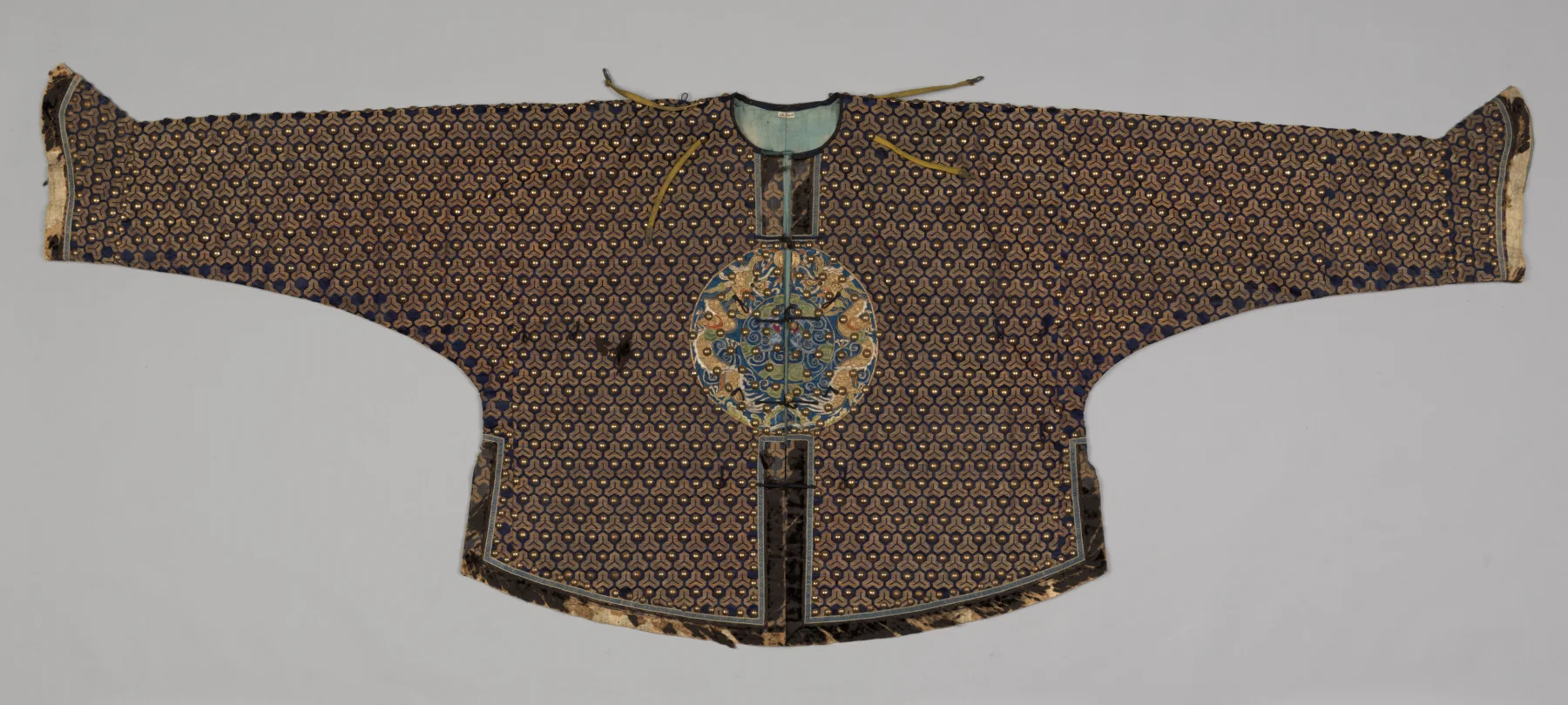
Laid flat, the jacket is startlingly wide: the museum gives an overall width of 204.5 centimetres. The photograph lets us follow sleeves, edges, collar, front opening, round embroidered emblems and hundreds of metal studs. It proves a planned relationship between textile, surface ornament and an armor-like body.
It does not prove that every stud secures a hidden protective plate. The collection record for this jacket identifies the materials but does not use the photograph as an X-ray. The safest description is exactly what we can see: a studded ceremonial jacket within a catalogued uniform.
The Metropolitan Museum's eighteenth-century ceremonial armors offer a useful comparison. Its record explains that one man's armor has steel plates secured between layers of fabric, even though the suit was intended primarily for ceremonial purposes. That evidence breaks a false choice. An object can contain protective construction and still be made chiefly for display. “Ceremonial” and “armor” are not mutually exclusive categories.
My second judgment follows: Chinese armor often protects more than flesh. It can protect hierarchy, visibility, ritual order and the authority of the person wearing it. On a parade ground or at court, the suit turns a body into an office.
Read the body in zones: head, torso, shoulders and lower movement
Armor is easier to understand when you stop staring at the chest and map the body.
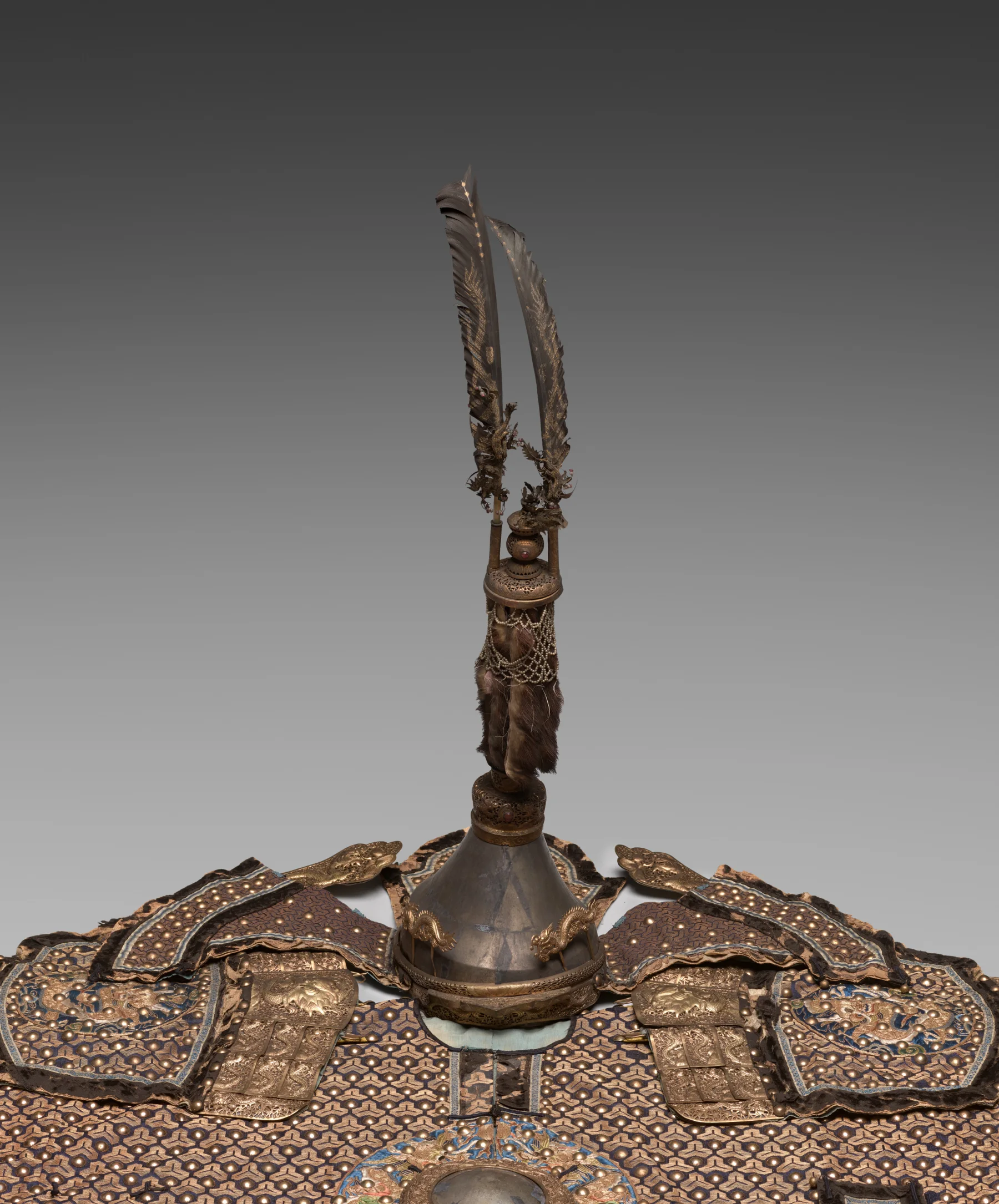
The Qing helmet combines a metal bowl with elaborate mounts, feather elements and the surrounding shoulder pieces of the ensemble. It makes vertical height and rank visible before we discuss protection. A helmet photograph can establish materials and form. It cannot tell us how the complete suit felt after hours of wear, how its lining was adjusted or whether the photographed arrangement exactly reproduces a historical dressing sequence.
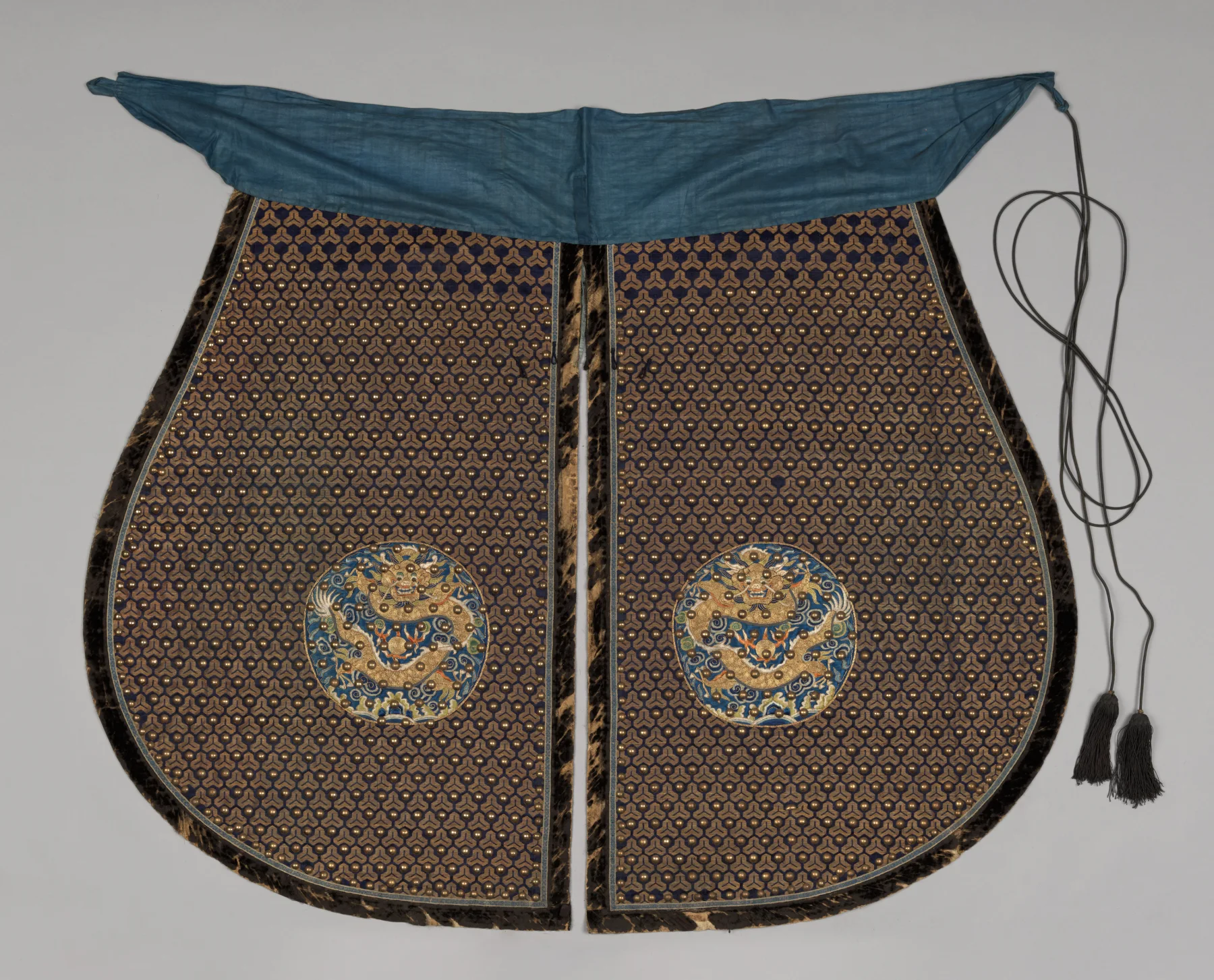
The skirt divides lower-body coverage into panels. That is the practical visual clue: armor has to protect while leaving some route for the hips and legs to move. On this ceremonial object, the two large dragon roundels also make the front unmistakably legible. The photograph proves panel shape, stud placement and textile decoration. It does not prove riding comfort or combat mobility.
Shoulder pieces solve a different problem. The joint needs coverage, but it also needs room to lift, turn and reach. Large pauldrons may amplify rank as much as they protect. A screen designer can exaggerate them until the character reads as powerful from the back row. A museum object asks a quieter question: how were the pieces actually joined to the rest of the ensemble?
The body-zone method is useful because it resists one-word identifications. Instead of saying “Chinese lamellar armor,” try: “a helmet with a metal bowl; a studded textile torso; separate shoulder elements; and a panelled lower section.” That sentence may sound less expert. It is much more accountable.
One metal plate reveals how easily decoration can be mistaken for defense
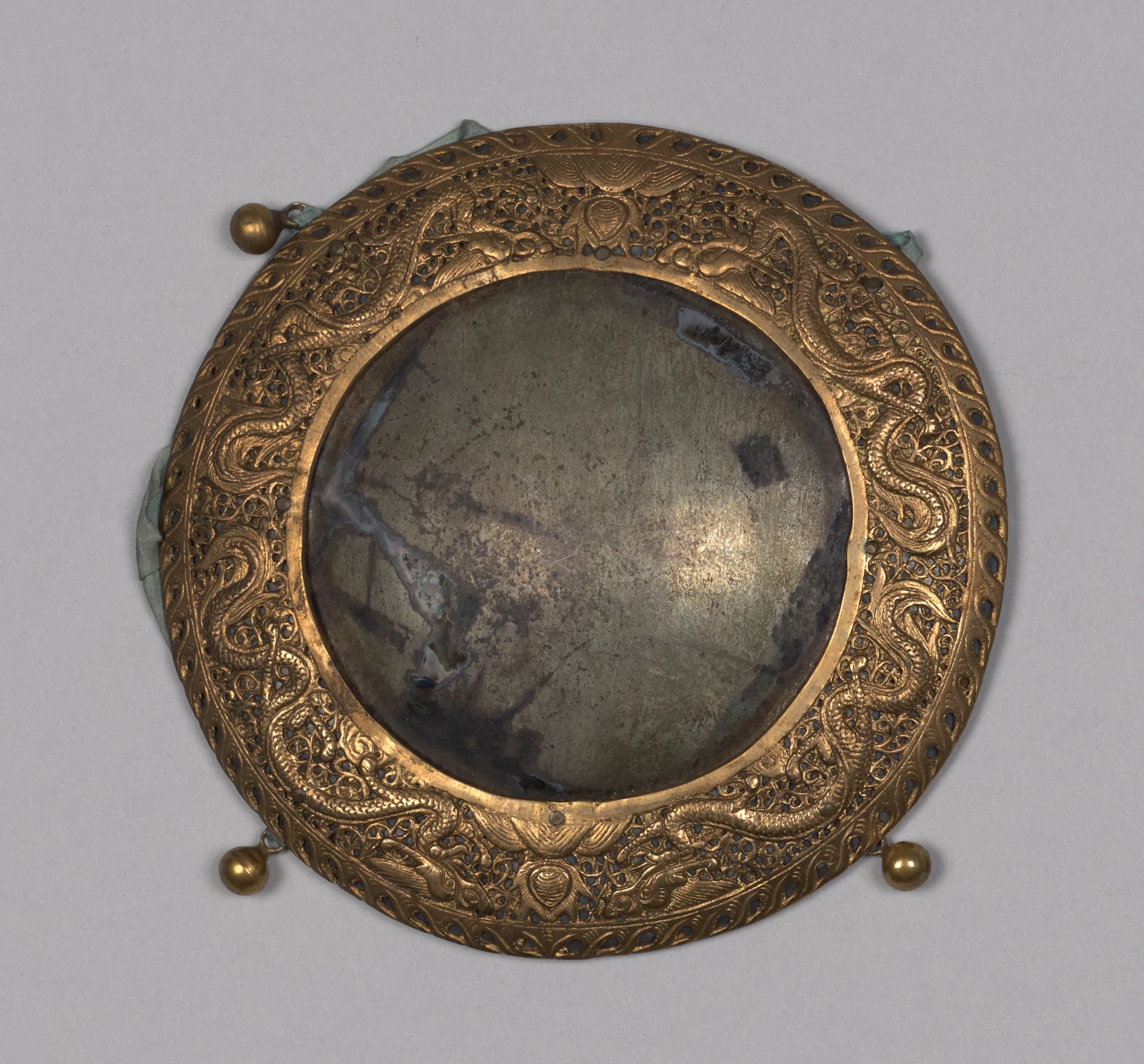
The Cleveland Museum catalogues this circular component as the uniform's Front Metal Plate. It is 14.6 centimetres across and 2.9 centimetres deep, made from metal—possibly brass—and lined in blue silk.
At first glance, it looks like a protective disc. The openwork border is dense with creatures and foliage. The centre is comparatively plain and bears wear. Three small hanging elements extend from the edge.
What does it do? The object title and its place in the uniform establish that it is a front metal plate. The image establishes shape, surface and attachment points. It does not supply a ballistic test, impact history or universal name for every similar disc. Calling it “bulletproof” would be fantasy. Calling it “only decoration” would also exceed the record.
This component is why I distrust the casual phrase “ornamental armor.” Ornament is not the opposite of function. A decorated metal plate can participate in bodily coverage, rank display and ritual presentation at once. Historical objects are not obliged to fit our modern product categories.
What was ancient Chinese armor made of?
The honest answer is plural: metal, leather, lacquer, textile, cord and composite combinations, depending on date, region, role and survival.
The Met's torso-and-hips armor from the Dali Kingdom, dated to the twelfth or thirteenth century, combines leather, lacquer, copper and iron. Tang-period scales in the British Museum preserve leather, lacquer and silk cord. Qing court ensembles can combine silk, velvet, metal and feather. Iron survives differently from textile; lacquered leather survives differently from an entire uniform. The archaeological record is therefore not a neutral inventory of what was once common.
Material also affects what modern viewers notice. Corroded iron looks “authentic” because age is visible. Bright textile and gold thread can look theatrical even when the object is securely historical. That bias makes us undervalue ceremony and overvalue rust.
Do not identify material from colour alone. Lacquer can change the appearance of leather. Textile can cover plates. Gilding can turn metal into a social signal. Conservation photography can reveal detail while flattening depth. A museum's material field is stronger evidence than a confident caption on a reposted image.
Film and games inherit armor as character language
Wuxia, historical drama and games do not simply reproduce armor. They decide which parts of the past deserve to become instantly readable.
A commander may receive broad shoulders and a high helmet so rank survives a wide shot. A wandering fighter may wear fewer rigid sections so the actor's movement remains legible. A supernatural general may carry overlapping plates that could never close comfortably because repetition creates a convincing fantasy surface. None of those decisions is automatically bad history. They become misleading only when promotional design is presented as documentary evidence.
In Where Winds Meet, armor belongs to a designed wuxia world where silhouette has to survive motion, interface and player choice. In Black Myth: Wukong, equipment can borrow from religious art, court dress, opera and historical armor without claiming that every combination once existed. Our guide to wuxia meaning explains why moral relationship matters more to the genre than a perfectly reconstructed kit.
When I look at screen armor, I ask three questions:
- What historical clue is being quoted? A helmet profile, riveted coat, lamellar surface, roundel or shoulder form.
- What has been altered for character? Scale, colour, symmetry, age, mobility or visible damage.
- What does the redesign make me believe before the character speaks? Rank, discipline, brutality, exile, religious power or belonging.
This approach respects both history and design. It does not reduce a beautiful costume to “wrong,” and it does not let beauty certify a false date.
The reverse-side test: my rule for rejecting fake certainty
Most armor guides begin with a dynasty chart. I begin by turning the object around. If an identification collapses when I ask how the plates are joined, what carries their weight and what the reverse side contains, it was never an identification. It was styling. This is the East Moment reverse-side test.
The test is deliberately unforgiving. “Chinese warrior” on a marketplace pin is not provenance. A dramatic shoulder line is not a date. A field of gold studs is not proof of hidden plates. Start with the source label, then move through the object in this order:
- Material: Are plates visible? Is the surface textile, lacquer, leather or metal? Is that identification supplied by a source or guessed from colour?
- Joining: Are plates laced to one another, attached to a backing or hidden behind rivets? Can you actually see the reverse?
- Coverage: What happens at the neck, armpit, elbow, hip and thigh? Joints reveal the compromise between coverage and movement.
- Role: Does the record call it armor, ceremonial armor, uniform, costume, tomb figure or guardian? Keep that noun.
- Date and place: Is the object assigned to a dynasty, kingdom, region or broad culture? Do not turn a broad date into a precise year.
- Missing evidence: What would you need to make the next claim—an interior photograph, excavation report, conservation note, contemporary text or comparison object?
Finally, deliver a verdict with a boundary. For the Tang figure: “This earthenware object preserves a Tang funerary image of an armored warrior; it does not preserve wearable sheet metal.” For the Qing uniform: “This museum ensemble proves a richly studded ceremonial armor form; its photograph alone does not establish battlefield performance.”
That boundary is not timid writing. It is control. A firm answer names what the evidence establishes, refuses the claim it cannot carry and still explains why the object matters. Confidence without a boundary is costume; confidence with a boundary is judgment.
My verdict: the best Chinese armor image makes you ask for the reverse side
The strongest armor image is not the one with the largest shoulder guards. It is the one that makes construction visible—and makes you wonder what the front is hiding.
Turn over a lamella and the holes matter. Open a brigandine coat and the plate layout matters. Separate a Qing uniform into jacket, skirt, helmet and metal plate and a heroic silhouette becomes a set of decisions. Place a Tang tomb warrior beside those surviving components and representation stops masquerading as manufacture.
That is how Chinese armor becomes more than a fantasy category. It becomes a negotiation among body, material, role, ritual and the images later viewers inherit.
If you find an armor image worth discussing, bring it to East Moment's Moments community. Name the source before the dynasty. Point to one construction clue. Then say what the image cannot prove. That small act of restraint is how a striking picture becomes useful evidence.